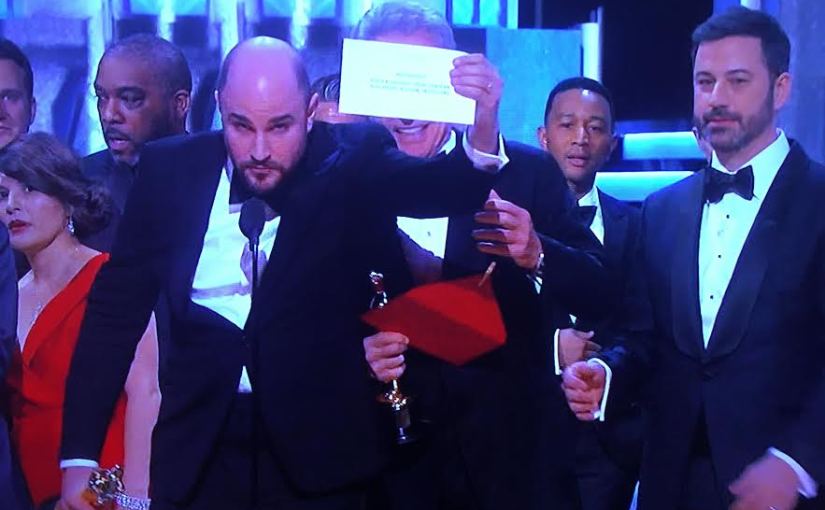
What we can all learn from the Best Picture snafu at the Oscars.

When I woke up Monday morning my iPhone was practically on fire. It was glowing and crackling with texts, tweets and push notes. The world was dying to tell me about the disaster at the Oscars. The wrong movie had been announced as Best Picture. OMG!  Hollywood had been embarrassed on national TV! Those poor, wealthy celebrities…

1280_faye_dunaway_warren_beatty_oscars_2017

I couldn’t wait to see the clip. (You can see the whole thing by clicking here. You’re welcome.)

It did not disappoint. The seven minutes of crazy was even better than I could have imagined. It was a train wreck. I squirmed through Warren Beatty’s confusion. I cringed through Faye Dunaway’s quick scan of the card. I felt terrible for La La Land’s la-cast and la-crew celebrating, and thanking, and feeling honored, before having their pants pulled down on stage in front of the world.

I felt even worse for the Moonlighters, who couldn’t really celebrate. After all, they just lost. Now, they didn’t know if they were coming on stage just to have their pants pulled down, before being forced to hand their hand-me-down awards to Manchester By The Sea. I watched it all several times. I will remember those seven minutes of award show infamy longer than I will remember the movies.  

What we can learn.

However, it is important that we take away more from this than the uncomfortable entertainment. Following the debacle I heard many people exclaim, “Someone should get fired over that mistake!”  Let’s think bigger.

We now know that the presenter, Warren Beatty, was handed the wrong envelope by a Price Waterhouse Cooper accountant. PWC has done this for 83 years. Which means a new gremlin was introduced that exposed a flaw in their process. As the founder of the ad agency The Weaponry, I see Envelopegate as a welcomed reminder that we should all use our mistakes to help improve our processes. Not to punish the mistakers.
checklist-book-image

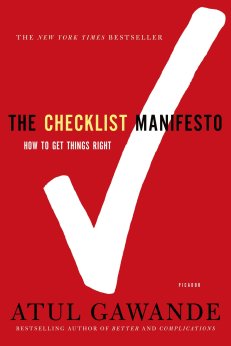
In the book, The Checklist Manifesto: How to Get Things Right (yes, I really read a book about checklists) Atul Gawande, a renowned surgeon, champions checklists as a way to ensure processes are implemented that help save lives in hospitals. He also cites checklists for having done more to prevent airplane crashes than any other innovation. If a checklist helps save lives in hospitals and on aircraft, certainly a checklist could be used to help save some unfortunate moments at The Weaponry and in Hollywood. And probably when you leave a restroom.

Simple Solution

A simple checklist used by the PWC accountants backstage, and the award presenters, would have prevented the mistake.

  1. Ask presenter what award they are announcing.
  2. Check run of show list to make sure the award they are scheduled to present matches answer.
  3. Read the award category written on announcement envelope aloud to make sure it matches before handing it to the presenter.
  4. Make presenter read the category on the announcement envelope aloud to make sure it matches before allowing them on stage.

Boom. Done. Bonnie and Clyde get away.

A Story

Once upon a time I was shooting a TV commercial in Indianapolis for Donatos pizza. When we arrived at the production company’s office for the wardrobe fitting, I was shocked to see the wrong actress there, trying on clothes. After a quick and panicked huddle we understood what had happened. It seemed that once the client signed off on our talent choices for the commercials, a message was relayed to the production house that we would be using all of our first choice talent. So the production company called, and hired, all the first choice talent. However, the first choices were not the same on both the agency’s list and the production company’s list. Yikes!

That afternoon, the production company made magic. They tracked down the actress who should have played the lead, and got her on a flight that night from Iowa City (which is where you go when you don’t think you got the lead in a pizza commercial) to Indianapolis. The next day we shot the commercial and it turned out great. More importantly, we improved our process. After that, my teams have always confirmed the talent choices by name, not first choice or backup.

What you can do now.

Today, I encourage you to watch the clip from the show again. Because it reminds us that mistakes happen. Mistakes are great at indicating flaws in our systems and processes. If we respond correctly, we come out stronger, with a better way of doing things and a lower chance of that same mistake happening again.

Through better processes we can save more lives, we can avoid plane crashes and we can prevent a lot of embarrassment. Getting angry doesn’t prevent a mistake from happening again. Getting better does. There is no need to fire anyone. I think we can all agree that the person responsible for the Best Picture goof will never, ever make that mistake again. Just as Steve Bartman will never again interfere with a fly ball.

If you have a process improvement story spurred by a mistake please share it in the comment section. You may help others avoid the same mistake. Or maybe you’ll just make us laugh. I’ll take either.


The one thing you need to know to effectively work a room.

We’ve all been told not to talk to strangers. But I love strangers. The stranger the better. This may be because I have moved a lot. Which means I’ve often found myself amongst people I don’t know. But most people are less comfortable with total strangers than I am. This is probably a good human survival mechanism. A mechanism I lack.

As the Founder of The Weaponry, I know that the ability to talk to strangers is critical for entrepreneurs. If you don’t talk to strangers you are not growing your business. Or helping  anyone else grow theirs. When I meet a potential new client, it is our ability to connect as humans first that leads to us working together.

I believe in building on my strengths. So recently I listened to the audio book How To Work A Room by Susan RoAne.  I figured I would find a valuable new nugget or two.  And I did.

The most important thing I learned from the book is this:

When people find themselves with other people they don’t know, they adopt one of two behaviors:  1. A guest mindset. or 2. A host mindset.

The guest mindset adopts the attitude of the outsider, of the person who waits for others to make the first move. They wait to be introduced, or welcomed or fed. They wait to join or participate until they receive an invitation. If you have a party full of guest-mindsets, you don’t have a party.

The host mindset means you initiate. You welcome others, introduce them, offer them food or drink or a crack at catching the greased pig (depending on what kind of event you typically attend).  You activate the party. If you want to feel at home and enjoy any group of strangers, take on a host mindset.

This is what I do. I just didn’t have a name for it. I don’t wait for someone else to decide whether or not I am worthy to talk to (I probably am not).  I make the first move. I create the introduction. I act as if it were my job to make people feel welcomed.

I’ve found that when you don’t worry about rejection you don’t get rejected. Think of it like a Junior High dance. You just have to walk up to someone and say, ‘Stairway to Heaven is a sweet tune. Let’s dance. And let’s not worry about the fact that this song will gradually speed up, and we’re going to go from a slow dance into a full-on rock song, and we won’t know when we should stop holding on to each other.’ Remember the Stairway analogy. Because holding on to one person too long at a social gathering also becomes awkward.

If you want to enjoy a room full of strangers more, lose the Stranger Danger, and act like it’s your party, your wedding, your conference or luncheon.  Start by introducing yourself to others. Ask people about themselves. So, where are you from? What do you do for work? Where did you go to school?  How do you know the homeowner?  Why are your palms so sweaty?  Why the neck tatttoo?

There are people at every gathering who are just dying for someone else to make the first move. They don’t know they should be doing it. Because they never read this blog. Or How To Work A Room. Or danced with me in Junior High. Help them out. Be a host. They may be extremely interesting or valuable to you. They’re just not comfortable initiating. So you have to be. And you’ll enjoy the rewards.  You never know when that total stranger may have the kindness, connection or kidney you need.

Instantly sound more trustworthy by dropping these words.

I love words. I understand, value and utilize the power they each hold. As a professional creative, I prescribe words like a doctor prescribes medicine. People hire me to find the right words to make their brands, products and services sound as attractive as possible.

Just as words have the power to make people, places and things sound more attractive, they can also make them sound uglier. I know which words make me sound like me is dumb. And I know which words make you sound pervy.

In America, we constantly introduce new words and phrases into our banter to see what sticks. Some of these are interesting and innovative (Emoji, FOMO, Photobomb). Some of them are moronic  (Totes, Obvi). Either way, blame Kanye.

Today, there are two unfortunate phrases that are clinging to conversations like cockleburs on corduroy.  If they haven’t arrived in your neck of the cell tower yet, they are coming. I’m referring to the increased use of, “To be honest’ and her twin sister, ” To tell you the truth”.  I know deep down you know this, but when you tack these unnecessary qualifiers onto any other statement, you have told the person on the receiving end of the statement, “Usually I lie to you.’ Or ‘Most of the time I just make up shit without verifying.’

At The Perfect Agency Project we are especially concerned about removing these phrases from business. We don’t want your salespeople or customers support staff dropping, ‘If I’m being honest’ or ‘To be completely truthful’ on your customers and potential clients.  This undermines the trustworthiness bestowed upon your brand. And that will end up costing both you and I real money.

Please coach your team out of using these phrases. You can do that by sharing this post. Or you could do what I do when people drop these phrases on me. I respond immediately to the errant statement with, “Thank you for being honest with me.” The response I get is always very WTF-y. Because people are not thinking about what they are saying.  But I want you to. I want you to sound smart. And trustworthy. And professional. But, hey, It’s all good.*

*’It’s all good’ has been rated as the funniest cocklebur-phrase of all-time by The Perfect Agency Project. Because it is almost always used in instances where something, if not everything, is not good at all.

The first step to make your team work.

Organizations are messy. Because they are made of humans. And humans are unpredictable animals. If you work in a business that trades in creativity, like I do, you deal with even more interesting dynamics. One of the challenges of professional creativity is that it tries to combine professionalism with non-traditional thinking and behaviors.  These can make for strange bedfellows. (Why do we say bedfellows?  Why couldn’t it be umbrellafellows? Or picnicblanketfellows? Or pewfellows?)

Sometimes teamwork is magical.  Other times it is, well, not magical.

Because when humans are involved things go wrong. In fact, there are things that go wrong in organizations every day.  It is not the avoidance of mistakes that makes a company great. It is how we respond to those mistakes that determines the health and strength of the organization and its culture.

I have discovered a very simple guiding principle that helps organizations thrive, even when things go wrong. It’s The Assumption of Positive Intent. It requires that everyone on the team assumes that the actions, choices, statements and decisions of others were made with positive intentions.

It comes down to believing that your teammates are good people who mean well. Even when their intentions aren’t clearly understood.

At the advertising and idea agency, The Weaponry, the Assumption of Positive Intent is core to our culture. This simple assumption has a number of positive effects.  First, it makes us all see each other as good people. It makes me feel better to feel like I am surrounded by good people who want to do good things. High morals and ethical standards are important. We should believe in each other and support one another until we have irrefutable proof that we should not.

The next benefit of the Assumption of Positive Intent is that it encourages people to take action. Make a move, make an impact, make a difference. We’ll support you. We won’t crucify you if it doesn’t work out perfectly. Because we assume you want to make great things happen. Even if an attempt fails. So go ahead, introduce New Coke. Have Kendall Jenner hand a cop a Pepsi. Or stick your chocolate in my peanut butter.  One of those things will work.

The word assumption often has a negative connotation in business and other performance-oriented environments. Because it indicates that we make judgements or decide without knowing. We’ve all heard the saying that when you assume you makes an ‘ass’ out of ‘u’ and ‘me’.  While that is a clever word play, the statement fails to recognize an important reality.  When you assume positive intent, you give people the benefit of the doubt. You presume the good. You believe in the best or most optimistic scenario.  And when you believe in good, you believe in people. This builds a culture of trust.

A Simple 5-Step Formula.

When you encounter an action that you don’t understand try these 5 simple steps:

  1. Assume positive intent
  2. Talk about the issue with the person or people involved.
  3. Make it clear that you assume they meant well and seek a better understanding.
  4. Listen for understanding
  5. Play back what you heard.

I believe in people. I think we all want to be part of a great team  The best way to set our teams up for the greatest success it to minimize the stress on the relationships between teammates. If we assume positive intent at all times, we will get the best out of each other. We will enjoy the attempts. Even when they #fail.