Why brainstorming is a bad idea and what to do instead.

I have never liked brainstorming. Ok, that is not entirely true. At first, I loved brainstorming. You know, the classic meeting that sounds like barnstorming, but without the barns, biplanes and scarves. In brainstorming sessions, a group gathers in a conference room with markers and candy to generate a collective storm of creative ideas that come from the brain.

In the very beginning of my career, I loved these meetings because I was good at them. Brainstorming sessions allowed me to show off just how stormy my brain was. I would blast the room with my ideas. I would build on the ideas that others stormed. I felt like I was in my element. Like a hottie in a swimsuit contest in Panama City on Spring Break.

But then I started realizing what was really happening in those brainstorming sessions.

  1. A small number of people shared a large number of ideas.
  2. A large number of people shared a small number of ideas.
  3. Too many people weren’t sharing any ideas. They were just eating the candy.

Boo.

The key to valuable ideation is volume and variance. You need to generate a lot of ideas. Because great ideas are a percentage of total ideas generated. You also need variance because you want different types and styles of ideas to compare and contrast with each other to weigh the relative benefits of each approach. If your volume is low, or your variance is low, your options are low. And your creative possibilities are limited.

Social dynamics also degrade the potential power of brainstorming sessions. The loudest and most influential people tend to Boss Hogg the air time. They create a hierarchy that prevents others from wanting to share ideas or stick their neck out with contrarian ideas. Which is what brainstorming sessions must have to provide maximum value.

Once I recognized how inefficient these group thinking sessions were I became a born-again non-brainstormer. And I have never liked them since.

A Better Solution

The best way to create the most ideas is to have people think on their own and write down as many ideas as possible. By ideating independently, each person maximizes their thinking time, which leads to more ideas, and a greater range of exploration. An hour spent with 10 people generating ideas independently means everyone has 1 hour of air time. That’s 10 hours of idea generation. Which beats 10 people together sharing 1 hour of air time every time. (See the talk show The View for proof.)

For maximum effectiveness, the ideas should be collected and shared anonymously, so they are evaluated without biases towards their creators. Once all of the ideas are available it is valuable to gather, evaluate, discuss and build on the ideas as a team. And you can still serve candy and sniff markers.

At The Weaponry, the advertising and ideas agency I lead, we’ve created something we call Seed Sessions. In these sessions, we share a broad range of pre-generated ideas that we call seeds. Each seed is shared as a slide with 3 elements.

  1. The name of the idea
  2. A short paragraph summarizing the essence of the idea
  3. A visual representing the idea

In a Seed Session, we may sow anywhere from 20 to 40 seeds. We discuss the ideas and build on the favorites. Everyone in the room has the opportunity to feed and water them. We shine sun on the favorites. And by the end of the session, the seeds have grown into vibrant plants full of potential.

The Seed Session process offers a great way to maximize idea generation and utilize the collective intelligence of the group to identify and build on the best ideas. Which is exactly what brainstorming sessions are intended to do. *Unless brainstorming sessions were actually created by candy companies to sell more candy to adults. Which is a pretty sweet idea.

Key Takeaway

Great ideas create competitive advantages for organizations. To generate the best ideas you should maximize both the volume and variance of your ideas. This is best done through individual ideation, which maximizes thinking time and minimizes social inhibitors and biases. Share the generated ideas and build on them together. It’s the greatest way to harness the collective brain power of your team.

*If you know someone who could benefit from this message, please share it with them.

+For more of the best life lessons I have learned check out my book, What Does Your Fortune Cookie Say? from Ripples Media.
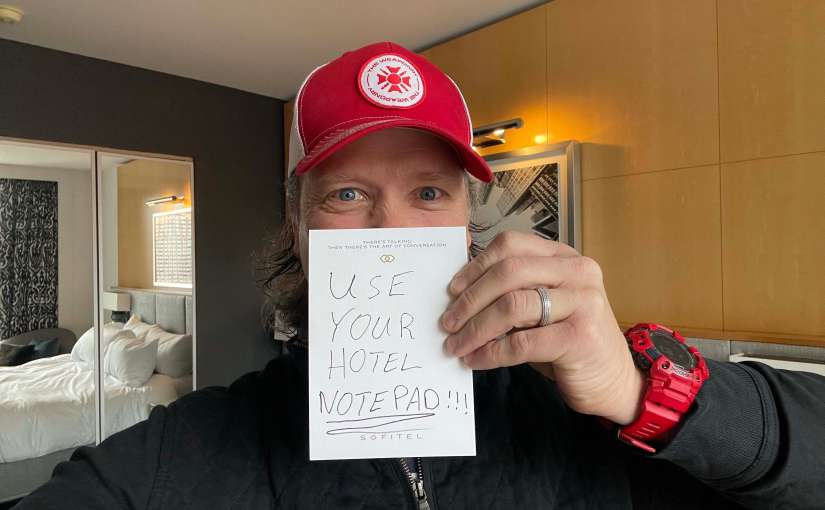
Why you should always use your hotel room notepad.

Last week when I was at my local gym my friend Spencer Koenig approached me while I was on the elliptical machine. (Not the ellipsis machine…) He handed me his phone. It displayed a photo of a profound thought he had written on a hotel room notepad.

Spencer smiled at me and shared, ‘In 2017, you wrote a blog post about how you should always use the notepad in your hotel room to write down your ideas. And I always think of that when I stay at hotels.’

I loved that!

I stay in a lot of hotel rooms each year. I have Titanium Elite status with Marriott. Apparently, that’s better than silver, gold and platinum, because they make body parts out of titanium. So I have body-part-worthy-metal status for my hotel room stays.

The Lesson

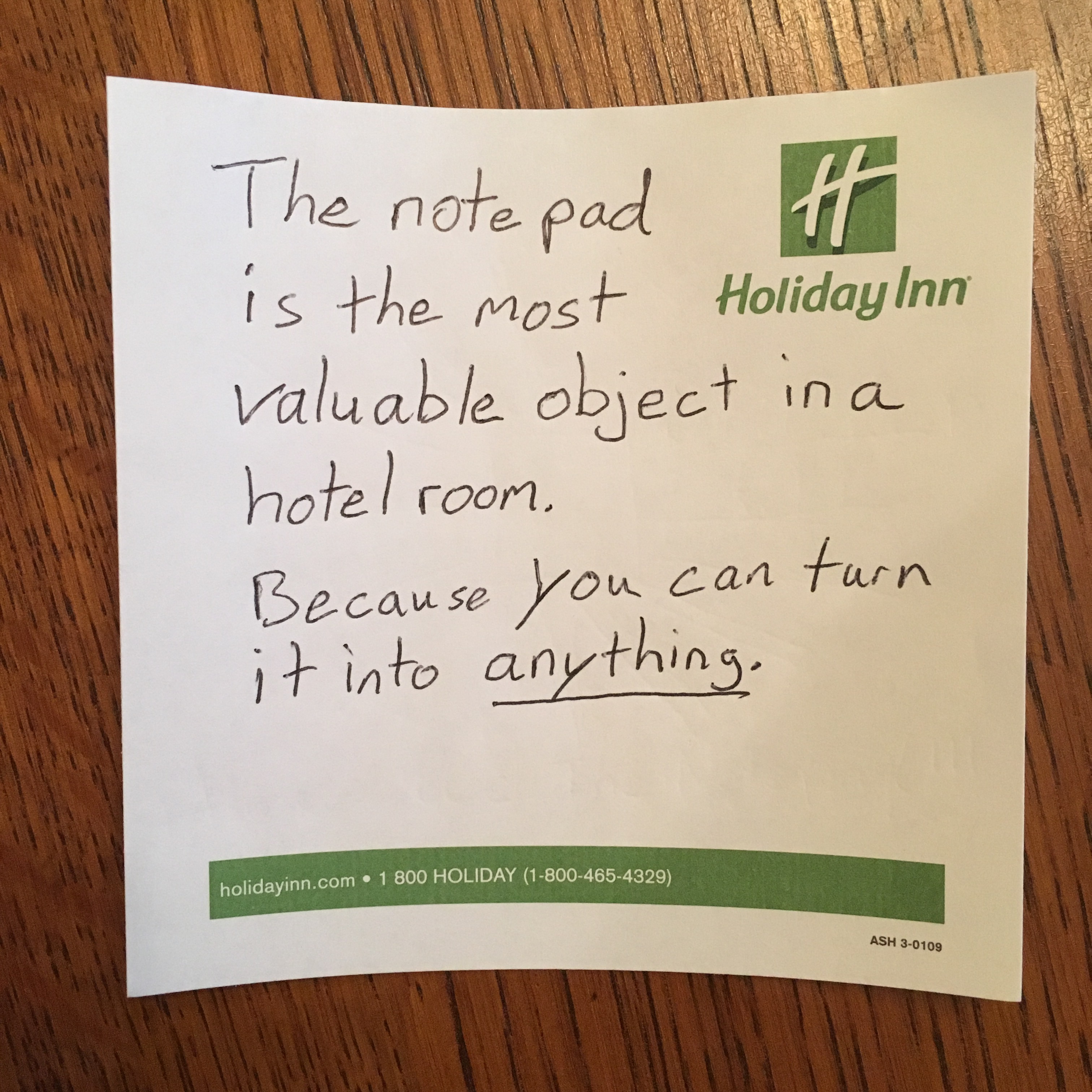
The most important thing I have learned from all that staying is that you should capture your ideas on the hotel notepads. By doing so, you turn the notepads into the most valuable object in the room.

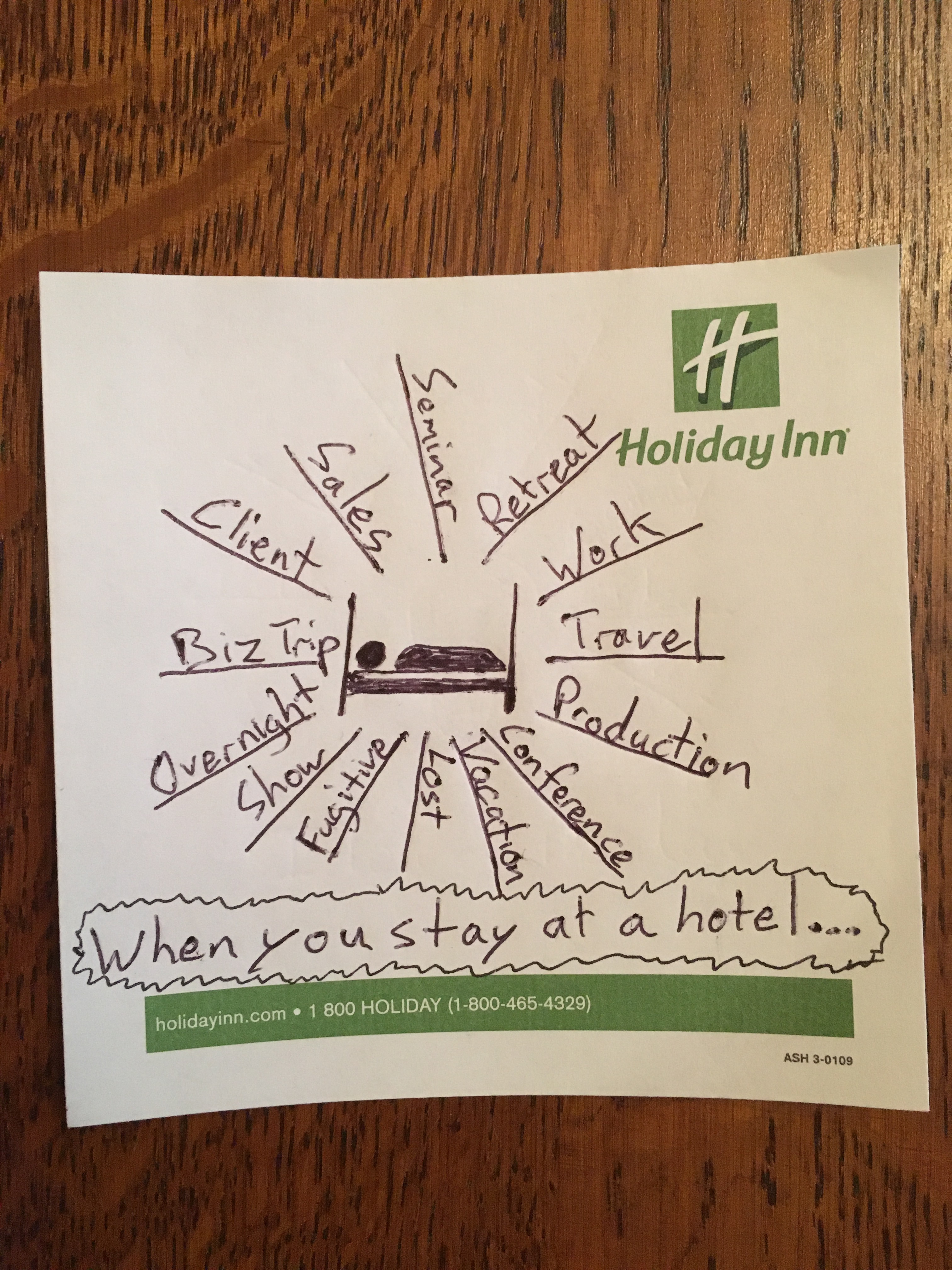
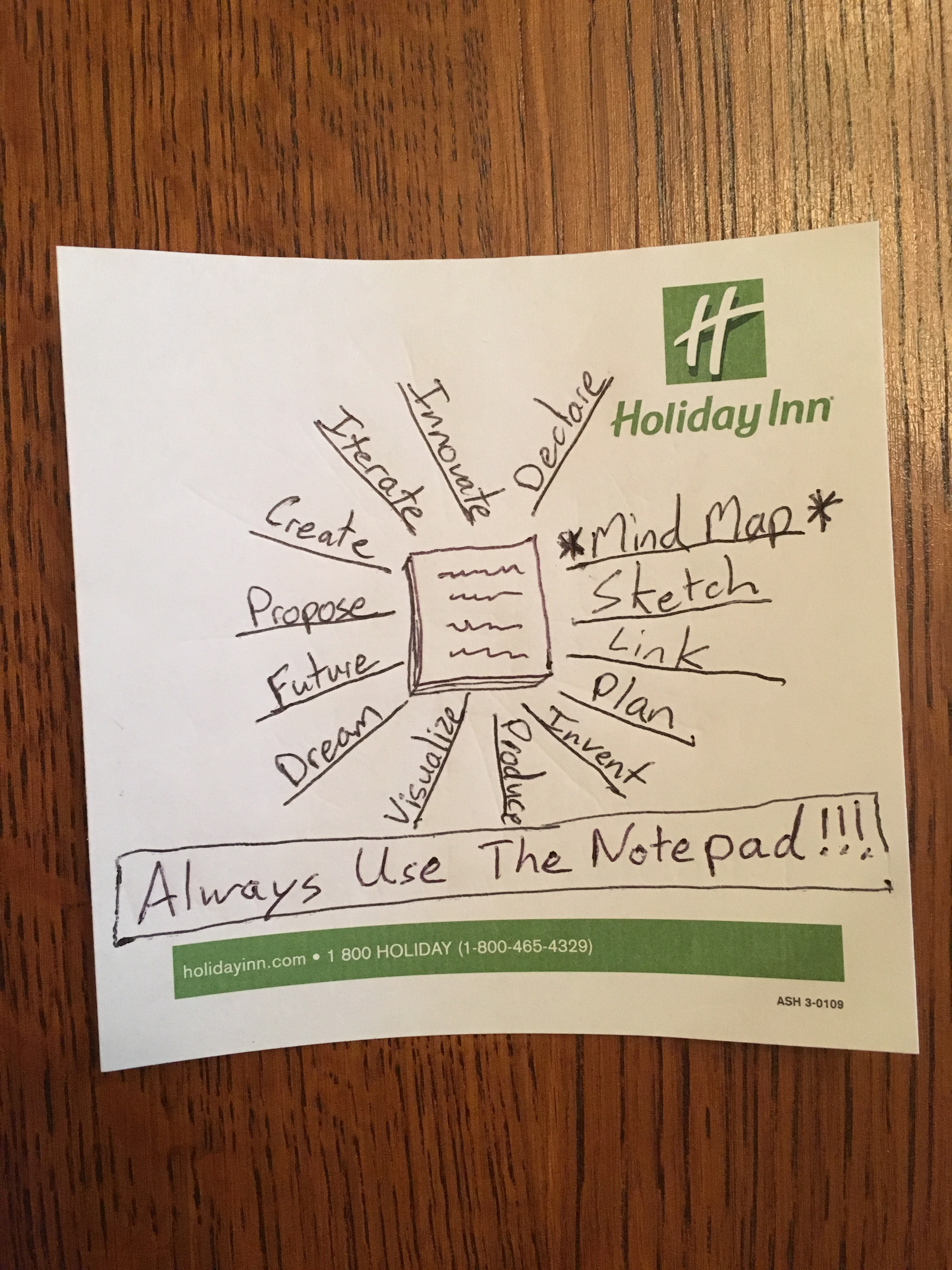
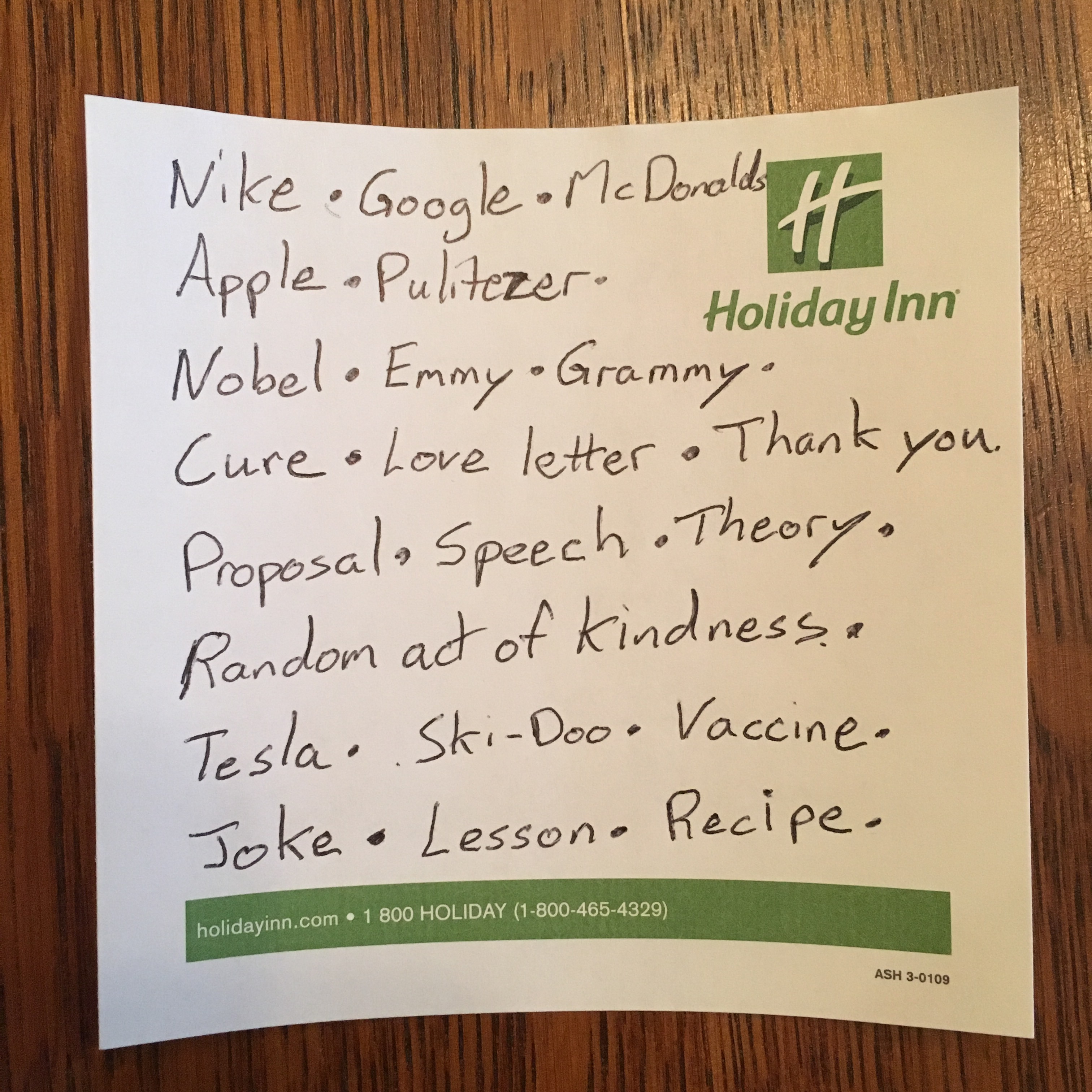
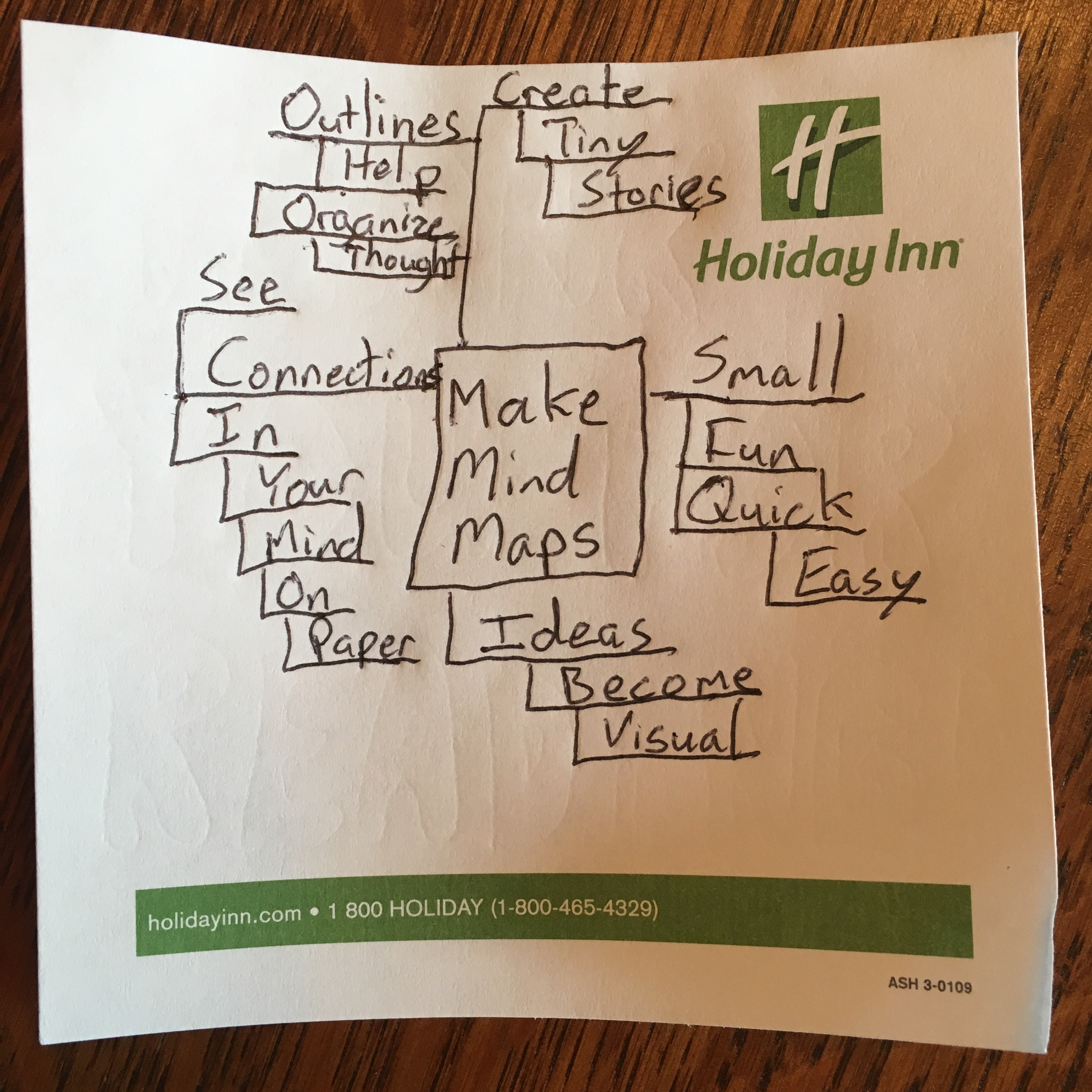
The following is the post I first shared in 2017. It is all written on the notepad from the hotel room I stayed at when visiting family in Austin, Minnesota.

Note: The Holiday Inn is a sweet hotel in Austin. And the Perkins next door is my go-to breakfast spot. I always order The Tremendous 12.

And now, The Notepad…

To have more great ideas stop thinking about it.

I love ideas. New ideas tingle and jump in my head like pop rocks. If that is how crack makes you feel I would like crack. A lot. Ideas are the seeds that grow every kind of human-induced improvement on this planet. Yet many of us don’t spend much, if any time ideating.

I love the entire ideation process. I love loading my brain with information by reading and researching. Great ideas come from rearranging the ingredients in your head in new and novel ways. The more ingredients the more possibilities.

But after you top off your brain with input about the problem to be solved comes the most valuable part of the process: Stepping away from the problem completely. And doing nothing. That’s right. Just let the elements do what they want to do. Not what you want them to do. Yet, deep inside your mind, the ideas are growing. And fermenting. Brewing and bubbling. Forming and frothing. Without any additional effort from you.

This part of the process is like making cheese. Or wine. Or a baby. Well not making a baby. Just the baby-growing part. To the naked eye it looks like you are being lazy. The fun distractions at advertising agencies and other creative environments are great at getting team members away from the active thinking and into incubation. That way you don’t get in the way of the natural process. Think of it like baking a cake. Opening the oven door and jabbing toothpicks doesn’t help transform the batter into cake. Time and heat do the work.

The incubation period is the most valuable step in developing unique and differentiating ideas. Yet it is absolutely free. At The Perfect Agency Project we don’t charge for the time when we’re not actively thinking about challenges. During this phase of the process you can multitask. Or sleep. Or make cheese. Or compost. Or babies. The longer the incubation period the more you compound the interesting.

Unfortunately, for the professional creative, the incubation period is an endangered part of the process. Over the course of my career this valuable time has been disappearing like the Brazilian rainforest. And record stores. A lack of planning on the part of the requester hacks at this time. So does a lack of patience. But creatives thinkers have not done enough to promote the ROI clients earn on this free time. I hope sharing this post is a first step in re-establishing the importance of this step.

To make sure you get the most value out of the incubation period start early, build in time for nothing and let the team sleep on it. I often wake up and find myself perched on a great idea like a hen sitting on a warm egg. Resist the temptation to see work ASAP. You will often get the best results if you see the work ALAP.

So spend less money. Offer more time. Let your team know the outline of the challenge early. And watch the great ideas emerge like popcorn. And wine. And babies.

The most valuable lottery you’ve never heard of.

By now you all know that you didn’t win last week’s Powerball lottery jackpot of nearly $1.6 billion dollars. Sorry. And if you were like most Americans you were probably off by 5 or 6 numbers. I know how you feel. Because when I was 18 I had a lottery experience that forever shaped my perspective on this get-rich-instantly game.

It happened at my high school graduation. My classmates and I received our Hanover High School diplomas from our principal, the late, super-great Uwe Bagnato. As he handed us our diplomas we each handed him a lottery ticket. It was an exciting experiment. We all wondered how much he might win with 143 chances. (Don’t laugh. We scoured ten towns from two states to come up with 143 educatable kids).  Anyway, we imagined Uwe would become mega-rich, and we would be the last class to graduate under his principality. But when we discovered that he only won a couple of bucks, and would be back at work again after Labor Day, the lottery was forever dead to me.

Since graduation I’ve been betting on myself.  I have made my career as an advertising creative.  And we make our money through an ideation lottery, where ideas bounce around in our head like lottery balls, randomized for fairness.  And when our mental machinery cues those idea-balls to drop into our consciousness we either have winning ideas or losing ideas.

I love the odds in this game.  I stack them in my favor by absorbing the world around me through interesting experiences, reading,  human interactions and sweet tea.  What I like even better is that you can play the idea lottery non-stop. And I do.  For some it is nerve-racking to make your living in this manner.  That’s why so many creative thinkers burn out or switch professions.  But the ones that stick with it are often well rewarded.

The value of the creative lottery is summed up beautifully in one of my favorite quotes:

“More gold had been mined from the mind of men than the earth itself.”  -Napoleon Hill from Think and Grow Rich.

Napoleon, that is some powerful stuff.  But it’s a strange reality. Because I really don’t know where the ideas come from. Sure, sometimes the thoughts are mashups of two things I’ve considered recently.  And sometimes there is a strong logic chain the leads me to an idea.  But a healthy percentage of the time God just drops gold nuggets in between my ears, and for all I know I had nothing to do with it. I’m just smart enough to watch for them, recognize them when I see them and polish them enough to enable others  to recognize their value.

So the next time you watch those lottery balls mixing, think of all the great creative ideas formed in the minds of men and women that have turned them into millionaires and billionaires. I hope it encourages you to bet on your own ideas. And take it from me and Uwe, the chances of winning the lottery are far better in your head.