
Why logic isn’t enough to win at marketing.

As the Founder & CEO of the advertising and idea agency, The Weaponry, I get to work on a lot of great brands with a lot of great people. But as someone passionate about great creative work it may surprise you to hear that one of my favorite brands to work on is in a historically conservative category. Yet we have developed a brand personality and creative work for our client that is full of the type of personality and wit that is more common in categories like soda pop or men’s deodorant. #ImOnAHorse.

But like most brands, our fun client also has a lot of legitimate reasons to choose it the way choosey moms choose JIF. So a while back the marketing team decided to emphasize those legitimate reasons to choose the brand in a fairly straightforward way. The personality was downplayed. Features and benefits took center stage. And the brand started feeling, well, flat. Kinda like soda pop after someone left the cap off of the bottle for a few days, in Iowa.

I could tell that we were starting to drift slowly off course. The fun brand we had built was an honest reflection of the reason customers loved the organization. The people and culture of the place were great. We simply made sure that it shined bright like a diamond in the marketing too.

So we met with our client and shared our concerns. I told the client that we were getting too logical. We were focusing on rational reasons to choose our brand. And our endearing personality, the fun, cool, the funny, was fading into the background. As we focused on our features and benefits, things that many of our competitors could also promote, we were losing our differentiation. And we were in danger of losing our emotional magnetism.

As marketers, we must never forget this fundamental law:

To be wildly successful, you need your audience to love you, not logic you.

Our superstar clients understood the problem. And we made appropriate adjustments. Starting with our next creative campaign, we put our personality front and center as we promoted the great reasons to believe in the brand.

Today, when I see our work I love everything about the brand. The personality is fun, smart and clever. It provides a smile if not a laugh. There is a clear reason to choose the brand in every marketing morsel. People comment on the work all the time. And the brand is enjoying strong growth and success across the board. Which I love most of all, Scarecrow.

Key Takeaway

Resist the temptation to focus fully on your features and benefits. Brands should have personalities, just like people. Invest time and energy in developing a great personality that grabs attention and magnetizes your audience to the brand. Make your customers and prospects love you, not logic you. Because once you win their hearts, everything else will follow.

*If you know someone who could benefit from this message, please share it with them.

+For more of the best life lessons I have learned check out my book, What Does Your Fortune Cookie Say? from Ripples Media.
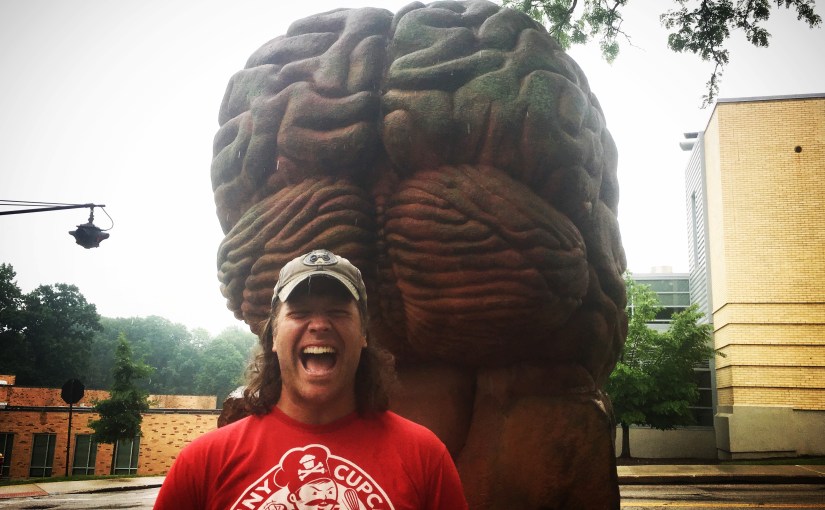
Why the right-brain vs left-brain talk makes me want to scream.

When I was a child I was fascinated to learn that the brain is not one solid organ. The brain is actually divided, down the middle, into two hemispheres un-creatively known as the right brain and left brain. The brainispheres have different job assignments. Essentially they work like a great team, dividing the responsibilities of braining for humans into separate but equal parts. Which means your brain works like Siegfried and Roy, Abbott and Costello or Dumb & Dumber.

Choosing Sides

People often talk about being either right-brained or left-brained. If you have not heard such talk, it goes like this: The right side of the brain is thought to control your creative and artistic thinking. While your left brain controls your logic and rational behavior. As with politics, when it comes to braining, people often identify with one side or the other.

I have spent my entire career as a professional creative thinker. I started out as a Copywriter and progressed to the title of Chief Creative Officer. Every title I had for 20 years had either the word writer or creative in it. So it’s natural to sort me into the right-brained team. People do it all the time. In conversations I hear people say ‘You right-brained types…’ or ‘Us right-brained types…’

nervous2
Lookie there! Your brain has a coin slot too.

However…

I have never thought of myself as being right-brained. Not once. Ever. I have never thought of myself as being primarily a creative thinker. It’s not that I don’t think creatively. I know I do. But I also use careful analysis and logic every day. I love the scientific method and the absoluteness of math. I enjoy calculating my taxes. But I don’t enjoy stereotypes. Except for Bose. Those guys make great types of stereos.

Business Thinking

The latest role in my career has been as an Entrepreneur. As the Founder & CEO of the advertising and idea agency The Weaponry, I am required to use all of my brain at work. While our service offering is unquestionably creative, everything else about the business is decidedly based in the left brain. I have to think about our accounting, finances, benefits, and human resources. I have to establish processes for project management, account management, and invoicing.

There is not an element of business that I don’t I feel comfortable with. I understand, appreciate and enjoy all of the thinking that goes into starting and running a business. I see it all as a big system of constants and variables. Some disciplines require more creative thinking. Others require very practical analysis. I am thankful that my brains get along like Bert and Ernie. Their daily cooperation helps me function as one whole person.

Unlabeling

It is limiting, if not damaging to label people, including yourself, as right-brained or left- brained. According to Dr. Daniel G. Amen in his book Making A Good Brain Great, it is a myth that we only use 10% of our brain. Our entire brain is on and working our entire lives, even when we sleep. If you were born with, and still have, both hemispheres of your brain, use them. Some skills and processes may come more naturally. But that doesn’t mean you can’t or shouldn’t work to develop the others.

Key Takeaway

The danger in the right-brain, left-brain labels is that you will start to believe that you can’t do things. Then you won’t take on tasks or challenges, because you have told yourself you are no good at them. But you can be. You just have to make sure you are not limiting your thinking.