Looking for office space: A startup story.

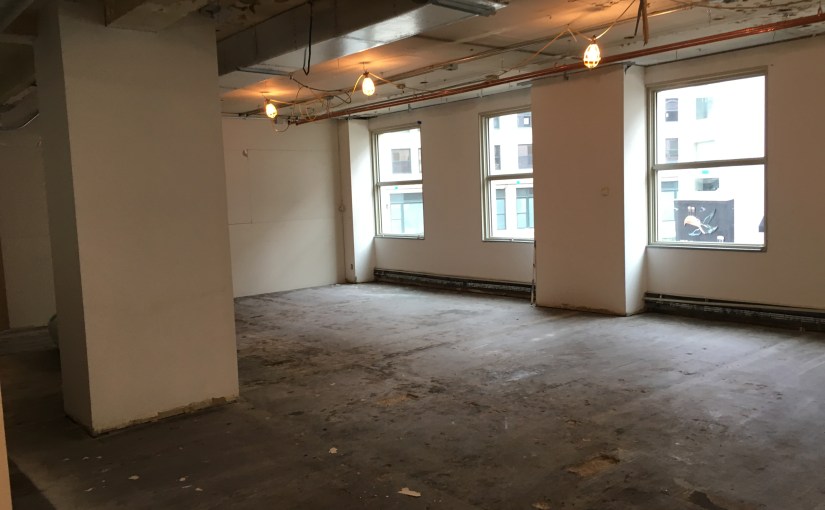
Welcome to the first post in my Finding Office Space series. I am writing a Lord Of The Rings-type of trilogy.  This is the beginning, where we optimistically begin looking for a great new office. The next post will be the journey, conflict and rising action, without resolution. Then finally, after defeating the dark lord, a giant spider and unmasking some Scooby Doo criminals, we will move into our new space.

The Beginning

We launched The Weaponry, an advertising and idea agency, in 2016. We started off working with five brands, all former clients who wanted us to help them make some marketing magic. We were really lucky to have great clients who wanted to help us get started. Or maybe it wasn’t luck. Maybe this was a product of building trust and a history of success with these clients. Nah. It was probably luck.

Like a technology company, we quickly formed a minimum viable product (MVP). It didn’t take much to get The Weaponry cranking. After all, our value is in our people. When you have great people with great ideas offering great service, you’re in business. Literally.

Modern technology has allowed us to create a successful business without a physical office space. What we quickly realized, was that when our first team members fired up their laptops, The Weaponry came alive. The technology we used made us one cohesive team.  Despite the fact that our initial team was in Atlanta, Seattle, Milwaukee and Columbus, technology like Slack, Google’s G-Suite, Dropbox and Zoom made us feel like we were all under one roof, collaborating seamlessly.

The Office

I was surprised when people asked me where we were going to have our office. A physical office was unnecessary. The office was wherever we were. We all had laptops and mobile phones. We were always on and always connected to each other.  We didn’t need 4 walls and a roof. Or two turntables and a microphone. And after enduring Atlanta traffic for a few years I was happy to not deal with a commute for a while. No offense Atlanta, but your traffic is not the jam. #expandmarta

Of course there are some benefits that come from having a physical space. But to be clear, they are a bonus. Not a necessity. In fact, by the time we decided it would be worthwhile to have a physical space we had become so busy that we didn’t have time to go look for one. That, my friends, is a good problem to have.

The Search Begins

Finally, a few weeks ago I had a free Friday afternoon. I drove around town like the property paparazzi, taking pictures of Space Available signs on buildings and then making a lot of phone calls. I was surprised that the process of finding office space wasn’t simpler.  If there is a comprehensive directory of all of the available office spaces in the galaxy, I didn’t find it.

Over the past few weeks I have visited eight buildings and seen twenty possible spaces. I have looked at cool riverfront lofts, an office in a converted brewery and high-rise suites overlooking Lake Michigan. I’ve looked at buildings full of bells and whistles. I’ve seen buildings that have lost their bell and can no longer whistle.  Now, I face some challenges in making the next decision.

Office Space Questions

  1. Do we take a conservative approach and only lease enough space for now?
  2. Do we rent a bigger space to give us room to grow?
  3. How much room should we have to accommodate for growth?
  4. Do we rent as-is space, or have it built specifically for us?
  5. How long should our lease term be?
  6. What amenities are really nice to have in the building, and which ones just don’t matter?

If you have experience with any of these challenges I would love to hear your thoughts. We have narrowed down to a few options and we are sending out our RFP within the next week. As we compare and contrast I’ll share my version of The Two Towers. Thanks for following the story.
Applying Dr. King’s approach at work.

I love MLK Jr. Day. It is a holiday that makes me think. It makes me appreciate being an American. Like the 4th of July, MLK Jr. Day is a reminder of the American Dream. Which is dreaming of your ideal world. Then overcoming the forces that have prevented that ideal from becoming your reality. Finally, you have a great movie made about you that garners critical acclaim, even if you don’t win the big awards you deserve.

My Dream

My dream is to be ridiculously happy. I’m a happy person naturally. I consider it fortunate wiring. But I want Maximum Happiness. To help chart my path to MaxHap I did what MLK Jr. did. I envisioned something better than anything I have seen. I wrote down my plan. I painted a picture of the dream in vivid detail.  Then I began to bring it to life. To spare you all the details, the rest of this post will focus on my happiness derived from work.

My dream was born in the last hours of my 39th year.  I contemplated what I wanted the next chapter of my career to look like. Then I started scripting a plan to make it happen.

We spend so much of our time at work that you have to get the work life right to get your whole life right.

It was clear to me that no one else was trying to create my ideal workplace. It was my responsibility. But after 20 years in the advertising industry I knew that if I could create the perfect agency I could help a lot of other people achieve their own happiness in the process.

The Perfect Agency Project

So I started The Perfect Agency project. It was just a project at first. Then, as it gained shape I decided to create a blog about it. Maybe you’ve heard of it. Maybe you are reading it right now. Maybe there is no way that you are not reading it right now.

Then I named the agency The Weaponry and began to bring it to life in 2016.

I started by scripting philosophies and processes. I have written down everything. I have written a list of clients I want to work with (you may be on that list).  I have created a list of teammates I want to work with (you may be on that list). I have detailed services, team sizes and office locations. I have a list of features for our physical space that will make others ask, “Why don’t we have that?’  I have created such a clear image in my head that the rest of the project is simply bringing the blueprint to life (as if that were a simple task).

Here are a few of the important points that will make The Weaponry my ideal place to work, contribtuing to my MaxHap.

Our 3 Pillars Of Success.

  1. Excellent creative ideas.
  2. Amazing customer service.
  3. A fun experience for everyone involved.

We will call our people team members, not employees.  They work with us. Not for us.

We must remain eternally optimistic. There is a beautiful solution to every problem. It is our job to find it.

We must be collaborative. We have to enable and create great ideas. But we also must recognize when the client (and, yes, even the client’s spouse) has a great idea that we should bring to life. Too may agencies think they have a monopoly on good ideas.  But there are two parts to the idea business that you have to master. 1. Coming up with great ideas. 2. Recognizing great ideas on arrival. Even if they didn’t hatch in your incubator.

Valuing Experience

The Perfect Agency is a place that values the experience and know-how of professionals who have been crushing it and accumulating knowledge for decades. But it also embraces the college student and even high schoolers who bring unbridled energy and fresh thinking to the table. Mixing the two together gives the ideal agency energy, stability and control.

Embracing Feedback

The Perfect Agency uses feedback productively. As an organization we are still in our infancy.  We have unlimited potential. But we need to take in feedback from others to learn and grow. Which includes feedback from staff, clients, advisors and partners. The kind of feedback you get when your walk in front of a speaker with a live microphone is not necessary to our success.

Playing Well With Others

The Perfect Agency plays well with our clients’ other agencies, vendors and consultants. We want to be the best partners we can be. That means that we don’t drop the ball. But just as importantly, we don’t try to steal the ball from others. If we do what our clients want we will earn more work. We don’t need to punch, kick and stab others to get ahead.  This isn’t prison.

The Perfect Agency allows you to live where you want and is flexible with your time. Happy people are better teammates. We want people who are living their ideal lives. Ideas come faster, and service is better from happy people.  That means being open-minded to remote and part-time work.

Working On Your Terms

The Perfect agency doesn’t force clients to sign a long-term commitment.  We are not trying to marry our clients after the first date.  We want our clients to be the ones who propose marriage because they love us so much and can’t stand the idea of us ever being with another client in their field of expertise. Romantic, I know.

The Perfect Agency doesn’t have A-holes. We baked that right into our logo.  See the A in the The Weaponry?  No A-hole.

the-weaponry_logo_red_cmyk

I could go on and on. But my dream blog post never hits 1000 words. If you would like to find out more about The Weaponry and how it could contribute to your long-term happiness give us a shout. My email is in my bio link. If  you can’t find that try adam@theweaponry.com.

Why everyone in advertising should own their own business.

There was a time when side hustles were frowned upon in America. And I’m not talking about the Post-Disco era. Having a second gig was discouraged because employers didn’t want anyone else owning any of their employees’ cranial space. Including the employees themselves. This is ignorant. Quite to the contrary, (delivered in my best British accent) I wish everyone at my adverting agency had a side hustle.

Throughout my career many of my team members have had interesting micro-businesses. I’ve had coworkers who created and sold posters and prints, invitations and greeting cards, cupcakes and macaroons. They’ve been DJs, authors, children’s book illustrators and whiskey makers (although not necessarily in that order). Given the innovative and interesting cast of characters I’ve worked with I expect there are plenty of other business exploits I know nothing about.

I have had a small side business for the past 10 years. I make t-shirts under the brand Adam & Sleeve. AdamandSleeve.com.  In 2006 I had an idea for a t-shirt that I really wanted. So I made a few. Other people requested them. And I realized that if I made enough to sell, I would get the t-shirts I wanted for myself for free. I’ve learned about sourcing, quality control, vendor relations, production, distribution, finance and customer service. Even better, I really enjoy it.

But a funny thing happens when you create your own business, even a micro-business, like selling micros. You develop a deeper and fuller understanding of all of the elements of business that your clients face. You better understand the contraints of time, money and resources. You understand the risks. You understand why they want their logo bigger.

Too often we only see a small sliver of what our clients are facing. Like the four blind men who are trying to describe an elephant based on the part they are touching. So we can’t understand why our clients don’t just upgrade all their gadgets and gizmos, or hire someone more savvy than my Grammy to handle their social media, or fly us all to Tahiti to research how far away it is.

Once you walk a mile in someone else’s cash register you can understand their reluctance to spend money.  Once you have received a letter from an attorney you think twice about  claiming you serve the world’s best cup of coffee.  And once you realize how hard it is to hire and retain good help you understand why the client didn’t just fire that lump of a salesman who landed in the marketing department.

So don’t be too quick to discourage your people from creating their own side business. It can be energizing, insightful and rewarding. It will help them develop empathy, which is one of the most important advertising skills. And properly managed it will pay dividends for them, for you and most importantly for your clients. Oh, and if there are any extra dividends left over please send them my way. I have another business idea to fund.