To have more great ideas stop thinking about it.

I love ideas. New ideas tingle and jump in my head like pop rocks. If that is how crack makes you feel I would like crack. A lot. Ideas are the seeds that grow every kind of human-induced improvement on this planet. Yet many of us don’t spend much, if any time ideating.

I love the entire ideation process. I love loading my brain with information by reading and researching. Great ideas come from rearranging the ingredients in your head in new and novel ways. The more ingredients the more possibilities.

But after you top off your brain with input about the problem to be solved comes the most valuable part of the process: Stepping away from the problem completely. And doing nothing. That’s right. Just let the elements do what they want to do. Not what you want them to do. Yet, deep inside your mind, the ideas are growing. And fermenting. Brewing and bubbling. Forming and frothing. Without any additional effort from you.

This part of the process is like making cheese. Or wine. Or a baby. Well not making a baby. Just the baby-growing part. To the naked eye it looks like you are being lazy. The fun distractions at advertising agencies and other creative environments are great at getting team members away from the active thinking and into incubation. That way you don’t get in the way of the natural process. Think of it like baking a cake. Opening the oven door and jabbing toothpicks doesn’t help transform the batter into cake. Time and heat do the work.

The incubation period is the most valuable step in developing unique and differentiating ideas. Yet it is absolutely free. At The Perfect Agency Project we don’t charge for the time when we’re not actively thinking about challenges. During this phase of the process you can multitask. Or sleep. Or make cheese. Or compost. Or babies. The longer the incubation period the more you compound the interesting.

Unfortunately, for the professional creative, the incubation period is an endangered part of the process. Over the course of my career this valuable time has been disappearing like the Brazilian rainforest. And record stores. A lack of planning on the part of the requester hacks at this time. So does a lack of patience. But creatives thinkers have not done enough to promote the ROI clients earn on this free time. I hope sharing this post is a first step in re-establishing the importance of this step.

To make sure you get the most value out of the incubation period start early, build in time for nothing and let the team sleep on it. I often wake up and find myself perched on a great idea like a hen sitting on a warm egg. Resist the temptation to see work ASAP. You will often get the best results if you see the work ALAP.

So spend less money. Offer more time. Let your team know the outline of the challenge early. And watch the great ideas emerge like popcorn. And wine. And babies.


What leaves the room when you do?

There are a lot of people on this planet. The last time I lined everybody up and counted them I tallied 7.4 billion humans. With that many people, all connected by the interwebs, you have a lot of options when you need a human. Whether you need an employee, a spouse or a plumber the supply works in your favor.

But we often find ourselves on the other side of that equation. We want to be employed. We want to be asked on a date. We want to snake someone’s drain. So how do we stand out in this 7.4 billion person crowd? It’s an important question that people spend far too little time contemplating. Yet I found a quote that states the answer quite succinctly:

Something special must leave the room when you leave the room. -Peter Drucker

Read that again a couple of times. (I’ll wait.)

Do you bring something special everywhere you go? You may have never thought about you in these terms. But you should. Over the next week I want you to think about what you bring to a room when you walk in. What do you add to the meeting, to the organization, to the relationship, to the overall value equation that others do not? What disappears again when you leave? If you can’t come up with anything you are a commodity. Our country places a very specific value on the commodity human. It’s called minimum wage. 

You’ve sat in meetings where there were too many attendees. You know there were too many because the meeting would have been exactly the same had one or more of the attendees not attended. On the other hand, we have also been in meetings when we asked, ‘Why are we meeting if Fill-In-The-Name isn’t here?’ You, my friend, want to be Fill-In-The-Name!

So what leaves the room when you do?

Here is a sample of the things you might bring to a room. Mix and match to create unique combinations. Or collect them all!

  • Energy
  • Experience
  • Connective tissue
  • Humor
  • Creativity
  • Compassion
  • Insight
  • Reason
  • Balance
  • Knowledge
  • Relationships
  • Trust
  • Positivity
  • Diversity
  • Know how
  • Spunk
  • Confidence
  • Reality
  • The wi-fi password

As you think about differentiating and marketing yourself The Perfect Agency Project reminds you that the same Principle of Specialness applies to all products and services.  What changes if your iPhone walks out of your life? Or your Yeti tumbler? Or your Johnsonville brats? You can’t simply replace these things with commodities without feeling you have lost something.

You and I both know you are not a commodity. But you must make sure that others clearly recognize the specialness you bring to the room. So reflect on your brand. What are your features and benefits that make you special. Focus on enhancing and augmenting them. Study the business and social situations you find yourself in. What isn’t there that you could add so that others miss you when you’re gone? I’ve always said that I never want to attend a meeting that I’m not in. Which sounds like something Yogi Berra might say. But if I can bring enough to the party that others are disappointed by my absences, we’re talking pure Drucker.


Who should go to the pitch?

Whoever does most of the talking at the initial meeting needs to work with us the whole time.  -Elise Demboski

Why Peyton Manning should be in the Marketing Hall of Fame.


Super Bowl 50 has come and gone. There were winners and at least one very sore loser. There was the expected halftime Pepsiganza and gonzo commercials. But what was particularly interesting to armchair marketingbacks  were the brands that scored extra points outside the 30 second commercial thanks to Denver Broncos quarterback, Peyton Manning.

After a historic career Peyton has an open invitation to the Pro Football Hall of fame. But as the clock counts down on his days playing football Peyton Manning will transition seamlessly into his next chapter. Because Peyton knows marketing. And endorsement. And business. Perhaps better than any other current athlete. My good friends at Nationwide will surely want him to share how their insurance and financial products will help him in retirement. Because those guys are on his side (and your side too). But I believe his actual retirement plan looks like this:

  1. Take a stake in a brand.
  2. Market brand at big moments.
  3. Cash checks.

We got a good look at his playbook during the Super Bowl. Just in case you missed it, here’s a breakdown of three of his scores.

The first came just before kickoff. Because it was Super Bowl 50 it created the perfect opportunity to honor the 49 past Super Bowl MVPs. The NFL invited them all to the game. And one by one they were announced to the crowd, emerged from the tunnel to much applause, and took their place in Canton’s West Coast Exhibit. There was, however, one notable exception. Peyton Manning. When they announced Manning’s name the collective NFL fan base wondered what would happen next. Was he really going to come out and join this elite group? Surely not. Didn’t he have someplace more important to be? I had flashbacks to when the Von Trapp Family Singer’s were announced as the winners of the Nazi talent show in The Sound of Music. So what happened next?

Suddenly the television coverage cuts to a profile shot of Peyton, sitting alone in the locker room. But wait! He was dressed to play, football!?! But he is 39 years old!?! How could he still be playing in the Super Bowl? Nobody this old has ever started at quarterback in the Super Bowl. But the answer was right there too. Because Peyton was seated in front of perfectly positioned pallets of performance-sustaining, career- sustaining, camera-shot-sustaining Gatorade. And if that wasn’t enough, the NFL’s ambassador to AARP was shown contemplatively sipping from his electrolyte-laden fountain of youth. Touchdown for Gatorade. Just another day at the office for this veteran spokesback.

Petyon drinking gatorade

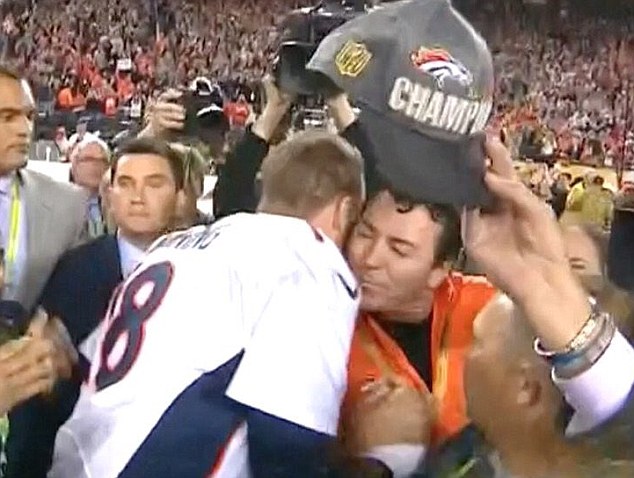
The second marketing score was on a trick play. Just as the clock was ticking to zero and all eyes and cameras were on Peyton he started to jog onto the field. But then he stopped. He turned to his left and obviously saw someone worthy of his attention. So he paused before he ran on to the field to celebrate the biggest and perhaps final moment of his career. But who would warrant a delay at such a moment? Archie Manning? John Elway? Beyonce’? Nope. The next thing we saw on camera was a hearty embrace between Peyton and John ‘Papa John’ Schnatter, The Pizza King of Louisville. Peyton obviously plays starting endorserback for Papa Johns. And he own 21 franchises in Colorado. But I was certainly surprised to see that they were close enough and brand savvy enough to get their pepperoni rally  in front of a world stage.

Peyton and Papa

The final drive was for Budweiser. After Old Man Manning won the Super Bowl the world wanted to know, “Are you going to ride off into the sunset now on your Bronco, or Colt or Buick? We waited with bated breath. But Peyton really wanted to kiss his wife and kids before he got himself a little beer breath. Which is what he said next. But not with just any beer. He said this moment called for the King of Beers, Budweiser. Twice he mentioned that he wanted to drink a bunch of Budweiser. Once in his post game interview and again on stage accepting the Lombardi Trophy. Closer examination reveals that Peyton owns a swig of two Budweiser distributors in Louisiana. Which means Peyton was going to celebrate his win by taking care of a little more business.

As you contemplate your next marketing move consider teaming up with someone who can help your brand move further faster. It doesn’t have to be a household name. Because in the social age important influencers are everywhere. They are key employees, consumers, bloggers, tweeters and YouTube celebrities. They can all be important advocates for your brands, dropping natural endorsements for you at important moments.  And the value you receive from your relationship may far exceed the investment. After all, my best performing blog post was the one Vanilla Ice retweeted. But just imagine if I could get Peyton to mention my blog …


3 things every business can learn from Super Bowl commercials.

The greatest sporting event in America is this Sunday. Maybe the greatest sporting event in the world. I know there are arguments that the FIFA World Cup is bigger than our football game. And that the Olympics have more flames, more luge and more cowbell. But neither of those is the Super Bowl. Our Super Bowl is the Super Bowl of all Super Bowls. Which I admit is a super dumb thing to say.

In 2015 more than 114 million Americans tuned in to the big game. And for good reason. Actually there are three good reasons to tune into this spectacle. First, for the football. The game is usually exciting. And this year we again have two great teams and a compelling matchup featuring Peyton “Old Man” Manning vs Cam “New Kid” Newton. (see what I did there?)

Second, the Super Bowl is a cultural phenomenon. It’s what everyone in the office will be talking about around the Coca-Cola Freestyle machine on Monday morning. If your office still has a water cooler the talk probably won’t be about the Super Bowl. It will be about why you still don’t have a Coca-Cola Freestyle machine.

And the third reason to watch is the commercials. The Super Bowl commercials are a fascinating study. Because we look forward to the commercials as much as we look forward to the game itself. Even though the commercials slow down the game and make the whole night last longer than a Wagner opera. But why?

The magic of the Super Bowl is that for at least one night a year we all recognize that the commercials themselves add value to our lives. They are entertaining. And on Sunday night, we as a nation will be in the mood to be entertained. The commercials are usually humorous. Some are big funny. Some are small funny. Some are produced like mini-blockbusters packed with action and drama. Some are touching and cute, usually with an animal tugging at your heartstrings. Which is particularly impressive when you consider that most cardiologists can’t even find your heartstrings.

As a whole the commercials are interesting and engaging. But even the lesser spots enable us to play commercial critic. And as we learned from American Idol, a few train wrecks amongst the stars makes for oddly enjoyable TV.

As you prepare for Super Sunday here are three things every business can learn from the Super Bowl commercials.

Meet people where they are.  As a business you need to put the audience you want to reach first. Understand their wants and needs. Understand their habits and how you can fit into them. If people want to party, like they do during the Super Bowl, party with them. If they want serious information to solve a serious problem, get serious with them. But don’t cross streams. Trust me on this one.

Offer a consistently enjoyable experience. A major reason we look forward to the Super Bowl commercials is that we enjoyed them last year. And the year before. And like Pavlov’s dogs, when we hear talk of the Super Bowl, we start salivating for Doritos, Budweiser and Coca-Cola commercials. So deliver a great experience every time. Because when you do, whether you’re a carpet cleaner, a dentist, a software company or a mortician, your customers will look forward to interacting with you again. Wait, scratch mortician.

Make great things.  Americans love greatness. We have a deep appreciation for things like a well crafted Super Bowl commercial, or say, a well written blog post. Great things get elevated in our culture.  Yeti coolers, iPhones and American Giant sweatshirts are all great products from great companies that generate a lot of love. In turn they help build great brands that command love, respect and a premium price. So focus your business efforts on making things great. And the profits will follow.

I hope you enjoy the game. I hope you enjoy the commercials.  And I hope you enjoy the conversations about the game and the commercials on Monday. But most of all I hope that by this time next year your business is competing in the Super Bowl of your industry. And that you have a long line of customers lining up outside your door.  Unless, of course, you’re a mortician.

The most valuable lottery you’ve never heard of.

By now you all know that you didn’t win last week’s Powerball lottery jackpot of nearly $1.6 billion dollars. Sorry. And if you were like most Americans you were probably off by 5 or 6 numbers. I know how you feel. Because when I was 18 I had a lottery experience that forever shaped my perspective on this get-rich-instantly game.

It happened at my high school graduation. My classmates and I received our Hanover High School diplomas from our principal, the late, super-great Uwe Bagnato. As he handed us our diplomas we each handed him a lottery ticket. It was an exciting experiment. We all wondered how much he might win with 143 chances. (Don’t laugh. We scoured ten towns from two states to come up with 143 educatable kids).  Anyway, we imagined Uwe would become mega-rich, and we would be the last class to graduate under his principality. But when we discovered that he only won a couple of bucks, and would be back at work again after Labor Day, the lottery was forever dead to me.

Since graduation I’ve been betting on myself.  I have made my career as an advertising creative.  And we make our money through an ideation lottery, where ideas bounce around in our head like lottery balls, randomized for fairness.  And when our mental machinery cues those idea-balls to drop into our consciousness we either have winning ideas or losing ideas.

I love the odds in this game.  I stack them in my favor by absorbing the world around me through interesting experiences, reading,  human interactions and sweet tea.  What I like even better is that you can play the idea lottery non-stop. And I do.  For some it is nerve-racking to make your living in this manner.  That’s why so many creative thinkers burn out or switch professions.  But the ones that stick with it are often well rewarded.

The value of the creative lottery is summed up beautifully in one of my favorite quotes:

“More gold had been mined from the mind of men than the earth itself.”  -Napoleon Hill from Think and Grow Rich.

Napoleon, that is some powerful stuff.  But it’s a strange reality. Because I really don’t know where the ideas come from. Sure, sometimes the thoughts are mashups of two things I’ve considered recently.  And sometimes there is a strong logic chain the leads me to an idea.  But a healthy percentage of the time God just drops gold nuggets in between my ears, and for all I know I had nothing to do with it. I’m just smart enough to watch for them, recognize them when I see them and polish them enough to enable others  to recognize their value.

So the next time you watch those lottery balls mixing, think of all the great creative ideas formed in the minds of men and women that have turned them into millionaires and billionaires. I hope it encourages you to bet on your own ideas. And take it from me and Uwe, the chances of winning the lottery are far better in your head.

50,000 reasons to take all your vacation days in 2016.

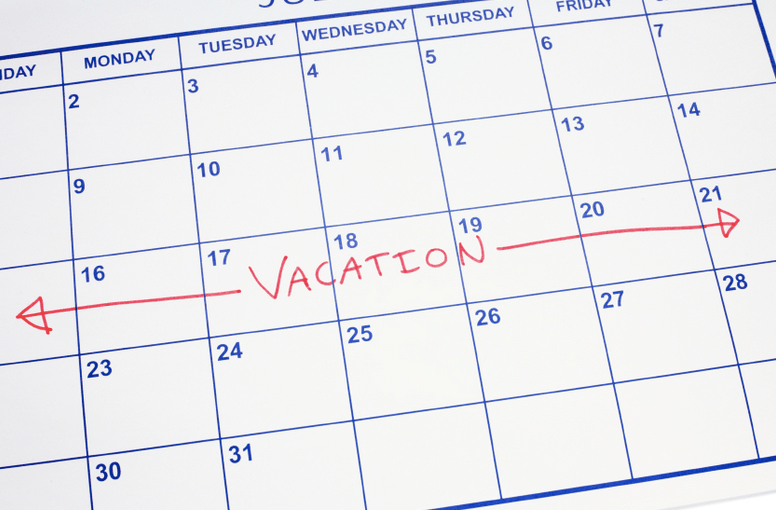
Right now millions of Americans are trying to figure out how to squeeze in the last of their remaining vacation days. Or worse, they are watching them disappear into the ether like the rest of 2015. According to a study by Oxford Economics the average American hits Dick Clark-Seacrest’s Rockin Eve with one week of unused vacation days still in their pocket. And when the ball hits Jenny McCarthy the vacation days disappear like gym goers in February.

This disturbing little study, commissioned by the U.S. Travel Association puts current vacation day consumption at the lowest point in the past four decades. And for those of you who don’t have a days-to-dollars calculator in your head, the result is 169 million days forfeited, amounting to $52.4 billion in lost benefits. Which means that your most valuable charitable contribution this year likely didn’t go to your church, the homeless or curing cancer. It went to your employer.

But there is yet a deeper problem here that The Perfect Agency Project would like to address. It’s the negative impact forgoing your vacation days has on your creative thinking. In fact, according to the National Science Foundation humans have an average of 50,000 thoughts every day. And if you don’t enjoy new experiences, read new books and meet new people you know what happens?  You have the same 50,000 thoughts day after day.  This type of stale thinking is career-threatening if you are a writer, art director, creative director, designer, strategist, developer, programer or marketer.

To enhance your creativity you have to add new fuel to the fire.  And the best way to do that is to take a day off and experience something new.  Travel somewhere you’ve never been. Meet someone new. Jump off something you’ve never jumped off. Scare yourself. Binge watch sunrises and sunsets. Visit a museum. Go to Burning Man. Because new stimuli create new memories. Which create new thoughts and new pathways. You will naturally incorporate all of these new thoughts into your work.  Which empowers you to solve new problems with more beautiful solutions.

So if you want to make 2016 your most creative and innovative year yet take your vacation days. It will freshen your thinking, expand your brain and make you a more valuable asset to your organization.  Oh, and if you do decide to jump off something you’ve never jumped off before make sure your mom isn’t driving by in her minivan. Trust me on this one.


Why everyone in advertising should own their own business.

There was a time when side hustles were frowned upon in America. And I’m not talking about the Post-Disco era. Having a second gig was discouraged because employers didn’t want anyone else owning any of their employees’ cranial space. Including the employees themselves. This is ignorant. Quite to the contrary, (delivered in my best British accent) I wish everyone at my adverting agency had a side hustle.

Throughout my career many of my team members have had interesting micro-businesses. I’ve had coworkers who created and sold posters and prints, invitations and greeting cards, cupcakes and macaroons. They’ve been DJs, authors, children’s book illustrators and whiskey makers (although not necessarily in that order). Given the innovative and interesting cast of characters I’ve worked with I expect there are plenty of other business exploits I know nothing about.

I have had a small side business for the past 10 years. I make t-shirts under the brand Adam & Sleeve. AdamandSleeve.com.  In 2006 I had an idea for a t-shirt that I really wanted. So I made a few. Other people requested them. And I realized that if I made enough to sell, I would get the t-shirts I wanted for myself for free. I’ve learned about sourcing, quality control, vendor relations, production, distribution, finance and customer service. Even better, I really enjoy it.

But a funny thing happens when you create your own business, even a micro-business, like selling micros. You develop a deeper and fuller understanding of all of the elements of business that your clients face. You better understand the contraints of time, money and resources. You understand the risks. You understand why they want their logo bigger.

Too often we only see a small sliver of what our clients are facing. Like the four blind men who are trying to describe an elephant based on the part they are touching. So we can’t understand why our clients don’t just upgrade all their gadgets and gizmos, or hire someone more savvy than my Grammy to handle their social media, or fly us all to Tahiti to research how far away it is.

Once you walk a mile in someone else’s cash register you can understand their reluctance to spend money.  Once you have received a letter from an attorney you think twice about  claiming you serve the world’s best cup of coffee.  And once you realize how hard it is to hire and retain good help you understand why the client didn’t just fire that lump of a salesman who landed in the marketing department.

So don’t be too quick to discourage your people from creating their own side business. It can be energizing, insightful and rewarding. It will help them develop empathy, which is one of the most important advertising skills. And properly managed it will pay dividends for them, for you and most importantly for your clients. Oh, and if there are any extra dividends left over please send them my way. I have another business idea to fund.


I Owe My Career To The Vanilla Ice Philosophy

I have a philosophy about philosophies.  It’s that everyone should have one. I believe we all need something to ground our actions, beliefs and decisions. It is our philosophies that create the bedrock of our character and our personal brands.

I also have a philosophy about the work I do as a professional creative. It encompasses why I believe advertising and marketing exist. And I stole it from Vanilla Ice. Yes, I am an evangelist of the Vanilla Ice Philosophy. What? You’ve never heard of it?  Right now consultants at Deloitte, Accenture and McKinsey are looking at each other asking, “Do you know what hell he’s talking about?” (And I know you guys read this. #analytics!)

Allow me to explain. The Vanilla Ice Philosophy was first introduced 25 years ago in Mr. Ice’s hit song, Ice Ice Baby. The philosophy emphatically states, “If there was a problem, Yo! I’ll solve it!”

It’s that simple. And it reminds me that there is only one reason agencies exist: To solve our clients’ problems. Fortunately for us, our clients always have problems (some more than others).  Sometimes they are really difficult challenges. Sometimes they are good problems to have.  But they are always there.  And solving them puts food on our tables.

I also love the attitude of this philosophy. You know, the “Yo! I’ll solve it!” part.  Because like an athlete who wants the ball, puck or frisbee when the team needs a big play, I always believe I can find a solution. So throw me the problem! Business is now my competitive sport. And I build teams full of people with the same competitive mindset.

Clients constantly warn us of big challenges or tight deadlines that make their problem difficult to solve. But our team never flinches. We’ve seen too much and overcome too many challenges. In short, we are hard to scare.

So what makes the perfect agency good at solving problems?  Again, we turn to Vanilla Ice. He doles out important instructions in the opening line of Ice Ice Baby. Because he knew in his infinite icy wisdom that the key to solving problems is to collaborate and to listen.

Collaborating means we work together. Our agency huddles together to put the best minds to work as one. We also collaborate extremely well with our clients. By representing all perspectives in the solutions we know we come up with better options than we ever could alone.

Listening means we hear the real problem to be solved. We listen for understanding. We listen for insights. We listen to hear the key problem we are trying to solve. In corporate America too much time is wasted by not hearing, identifying or responding to the real problem.

So thank you Robert Van Winkle. Over the past 25 years you’ve made great music. You’ve made us dance. And you have penned some solid philosophy that I follow every day. Word to your mother.


Why your next hire should be an Imperfectionist.

To build a great business you need to collect great people.  But what makes people great, and thus collectable, is certainly a topic of debate. I am sure you have your own trait that you think makes you a valuable addition to an employer. You’re organized. Or energetic. Or creative. Or not easily bored.

I spend a lot of time interviewing candidates for our ad agency. And there’s one label I have heard more than all others. In fact I can’t even count how many times I’ve heard people proudly state, ‘I am a perfectionist.’ This proclamation makes me want to throw up. Because I believe that in an idea business like advertising perfection works against you.

That’s why I proudly consider myself an Imperfectionist. So what does that mean? It means I value progress in any form. I am quite comfortable dreaming up and then sharing half-baked ideas. Or writing a first draft and passing it around for a reaction. Why? Because unbaked and half-baked ideas are available faster than fully-baked. And often times a team simply needs a ‘for-instance’ to get moving in the right direction.

I enjoy sharing ideas that are still in a moldable state. They enable others to help form, modify and improve the ideas before they’re finished. As an Imperfectionist I embrace the process of creating, testing, learning and improving. I love working in an environment that recognizes the great value in being aggressive.

Today, speed is king. In the agency business we need to act quickly to help our clients take advantage of short-lived opportunities and to thwart threats.  This puts a premium on quick thinking and swift action. We no longer live in an era that rewards you for sitting alone in your office making sure your ideas or your presentations are bulletproof.

Now don’t get me wrong.  Once our team has determined a direction and we move into the execution phase, every detail matters. I will question the kerning, analyze the delivery of a line, and poke at a transition until I’m absolutely convinced we have it right. There is a time and place for this type of scrutiny.  And I believe it’s at the end of the process.

So find yourself more Imperfectionists. Explore more. Fail fast. And improve faster. It is the difference between doing and dreaming. Action and inaction. Talking and walking. It may not be the perfect approach for everyone. But it works perfectly for me.