Take a little time to save yourself a lot of time.

A few months ago, something coo-coo happened with my default search browser on my laptop. This is not something I would typically write about. (Or read about.) But stay with me. There is a valuable lesson at the end of this techno-rainbow.

Instead of defaulting to Google for search, suddenly my computer was defaulting to Yahoo’s search engine, as if it were 1995.

For months, I would type a search into the search bar and it would take me to Yahoo’s results page, which, unlike a Snickers, was not very satisfying.

So I began to simply type Google into the search bar, then click on Google, and then perform my search once I had arrived at the Googler.

This was inefficient. And a waste of time. (But you already knew that.)

So one day I went to Google, and googled how to make Google your default search engine.

I got the answer immediately.

Because Google is good like that.

The process of changing my search engine took about 20 seconds.

And every day since then I have enjoyed a highly efficient search process.

The Bigger Lesson

The experience served as a reminder that we all have unnecessary inefficiencies that are slowing us down, wasting our time, and negatively impacting our productivity or our quality of life.

Recognize those inefficiencies and eliminate the time-wasting workarounds. Look for opportunities to improve your processes to save you time, energy and money over the long haul.

This may include improving your processes. It may include training others to do tasks so that you don’t have to. It may include fixing a broken or worn-out thing you have been working around. It may involve cleaning or organizing so that you can easily find the things you need when you need them. Which is kind of like Google in the physical world.

Key Takeaway

There are unnecessary inefficiencies in your world right now. Addressing them will take a little bit of time now, but save you a lot of time later. Seek out ways to improve your professional and personal productivity by improving your processes, training others, fixing, and organizing. It will eliminate your time-stealing workarounds. And decrease the friction in your work and in your life.

*If you know someone who could benefit from this message, please share it with them.

+For more of the best life lessons I have learned check out my book, What Does Your Fortune Cookie Say? from Ripples Media.  And consider subscribing to Adam’s Good Newsletter.
3 ways that you can work like Google.

Have you heard of the Google? If your answer is yes, then you know that they are one of the smartest, most progressive companies on Google Earth. If you’ve never heard of them I strongly encourage you to google them. I’ll wait while you do.

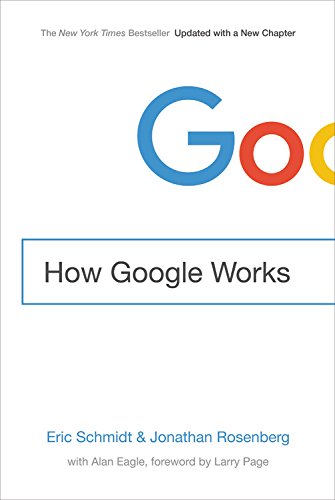
I’ve been so impressed by this organization that I’ve recently read several books written by a gaggle of Googlers. Including How Google Works by Eric Schmidt and Jonathan Rosenberg. These cats who run Google have some pretty good ideas. So I’ve stolen them. (Actually, I think they wanted me to steal them. Because they wrote a book about them. Which makes them open-source ideas, right?)


41O-nnsG5fL
How Google Works is about how Google works. And don’t be confused by the design. The book title is not Goc.

3 Ideas I stole from Google

1. Hire Smart Creatives:

Smart Creatives are people with smart, curious minds.  They are dreamers and doers. They are self-propelled. They are constantly coming up with great ideas and acting on them, with or without you. They have lots of interests. And they are hard to find.

When you find a Smart Creative, grab him or her by the intellect, and don’t let go. At my advertising and idea agency, The Weaponry this is exactly who we hire. I’m proud to say we are dense with these types.  But Smart Creatives are not just found in creative fields. They are in every industry and every category. Find them and they will transform your organization.

2. Keep your people crowded:

Most companies give their people too much space. Business space is like personal space, but at work. We mistakenly think the more business space you have the better. Organizations reward employees with more space as they become more valuable. Because the bigger the office the better, right? Google says no.

When you give your people lots of space the only time they interact with each other is in meetings and in the hallway. Google recommends keeping people close to each other so that interacting and sharing ideas is the norm, not the exception. At The Weaponry we are crowding our people together. It helps us rapidly share and build ideas. It helps build culture and camaraderie. It’s also great for sing-alongs. And I love a good sing-along.

3. Spend 80% of your time on 80% of your revenue:

Google stole this mantra from a guy named Bill Gates. The founder of Microsoft obviously knows something about macro-thinking. After all, he is the richest man in the Seattle metro area. The reason to use this 80-80 rule is that it is easy to get distracted by new ventures, experiments and pet projects.

New things are always fun and exciting. But you have to stay focused on the work that  keeps the wi-fi on. This has been especially valuable advice to The Weaponry lately. We have recently moved into new office space. And it is really easy to find cool projects to work on in the new space. But we have reminded ourselves to budget the time we spend on the space according to the 80-80 rule.

How you work

There are a lot of other great ideas in How Google Works.  But I’d like to hear from you. What is one thing that you do in your organization that you know contributes to your success?

*If you are in the market for more semi-stolen ideas please consider subscribing to this blog.

The 2 Things You Can’t Google.

Do you remember life before the internet? Back in the day, when you had a question, you just had to guess what the answer was. Or you could spend a lot of time searching for answers with primitive tools. Like books and microfiche.

Now, the detailed answers to our most random questions are literally everywhere. We have harvested all human knowledge and loaded it onto the internet like stacking hay in a barn. Anyone with a smart phone has access to that barn and all the information in it anywhere, anytime. Yes, the barn door is always open.

The Google

Today, if you have a question you simply google it. Where did Humphrey Bogart and Lauren Bacall get married? (Lucas, Ohio). What was the first interstate school district in America? (Norwich, Vermont and Hanover, New Hampshire). What is the air-speed velocity of an unladen swallow? (African or European?) Curiosity, and the ability to satisfy it, is the driving force behind Google’s success.

Curious Mind

I recently read Brian Grazer’s book, A Curious Mind. He positions himself as a modern-day Curious George (my words, not his). The Graze (my word, not his) credits his curiosity, not his creativity, as the driving force behind his Hollywood success. His curiosity lead him to interesting stories that turned into blockbuster movies like A Beautiful Mind, Backdraft, 8 Mile and The Da Vinci Code.

Curiosity also led him to push the limits of what hair gel can do. He talks about that in the book too. But you can just look at the picture below to find the answer.410161296_hr

However, one of the most interesting elements of the book was Grazer’s, statement about where Google’s supreme powers stop. He writes:

There are two things you cannot google.

  1. Answers to questions that have not been asked.
  2. New ideas.

Unasked Questions

If you are the first person to ask a question, the best search engine to find the answer is you. Don’t stop because the answer doesn’t exist. These are the most important questions to answer. And once you do, you get to pitch the answer into the haymow of knowledge to benefit the rest of humankind.

New Ideas 

You can’t google a new idea. You have to invent it. You have to do the work, the thinking, the ideation yourself. Only the human brain can come up with valuable new ideas. There will always be a great need and great value for those who can create a new idea, not simply blow the dust off of an old one.

More importantly, there are new ideas that can only be created in your mind. Yes you. The person reading this. Just like no two snowflakes are alike, no two minds are alike either. Your mind is formed by your unique combination of thoughts, perspectives, experiences, readings, learnings, language, friends, physiology and chemistry. Which means that despite the fact that there are 8 billion people on this planet, there are ideas that could only possibly come from you.

As the Founder of the advertising and idea agency, The Weaponry, I am constantly wowed by the power of the human mind. The power of the new idea. The power to create new things, new thoughts, new connections. There is so much still to come.

It is up to us to create new innovations, new stories, new humor, new lessons, new solutions to old and new problems alike. Stay curious and you will discover the new ideas yourself. Those ideas, your ideas, have the power to change the world. Which means the world may soon be googling you.