On a recent Saturday morning, I was really lazy. Like, pro-level lazy. I was lazy like a boy in an overstuffed recliner.
I got up early, as usual. I made my son Johann breakfast and made sure he had everything he needed to take the ACT’s that morning. Basically number 2 pencils. But hey…
After Johann left, my wife and I had an empty nest. Our daughter Ava was off at college. Johann was testing at school, and then would be off to practice music with his bandmates. And our youngest son, Magnus, was at a water park for the weekend with his friend Phineas and his family. I assume Ferb was there, too.
So Dawn and I were alone. And we sat in our living room and read. We read for a long time. It was great. And lazy. It felt as if we were finally recovering from our very active trip to Arizona. I hadn’t allowed myself to feel that lazy for a long time.
But then something quite predictable happened. I got itchy to do something. I had sat long enough that I was now compelled to work, to do, to be productive.
So I went outside with a rake and trimming equipment. I cleaned up, cut down and spruced up all of the beds in the back of my house. I then took 3 loads worth of yard waste to the dump.
After that, I came in the house and had a light bulb moment, which sent me on a mission to replace every burned-out light bulb I could find in the home.
Before I knew it, I had 5 hours of productive work done on the laziest Saturday in recent memory. Because for me, laziness serves as a springboard to productivity. I saturate with laziness, and then I have to do something. I lounge until I must labor. Then I labor until I must lounge. It’s a strong and satisfying approach that I recommend everyone have in their playbook.
Key Takeaway
Everyone needs a little downtime to recharge. It provides both a physical and mental reset. As soon as your batteries are fully recharged from rest, get right back to it. Then go until you need a good rest. The cycle will leave you feeling both productive and restored. That’s a win-win.
*If you know someone who could benefit from this message, please share it with them.
Recently, I was asked to speak to my son Magnus’s freshman football team the night before their last game of the season. Preparing for the talk offered an opportunity to go back in time and reflect on the feelings and thoughts I had at the end of my own freshman football season. But this time I had fewer pimples, my voice didn’t crack, and I had a much longer lens with which to view the whole experience. I wrote about the talk and what happened in The Power of Enthusiasm and Teamwork.
The major insight I gained was that my own reflection at the end of my freshman football experience created one of the most valuable experiences of my life. And it still benefits me today. (Or at least it benefitted me yesterday. It’s too early for today’s results to be tabulated.)
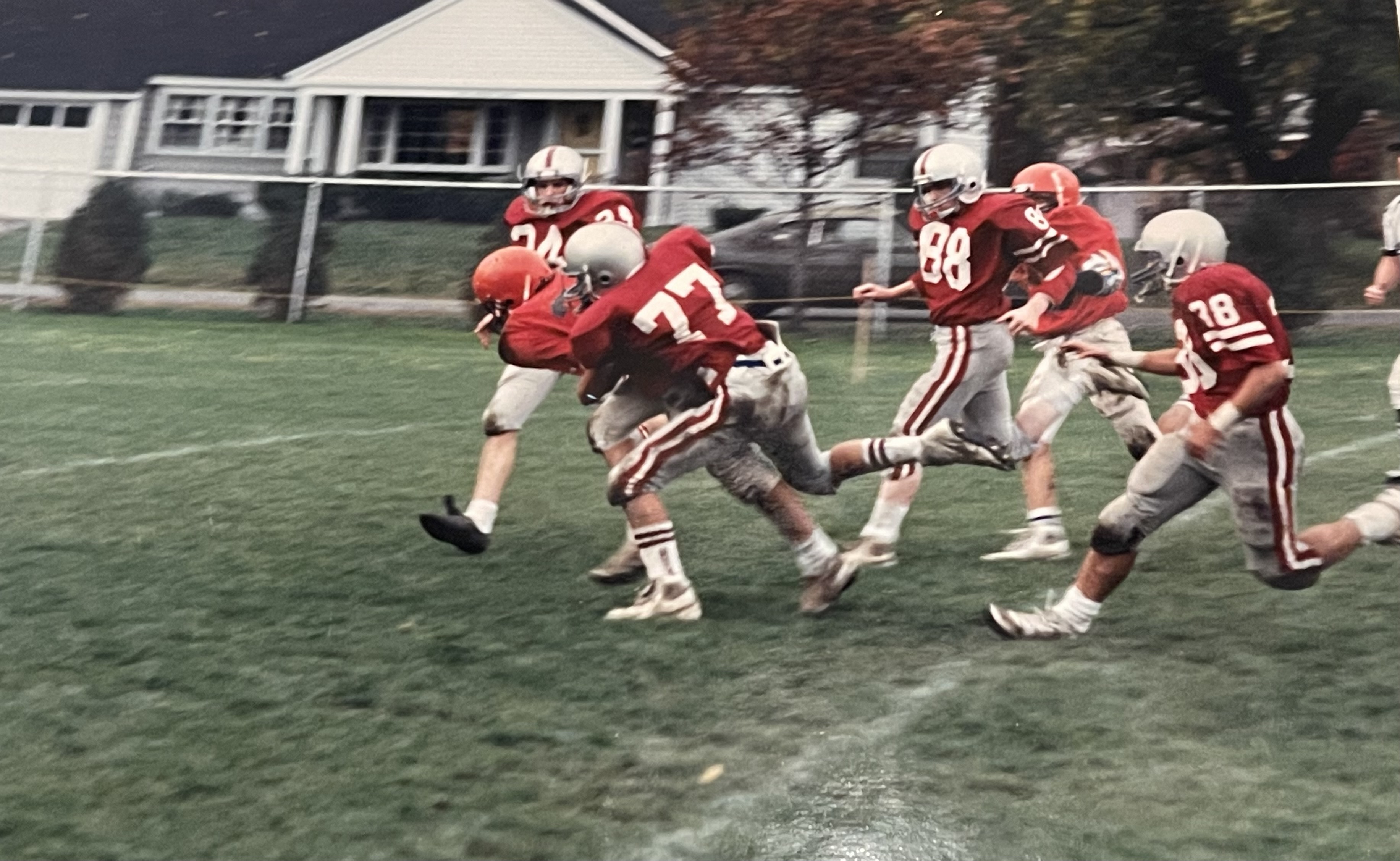
That’s me (77) making the tackle during a game my freshman year of high school. Our uniforms used to get dirty, because we played on real grass and dirt.
The Reflection On My Freshman Football Experience.
By the end of my freshman season of football at Hanover High School in Hanover, New Hampshire, I realized a few things.
First, I loved playing football.
I realized I loved the brotherhood of playing a team sport. Going into battle with a group of badass boys creates a bond. A brotherhood. An identity.
I realized we played better when we played as a team.
I realized how much practice helped. (Yes, Allen Iverson, we’re talking about practice.)
I realized that after a bad play, or a lost game, you had to learn from what you did wrong, but then put that behind you and move forward.
I learned that bringing energy to the game made a huge difference. And I run better on positive energy than negative energy.
I recognized that encouraging each other made a significant impact on our play and our relationships.
I learned that I represented my high school and my community when I wore that uniform. And I could either add to it or reduce it through my actions. (It was this 14-year-old’s first lesson in branding.)
And I realized that I needed to get stronger. There were guys who were a lot bigger and stronger than me. And while I was quick and athletic, sometimes big and strong won. And I wanted to be the bigger guy. Or at least stronger.
What Happened Next?
When my freshman football season wrapped, I was 6 feet tall and 150 pounds. The following Monday, I started lifting weights. And that simple decision, and the strong workout habit I created that year, set in motion the self-improvement journey I am still on today. (Or at least I was yesterday.)
I never got any taller. But by the start of football season my sophomore year, I weighed 170 pounds. My junior year, I weighed 190. By football season my senior year, I weighed 210 pounds. And by the time I graduated from high school, I weighed 215 pounds. I got a lot of new clothes in the process.
My first day in the weight room, I bench pressed 95 pounds. And that was really hard. But my senior year, after years of slow and steady improvement, I benched 335 pounds. It was hard to believe I was the same guy. But slow, steady actions compound in ways that are hard to imagine, unless you read the book The Tortoise And The Hare.
That’s me (78), my senior year. The weight lifting had added 60 pounds, and a lot of grip strength.
The Broader Impact.
My love for football and desire to get better didn’t just help me on the football field. The strength and conditioning that I did to get better at football helped me as a track and field athlete. (Which I chose because I was terrible at baseball.)
By my senior year, I broke 2 school records and a conference record, I was a state champion in both the shot put and the discus, I won the New England Championship in the discus twice, and I set a state record in the discus that stood for 12 years.
Discus throwing my senior year of high school.
But perhaps more importantly, I grew my personal relationships with my football teammates. We became a band of brothers. (A band with no instruments or spandex.) We went to battle together. We made it to the state semi-finals together both my junior and senior years. Both years, we came within one score of the state championship game. But that journey, even with an imperfect ending, brought us closer together. And we have great stories to share every time we are together.
Then we stood up in each other’s weddings.
And we helped each other in our careers.
When I started the advertising and ideas agency, The Weaponry, my very first client was Dan Richards, one of my football teammates from my freshman year in high school, and one of my best friends in the world. (Dan is the other guy making the tackle in the cover photo for this story.) He had also used the lessons he learned through athletics to help build an amazing business called Global Rescue, which does what the name says it does.
The relationship I developed with Dan has had a huge impact on my adult life. And it all started by being a strong, supportive, reliable teammate in football. Which made us trust each other in life and in business.
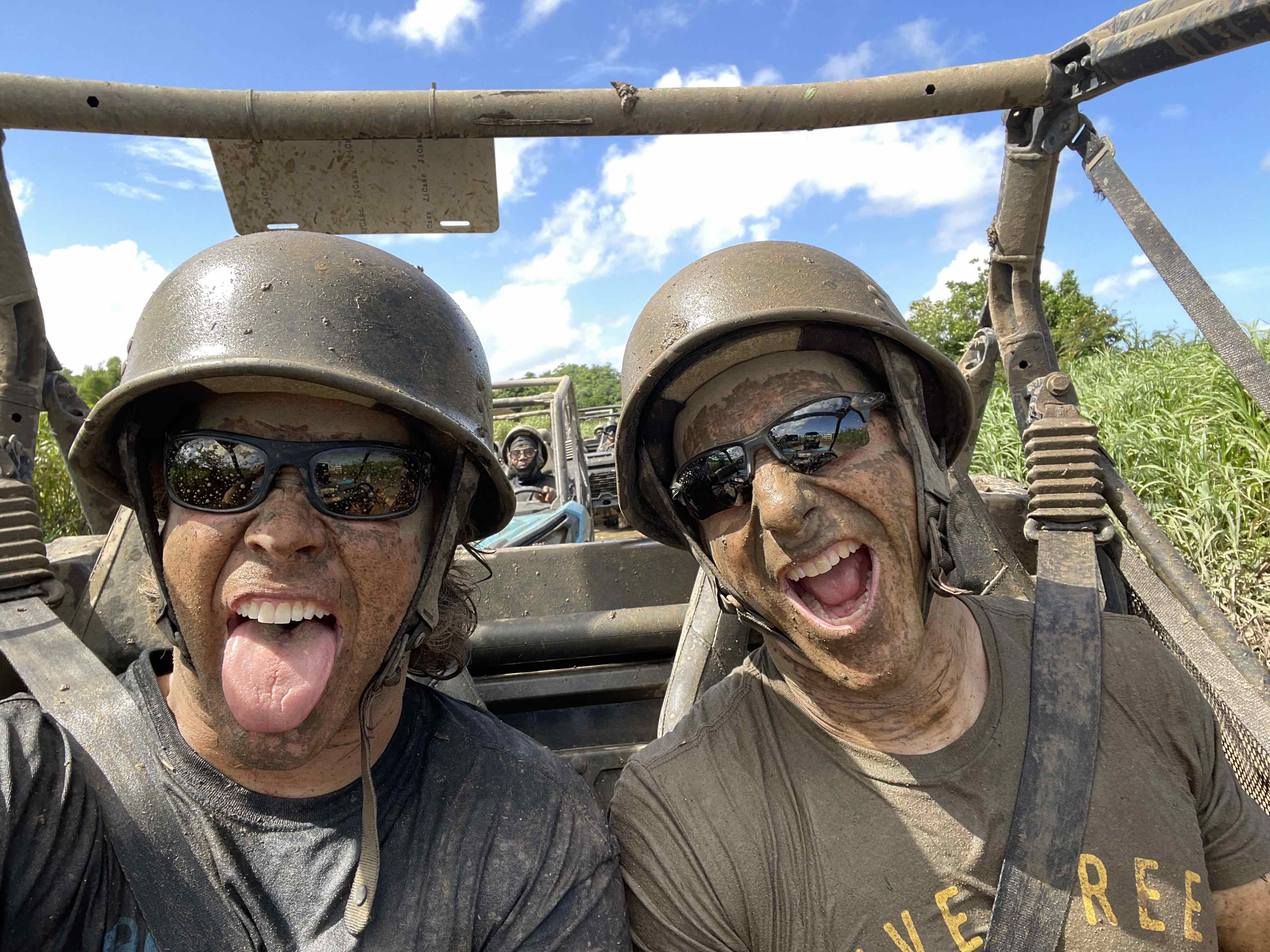
Dan Richards and I, getting muddy in Puerto Rico.
Key Takeaway
Don’t miss your great opportunities. To improve yourself. To create strong bonds and friendships. To use your drive to become better at sports or other competitions. And at life. Become a winner in your mindset first. And you will be a winner on the field and off. Use the same drive to improve in sports to win in your classwork and in your career. Bring the same relationship-building approach you bring to your team, to your family, to your friendships, coworkers, children, and spouse. And you will live a life you can be proud of, that is full of wins every day.
*If you know someone who could benefit from this message, please share it with them.
If you are not careful, your life will pass by in a flash. Your career will be over in a snap. Your kids will be grown and will have flown in a Blink-182. Because time is a crafty thief that lulls you into someday thinking. Like Sugar Ray. And then it yanks that someday away just like your prankster friend, pulling your chair away just before you’re about to sit on it, Potsy.
Milestones
One of the great ways to create a far more enjoyable and successful life and create memorable experiences is to utilize the power of milestones.
Milestones are those moments on the calendar that humans have made to mark the passage of time. Those days or events offer valuable markers for accomplishments, challenges and traditions. They are there to host rites of passage and other memory-making events. And without milestones, Hallmarkwould have a hard time selling you paper.
You know the big and obvious milestones. At Halloween, you dress up in a costume and do candy things. At Thanksgiving, you gather with family or friends, feast, and get thanky. At Christmas, you exchange gifts, eat, drink and praise Mary. At New Year’s, you celebrate and create lists of how the next 2 weeks will be different.
Deadlines and Opportunities
But milestones also create deadlines for accomplishments and opportunities for memorable experiences.
I sit down to write every morning by 6:10am. But Tuesdays and Thursdays are milestones to publish blog posts. Every 3 weeks, I publish Adam’s Good Newsletter. And every five years, I want to publish a new book. Those are all random and arbitrary deadlines. But they become useful milestones that make my elective activities time-bound. Milestones offer navigational markers on the naked landscape of time. Which ramps up your self-imposed productivity.
I had a major speaking event yesterday, and I used it as an opportunity to get in better shape. I committed to doing 30 minutes of cardio every day for 30 days leading up to the talk, so that I would look and feel more fit on stage in front of 1,000 people. (And I requested to have no cameras in the venue, because the camera adds 10 pounds.)
I always use my birthday as a motivating milestone. I’ve also used class reunions, New Year’s Eve, and the birth of my children as important starting points, end points and exclamation points.
I have used milestones to gain traction towards health and fitness goals, to measure my business success, and to create deadlines for my entrepreneurial launches. (Which are a lot less launchy than Elon Musk, Richard Branson or Jeff Bezos’ entrepreneurial launches.)
I used the end of the COVID-19 lockdown in 2020 as a milestone to finish the first draft of my manuscript for my first book, What Does Your Fortune Cookie Say? Then I used Thanksgiving of 2021 as my milestone to publish the book. I made both of those goals happen, thanks to the power of milestones. (Since then, I have learned how to write a manuscript without a worldwide pandemic.)
I use milestones to schedule big travel. For my wife Dawn’s 40th birthday, I surprised her with a trip to Europe. We scheduled a trip to Europe in the summer before my daughter Ava’s senior year of high school. We realized that the milestone provided the last summer opportunity for us to all travel together before college obligations made summer travel problematic. Using milestones is one of the best ways to visit the big places on your life-travel list. (Using airplanes is the other best way.)
I used a milestone to plan a major move. My wife and I wanted to find a place where we could settle to allow our children to finish their schooling without moving by the time my daughter Ava entered middle school. We moved from Atlanta to Mequon, Wisconsin, a large-yarded, low-taxed, great-schooled northern suburb of Milwaukee that sits on the Western shore of Lake Michigan. We called this our 13-year home. Which meant that we would stay in Milwaukee for 13 years, until we hit another major milestone: our son Magnus’s high school graduation. Then Dawn and I are free to hit the road again and take on more adventures.
Key Takeaway
Your greatest ambitions, experiences and traditions are far less likely to happen if you don’t tie them to a milestone. Use those special days to inspire your work, to create deadlines, and to force urgency. Use them to create regular events to bring your people together. Or to reset your ambitions, spark your goal setting and help you accomplish more elective activity than you could without them.
*If you know someone who could benefit from this message, please share it with them.




 Adam Albrecht Blog