How our agency overcame a Biggie Smalls experience.

It was the rapper Notorious B.I.G. who once penned that famous American quote: ‘Mo Money. Mo Problems.’ In 2018 I learned Biggie was right. Because as my young advertising and idea agency was growing at an exciting pace, we also faced mo money problems. Or was it less money problems? Maybe it depends on whether you’re more East Coast or more West Coast.

Go With The Cashflow

In 2018 The Weaponry, faced a cash flow problem. It wasn’t as if I hadn’t been warned. My posse of entrepreneurial homies, including Dan Richards of Global Rescue and Jeff Hilimire of Dragon Army, warned me that as you work with larger and larger clients they will use their financial muscle to get longer and longer payment terms. So instead of our standard 30-day terms, new clients began requesting, pushing for or demanding 45, 60 and even 90-day terms. #WhatWouldSugeKnightDo?

The 60 and 90-day terms put growing businesses like mine in a conundrum. Obviously we want to work with the biggest and best companies in the world. The problem is that while we wait to get paid for the work we have completed, we still have to pay the Weapons, vendors and freelancers who work for us. Which means that like a leaky bucket, more money is leaving the system than coming in. #DearLizaDearLiza

the-notorious-big-biggie-smalls-5-1400684427-view-1

Big Poppa

By June of 2018 we had been in business for 2 years. We could clearly feel the momentum build. There was sharp rise in the demand for our work. But with all the new work, longer payment terms, and invoices that seemed to have taken the slow boat to PayMe Town, we started carrying between $500,000 and $700,000 in our monthly accounts receivable stack.

For a business that bootstrapped its way into being just 24 months earlier this was an interesting turn of events. It is nice to be owed that kind of money. But cash is the life blood of a business. And there were serious demands on our blood supply.

We were always able to pay our salaries and all of our bills. But the depleted cash on hand meant that we weren’t able to invest in our own growth. We had started looking at space for our Columbus office in June, then hit pause on our plans to sign a lease in order give ourselves some breathing room. We waited on transitioning some of our freelance help to full-fledged Weapons. And we postponed the company offsite meeting in Monaco.

unnamed-2

It Was All A Dream.

When I shared our mounting money challenge with our team, they once again stepped up to solve the problem. Simon Harper, one of our outstanding account directors, shared how we could adjust our invoice timing to make sure we were paid by our clients sooner. Other account leads also contacted their client contacts about the outstanding bills. Which helped get the money ball rolling.

Our accountant, slash bookkeeper, slash egg dealer, Sally Bretsch, recommended another adjustment to our billing process that would ensure that our invoices got into our clients’ accounts payable systems faster, with greater accountability. Which is either totally meta or just a nice word play (Did I mention I used to read Word UP! magazine?)

From Negative To Positive (And it’s all good.)

With these team-driven enhancements in place, suddenly we dramatically decreased the turnaround time between work performed and payments received. We had our own Black Friday moment, when suddenly, following months of increased billing, but decreased cashflow, we started seeing the fruits of our labor manifest in our bank account.

Key Takeaway

Business is a team sport. As an entrepreneur, leader or department head, it’s important to understand that your team will find ways to solve problems and improve performance faster, and in better ways than you would be able to unearth on your own. Share information with your team. Make them part of the solution. If you’re thinking about starting a business, surround yourself with a strong crew who knows more about their specialties than you do. Then give them a mic and let them flow. That’s how small teams make big things happen.

The key to the Patriots’ success that most people never notice.

The New England Patriots are my favorite professional team, in any sport, hands down. Heck, I love the Patriots regardless of hand position. I have been a Pats fan since I was a boy growing up in Vermont, which for the international crowd, and the geographically challenged Americans, is one of the six states that make up New England.

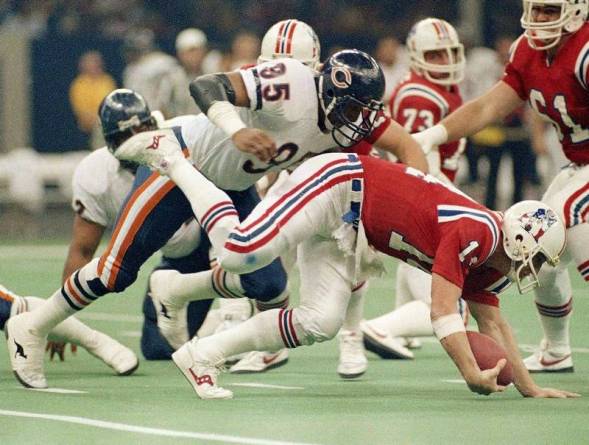
In my youth, the highlight of my Patriots fandom was the kickoff of Super Bowl XX (that’s 20 for those of you who don’t speak Roman). I was so excited and full of hope, until my Pats got refrigerated and Super Bowl Shuffled off like the Buffalo Bills by the historically impressive 1985 Chicago Bears. If that game didn’t completely break my heart, Billy Buckner finished the job just a few months later.

EP-709229792.jpg&updated=201109221639&MaxW=800&maxH=800&noborder
My Patriots took it in the worst way from the Chicago Bears in Super Bowl XX.

A Whole New World

Oh, but this is a new millennium. It has been unbelievable for Patriot fans. But completely annoying for many non-Patriotic Americans. I get that too. Because I can’t stand the New York Yankees.

Since 2001, no team in any sport has been more dominant than the Patriots. Love them or hate them, their record has been spectacular this millennium. Since 2001 they’ve played in the Super Bowl 9 times, winning 5 championships, with a chance to add another W in Super Bowl LIII.

It’s Gets Harder And Harder.

Each return trip becomes less and less likely. Because following a Super Bowl appearance, both teams are rewarded for their efforts with one of the two worst draft positions, and one of the two hardest schedules the following year. Yet here the Patriots are, once again playing for the Lombardi Trophy.

Which Begs The Question…

Just why have the Patriots been able to remain so dominant for so long in the era of the salary cap and free agency? This is an era in which it should be the hardest of all to maintain a Joan Collins-caliber dynasty.

2006-g12a-3284
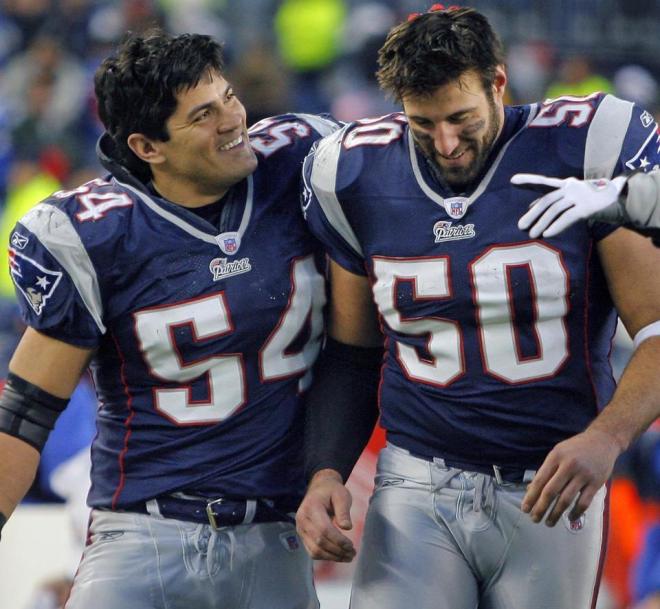
Patriot great Tedy Bruschi checking Mike Vrabel for lice.

The Harder The Problem, The Harder You Look For Solutions.

Budget limitations often encourage us to approach our challenges differently. If you really study the NFL data like Bill Belichick has, it may lead you to create an entirely new formula for success.

Belichick and Brady

In Michael Holley’s New York Times bestseller, Belichick and Brady, there is an eye-opening analysis of the economics of football. While we are often distracted by the conspicuous performances on the field, we may be missing something far more important. There is far too much emphasis put on the traditional statistics. And Bill Belichick and Scott Pioli were just the people to unearth this non-intuitive truth.

51FeEcGMjLL._SX330_BO1,204,203,200_

The following passage from the book offers one of the great aha’s of how the Patriots have accomplished so much despite the NFL’s systematically promoted parody.

We slowly accumulated winning stat guys as opposed to the high-sack, high-interception guys,” former Patriots linebacker Matt Chatham says. “Willie McGinest, Mike Vrabel. Those guys are way more valuable if they get eight sacks rather than sixteen. Dominating the edge, getting on the tight end, blowing up wide receivers and never letting them get into the pattern. That’s way more valuable than sixteen sacks.

“I think that the world thinks that the sixteen-sack guy is more valuable, but the Patriots don’t think that, and you can get into the economics of this: The sixteen-sack guy costs twice as much as the other guy. And once you get to a certain point, it’s saturation. It’s just sixteen plays and when you play five hundred snaps, it’s not that important. It just isn’t. Who are the best rerouters among outside linebackers? Who are the best edge setter? Does anyone in the media know that?”

-From Belichick and Brady by Michael Holley

gettyimages-2879250
Matt Chatham: Revealer of truth. And guy who got stuck trying to shove his arms through a little kid’s bike inner tubes.

Key Takeaway:

Know your winning stats. The winning formula isn’t always obvious. But understanding what really factors into your success gives you an edge in every endeavor. Analyze your own organization, or your own personal success. Know what works and which part of the performance may be distracting you from the things that matter most.

I hope the Patriots win the Super Bowl again this year. But even if they don’t, it sure is fun being a Pats fan. Because win or lose (and it is mostly win) they have found the winning formula to be in the mix every year.

Go Pats!

It’s time for a new office in a new city!

When I first decided to launch my own advertising agency, I had a clear vision of what the fully formed business would look like. It was spectacular, as visions should be. Because it costs just as much to envision a multi-billion dollar empire as it does to envision a lemonade stand. So you might as well envision big.

In 2015, even though my startup was still in the embryonic-stage, I was confident that great things lie ahead. I just never knew the pace at which success would unfold. But I knew, like a 2-year old in a laundry room, the unfolding was just a matter of time.

Things Started Happening

In the fall of 2015 I ran an alpha test of our minimum viable product (MVP) with our first client. The test run went as well as advertised. (#punsalwaysintended) Then, in the spring of 2016, my home office in Atlanta, where I planned every detail of the business, became The Weaponry’s first headquarters. Suddenly I was in business. And I had the best commute in Atlanta.

By the end of 2016, as part of my life design, I moved to Milwaukee. The Weaponry’s new headquarters was my new  home office. In 2017 the business was humming, we saw plenty of runway ahead, and we signed a lease on 1000 square feet of office space downtown, on the Milwaukee River (actually it was on the side of the river).

IMG_5273
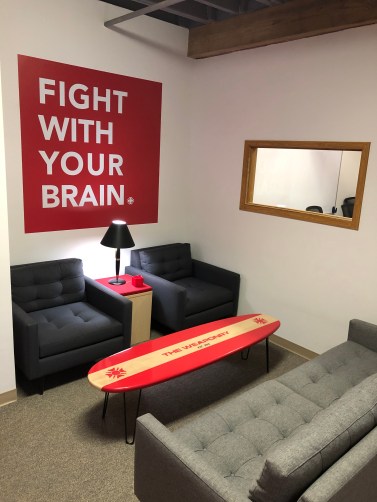
Our Milwaukee office. As they say, home is where custom designed surfboard coffee table is.

But Wait. There’s More!

I never wanted to settle for just one office. That’s why I developed my Home Office Strategy. Which means I plan to establish an office every place I’ve owned a home. This includes Milwaukee, Atlanta and Columbus. I also want an office in New England, where I grew up. So Burlington, Vermont and Boston are possibilities too.

By 2018 we had full-time employees in Milwaukee, Columbus and Atlanta. 6 months ago we started thinking about the next office. And, (drumroll app please…) we’ve decided that Columbus, Ohio will be the home of the next office of The Weaponry.

meetings_skyline_08ac1260-445a-47ce-9655-3039e6a8d6b7
Columbus, Ohio just keeps getting better.

Discovering Columbus.

Columbus, Ohio is a hidden gem. It is well stocked with a highly educated workforce. It offers an amazing quality of life. And thriving industries. We have had full-time Weapons in Columbus for well over a year. And we are eager to add more.

Back Story

I spent 7 great years in Columbus with the ad agency Engauge, before it was acquired by Publicis, and I was asked to move to the new headquarters in Atlanta. Columbus has a 3-ship flotilla of talented advertising and design professionals. And there are more great brands and smart marketers there than even John Lennon could imagine.

Getting Down To Business

Columbus is the home to well-known brands like Nationwide Insurance and Safelite Auto Glass. There are great restaurants headquartered in C-Bus, including Wendy’s, Bob Evans, White Castle, Charley’s Philly Steaks, Sbarro, Donatos and Steak Escape. There are great retail brands, including Victoria’s Secret, Bath & Body Works, Hollister, Abercrombie & Fitch, and Express. Scott’s Miracle Grow is also growing plants miraculously in Columbus. Cardinal Health, which is the 14th largest company in America is headquartered there too.

The Weaponry C-Bus

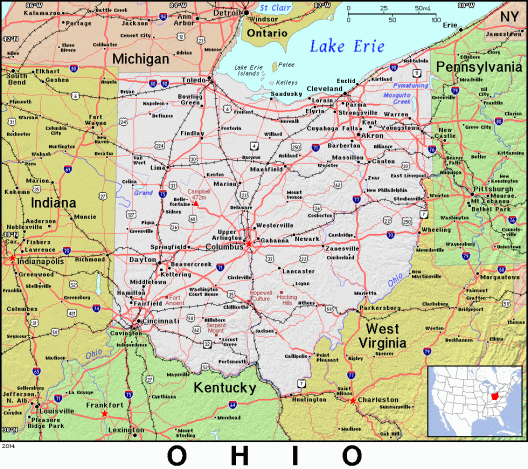
We have collected a great nucleus of talent in Columbus, including both full-time and freelance Weapons. The relatively low-cost of living and high quality of life make the city a great draw. What’s even better is that Columbus is within a 3-hour drive of Detroit, Windsor, Cleveland, Pittsburgh, Cincinnati, Lexington, Louisville and Indianapolis. Not to mention Youngstown, Akron, Canton, Dayton and Toledo (wait, I DID just mention them!) The close proximity enables us to service clients in all of those cities from our Columbus hub.

oh_blu
What is round on both ends, hi in the middle, and loaded with Weapons?

Key Takeaway

There is a lot to love about Columbus. Which is why we are excited to be opening our next office in this great city. I look forward to sharing how we’ve gone about the process of finding our new space, and why we landed where we did. If you are in Columbus and want to be part of a great team, we should talk. Because things are about to get really interesting.

Does your organization trust you to be an insider?

One of the great debates in business is about how much information we should share with our teams. There are two schools of thought:

  1. The ‘You-Can’t-Handle-The-Truth’ Community College.
  2. The ‘There’s-No-Such-Thing-As-TMI’ Prep Academy.

I have gone on recruiting trips to both campuses. They feel very different. One has a work hard, play hard vibe. The other feels like the place where the parents from Footloose went to school.

Solving For Happy

One of the key factors of employee satisfaction is feeling like you know what is happening within your organization. Employees are afraid of being left in the dark. It makes them feel like outsiders, when all they really want is to feel like insiders. #SodaPopAndPonyBoy

A lack of information sharing makes employees suspicious, and encourages them to jump to their own conclusions. In many corporate cultures conclusion jumping is like an Olympic event, and a world-class distraction.

Low Unemployment Means Higher Expectations.

Today, the labor market is tighter than a Boca Raton facelift. Which means that we have to make sure our employees feel valued and included in order to keep them engaged (I mean actively interested and invested in your company, not committed to getting married).

That’s why I believe in this simple philosophy:

Share information to show your employees that you see them as part of the solution. And not part of the problem.

IMG_6468

If You’ve Got A Problem, Yo, Let Them Solve It.

At the beginning of 2018 all of the business at my advertising and idea agency, The Weaponry, was project based. We were thrilled to have the work. And the work we performed for many of our clients was steady throughout the year. However, because we didn’t have any long-term commitments from our clients it limited our ability to plan. And it prevented us from committing to more full-time hires, which would better serve our clients.

I shared this challenge with our team at the beginning of 2018. Our account leaders took matters into their own hands. They had discussions with several of our clients who regularly engaged us for projects. They shared the merits of having a fixed plan in place, dedicated employees who accumulated knowledge on their business, and the ad agency-equivalent of rollover minutes that would never expire.

As a result, by the 3rd quarter of 2018 we had 6 retainer clients who compensated us with a fixed monthly payment. That helped make our revenue stream steadier and more predictable. It makes it easier for our clients to manage their budget. The retainer commitments have enabled us to think longer term about the work we do for our clients. And it has allowed us to invest in our team and infrastructure to better serve our clients.

Key Takeaway

People love solving problems. They love showing that they know, or can find the right answers. So share information with your team. Let them solve more of your organizations challenges by giving them more of the information they need to create great solutions. Remember, leadership will never have all of the best answers to the challenges that face an organization. It’s amazing how much faster and more intelligently you can solve an issue when all of your best minds are working on the problem.


Recognizing the tremendous value of your client ark.

In your career you will have the opportunity to work with a broad range of clients. Some will help you make a lot of money. Some will help you make a little money. Some will help you grow old friendships. Some will help you make new friendships. Some will be strictly business. And some will be a party. Some will enable you to do great work. Some will help you make a difference. Some will build your confidence. Some will test your limits. Some will cost you money. Some you will love. And some, you will wish you never met. But if you pay attention, they will all help you grow smarter, stronger and more capable. So on the toughest days with the toughest clients, and the best days with the best clients, don’t forget to learn.

A better way to measure business success.

This week marks the beginning of the 22nd year of my advertising career. Over the past 22 years I have worked for an agency owned by private equity, an agency owned by a public holding company, and an agency that was privately held. I have learned a lot along the way. In 2016 I launched my own ad agency called The Weaponry. And I’m trying to apply all I have learned to make this bird fly.

Private Equity Goals

When I worked for the advertising agency owned by private equity, its main focus was growing to sell. A funny thing happens when you want to grow to sell your company. Especially when your investment clock is ticking, and you want to sell within the next 24 months or less.

You become hyper-focussed on revenue growth. When you obsess over revenue growth, you want to add business as quickly as you can. The quality of the work, the fit, the preparedness or the organization to take on the new work, and both the quality and the timeliness of the work flies out the window. Because short-term growth makes you do funny things.

Public Company Goals

Eventually that agency was bought by a large publicly held company. And the focus of the business changed. The new organization wasn’t obsessed with revenue growth. They were focused on margin growth. They wanted to make sure that we were making healthy profits on everything we did. They were constantly looking for ways to increase that margin.

The agency cut or discarded clients that didn’t offer the margin needed to sustain the infrastructure of a large, publicly held agency. As a result, they made decisions that were based on the target margin number of the day (that’s english for du jour). We walked away from clients who were facing some short-term challenges. We discarded several clients that had great long-term potential. Because the company was focused on meeting margins for the next quarter.

Family Business Goals

I recently worked with a company that had a very different way to think about their business growth. The organization was owned by a successful and impressive family. The key shareholders are not outside investors. They are family members. As a result, the most important measurement they focus on is generational growth. They ask deeper, more important questions, like How can we grow a healthy organization that can sustain generations of positive growth?’ And ‘Who let the dogs out?’

They certainly want good revenue. They also want a good margin. But they play the long game in every decision they make. As a result, they don’t grow faster than they can maintain a high quality of delivery. They don’t cut clients because they don’t live up to today’s margin standards. They are flexible and understanding of their clients’ challenges. That builds trust and loyalty. And long-term relationships. All of this has helped build both revenue and margin. And a long runway for growth for years to come.

Key Takeaway

Revenue and margin are important to a business. But we should never forget that they are results of how we run our organizations, and the hundreds of decisions we make along the way. When you think about your business in terms of generational growth, you will make better decisions for the long haul. You will build relationships that get you through hard times. And you will build something that lasts long after you are gone.

There is the easy way, and the Rube Goldberg way.

My daughter Ava is a good student. She just finished 6th grade and her report cards always look like they have my initials all over them. She is a self-starter and a self-finisher. Which means that while I would like to be more involved with her academics, she usually doesn’t need my help.

Final Project

Her final science project of the year finally gave me a chance to get involved. The assignment was to build a Rube Goldberg Machine that incorporated at least four simple machines (#physicstalk).

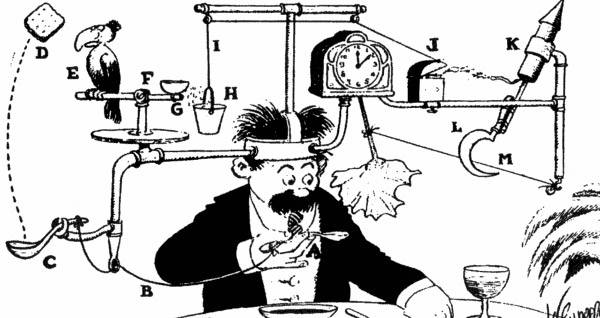
For those of you who aren’t down with RGM, a Rube Goldberg Machine is a machine, device or thingy that uses a chain reaction to perform a very simple task in a very complicated way. I love this kind of project. It combines science, creativity and whimsy (Did I mention that in college I majored in whimsy?)

IMG_0527
Ava’s machine mid-project, featuring ramps, teeter totters, ropes, roller skates, dominos and ping-pong balls. The yard is littered with discarded parts, thrown in frustration.

The Big Question

The project was a mixture of problem solving fun and you-have-got-to-be-kidding-me frustration. But helping Ava with her RGM set off a series of linked thoughts in my head. My Father Brain nudged my Business-Owner Brain which produced the question:

Are organizations unintentionally creating Rube Goldberg Machines to do what should be done easily?

It shouldn’t be that hard.

Most organizations develop processes and procedures, whether officially or by default, that are way too complicated. What should take a one person a few minutes to complete turns into a complicated chain of events, with too many sign-offs, too many check-ins, too much standing in line, too much discussing and not enough doing.

Check yourself before your wreck yourself.

Chances are that you have an RGM in your organization.  But instead of being whimsical and entertaining, it wastes time, adds costs and has a negative impact on customer service.

If you notice an overly complicated process within your organization, or in your interactions with your partners, vendors or clients, let them know. Businesses need this kind of feedback. Because it is really easy to make an easy task difficult.

Taking a fresh look.

When I started the advertising and idea agency, The Weaponry, I reveled in the opportunity to make our processes simple. I also have a long-term vision of the business that should help us avoid unnecessary complexities. But we are not perfect. We will also require regular evaluations and feedback from our team, partners and clients to make sure we are not complicating what should not be complicated.

Key Takeaway

Rube Goldberg Machines offer good opportunities to teach children about physics. They offer great entertainment. In fact, I would subscribe to The Rube Goldberg Machine channel if such a thing existed. But within organizations, let’s not overcomplicate. Let’s always look for ways to de-complicate our processes and procedures to make sure we are not wasting time or money.

In case you were wondering…

*I envisioned Ava creating a small contraption on a table in our basement. But that’s not Ava’s style. She created a large machine in our driveway, despite the fact that she would have to set it all up and take it all down every day until she completed the project.  She finally completed a successful run at 8pm on my birthday. Which meant that my birthday was spent doing a lot more tweaking of components than celebrating me. But that’s what parents do.

How to think about meetings like a NASCAR team.

Most businesses have way too many meetings. They last too long. They have too many participants. And they are held in conference rooms with chairs that are too comfortable. Too often our days are defined by these meetings, rather than by the stretches of non-meetingness when the real work gets done.

NASCAR

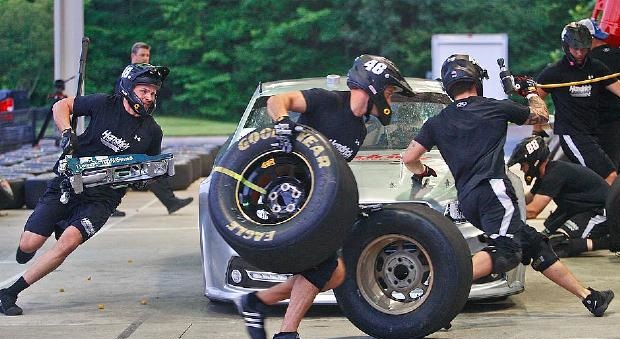
If you want to solve this problem in your organization, watch more NASCAR. Scratch that. Find yourself a NASCAR Pit Crew Meeting Mentor. In a NASCAR race, the goal is to get to the finish line before anyone else. The more time a driver spends driving the car as fast as he or she can, the better. Calling the driver to a meeting during a race sounds crazy, right? But that’s exactly what happens.

The Meetings

In every NASCAR race, the driver will pull into the pits, and a company meeting breaks out. Attendees typically include the driver, the Gas Man (#snickering), The Jack Man, A couple of Tire Jockeys, and maybe someone to extend some fresh beef jerky to the driver.  If you watch a full race you’ll pick up on a few key meeting tips that you can put to work in your place of business.


 5 Meeting Tips You Can Learn From A NASCAR Pit Crew.

  1. Go into each meeting with a clear, concise agenda. If you don’t have a clear agenda, clear the meeting off your schedule.
  2. Only invite critical team members. Which means Barney from accounting will be invited to as many meetings this year as he was invited to parties in college.
  3. Meet as quickly as possible and get out. Time your meetings with a stopwatch, not an hourglass.
  4. Meet as infrequently as possible.  The more time you spend working alone the better. Just like that business trip when you forgot your deodorant.
  5. The longest team meetings should be in the winner’s circle.  And everyone should be wearing confetti and a fizzy beverage.

Key Takeaway

Meetings are occasionally necessary. When they are, think like a pit crew. Plan the meeting ahead of time. Know how many people need to jump over the wall, and how many tires they should bring. Always make the meetings short and sweet. It’s the best way to ensure you and your team will accomplish more of your long-term goals.

This is where I encourage you to pitch your elevator pitch.

In 2015 I decided to launch a new advertising agency. I already had a vivid image of the agency in my head. So I began mapping, sketching and listing every detail of the company. I considered the business from every angle. I even created a Life Stage chart of the yet unborn business. It was like What to Expect When You Are Expecting. Except I was expecting a bouncing baby business.

The Elevator Pitch 

However, there was one detail that start-ups typically obsess over that I skipped entirely: the Elevator Pitch. It is supposed to be the centerpiece of a startup’s marketing efforts. If you’ve never heard of an elevator pitch, the idea is that you have to summarize the essence of who you are, and what you do, in a short statement that you could deliver to a captive hostage on a brief elevator ride. Apparently, lots of entrepreneurs stalk high-powered executives on elevators, thinking it would be a great strategy for winning their affection.

I’m not buying it.

I hate the whole concept of the elevator pitch. I think it is the most overrated, over-discussed element of salesmanship. And entrepreneurship. And elevatorship.

Sure, it is important to be able to succinctly talk about your business. Your Great Aunt Petunia doesn’t have enough time left on Earth to waste it on your full story. But I have never bought anything or hired anyone because of a brief discussion I had on an elevator, escalator or Wonk-avator.

In fact, I have been in business for two years. And not once have I found myself in an elevator with someone who told me I had 10 floors of verticality to perform the sales pitch of a lifetime.

My Approach

Instead of scripting and performing an elevator monologue to an audience that never shows up, which feels a little like writing an acceptance speech for an award you didn’t win, I take the opposite approach.

The Quiet Game

I play the quiet game. You know, it’s that game where you see how long you can go without talking. I was terrible at the Quiet Game as a child. Scratch that. I was the Cleveland Browns of The Quiet Game. But today, as an entrepreneur, I am quite good at it. When I meet a marketer, I don’t whip out a polished sales pitch and throw it at her. Instead, I listen.

I want to hear what potential clients talk about. I want to hear what challenges they are facing. I want to know where their pain points are. I want to identify their greatest unmet needs. I continue to grow and transform The Weaponry in response to the unmet needs of our clients. Because we are focused on solving client problems, we grow in the direction that our clients’ needs dictate.

Key Takeaway

If you want to collect more great clients and grow your business, don’t practice your elevator pitch. Practice listening. Play detective. Or doctor. Listen for the discomfort, the bottlenecks, and the solution-less problems your clients and potential clients are facing.  Discover their unmet needs. And you’ll have found your next opportunity.

*If you found anything of value in this post, please consider subscribing to this blog. You’ll receive two fresh-baked posts via email each week. Oh, and you may also dig this post I wrote about My Vanilla Ice Philosophy. Vanilla Ice himself liked it. And Tweeted it. And hung it above his bed (ok, that very last part might not be true).


Our time here is short. Make the most of it, like Steven did.

The best part of business is the people. I didn’t know that when I started my career. But over the past two decades I have discovered that businesses aren’t just powerful economic engines. They are the primary source of social interactions among adults.  The workplace is dramatically undervalued as a matchmaker of friends, mentors, collaborators and life partners. In fact, I met my wife, Dawn, at work.

Steven Schreibman

On Mother’s Day I got a shocking text from my close friend, Jennifer Hanley, whom I first met when she became a client of mine in 2008. She had bad news. My friend and former client, Steven Schreibman, had passed away the day before. This was totally unexpected. He recently began experiencing severe headaches. Then, on May 7th, he suffered a fall that resulted in a brain injury. He never regained consciousness.

I am truly blessed to have known Steven. But we would have never met had it not been for business. Steven was a fancy pants marketing lead at Nationwide Insurance. I was the creative lead at one of Nationwide’s advertising agencies. And we became fast friends.

The Legend

Steven’s reputation preceded him. My coworkers would come back from meetings with Nationwide telling stories of this wild, rogue client. I couldn’t wait to meet this mythical marketing creature.

He didn’t disappoint. In fact, Steven Schreibman was such a fantastic character, that even though I am only halfway through my advertising career expectancy, I am declaring that I will never encounter another client or coworker that is more spectacularly unique than Steven.

IMG_1191
During an all night shoot in LA, we snuck into a diner for the best peanut butter chocolate shake I’ve ever had. I think Steven (back-row middle) had a Burberry Shake.

Today I am reflecting on Steven’s impact on my life. My last 10 years have been much more flavorful thanks to Steven. Here are four of the many things I will never forget about him.

The Steven Schreibman Top 4 List.

1. His Laugh

I love to laugh. But Steven’s laugh made me look like the farmer in American Gothic.  His laugh felt like the essence of life itself. His laugh was big and loud, like an alarm. And it never contained an ounce of restraint. Nor did it adhere to any social norms. I would have loved to have gone to church or synagogue or a library with Steven just to see if he could actually put a lid on his impulse to laugh without a hint of inhibition at the hilarity of the world. We should all live and laugh like that.

2. He cared.

Steven engaged with people as if he were a talk show host. Which is probably the job he should have had. In fact, I hope he gets that gig in Heaven. Because me and St. Peter would watch the Steven Schreibman Show every night.

2010-04-07 17.24.22.jpg
Welcome back to the Tonight Show. I’m Steven Schreibman. And you are not. BWAHAHAHA!

Steven always showed a genuine interest in my life. He was full of questions and remembered everything I ever told him. When we first began working together, my family was small and growing. I have three blonde haired, blue-eyed kids named Ava, Johann and Magnus. Steven would always ask me, ‘How is your little Aryan race coming along?’ I laugh out loud when I think about how completely inappropriate he was, even as he demonstrated how much he cared about me and my family.

3. He Was Eternally Optimistic

Steven was a great client to present creative ideas to, because he recognized the potential in every idea. This is an extremely rare and valuable skill. Everything was Fabulous and Brilliant and Amazing. He loved pushing each idea to see how far it could go. He loved making things bigger, wilder and more attention-getting. He loved making ideas more memorable, and less like everything else. He could have taught a class on getting the most value out of a creative idea. He also could have been the class clown in that very same course.

tonight-show
This is a very bad picture from a very interesting night. While out in LA on a shoot, Matt Haritan (far right) and I had the idea to go to a taping of the Tonight Show. Not only did we go to a taping, afterwards we got invited back stage, on stage and even staged a coup d’etat on Jay Leno’s couch. Steven (third from the left) loved this kinda stuff.

4. He Was Entertaining

Steven was outlandish, and over-the-top, all of the time. His personality was completely incongruent with that of a large, conservative insurance company. But Steven reveled in being the pot stirrer. He understood his role as the person who could balance out a conservative corporate culture with his total irreverence for all things conservative.

The Master of Shock Value

We should all have a friend who is as endlessly entertaining as Steven was. He was so funny, and so outlandishly unpredictable, that you just wanted to be around him to see and hear what he would do next. There were no ordinary conversations with Steven. I think it would have been a violation of his personal brand to give you a straight answer. Every conversation with Steven was like a box of Cracker Jacks. And I looked forward to the joke, the surprise, or the shocking commentary that was tucked into every exchange.

My First Impression

I first met Steven on a Nationwide commercial shoot, on a 100 degree day in North Carolina. His face was lathered in sunscreen that was barely rubbed in. Which meant that he looked ridiculous. And he loved it. He kept asking if there was something on his face, and he acted oblivious to the white creamy mess he wore like Halloween makeup, just to get a reaction.

IMG_1846
This is from Steven’s going away party when he left Nationwide. Clearly it was significantly retouched. Because he did not have red hands.

The Shirt Incident

One of my favorite Steven memories was from his birthday in 2009. We had a meeting together, and I wore a wild paisley shirt. When the SS waltzed into the meeting he was wearing the exact same shirt! When he spotted me wearing his birthday shirt, his jaw dropped, and he exclaimed, ‘Oh. My. Gawd!  We HAVE to sit next to each other!!!!’ So we did. The rest of the meeting felt like a Saturday Night Live skit. It was all just too ridiculous to take anything seriously. As I think about Steven now, I immediate go back to that meeting. We looked like twin clowns. And we loved every minute of it.

dsc07453-e1274843083156
Steven reacting to a production assistant on a shoot who warned him to be careful on the stairs.

This Blog

Steven was the most engaged reader of this blog. Literally. The insights page on The Perfect Agency Project show that he has provided the most comments on this blog, by far. In fact, Steven has 33% more comments than the next most prolific commenter. This blog will miss him.

Conclusion

I love characters. And Steven was one of the greatest characters I’ve ever known. My conversations with Steven were more provocative and entertaining than the Howard Stern show. Always hilarious. Always inappropriate. And never a bit predictable.

Steven was indeed larger than life. And to those of us whose lives he touched, he is larger than death. Nothing can undo the impact you’ve had on all of us Steven. We will miss you greatly. I can’t wait to hear your laugh again on the other side.

*If you know a friend or family member of Steven’s, please consider sharing this post with them.