We’re all experiencing some crazy right now. But if your biggest challenge is that your kids are home from school, demanding fruit snacks, and TikTok-ing around the clock, you are dealing with a great kind of crazy. Enjoy it.
Business Crazy
Unfortunately, many business owners and leaders are dealing with a more challenging kind of crazy right now. For many, everything has gone off script. And now they have to figure out what to do next. Kind of like the fake wrestler who gets hit in their real face, with a real medal folding chair, and it really hurts. But the show must go on.
Right now leadership is all improv, all the time. In many industries business and revenue have been shut off like a water faucet. In times like this, entrepreneurship feels a lot less sexy, and I know it.
Decision Making
If you own a business, or are part of an organization’s leadership team, you are likely facing some very challenging decisions in the immediate future, or as part of your early planning for worst case scenarios (not to be confused with wurst casing scenarios at the sausage factory).
In your war room you will weigh the pros and cons of various decisions. You will model and remodel. You will debate and disagree. And none of it will be easy.
But before you make any final decisions, remember this:
A business leader’s primary responsibility is to make sure the business survives forever.
Key Takeaway
Do what you have to do to keep the business going. The difficult decisions you make now will ensure that once the current climate changes you will once again be able to provide great opportunities for great people and great partners.
*If you know a business leader facing difficult decisions right now, please share this with them.
I love books. They are like fertilizer for your brain. I like to read them and listen to them. I like to collect books and display them throughout my house. I like books that educate, inspire and entertain. And I just finished a great book that did all 3 of those things in one handy-dandy, hard-covered, Amazon-Prime-delivered package.
The 5-Day Turnaround
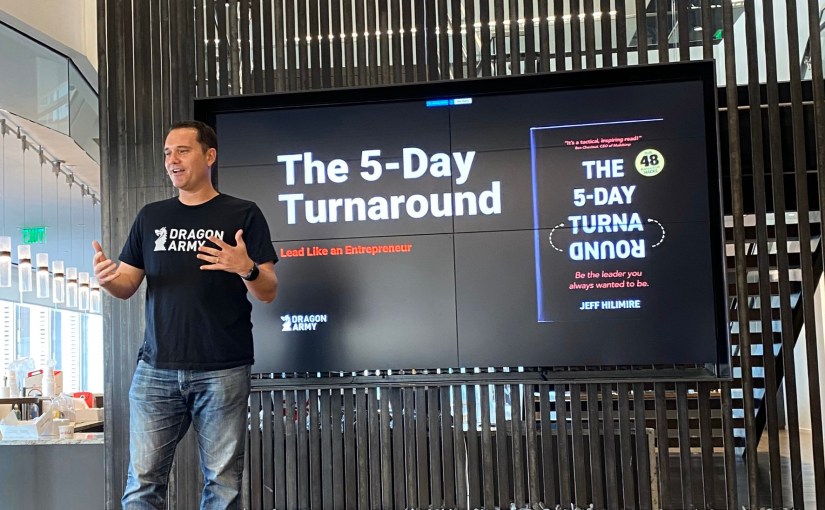
My great friend, former co-worker and serial (not cereal) entrepreneur, Jeff Hilimire, somehow stole enough time from his crowded calendar to author a book called The 5-Day Turnaround.
I’ll admit that when I first heard the title of the book I was quite skeptical. I mean, who needs 5 days to turn all the way around? I think the Earth itself only needs like 2 or 3 days to turn around, right?
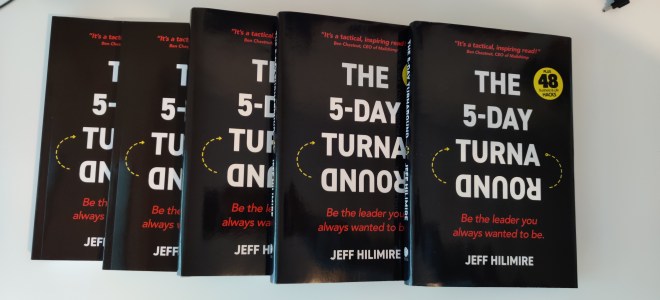
Five copies of The 5 Day Turnaround at Five Guys at 5:00 pm.
The Book
When I dug into the book I realized it wasn’t about slow-turning humans after all. It was about how to inspire established companies to think more like startups. And how to get corporate leaders to think and behave more like entrepreneurs.
I found this book fascinating. And highly relatable. Because 4 years ago I went from a very large, publicly held organization to a startup. My own startup. And as I launched my advertising and idea agency, The Weaponry, I noticed how different the 2 organizations were in their approach to, well, approaching things.
Comparing and Contrasting
The 5-Day Turnaround captures the mindset, speed and aggressiveness embodied in a startup, and contrasts it with the cautious, conservative nature of a well established company. The book is written as a fictional novel. Which means that the reader follows the story, and through ahh-smosis, picks up on all the important lessons learned by the story’s floundering corporate character, Matt.
The Pitch. And The Proposal.
The book really kicks into action after an ad agency pitch, when the potential client (Matt), tells the agency that they didn’t win the pitch because their ideas were so good and innovative that the conservative corporation didn’t have the chutzpah to implement them. Which meant the company was likely to choose a lamer agency instead.
However, the agency’s leader, Will, comes up with a daring plan to help Matt transform from a beaten down corporate dog into a daring, entrepreneurial leader within his large organization.
The story is a bit like the Fairy Godmother turning Cinderella into the belle of the ball. Only Cinderella was a cautious middle manager, who became an aggressive, entrepreneurial executive. And in this story Cinderella kept both of his Allen Edmonds wingtips on as he headed for home, at midnight, in his Tesla.
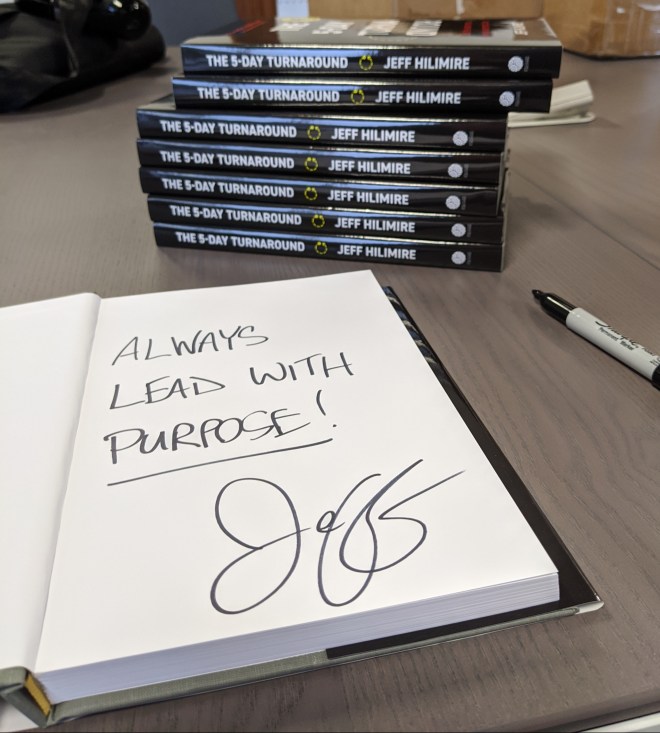
At first I thought this said, ‘Always Lead White Porpoise!’ But it doesn’t.
The Lessons
The book is packed with relatable organization challenges. And Will teaches Matt how to overcome them all in just 5 days. Will does this using foundational fundamentals that help organizations and departments grow at startup speed. Which is only slightly slower than ludicrous speed. #wevegoneplaid
The book challenges the assumption that bad things will happen if you take a risk within a large organization. It walks through a worst case scenario to dispel the myth that bad things happen to people who stick their necks out. It encourages readers to become fearless in their thinking and actions. Which is a lesson that benefits everyone.
You Down With PVTV? (yeah you know me!)
The book walks through the importance of establishing your Purpose, Vision, Tenets and Values (PVTV). Which sounds like the local station in the Portland-Vancouver, WA metro area. It even guides you through a process to determine the PVTV for your organization or department. This alone is worth the read.
The book covers such important topics as:
The Do Or Die Mindset
Identifying the right and and wrong people for your organization, based on the PVTV. (I want my PVTV!)
Moving Faster.
Establishing Trust
Embracing Failure.
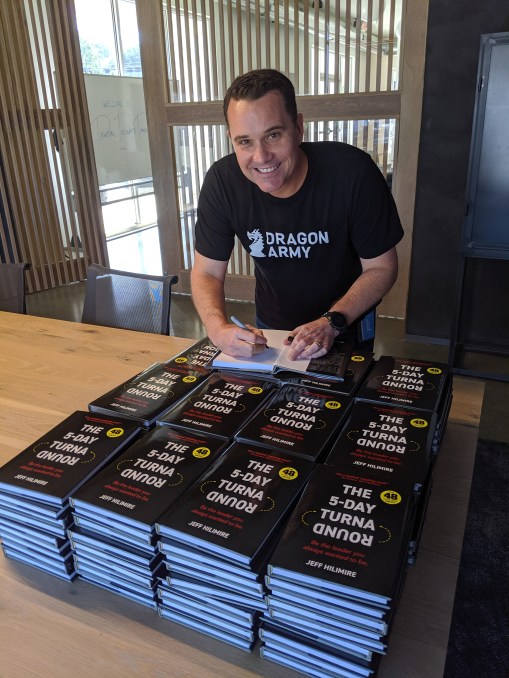
Here’s a great picture of Jeff and a whole pile of books he birthed himself. But I am fixated on the sign in the background that says, ‘Welcome to Igital Elights Anis.’
Who Is It For?
This book is great for any leader interested in thinking and acting more like an entrepreneur, even if you never plan to start your own business. The entrepreneurial mindset is confident, inspired and fast-acting (like Tinactin). Which leads to more success, because it creates more opportunities for success.
The 5-Day Turnaround is not just a book you read once. It becomes an easy-to-use reference book that you can pick up anytime for a quick hit of inspiration. It provides a series of valuable guideposts to keep you on course. Plus, it is a quick, easy and engaging read that flies by, allowing you to digest a lot of new information in a short time.
Personal Experience
I found a couple of other fun things in this book. A crazy, risk-taking example Jeff mentions in the book was inspired by a meeting Jeff and I had at Proctor & Gamble, that involved a surprise performance from an opera singer. It was weird, and fun, and memorable. #TakingRisks
Pleasant Surprise
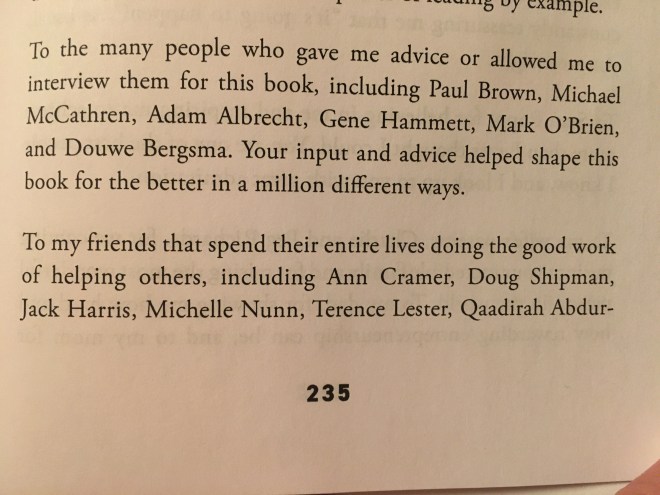
One of the really fun surprises at the end of this great read was that I found my name in the acknowledgements section. It was the first time I remember receiving a literary shout out. I think the major contribution I provided was simply encouraging Jeff to write the book in English, and number the pages, in order, starting with the smallest numbers.
Don’t bail on this book before page 235. Or page 236 if you want to know what Qaadirah’s full last name is.
Thank You!
Thank for writing The 5-Day Turnaround Jeff. Thanks for sharing your insights, experiences and talent with the world. You have been a positive and motivational, and inspiration force for me and so many others. Now, you have inspired me to want to write my own book. I’m thinking of calling it The 4-Day Turnaround. Or maybe 6-Minute Abs.
*If you know someone who could benefit from this book, please share this post with them.
I was recently invited to speak at a Metro Milwaukee Chamber of Commerce event about storytelling. As the 3rd of 3 speakers on the same topic of storytelling, I knew I better take a unique angle on the topic in order to cover some new ground. I reframed storytelling in a different, perhaps more approachable or understandable context for business owners, small marketing teams and generalists. Here is the story I presented.
The Story on Storytelling
I have spent over 2 decades in marketing and advertising. About 10 years ago people started talking about ‘Storytelling’ like it was the hot new thing in marketing communications. But as the author of 23 years of ad campaigns and marketing programs, I’ll tell you that I don’t think about marketing in terms of storytelling.
The term ‘storytelling’ is weird for adults. If conjures images of fairytales, campfires, ghost stories, and once-upon-a-time-ness. It can be hard to connect the dots back to business and marketing. Unless, of course, you are Mother Goose, work at Disney, or are one of the Brothers Grimm.
This is the kind of image the word ‘storytelling’ often conjures. And it is not very businessy. Unless you are in a really weird business.
Reframing Storytelling
If you are struggling with the idea of incorporating storytelling into your work, I want you to think about storytelling another way. I want you to think of business-related storytelling as Recruiting. Because marketing, advertising and sales is really just recruiting:
Recruiting customers to your store, show or restaurant.
Recruiting shoppers to your shelf.
Recruiting clients to your firm or agency.
Recruiting voters to the polls to vote for you or your agenda.
Recruiting attendees to an event.
Recruiting employees to work for you.
Where I learned this
Let’s go back in time to where I learned about marketing as recruiting. It wasn’t at my first advertising job. Or in my college classes. I learned about selling, marketing and advertising from an unexpected teacher: my college track coach.
Mark Napier
Mark Napier, my coach at the University of Wisconsin, was a great track coach. But Mark Napier, was a world class recruiter. To be successful in college athletics you need to be able to recruit great athletic talent. And Coach Napes was masterful at it.
I have bachelor’s degrees in both journalism and psychology. But I earned a master’s degree in selling by studying how Professor Napier recruited. (He wasn’t really a professor. He didn’t even own any elbow patches).
The Essential Recruiting Technique
You know how Napes recruited top track and field athletes from across the country, the Caribbean, and Europe to come to Wisconsin? Where it snows from October through May?
He told stories. Stories that sold people. The most important lesson I learned from Napes was, know your audience. What do they want? What do they need? Because if you know what they want and what they need you know what to tell them to sell them.
It’s not you. It’s them.
But remember, don’t tell the story you want to tell. It is all about the story they want to hear. When it came to recruiting high school track and field athletes there were many different wants and needs. You had to do your homework to understand their hot buttons. You have to do your own research. You have to observe the athlete. Ask questions. And listen to what they say.
I helped Coach Napes recruit my teammate Jeremy ‘Shakes’ Fischer, from Los Angeles. Shakes was a 7’4″ high jumper in high school. He is now one of the world’s best jump coaches.
The Prospective College Athlete Hot Buttons May Include:
Academic quality and reputation
Facilities
Proximity to home
The athletic program
Proximity to Aunt Deanie (my Aunt Deanie lived in Madison and was a draw for me. But many other kids have their own version of Aunt Deanie).
The town itself
National reputation
School size
Proximity to stupid high school girlfriends or boyfriends.
A particular major or program
Family tradition
The conference you compete in.
Good looking girls
Spring training trips
Travel schedule
The coaches track record of success
Ass-Kicking-Ness (You can tell this by smelling their shoes)
Someone just like them in the program
Acceptance/Belonging
I recruited Napes to have dinner with me in Punta Gorda, Florida.
Pushing The Hot Button
Coach Napes was masterful at discovering the hot buttons of each athlete we were recruiting, and telling them the story they wanted to hear. Or demonstrating it. Or making them experience it.
The Results
As a result were able to successfully recruit national champions from Southern California and from Florida to join our track team in Madison, Wisconsin.
In fact, my junior and senior years we were Big 10 Champions in both indoor and outdoor track. My senior year our team was 6th in the nation. I had 6 teammates who were Division 1 National Champs in their events.
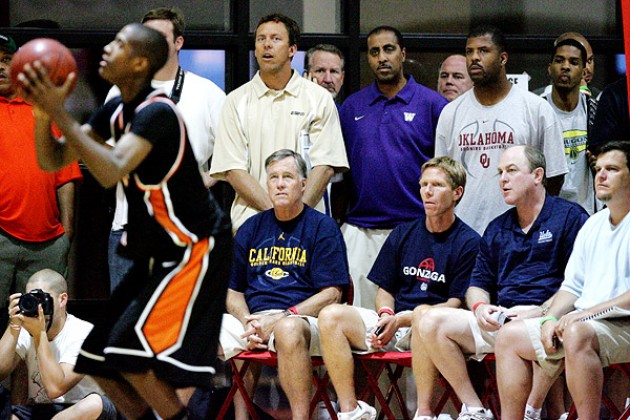
A bunch of college basketball coaches, all trying to figure out what they are going to tell some 17- year old kid to make him want to come to their school. #UmmWeHaveGreatPizza
Putting Recruiting To Work At Work
You can use the same approach to recruiting in your business. I want you to think of yourself like a Division 1 coach who is trying to attract 5 Star Recruits. For those of you who are sports illiterates, that means you are coaching at the highest level, and recruiting the very best athletes.
Departments or roles that should be recruiting for you:
Advertising
Marketing
Sales
Human Resources
We All Have Needs
It all starts with understanding your potential customer’s wants and needs. Know this and you will know what story to tell. Because in business the only thing that matters is what your audience wants or needs. And whether they think they can get it from you.
I recruit to my team at The Weaponry by telling people they will smile a lot at work.
This is where the story starts.
Create a persona of the target audience you want to recruit. Understand them in detail.
Age
Occupation
Education
Geography
Hot Buttons
Pain points
Needs
Wants
Once you know who you are trying to reach, you talk to them about the things they want to hear.
Price
Quality
Value
Style
Quantity
Fun
Innovation
Service
Community Member
Organic
Cool Kids
Smarter
Money Making
Satisfaction
Track record of Success
Happy Customers
Ease of Use
Strategy
Find the most compelling story you can tell to make people buy into you and your offering. That is your strategy. Then tell the stories that make you appear more attractive to those you are trying to recruit.
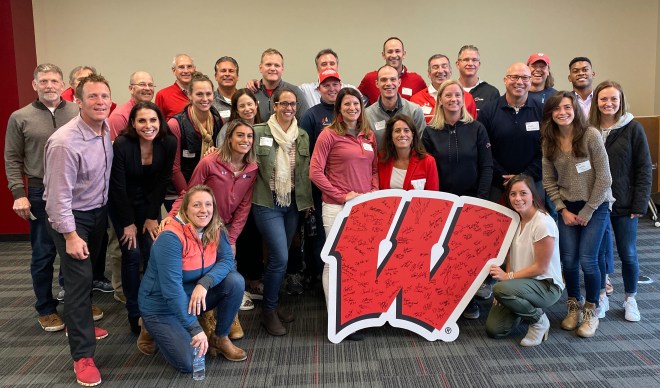
I still hang with a bunch of impressive Badgers who apply what they learned about college recruiting in their professional careers.
Key Takeaways:
Storytelling in business is simply recruiting. It is sharing the great things about you, your organization, your products, and your services, with those you want to attract. Know your audience and what they want. And then show and tell them how you can deliver against their wants and needs. The End.
*If you know someone who could benefit from this story, please share it with them.
I often talk about work at home. I want my 3 children to learn as much about business and entrepreneurship as possible. In the same way languages are easier to learn when you are younger, good business lessons are easier to learn before you become a cog in a machine. I learned that from reading Rich Dad. Poor Dad. And from becoming a cog in a machine.
The Proposal Parade
My advertising and idea agency, The Weaponry, has been writing a lot of proposals lately. You write a proposal when a client or potential client wants to know how you would handle a specific project. The proposal, also called a statement of work (S.O.W.), includes a proposed course of action, timing and budget. It does not include getting down on one knee. #KaepernickCouldDoIt
The Conversation
Earlier this week I was telling my wife about an exciting new proposal that we were working on. My 9-year old son Magnus overheard the conversation. Mostly because I wanted him to overhear the conversation. #sneakydadlessons
When I tucked Magnus into bed that night he asked me, ‘Dad, is someone really going to pay your business Vague Large Sum of Money? I was glad he asked. Because his interest gave me a perfect opportunity to share a lesson…
The Bedtime Story
Me: Yes Magnus. Someone is really going to pay us Vague Large Sum of Money. But there is more to it that you should understand. Remember when we went to Dallas during spring break last year? And on the last day we went to Dunkin Donuts?
Magnus: Yes.
Me: Remember after we ate donuts, Mom dropped me off to have chocolate milk with my friend? Then Mom took you, Ava and Johann to some shops and to that park nearby where you played on that long horned cow statue?
Magnus ripped his shorts getting off this statue in Dallas, and it was the last time he ever wore them. #hookedemhorns
Magnus: Yes.
Me: Well, after my friend and I caught up on what had happened over the past 13 years since we had last seen each other, he said, ‘I could use your help on some projects I am working on.’
Then he called me after we got home from vacation, and we set up a video conference meeting between our teams. We did 3 small projects together. And they really liked how those projects went. So they asked us to do more work for them. And we did a good job on those project too.
Because we did a good job on all those projects, now they are going to give us Vague Large Sum of Money to do an even larger project.
But, think of that money as a loaf of bread. They give us the whole loaf. And that is called Revenue.
But then we need to give slices of bread to the workers at The Weaponry who work on the project. And we have to give slices of the bread to the film crew and the photographers and editors who work on the project. And we have to give a slice to other companies, like the airlines and the hotels that we use when we travel to do the work.
After everyone else who works on the project gets their slices of bread, The Weaponry keeps a few slices for itself for helping to organize all of the work that needed to be done.
And those slices of bread that we keep are called profit.
Magnus: How much profit does the business keep?
Me: We like to aim for 25%. Or 1 out of 4 dollars. So if they gave us $100 our profit would be $25. (Profit is actually a bit more complicated, and depends on the project. But I was trying to keep things simple.)
Putting Math To Work
Magnus and I then applied the 25% rule to the Vague Large Sum of Money so that Magnus could understand what a project of that size represented after all of the work was done, and all the bills were paid.
The Lesson Learned
After completing Daddy’s Bedtime BusinessLesson, I asked, ‘So Magnus, what is the key lesson you learned here?’
And without a moment of hesitation, Magnus replied:
‘Have chocolate milk with your friends.’ -Magnus Albrecht (9 y/o)
Key Takeaway
Have chocolate milk with your friends. Or coffee, or beer or Kool Aid. Spend time with your people. Good things happen when you first develop and maintain good relationships. Even a 9-year old knows that.
*If you know someone who could benefit from this story, please share it with them.
Have you ever dreamed of owning your own business? I have. It’s easy to dream about the fun you would have being in charge. It’s fun to dream of a cool company name, the bazillion dollars you would make, and the crazy company benefits you would offer. #EveryoneGetsAPony
The Details
But on the other side of the dream are the details. It is the details of owning and running your own business that scare most people away. And the more people you have in your organization the more details there are to figure out. That’s why so many people decide to simply freelance, or become consulting cowboys and cowgirls, rather than deal with the complexities or paying other people.
Look how serious this dude is about taking care of business!
I have seen far too many freelancers, consultants and business-of-one types become so fearful of hiring additional help that they hurt their own business and limit their own income. They never take advantage of opportunities for larger projects. And they never scale up. Because they don’t know how to handle employees, freelancers, contractors or outside vendors. And that’s a real shame.
The Weaponry
When I launched my advertising and idea agency, The Weaponry, I had a dream. #MLKJr I dreamed of growing The Weaponry into a large, amazing organization. Which meant that we needed to be able to easily add to our team. Luckily for us, there has never been a better time in history to launch a business. Because there are so many digital resources to enable you to easily do big businessy things as a small startup.
Some of The Weapons.
Quickbooks
We use Quickbooks to run our accounting. It makes it hyper-easy to create and send estimates and invoices. It allows us to track our accounts payable and accounts receivable. We can see our profit and losses anytime. We link Quickbooks to our bank accounts and credit cards. And it makes it easy to track everything.
Paying People
One of the challenges a business owner must be able to handle is paying the people who perform work for the business. Some business owners decide to pay people under the table. This typically means you pay them in cash to avoid officially tracking the payment. Which means no one has to report the payments or the income to the IRS or state or local taxing agencies.
But this is not how real businesses operate. If you want to have a legitimate business, which you should, you pay people real wages, report the payments and income legitimately, and pay the appropriate taxes and withholdings. (Cue the national anthem and soaring eagle.)
Gusto
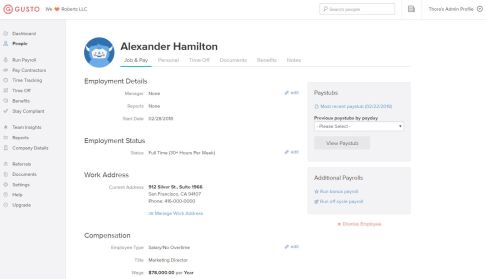
Making all of your payments legally and correctly is actually really easy. We use a great payment app called Gusto. Every time we hire an employee, freelancer, contractor or vendor, we set them up on Gusto.
Here’s how it works:
Individuals enter their social security numbers.
Businesses enter their tax ID numbers.
Everyone enters their address.
Everyone enters a bank account where they want their payment directly deposited.
We then process all of our payments through Gusto. And it works like magic. Based on factors like location and type of work performed (employee vs contractor vs vendor), it knows what type of payment needs to be made. I think it even knows if you’ve been bad or good, so be good for goodness sake.
Gusto automatically figures out taxes, social security, unemployment insurance, workers comp details and the types of things that would otherwise keep you awake at night wondering why you decided to start your own business.
Dream Team
Together, Gusto and Quickbooks, along with our accountant, Sally Bretsch, make our accounting one of the least stressful parts of owning my business. We have an easy-to- follow system for onboarding employees, contractors, clients and vendors. We get people set up quickly and we pay them on time. All of the difficult calculations happen automatically. And we spend more time doing the important work that helps us grow our business and keep our clients happy, like Pharrell Williams.
The Price Is Right
The fee structure is simple. You pay a small monthly fee. And then you pay a small, increment cost per-person-you-pay-through-the-system each month. It is highly affordable and totally worth the sanity it preserves.
A Great Time To Sign Up
Recently, my friend Dr. Theresa Pride, who owns a great business in Atlanta called Pride Physique Pilates and Physical Therapy told me she was going to switch to Gusto based on my recommendation. She asked me if there was a referral code she could enter to make sure Gusto knew I sent her. I looked in my email and sure enough, right now Gusto offers a referral bonus to both the referrer and the referree (that could be you you).
My email associated with the account is still my startup-stage email: adamralbrecht@gmail.com (not my I-started-up email which is adam@theweaponry.com)
When you run your first paid payroll, you’ll get a $200 Amazon gift card. And I will get a $200 Amazon gift card, too.
Key Takeaway
Don’t be afraid to start a business. Don’t be afraid to hire contractors, employees or vendors. Gusto makes it easy to pay everyone you work with over the table, tax compliant, like a real, legitimate business. And because you don’t have to worry that you are paying people the right way you’ll have more time to think about the real business of your business. Which is what you have dreamed about from the beginning.
*If you know someone who owns, or would like to own their own business, please consider sharing this with them. #ThatsALotOfOwnsInOneSentence
Throughout my career I have done a lot of public speaking. I frequently get requests to do presentations to businesses and professional organizations. I guest lecture a few times each year to college classes. I really enjoy being able to offer value by sharing what I know. In fact, I have a blog dedicated to sharing my learnings. And you are reading it right now. #meta.
I never want people to walk away from one of my talks thinking it was just ok. That’s why I think about offering value in my talks through the 3 Es.
My 3 Es of Public Speaking
Education I try to teach people something they didn’t know. It could be information they didn’t have. Or a new perspective or philosophy that makes them think in a new way.
Energy I always try to offer energy. It’s much easier for an audience to pay attention and learn something when they are awake. So I make it awfully hard to sleep during one of my talks.
Entertainment I try to make my talk interesting. I use humor and storytelling. And I use liberal amounts of Surprisium. Which is the element of surprise. (I discovered that in my high school chemistry class.)
Chickety Check Yourself
When preparing to give a talk I always check to make sure I have all 3 Es in my presentation. It’s how I ensure that I am offering value. Because when I offer real value to others I know I will receive real value in return.
The Payment For A 3-E Talk
If you are wondering what kind of payment you should expect to receive for your public speaking, here is the payment I recently received for a guest lecture I gave to 35 students in Erin Napier’s integrated marketing communications class at Marquette University.
‘I had to email you to send a massive “thank you” for the presentation you gave to my advertising class, it was absolutely killer and it will leave a lasting impact on how I go about my future. Between you and me that was the most engaged I was in this class all year! (You are the type of guy Id love to sit down and have a conversation about life with)
From the moment you entered the room I noticed I had a lot of the same personality traits you shared with us and I am now, so excited to see what I can do with them. You showed me how to use the talents I was born with and use it to my advantage.
The way you asked us a little about ourselves was amazing because it shows that you are interested in what we have to say. Who doesn’t love talking about themselves?!
I learned so much in the short time you spent with us and from the bottom of my heart I really appreciate it and I wish you the best of luck with everything in your life and hopefully someday we cross paths again.’
‘Just wanted to say the presentation was great and one of the most interesting I’ve seen in my time at Marquette. On another note, i have a start up I’ve been working on with a buddy of mine and was curious if you’d be willing to connect one day and give some thoughts/ feedback. Either way, you crushed it tonight and hope we can connect in the future.’
‘Thanks for speaking tonight. Your talk made me want to quit my day job.’
‘Hey Adam, I am NAME CHANGED TO PROTECT THE LACK OF PROOFREADING, I am in Erin Napier’s advertising class that you spoke to last night.m (if you need a reminder of how I am, I was the NICKNAME I GAVE THE STUDENT IN CLASS). I really enjoyed your talk and I related to your engery and passion for the topic so I wanted to reach out and connect. Thanks’
‘Hi Adam. I enjoyed your presentation during my advertising class last Tuesday. You had mentioned to connect on LinkedIn if I was possibly interested in future opportunities. Thanks for volunteering your time and sharing your insight.’
‘This was the first time all semester I paid attention to a guest speaker. That was awesome.’
‘Hey Adam! I am the perfectionist from Pewaukee! (From Erin’s Advertising class.)
I wanted to thank you again for an awesome presentation last night. You have an amazing zeal for life which is not only refreshing to see, but inspirational as well.’
Adam: Again, thank you for your wonderful presentation last night. As usual, my students were mesmerized. You represent real world perspective which is difficult at times to bring into the classroom. I also appreciate that you provided some perspective on the DNC project.
It was also delightful to have Sara attend. She is a great example for my athletes in the room in how balancing their time between academics and preparing for post college starts now. Please feel free to bring members of your team again.
Erin
Key Takeaway
When you speak, expect to give. Provide value by educating and entertaining. Do it with energy. And when you do your job well you should expect to get paid with wonderful feedback from your audience. That positive feedback alone makes it all worthwhile.
*If you know someone who could benefit from this message, please share it with them.
Entrepreneurship is full of difficult decisions. Especially in the beginning. In fact, the decisions you make about expenditures early on determine whether your organization lives or dies. It sound dramatic. Like a commercial for the business board game Go! Gordon Gekko Go! But it’s the truth.
I have always been financially conservative. I believe leadership’s #1 responsibility is to keep the business alive forever. That’s why I have hired slowly, expanded slowly and invested slowly.
At my advertising and idea agency, The Weaponry, we have bootstrapped everything. Which means that we have paid for everything ourselves. No outside investors. No loans. No crowdfunding. No Ponzi scheme.
We started with the free version of every app and software until we knew it was worthwhile to upgrade. We made our first 3 desks out of countertops and legs we purchased at a used office furniture store. And we commuted to work uphill both ways.
Yep, I made that desk out of found parts. And it works as well as the most expensive desk you can buy.
Office Space
When I first launched The Weaponry I waited a year and a half until I decided we could afford an office. In hindsight I feel like I nailed that decision. Because we didn’t over commit in the early months when we were most fragile. We didn’t assume that our rate of growth was predictable or sustainable.
Cautionary Tale
I recently heard about another agency that launched the same time as The Weaponry. It just shuttered one of their 2 offices and laid off all but 1 employee in the other. (By shuttered I mean that they closed it, not that they added fancy, yet extraneous exterior window treatments).
The agency had invested and expanded aggressively. Too aggressively to sustain. Watching them establish beautiful offices with enviable appointments made me jealous. But it also made me concerned for them. Because those investments made them vulnerable. And of all the abilities your business can have, vulnerability is among the least appealing.
Doing It Right
Last month I saw an office that I absolutely loved. It was the office of an early stage human resources company. It had 4 desks in a space half the size of my bedroom. The density of humanity in that office equated to a very dense return on the investment in the space.
This is where my friend Amy Fallucca grew her human resources business, Bravent, into a thriving organization before moving it into a large fancy-pants space.
Idea of the Day
Calculate how much revenue you earn per square foot of office space. It is a much better way to think about your space than cost per square foot.
Key Takeaway
When considering office space for a small or new business think of the Tiny House movement. Consider the minimum space you need, not the max you can afford. Put the rest of the money you save in the bank as an insurance policy for future downturns and slow periods. Because they are likely to come. And you will be prepared when they do.
*If you know someone who could benefit from this story, please share it with them.
I’m not a huge fan of rules. Creative people as a species are naturally averse to them. But if you want to develop a business with a strong culture and a rock solid, repeatable process you need some rules to guide you.
Some Background
Prior to starting my own ad agency I had been part a fun, feisty and progressive agency called Engauge. We had offices in Atlanta, Austin, Columbus, Pittsburgh and Orlando. And we worked with some of America’s best brands, including Coca Cola, Wells Fargo, UPS, Nike, Chick-Fil-A, Nationwide, Walgreens, and Cisco. We had a lot of very talented people. And we had a great company culture. #weness But it didn’t happen by accident.
Rules That Free Us
When I joined Engauge’s restructured executive leadership team in 2011 our first order of business was to create some simple rules to govern the organization. Because we believed that a great organization is made of great people who enjoy working together, the first rule we unanimously agreed on was the ‘No A-holes’ rule. For those unfamiliar with the rule, or the obviousness of the phrase, it means that your organization will not tolerate people who act like A-holes.
This dude is acting like a textbook A-hole. Well, maybe not a medical textbook A-hole, but you know what I mean.
Prevention
Preventing the A-holes from joining your team isn’t easy. Because they are on their absolute best behavior in interviews. Sometimes we sniff them out (yeah, I said it). But often they sneak past our filters. So as much as we try to prevent an A-hole from getting into our organizations in the first place, they get in. So now what?
The Conundrum
You just get rid of them, right? After all, no one likes an A-hole. Unfortunately, it’s typically not that simple. Because let’s face it, there are a lot of talented A-holes. The drive, intelligence, confidence and will of a typical A-hole help makes things happen. It’s common for them to make a quick impact and create immediate wins.
The Problem
But that upside comes with an equally significant downside. Because A-holes are uncomfortable to be around, they drain morale and sap energy. The unfortunate reality is that when you retain an A-hole, (which means you are A-hole retentive) it sends a terrible message about your values to your most valued employees. You’ll watch them drop like flies. Among the employees you will retain you’ll lose untold dollars in productivity as co-workers gather to talk about what an A-hole the A-hole is.
Even Worse
Of course the worst problem of all occurs when an A-hole develops a close relationship with a client. Because then the business has to decide whether they want to lose the valuable contributions of the A-hole and irritate or lose a client.
The Solution
There is a proven 2-step process to handling such problem employees. First, ask a handful of cross functional team members if they think the co-worker in question is an A-hole. Second, if the consensus is yes, you put on your scrubs and perform an Assholectomy.
There simply is no room for the distraction, the division and the drama caused by A-holes. Accepting them tells the rest of the organization that It’s okay to be an A. That can’t happen. Because eventually enough people will leave, or threaten to leave that you have no choice but to get rid of the A-hole A-nyway.
The Result
After implementing the A-hole rule in the past, I’m proud to say we purged several very talented but very difficult people. By dropping those stinky sphincters, the culture, vibe, productivity and overall love for the organization improved.
The Weaponry
When I launched my own advertising and idea agency, The Weaponry, in 2016, the first rule we implemented was the No A-Holes Rule. But we didn’t just make it a rule. We baked this non-negotiable into the center of our brand identity. You’re probably wondering how we did this.
See the A in the middle of the word Weaponry? Notice that it has no A-hole? That’s because there are no A-holes at The Weaponry. #TrueStory #BakedInFromTheStart
By establishing this rule from the beginning we have had no A-hole problems at The Weaponry over the past 3 years. None. Not even a whiff of a personality problem. #snickering All of our full-time and part-time team members have been exceptional people who work great with others.
Key Takeaway
If you want to create a great work environment, team and culture you have to invite the right people in and keep the wrong people out. There simply is no room for A-holes. Even really talented A-holes. Because you will be cleaning up their crap until the day they leave. So create a policy and a process to prevent them from getting into your organization, and for removing them if they sneak in. By eliminating A-holes you will have avoided the negative distractions that kill both productivity and culture. Which means you and your team can focus on building a great business. And building great, long lasting relationship with each other.
*If you know someone who could benefit from this message (like someone dealing with an A-hole) please share it with them.
Being an entrepreneur is like being an astronaut. Not just because they are both weird words. But because both jobs require you to know a little bit about everything. However, no one starts out knowing all the things they need to know. Which means that when you begin your entrepreneurial adventure you start in an uncomfortable, if not vulnerable position. Like astronauts.
Sometimes entrepreneurship feels this way.
When I first launched The Weaponry, my advertising and ideas agency, I was curious to discover which newly-required skill area would test me the most. Accounting? Contract Law? Human Resources? Dry Erase Board Maintenance? But 3 years later there is one skill I find I need to use more than any other. It’s my humanity.
Honing Humanity
Being a great entrepreneur, first and foremost, requires you to be the best human you can be. Because businesses are not businesses. They are collections of people. To help people be their best you have to listen, understand and care about the issues they are dealing with.
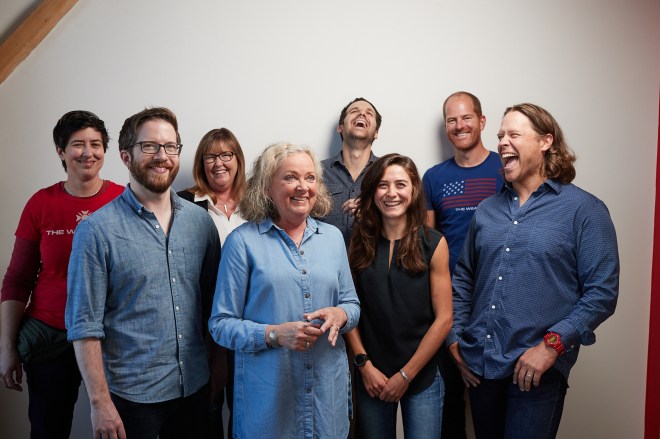
This picture includes clients, partners and employees. Which are all the basic kinds of humans you need to create a successful business.
Human challenges regularly get in the way of business. That’s simply a fact of life. Entrepreneurs have to be good at working with those challenges. They come from everywhere. From your clients, employees, contractors, vendors and suppliers. Over the past few years I have had the honor or working through a wide variety of human challenges with my teammates, clients and partners.
Human Challenges I Have Worked Through As An Entrepreneur
Pregnancy
Home Buying
Home Selling
Mental Illness
Balance Issues (real, physical balance, not work-life or checkbook related)
Cancer
Care for Aging Parents
A Desire To Go Back To School
Weddings
Changes To Hopes and Dreams
Surgery
Home Power Outages
Family Vacations
Spousal Job Loss
Doctor’s Appointments
Major Dental Procedures
Drug & Alcohol Testing (which we are required to do for a client)
Criminal and Financial Background Checks
Sick Children
Alzheimers Disease
Parkinson’s Disease
Hearing Loss
School Events
Financial hardships
Business failures
Lawsuits
Preparing Yourself
Working through these issue doesn’t require an MBA, finance degree or a Wall Street internship. It simply requires you to be a good compassionate and understanding human. It requires you to put people issues before business issues. It requires good listening skills and good problem solving skills. It requires you to be prepared for life to get in the way of business. And to be okay with that.
Weaponry Humans
My Favorite Part
Still, the humanity is my favorite part of business. It provides a constant reminder that we are people first and clients, employees and contractors second. We work to live. We don’t live to work. At the end of your career you will be remembered more for how you impacted lives than how you impacted products and services.
Business people having a very human experience.
Key Takeaway
Humans are critical to business success. If you want to create a thriving business you should always put the humans in them first. Because you can’t succeed without them. When you show that you care about the human issues that your team, clients and partners are dealing with, those same people will care even more for you and your shared business in return. So remember the Golden Rule. It’s the most golden entrepreneurial lesson I’ve learned so far.
*If you know someone who could benefit from this story, please share it with them.
There are some business problems they don’t teach you how to solve in business school. They are too odd and too unlikely to happen to spend time discussing. So today, I am going to serve up an odd, real-life scenario to see how you would respond. Because I am not sure what the right answer is. Or even if there is a right answer. So let’s try to figure this out together.
The Setup
Last night, just before dinner, I went into the bathroom at my home to wash my hands. As I was washing I looked at myself in the mirror and noticed a problem. My left eyeball was completely red. Not as if it was irritated. Or as if I had taken a red eye flight. It was red like a blood vessel had burst in my eye. And it looked disgusting. Like an eye I never want to make eye contact with. Like ever.
When I returned to the table and shared my problem with my family the reaction was not good. My 11-year old son thought I looked hideous and demanded that I not look at him again. My 8-year old son was fascinated, the way a boy may be fascinated by road kill. My 13-year old daughter was greatly concerned for me. (Everyone should have a daughter). And wife Dawn immediately asked if I had any important client meetings this week. The answer was yes.
The Problem
I have an important meeting with a brand new client that is scheduled to start 24 hours from now. The Weaponry, my advertising and idea agency, was just awarded a significant project with this client after an agency review. During the review process we met 3 members of the marketing and sales team, whom we liked very, very, very much. #IThinkTheyWillReadThis
The upcoming meeting is for us to meet the client’s executive team, a team we will be working closely with throughout this project. The purpose of the meeting is to introduce ourselves and take them through the proposal with our color commentary.
The most important outcome from this meeting is for us to make a great first impression on our new client’s senior team. That’s hard to do when you have a horror film eye ball. What makes this worse is that I have had a burst blood vessel in my eye before. It was many years ago. During that red period I had multiple client meetings. And my clients were undeniably grossed out by my gore eye. Sorry clients.
Seeking a Solution
This is where I need your help figuring out what I should do next. There are a couple of details you should know before offering your advice. 1. This problem usually takes 5 to 7 days to clear up. There are only 2 people from my team scheduled to attend this meeting, Just me and the account leader. There was a 3rd member of our team who would have attended if she wasn’t on vacation in Europe. It’s amazing the lengths some people will go to in order to avoid seeing my eye.
The Options As I See Them (through my bloody eye).
Reveal the problem and ask to reschedule the meeting for 1 week later.
Send the account leader alone.
Proceed as if there was no problem.
Make the meeting a phone call or video conference.
Attend the meeting, but wear sunglasses
Attend the meeting but wear an eye patch (Arrrr Matey!)
Attend the meeting but wear a welder’s mask.
Attend the meeting but avoid all eye contact, like Rain Man.
Call the client, explain the situation, and ask them how they want to proceed.
What would you do?
Which of the options do you think I should choose? Or do you have a good solution that is not on the list? I appreciate you sharing your opinion. If you know a wise owl who-who offers good advice, please pass this along to them too. Me and my eye look forward to hearing from you.