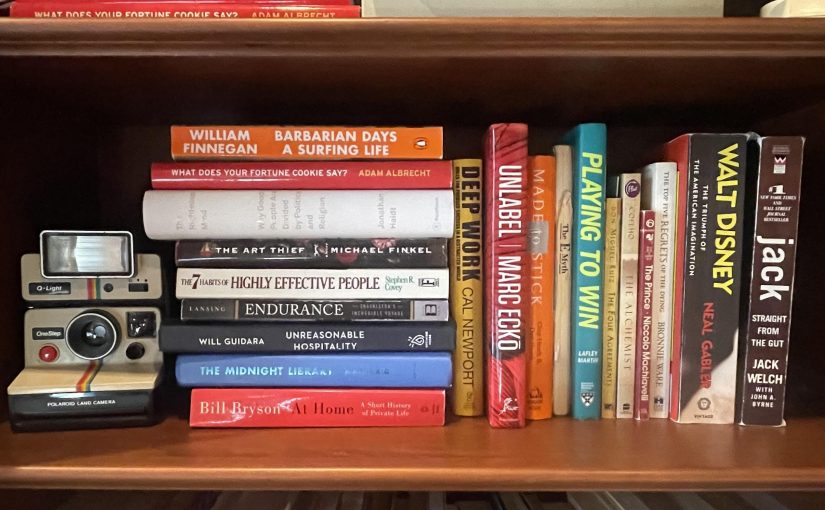
People are reading less. Which is great news for you!

The greatest way to increase your value to yourself and others is through reading.

You could just stop reading this post now and go grab a book to read instead.

But I am going to drop some new reading knowledge on you that is worth 90 seconds of attention.

Why Should You Read?

Bill Gates reads about 50 books a year. Or about a book each week.

Warren Buffett famously reads about 500 pages per day.

Lin-Manuel Miranda bought the book Hamilton to read on vacation in Mexico.

So read books that expand your thinking and your knowledge base.

Read to understand how things work.

Read for inspiration, motivation, and all the other great ations.

Read to understand how successful people became successful.

Read about what worked in the past in your field of expertise.

And read to learn what is changing in your field, so you can surf that change, rather than get pummeled by it.

Read to improve your writing and expand your vocabulary.

Read to develop your focus and your patience for long-term goals.

But most importantly…

Read To Separate Yourself From The Pack.

Despite all of the mental nutrition and long-term success that sprouts from reading, a new study just released by researchers at the University of Florida and University College London (which sounds like the fakest British school name ever) found that reading for pleasure among Americans has declined by 40% over the past two decades.

  • In 2004, 28% of Americans said they read for fun.
  • In 2023, only 16% said they read because they wanted to.

It is not lost on me, or the researchers, that Facebook launched in 2004 and the iPhone was released in 2007. Together, social media and smart phones may be accomplices, killing reading softly, like Roberta Flack or the Fugees.

This all means that people who read books have a greater competitive advantage now than ever before.

The statistics are fascinating.

The average number of books adults read each year is 12. Which was also my favorite song from Sesame Street.

However, this is massively skewed by the avid readers.

In fact, estimates reveal that between 25-46% of adults READ NO BOOKS each year.

And the median number of books read annually by adults is only about 4. That’s how much the average person hates paper cuts.

Which means there are fewer and fewer people after the pot of gold at the end of the Reading Rainbow.

There are fewer people who are willing to do the slow, steady, yet transformational work of knowledge gain through reading. While others are settling for bite-sized bits of video, podcasts, and tweetable wisdom served by algorithms, readers are accumulating broad and deep knowledge that helps make them more capable, valuable and irreplaceable.

The new study also revealed that those who do read for fun are spending more time doing so. Because while haters gonna hate, readers gonna read.

And in the era of artificial intelligence, it is the humans who can contribute more than the machines that will be in greatest demand.

Key Takeaway

Now more than ever, reading is your great competitive advantage. Your self-directed education makes you a valuable and irreplaceable resource. It improves your thinking. Which drives smarter decisions and actions. And it draws other people to you who want to tap into what you know.

*If you know someone who could benefit from this message, please share it with them.

+For more of the best life lessons I have learned check out my book, What Does Your Fortune Cookie Say? from Ripples Media.And consider subscribing to Adam’s Good Newsletter.
Would people stand in long lines to get to you?

Over the 4th of July weekend, I completed a circle tour of Lake Michigan. My wife Dawn, sons Johann and Magnus, and I took 4 and a half days to circumnavigate the lake clockwise, starting in Milwaukee. Which is on the southwestern shore of the Great Lake, 90 miles north of Chicago. But a world away in terms of traffic, cost of living and pizza.

On our adventure, we saw a lot of new things. New cities and towns. New parks and National Lakeshores. We took new ferries and boat tours. We crossed new bridges. We explored new islands. Who knew there was so much new to know?

We also needed to eat, drink and do a little shopping. In the process we found many establishments that were mostly empty and easily accessible.

But we found other establishments with long lines out the door and down the sidewalk.

The places with the long lines still have my attention as I return to work at The Weaponry, the advertising and ideas agency I lead. Because generating long lines of eager customers should be the goal of those who create, run or contribute to successful businesses. And it should be the goal of every brand that offers products or services.

Today, I encourage you to think about creating lines out the door for your offerings. Here are the 6 things that help create long lines that people are happy to stand in.

6 Factors That Create Lines Out The Door.

1. Quality products. Offer products that really work. Things that are well-made and do their jobs well. Products that take care of business will take care of your business. Like Bachman-Turner Overdrive.

2. Great Service: Take care of your customers. Make them feel that their needs and expectations are met, their questions are answered, and their time is respected. Treat them like that boyfriend or girlfriend you really want to keep. But don’t make out with them. Unless that’s part of your service. (I hope it’s not.)

3. Great Value: Make your customers feel like they get more than they paid for. Or more than they would get for the same dollar spent somewhere else. This does not mean your offering is cheap or inexpensive. It means every penny is well worth the investment.

4. Great Experience: You want your customers to feel that the whole experience was interesting, fun, worthwhile, memorable, and story-worthy. It wasn’t just a transaction. There was something more to it. It felt different than other seemingly similar transactions or purchases. It was worth doing again. It was worth telling others about. It was something you are proud to have done. Even if you can’t fully articulate why it was so great. Even if you are a fully articulate human.

5. Scarcity: This means that what you offer isn’t easy to find. There is no easy substitute. It means that people are willing to make additional sacrifices for your offering. They will wait and trade more of their time in order to get what you are offering. They are ok suffering inconveniences like standing in line. Or sitting in a waiting area for their opportunity to enjoy your offering. Because nothing compares to you. Like Sinead O’Connor said.

6. Esteem: Some offerings are so good that they transcend mere preference and become part of what can be considered esteem experiences. This means that you get additional social credit for having experienced the offering.

Examples:

  • People who saw the play Hamilton in its first year.
  • Consumer space travel
    • Eating a Cronut in 2013
    • Attending a Taylor Swift, Coldplay or Noah Kahan concert in 2025.
    • Owning American Giant hoodies when there was a waiting list.

Cue the Queue

Consider these 6 factors when crafting your offers. They will push you to develop things that are beyond compare. Beyond substitute. Things that are rewarding to experience. Things that are hard or impossible to find anywhere else. They lead to offerings that command a higher price and are still worth every penny, Marshall. And they leave customers feeling like you did a great job taking care of them.

It’s a winning recipe. It is how brands thrive. It is how startups become stalwarts. It is how you grow revenue, profits and envy. It is how you create momentum. And competitive advantages. It is how you build a moat around your business. It is how you generate talk value, word of mouth advertising, referrals, 5-star ratings, and repeat customers.

That’s how you create lines out the door.

Key Takeaway

Never settle for good enough. Push for greatness. Continually look for opportunities to improve your offering, your experience, your value and your uniqueness. If others copy you, innovate again. You can’t create advantages or envy with commodity and parody offerings. Your goal should always be to create lines out the door, and be able to charge a premium to your competitors. Better yet, innovate your offering to the point where there are no competitors. There are just customers lined up out the door.

*If you know someone who could benefit from this message, please share it with them.

+For more of the best life lessons I have learned check out my book, What Does Your Fortune Cookie Say? from Ripples Media.And consider subscribing to Adam’s Good Newsletter.