You know who is great at starting a business? (Besides Richard Branson.)
Someone who already works in a business.
Someone who has seen how their employer’s business runs.
They know how their current business wins and how it gets beaten.
They see the flaws to be fixed and the opportunities to improve.
In other words, the best people to start their own business are people just like you. (And Richard Branson.)
Always Be Planning
You should always be thinking of what your own business would look like.
Think about the systems and processes.
Think about the customer you will serve.
Think about your values.
Think about your culture.
Think of who would be on your team.
Think about the epic company parties that aren’t yet restricted by a buzz-killin’ CFO. (I hope Kid Rock, Beyonce and The Rolling Stones are all playing at your party, and asking you to sign their foreheads, because they know you are a rock star!)
Imagining the details of your own business is how you build your own life raft. That way, it will be ready to use when you are ready to jump. (Or if your current business sinks or you get thrown overboard.) You can use your boat to save yourself, create your own epic adventure, or sail off into the sunset.
1 Hour Per Week
Spend an hour per week thinking about building your own business.
Take it from your InstaSnapTok time.
Then, every year, you will spend 52 hours working on your own business.
10 years into your career, you will have spent 520 hours working on your business.
And 2 decades into your career, you will have spent 1,040 hours on your own business. #mathwhiz
That’s how a steady drip of thinking, formulating, and crafting turns into a business started by a veteran with 20 years of experience, a vision, and a valuable network of industry experts, coworkers, partners and suppliers.
I know this approach works. Because it is how I started The Weaponry nearly 10 years ago. And it was the best career move I ever made.
Key Takeaway
Spend a little time each week thinking about what your own business would look like. Capture your ideas in a notebook or a Google Doc. Add a little bit each week. It is a great way to slowly plan your own business before you need it. And if you never need it, it will provide a great roadmap to improve the business you are currently in. It is a win-win that could lead to the greatest adventure of your career.
*If you know someone who could benefit from this message, please share it with them.
There has never been a better time to start a business. Because so much of the infrastructure needed to run a business is simply a small stack of software that you can set up and run online. The software needs of a newborn business may seem intimidating from the outside. But they are easy to find, easy to implement and easy to scale. Like Eazy-E. To help make it even easier for you to start your own business, I am sharing the ten software suggestions to get your startup party started right.
One of the first things we did when we created The Weaponry in 2016 was set up a series of software accounts. This, in essence, becomes your operational center. It’s super easy to set up. And generally quite affordable to maintain. Not only are the software accounts scalable, which means you pay a small amount for a small business, and then slowly increase your payments as your needs or size increase, but there are free versions or free trial periods of many software offerings that allow you to try them out before you get too deep.
Here’s a quick overview of the software systems we use to run The Weaponry.
Google Workspace is the central hub of our business. It offers email. It offers Google Docs for writing. (I also write my books on Google Docs.) It provides Sheets for spreadsheets (not bed sheets) and Slides for building decks and presentations. (Not playgrounds.) It offers an online calendar, chat, a file storage drive for documents and much, much more. Microsoft Office also offers this type of functionality. Choose your favorite and get businessing!
We use Slack for instant communication. This is the primary venue for our teams day to day communication. This takes a lot of unnecessary traffic out of your email inbox. You can have real-time communications and share files instantly on this platform. Think of it like a super chat platform. (Or chatform.) You can create dedicated channels for specific accounts, departments or teams. There is a ton you can do for free. Or you can upgrade and also use Slack to store all of the documents you ever share on the platform. Which is cool. I also find that Slack is a better platform for sharing funny comments than email because it is quicker. And the little emoji responses make it feel like people think you are funny. (Just in case funniness is important to you.)
Quickbooks is the accounting software we use to track and manage all of our accounting. This is the heart of our accounting world. You connect all of your business bank accounts and credit cards here. It makes it easy to create and send invoices (bills) and to know what is due and when. It also provides reports (profit and loss, profitability, balance sheets, etc.) and dashboards that help you manage your business. You can set up Quickbooks to receive payments from your clients, including via credit cards. Get this going as soon as you can afford to. It will become the backbone of your accounting system. And your business’s scoreboard. It helps make everything official, and easy to share with your tax accountant when it is time to talk taxes. And best of all, Quickbooks is not the book equivalent of quicksand. (Just in case you were wondering.)
We use Harvest for all of our time tracking and reporting. Our team members enter the time they spend on each task, project, or client on a daily basis. This easy-to-use software helps us track our labor costs for every client. Plus it enables us to track our staff utilization. So we always know how much of our team’s time is billable. Which helps you know when you should hire more people. However, this software does not let us know the best time to harvest the stuff we grow in our gardens. I hope they fix that in the next update.
We use Asana as our project management tool. We use this to help house important information like timelines, files, overviews, and due dates on each project, by client. This becomes the central hub for all information needed to deliver a project. Like The Manhattan Project, The Alan Parsons Project, or The Mindy Project.
We use Gusto to process our payroll. You want a payroll processing software to help make sure you are automating everything in accordance with the IRS as well as state and local laws related to taxes and various benefits. Plus, it just makes your life a lot easier when you’re not wanted by the feds for tax evasion.
We use Guideline to provide and administer our 401(k) plan. Guideline is offered as a partner through Gusto. That makes it an easy add-on when your organization is mature enough to offer this great employee savings and retirement benefit. Which is kinda like hitting puberty for a startup. Only without the bad skin.
We use DropBox for file storage. This works as both a server and as a way to share and request large files with clients and partners. As an advertising and ideas agency, we create and move a lot of large files. Like art files, video files, X-Files and Simone Files.
We use Zoom for video conferencing. Thanks to the COVID-19 global pandemic, everyone on the planet knows about Zoom. At The Weaponry, we’ve been using Zoom for both internal and client meetings from day one. Because our clients are all over the country and in Canada. Not to mention we have worked with great clients in England, France and India. (Except I did just mention them. Which ruins the not-to-mention thing.) Google Meet also works well, and is offered as part of the Google Workspace. And if you go with Microsoft software you can use Teams.
We use Grasshopper as our virtual phone system. As a startup business you don’t need a receptionist or a fancy phone system. Grasshopper and options like it allow you to create a virtual system that connects your teams’ mobile phones and makes you appear professional and organized in a way that transcends simply using your personal phone as the phone number for the business. (Which of course is fine to do in your early stages. Part of the charm of a baby business is having a voicemail that says, ‘Hi, you’ve reached Billy’s voicemail, and the world headquarters for Galactic Pickles.)
Specialty Software
You will also find specialty software available for your specific industry. In our world, those things include the Adobe Creative Cloud for all creative development software including Photoshop, Illustrator, InDesign and more. We use Figma when creating websites. A quick Google search will help you discover the useful software services available to you and your industry online.
To Shop or Not To Shop…
There are plenty of other options for each of the software offerings shared above. But my goal is not to list all the options. It is to show you what you can grab today and get going so you don’t put off your great business idea any longer. I encourage you to look at these options first, and if you have a problem with something they don’t offer that you want or need, keep looking. But don’t let research and shopping turn into procrastination and delay. The key is to get going. And get rid of all the things that are stopping you from starting. Which sounds funny, but it’s true.
Key Takeaway
It has never been easier to set up your business infrastructure online. Start with the relevant software shared here. Shop for potential alternatives if these options don’t serve your specific needs. Many of these are available as free versions to get started, or for very low trial rates. The software offerings make it easy for you to set up a fully functional business quickly. So don’t let your infrastructure needs delay your entrepreneurial dreams. You don’t even need an IT expert to get these resources up and running. I am living proof of that.
*If you know someone who could benefit from this message, please share it with them.
I am asked about my entrepreneurial journey a lot. It seems that far more people are interested in starting their own business than ever sail their own entrepreneur ship. If you are considering starting your own business, either as a side hustle or as your main hustle, here are 4 things that I have done that I highly encourage you to do too.
1. I Took Action.
Everyone has a dream. And I dreamed of starting my own advertising agency for a long time. But to actually start your own business you have to move beyond dreaming to doing. Starting in the fall of 2015 I took an endless series of small actions that led me to today. My business, The Weaponry, will turn 8 years old next month. So if you want to make sure you don’t die with your dream still inside you, take action to make it real. (Also look both ways before you cross the street.)
As a professional creative thinker, I take lots of risks with idea exploration. However, I am fiscally conservative. I have been cautious with our expenditures, our office space and our staffing size. I have been conservative about leaving cash in the business, versus taking it home as part of my return. As a result, The Weaponry has strong reserves to outlast downturns. This was a key reason I didn’t panic at the disco in 2020 during the Covid Cray Cray Fest.
3. I Planted Seeds.
Business development is critical to creating a pipeline of opportunities. Over the years I have stayed in touch with old friends. I’ve made one hundred billion new friends. I have had phone conversations, chocolate milk meetings and lunches. I have volunteered my time. I have guest lectured and given talks. I write a blog. I wrote a book called What Does Your Fortune Cookie Say? I co-wrote a book titled The Culture Turnaroundwith Jeff Hilimire. I have given interviews and served on committees and boards.
All of those things are like planting seeds. You never know when they will sprout or what they will turn into. So keep planting seeds and watch what happens, with Andy Cohen.
4. I Delivered
The best source of new business is a happy client. And you develop happy clients by delivering for them. (Especially if you are an obstetrician, or a milkman.) The Weaponry has grown by keeping our clients happy and expanding our work with them. We are also expanding by having happy clients leave for great new jobs and bringing us with them to their new companies. I have a really great team. And I appreciate all that they do for our clients. It is why we are still here, and still growing strong.
Key Takeaway:
To develop a successful business you have to take action. Without action, you are just a dreamer. You have to save money so that you are prepared to weather the storms that will surely come. You must keep planting seeds by creating and nurturing relationships and providing value to others. Then you must deliver the goods. Nothing grows a business like happy customers. None of it is easy. And none of it is that hard. It is simply the price you have to pay to get what you want in life.
*If you know someone who could benefit from this message, please share it with them.
I always wanted to start my own business. Not because I was an unhappy employee or a free spirit who couldn’t stand to work for The Man. I just like a good challenge. And everything I ever heard about entrepreneurship made it seem like it was the career equivalent to bull riding. Or free solo climbing. Or streaking at the Super Bowl. I knew it was dangerous. The likelihood of failure was very high. But if you are successful, there are few endeavors as rewarding.
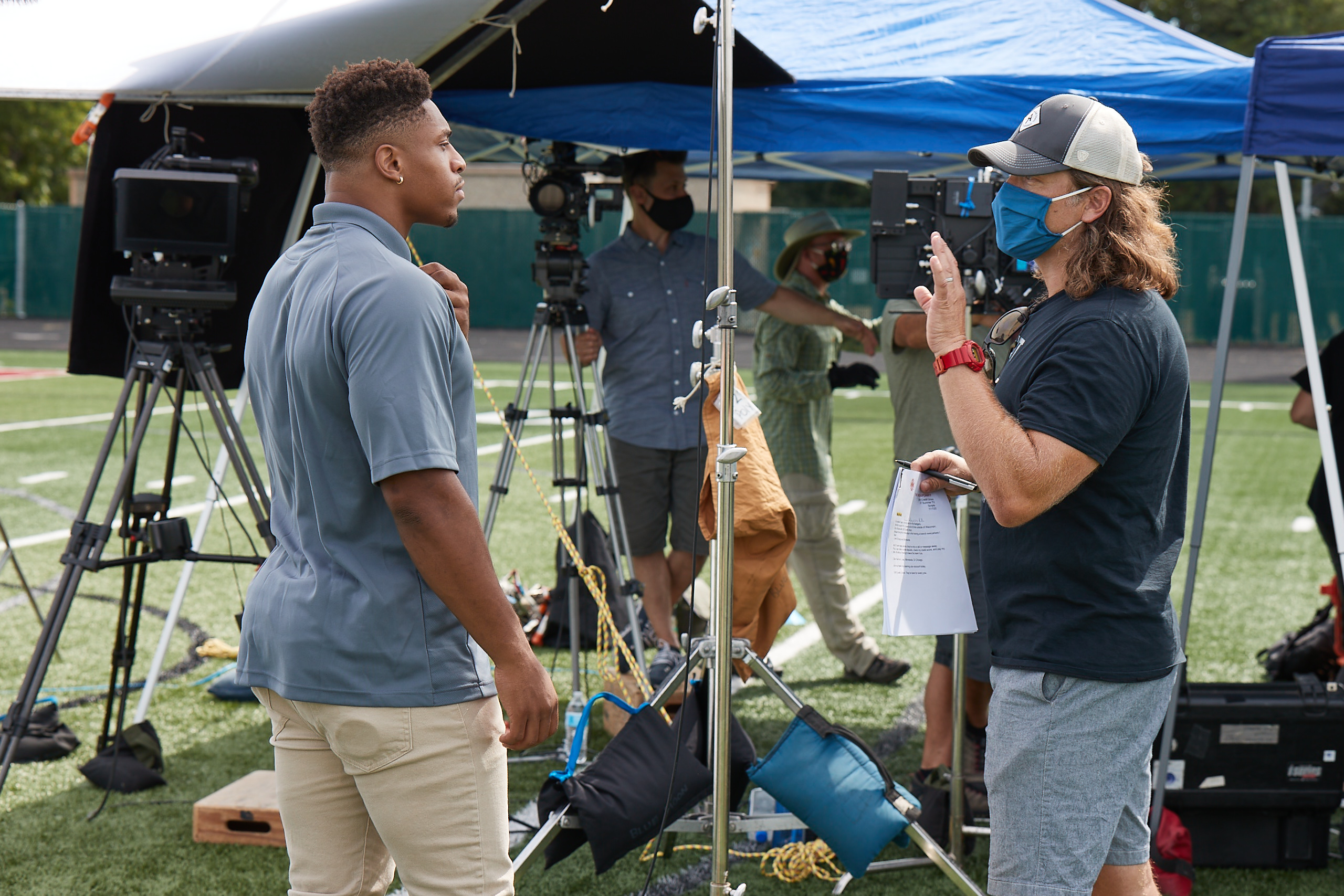
On the set of a recent TV shoot with Jonathan Taylor of the Indianapolis Colts. I tried to steal his necklace, and he tried to defend it. It was all very subtle.
Some Fun Entrepreneurial Facts
There are 31 million businesses in the United States
90% fail within the first 5 years
Only 4% ever make $1 million a year.
The average age of startup Founders is 42 years
A first-time entrepreneur has an 18% chance of succeeding
70% of entrepreneurs were married when they started their first business
60% had at least one child
44% had two or more children
66% of start-up founders pay themselves less than $50,000
69% of American entrepreneurs start their business at home
80% of small businesses are non-employer businesses.
51% of small businesses make less than $100,000 in annual sales.
Riding The Bull
With these facts in hand, I launched The Weaponry, an advertising and idea agency, in 2016. I wholeheartedly believed that we would succeed. The statistics didn’t scare me. They motivated me to prove that I was one of the few, the proud, the elite non-failers. Although I am sure the failers also felt confident when they first started out. After all, you don’t jump out of an airplane unless you are highly confident your parachute will open. Unless maybe there were snakes on the plane.
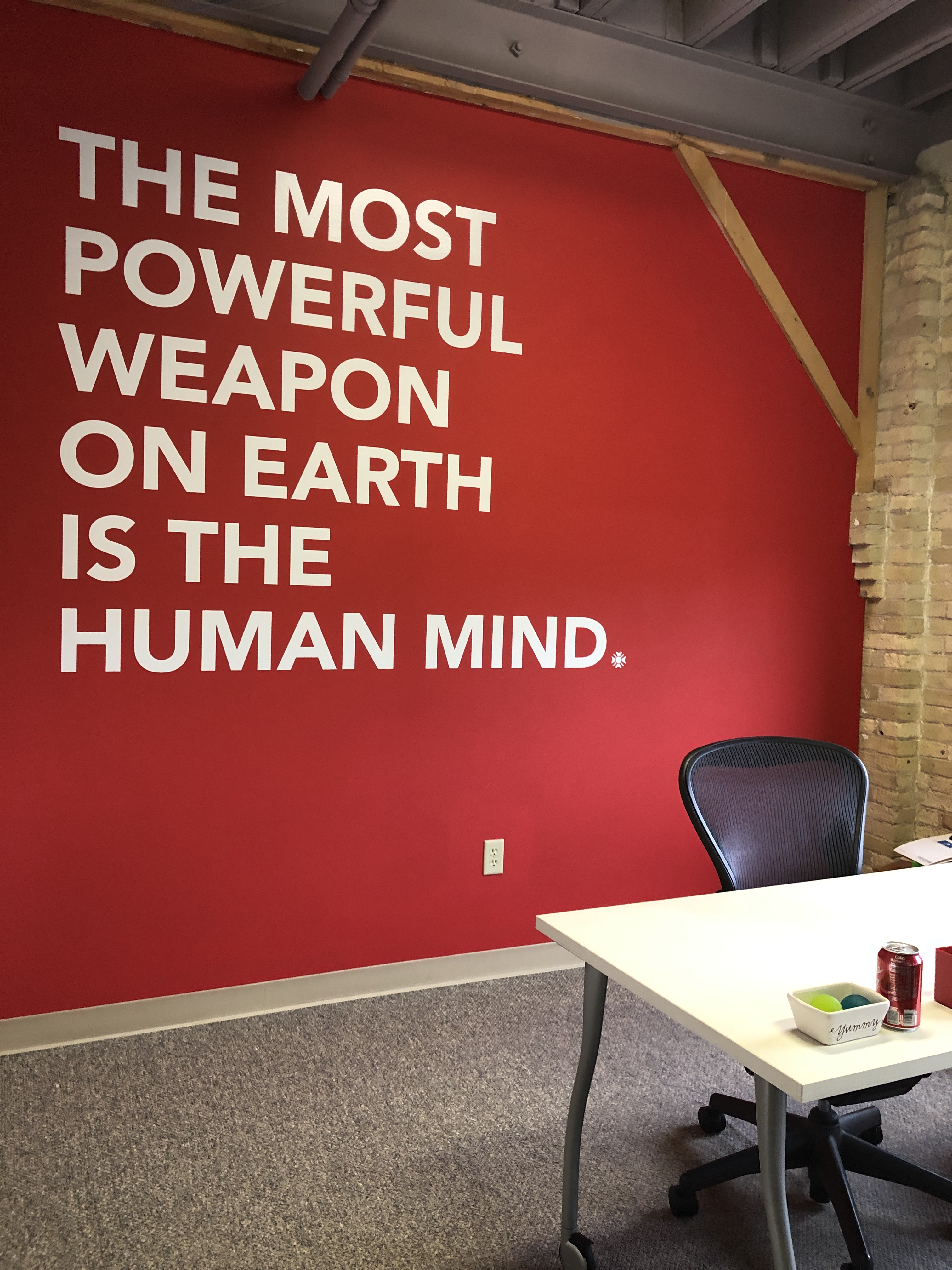
A constant reminder in our offices to think.
Turning 5 Years Old
Today, I am thrilled and proud to say The Weaponry is 5 years old! We gave grown significantly each year. And despite the global pandemic, 2020 was our best year yet. Now 2021 is off to a strong start. We continue to add to our team. And we have added 2 new clients in the past 2 weeks.
From a trip to India in 2018 to work with our clients Fifth Third Bank and SLK Global Solutions. I didn’t get the White Shirt Memo.
Funner Entrepreneurial Facts
The Weaponry has offices in both Milwaukee and Columbus.
We have 24 clients
We have clients in all 4 US Time Zones.
We have clients in 3 countries: The United States, Canada and India.
We offer Health Insurance and Dental Insurance
We have a 401(k) plan with a 4% match
We have two red refrigerators
Both of our offices are in Suite #206 (Although the signs say Sweet #206. Because I thought that was funnier. Those are the kinds of dumb things you can do when you start your own business.)
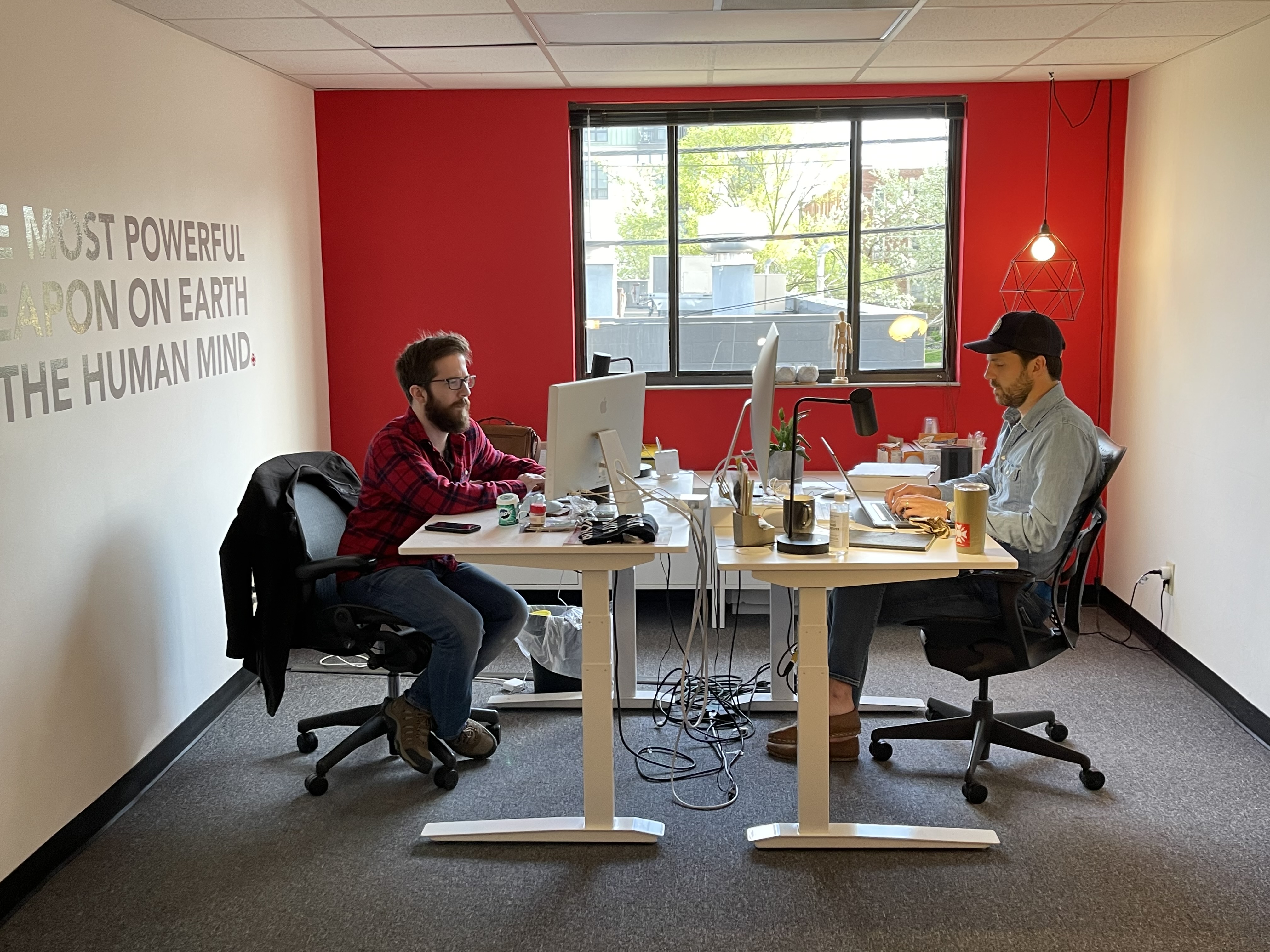
This is where the magic happens.
What’s Next?
I feel as if we have only just begun, like Karen Carpenter. We have much more to accomplish. We expect us to grow and expand significantly. It is clear that we are having great success with happy clients who have hired The Weaponry 2 and 3 times as they have changed jobs. Which I think is the best compliment a client can give you.
Our 3 Pillars of Success.
Before we won our very first client (Global Rescue), I declared The Weaponry’s recipe for long-term success. And unlike that finger-licker Colonel Sanders, I am happy to share it with you.
Great Creative Idea
Excellent Customer Service
A Fun Experience for Everyone Involved.
Me and Dan Richards, CEO of our first client, Global Rescue. We were trying to look tough while wearing polos.
What’s Next?
If we continue to deliver on these 3 points we will enjoy perpetual success. And while I am very thankful to have made it to 5 years, I believe the job of leadership is to keep a business in business forever. To do that we will have to continue to listen, learn, adapt and improve. I am fully committed to it. Just like a streaker.
Key Takeaway
Entrepreneurship isn’t easy. In fact, it offers one of life’s greatest challenges. But if you want to try it, I highly encourage you. It is extremely rewarding in more ways than I have room to share in a concluding paragraph. To dramatically improve your chances of success start a business doing something you know well. Choose work you love to do. And you will have the intellectual equipment and the magnetic pull to get you to 5 years and beyond.
*If you know someone who could benefit from this message, please share it with them.
When you set out to start a new business people give you lots of encouragement, advice, warnings and worried looks. Even so, you don’t really know what lies ahead. You wonder what will be worse than expected, what will be easier than expected and what to expect when you are expecting (unless you already have that baby book).
Cash Money
A topic that everyone warned me about when I started my advertising and idea agency, The Weaponry, was cash flow. The basic issue is that you get paid for your work, and you have to pay bills, like salaries, rent and insurance. The problem is that you don’t always have an equal amount of money coming in as you have going out. Which means that you must have enough cash on hand to cover slow payments, slow months of work, or larger-than-usual expenses.
What I’ve learned
Cash flow challenges aren’t necessarily a result of a customer being delinquent in paying invoices. The challenges can simply be a matter of timing. Your projects, or deals, may take longer to complete, so it takes longer to bill, and thus longer to get paid. If you are delayed in sending out your invoices, that can funk up your cash flow too.
Avoid At All Costs
But regardless of the reason, running out of cash on hand is a common cause of death for businesses of all sizes. It is a lot like humans running out of oxygen, or blood. Which I’ve never done. But I know some people who have, and they wanted me to tell you to avoid it at all costs.
If you are thinking about starting a business, or already have a business and could use some advice, here are a few tips to keep the cash flowing and your business going.
5 Cash Flow Tips
Don’t quit your job until you absolutely have to. A salaried job helps the cash flow in your startup in two ways. 1. It ensures that cash keeps coming into your world. 2. It decreases or eliminates the need to draw a salary from the business in order to pay yourself. This enables cash to build in your business. Like water behind a dam baby!
Start with more cash on hand than you think you need. Don’t start a business without a reserve. Inevitably you will need it. And if you can’t float an expense because you don’t have the cash around, you clients, suppliers, partners or employees will question your business-hood. And you don’t want your business-hood questioned.
Send your invoices as soon as the work is complete. Entrepreneurs have a lot of demand on their time. So it can be easy to let your invoicing slide while putting out fires and keeping plates spinning. But you have to keep your invoices flowing if you want cash to flow into your business. A good bookkeeper, aka God’s Gift To Entrepreneurs, and a repeatable invoicing process can help ensure that you don’t fall behind on this process.
Delay adding salaried employees until you have a 3-month runway. We began The Weaponry with a freelance workforce. I wanted to be able to see 3 months of sustainable work ahead in each discipline before I committed to hiring a full-time, salaried employees for that role. The 3-month rule has been a very good guide for us. For other businesses the timing may vary. Regardless, develop your own rule of thumb, and enforce it.
Keep 3 months worth of salary in reserve at all times. You never know when the demand for your product or service will go dormant. It doesn’t mean it won’t come back. But you have to be able to weather the winter in order to be around when the demand springs up again. Having the cash reserve on hand is like a squirrel storing nuts. A three-month reserve is good. A six-month reserve is better. A billion-month reserve is best.
Key Takeaway
Starting your own business is extremely rewarding. But to keep the rewards coming, you have to keep the cash flowing. It is important to understand that cash flow isn’t just a part of the entrepreneurial game. It is the game itself.
*To learn more of what I have learned through my entrepreneurial journey, please consider subscribing to this blog.
In the spring of 2016 I left my job as EVP, Executive Creative Director of a large advertising agency. It was owned by a publicly held advertising agency holding company that employed 80,000 people in over 100 countries. One of the great benefits of working for a company that size was the benefits themselves. Because when you have that many people in your organization, you have Bezos-level buying clout.
More People = More Benefit Buying Power
On My Own.
I love a good adventure. So I left the cushy benefits behind and started my own advertising and idea agency called The Weaponry. I love what we have built. The Weaponry is quick and nimble. Strategic and creative. It is a really fun place to work and offers a great culture of collaboration. We have a lot going for us. But one thing we do not have is benefit-buying clout.
The Hard Part
When I launched The Weaponry I asked a lot of questions of my entrepreneurial network about a broad range of subjects. In return I got a lot of great advice. But when it came to insurance I got absolutely nothing. Unless those crickets I heard were trying to tell me something (chirp chirp… run while you can… chirp chirp).
I could tell by the lack of insights that insurance was the toughest nut for entrepreneurs to crack. Those who did comment said things like, ‘Yeah, that’s hard. I don’t know what to tell you.’ And, ‘It Sucks.’ And, ‘I would love to help you, but I would rather set the world record for most paper cuts received over a 24-hour period than talk about health insurance.’
We must protect this house (with health and dental insurance)!
Me vs Goliath
However, I am very proud to say that as of January 1st, 2018, The Weaponry offers insurance benefits. I wanted to share my experience with anyone thinking of starting their own business, or wondering how Obamacare impacts a small business and its ability to grow and compete.
Starting The Search
Over the second half of last year I began planning our employee benefits for 2018. I wanted to offer health and dental insurance. But I also considered a couple of other benefits, including life insurance for full-time employees. But as with so many other aspects of this startup adventure, I decided to simplify to make sure we completed the critical mission.
I felt like this in the beginning. Only without the suit and itchy scalp.
Research
I began with research. I learned right away that you need at least two non-related employees in your business to be able to offer insurance as an employer. We qualified. I found my way to the health insurance marketplace and started poking around and modeling various products and prices. But in a vacuum it was pretty hard to evaluate what was good, what was necessary, and what was not. From this initial poking I learned my first lesson:
Key Insight: You will not feel empowered to make a good health insurance purchasing decision if you try to do it on your own.
Broker
My business finance advisor encouraged me to talk to an insurance broker, and preferably more than one. He encouraged me to have them model a variety of options so that I could get a feel for the landscape available to me. By talking to more than one broker, he said, you can compare and contrast styles to know that you are getting the right option for you. This was all good advice. But I still didn’t know how to find a reputable broker, let alone multiple brokers.
This photo is merely a re-enactment. Although we did sit at a desk and look at papers like this, nobody wore a tie. And I didn’t wear a bracelet like the dude in blue.
My Wife To The Rescue
My wife Dawn is a smart woman, and an important part of The Weaponry brain trust. She was the one that finally got us moving in a positive direction on health insurance. How? She talked to our neighbor Sally.
Sally’s husband, Bruce is the President at EBSO, a third party administrator (TPA) benefits solutions company. However, because of our size and our specific needs EBSO couldn’t help us, yet. But Sally said that Bruce frequently partners with Jon Rauser at The Rauser Agency for clients of our size. Dawn got Jon’s contact info. And within a few days Dawn and I were sitting in Jon’s office.
Key Insight: A good wife is the best business asset in the world. This may also be true of good husbands, but I’ve never had one of those.
Before signing anything that may be photographed make sure to get a manicure.
Dawn and I met with Jon, and it couldn’t have gone much smoother. He started by offering us a range of three or four different insurance providers. Based on our preference, and the providers prevalence in our healthcare market, we quickly narrowed in on one health insurance provider. Then it was a matter of comparing deductibles to get to the final premium options. We simply had to share the ages and family status of our employees. With that we were able to see projected costs, broken down by employee.
Once we provided the names and ages of our employees who would be opting in for our insurance we had to sign a couple of forms to initiate coverage. We also needed forms signed by the full-time employees who were opting out, acknowledging that they had been offered coverage. Next, we had to decide how much of the premium we would pay for our employees. Then we had to send in a check for the first month’s premium.
Then we were done. Seriously.
We signed documents. But I never saw a stethoscope.
We Did It!
We had an employer health insurance plan! We have dental insurance too, which was easy to get. We were all grown up! And we were becoming an even more attractive place for smart creative people to work! We had climbed the most daunting mountain on the Entrepreneurial Range. And we planted The Weaponry’s flag at its peak.
Apparently when someone took a closer look at Obamacare a line came shooting out of a piggy bank’s right nostril.
Obamacare
Why was the process so easy? Obamacare. I should insert here that I am a staunchly independent voter. I grew up in Vermont where independent thinking flows like maple syrup. I think the two parties are antiquated and don’t allow for my complex vision of the world. But Obamacare made it really easy for this startup to insure our employees. There are no pre-existing conditions. We didn’t need medical exams. We didn’t need to take a lie detector test. I didn’t have to tell anyone that my Great-Great Uncle Nels choked on a peach pit when he was eight years old. (RIP Little Uncle Nellie…)
Is Obamacare perfect? No. It has driven insurance costs up by 30%. But you know what? My baseline is today. So I simply look at the price today and ask, ‘Can we afford to pay this?’ And the answer is yes.
I can’t change the costs. But what should it really cost? I have no idea. All I know is that we were able to get it fairly easily, and all we had to do was pay for it. Our premiums are not much more expensive than the COBRA prices I had been paying since I started The Weaponry.
Conclusion.
I may hate Obamacare in the future. And I certainly don’t want to ever pay more than I have to. But today I am happy to have easy access to health insurance for my team. I want to make sure they are protected. So as you follow the political fight over Obamacare, know that this independent voter, who owns a small business said it was easy to protect his team because of Obamacare. And the small price to pay is simply a larger price to pay. And today, we’ll take it.
*If you know someone thinking of starting their own business that could benefit from this story, please share it with them. If you would like to learn more from my entrepreneurial journey consider subscribing to this blog. If you have more specific questions about my health insurance experience please contact me directly. I am happy to share what I know.









 Adam Albrecht Blog