I am always looking for good ideas on how to live a better life. We are only here for a limited time. Like the McRib. So, in the words of Alexander Hamilton, or at least the words that Lin-Manuel Miranda put in his mouth, I am not throwing away my shot.
The latest idea I have been thinking about is what I am calling Exampleism. Which is like the word example, but with an ism at the end. And the idea is this:
Live in a way that everything you do is a great example for others to follow.
This is a great and valuable challenge. The best example I know of this is Jesus. He showed that if you are successful, not only will people follow in your ways, they will live better and more fulfilling lives, and they will get into heaven, buy your book (The Bible), and wear your merch (WWJD bands).
I find that when evaluating my actions and behaviors with the Exampleism criteria, I am a good example of many things most of the time, and I am a bad example of other things too often.
However, just like the Golden Rule encourages us to always think about how we treat others, Examplesism shows us every day where we are going right, and where we are going wrong, and need to improve.
When you encourage and support you are a great example.
When you smile at others you are a great example.
When you work hard you are a great example.
When you give your time, talent and Takis you are a great example.
When you neglect your health you are not a great example.
When you lie, cheat or rob casinos with 10 of your friends you are not a great example.
When you lose your temper at something your kids did instead of showing your disappointment and teaching them the right way, you are not a great example. I sometimes get this right and sometimes get it wrong. But I am working on being a better example every day.
Key Takeaway
Set your standards for all actions and behaviors. Then live up to your own standards. When you live in a way that sets a great example for others to follow you are pursuing the greatest success, and creating a great model for others to follow. That model, your example, will be the greatest impact you have on the world. And that impact will last as long as your example is followed. Which could be forever.
*If you know someone who could benefit from this message, please share it with them.
Self-improvement is a fun and exciting challenge. Perhaps the greatest challenge is that in order to improve, which strengthens your confidence and self-image, you have to do something that negatively affects your confidence and self-image. It’s a paradox. Like two physicians. Or two places to park your boat.
Here’s The Deal
To improve you must see your faults.
If you can’t see them, or refuse to acknowledge them, you can’t work on them.
You will be a clumsy dancer for the rest of your life unless you recognize the flaws in your footwork.
You will be a flawed parent or spouse unless you spot your subpar patterns. But you will be a poor golfer unless you understand your over-par habits.
You will lose out on closing the sale over and over until you understand why you are losing.
If you go to your eye doctor and don’t admit that you can’t see very well you won’t get the corrective lenses you need.
And if you don’t see the Martin Shortcomings in your actions and behaviors you won’t take the corrective actions to Pauly Shore up your weaknesses.
Those who make the most progress and improvement see their faults. Which also empowers them with the prescription for improvement.
Key Takeaway
To improve you must know where you stand today. That means acknowledging your flaws and accepting the recipe for fixing them. It is in the deficiency that we find the key to improvement.
*If you know someone who could benefit from this message, please share it with them.
Yesterday I listened to the Ed Mylett Podcast interview with Matthew McConaughey. I recently finished McConaughey’s audiobook Greenlights, which I thought was more than alright, alright, alright. And I was interested in hearing more color.
The interview was good. The answers were good. But I found myself preempting M&M’s answers with my own. In other words, when Mylett asked a question, before letting M&M answer, I considered the question as if I was the one being asked.
There is great value in considering how an interview subject’s answers differ from your own. It offers an interesting contrast in perspective and philosophy. It’s kinda like hearing how different contestants on The Family Feud answer the same question. Only without the buzzer and big red Xs telling you that you are dumb.
Deep into the interview, Mylett asked M&M, ‘Do you worry?’
I thought this was a juicy question. So I paused the podcast to contemplate the question myself. And I found my own answer interesting. Because it was a 2 part answer.
The simple answer: Yes, I worry.
But I don’t worry about things beyond my control. If I can’t do anything about the subject I let it go, like the girl from Frozen. I expect that I can deal with whatever happens when it happens. But I won’t spend time fretting over what that means until it means something.
2. I use worry as an active ingredient. I worry myself into action. And typically, I worry myself into pre-emptive action. As Andy Grove, former CEO of Intel said, only the paranoid survive. And like Beyonce, Richard Hatch, and the band that sang Eye Of The Tiger, I’m a survivor.
I often worry that my actions are not enough. I worry that something will go wrong if I don’t prepare. If I don’t do my homework. If I don’t invest my time and energy properly. Then I get to work.
I worry that I am running out of time. I realize that time is my most precious resource. (Well, that and my 10 pints of blood.) In order to accomplish and experience all that I want and avoid regrets, I have to make great use of my time.
I worry forward. I worry productively. I worry with an outcome in mind. And I use that worry to help create the desired outcome. But I don’t worry that I said the wrong thing. Or that people won’t like me. Or that I didn’t lock a door. Those things have all happened. And I survived.
Key Takeaway
Used correctly, worry is a great tool. It prevents regret and pushes you to achieve more, out of concern for the alternative. But if you can’t do anything about the situation, worrying in place is of no use. Focus on what you can do to prepare, and what you can do to respond. But don’t waste a moment of your life worrying about outcomes you can neither influence nor control.
*If you know someone who could benefit from this message, please share it with them.
I recently had a talk with someone who had made a mistake. They didn’t break any rules or laws. The mistake was more of a personal accountability issue. It was like a failure on a mental fortitude challenge. The kind of mistake that won’t get you in trouble with the law, but it could get you voted off an island.
After discussing the mistake I shared 2 simple lessons with this person. Because there are lessons in everything. Kind of like high fructose corn syrup.
The 2 lessons:
Know how The Ideal You would handle this type of situation. The Ideal You provides a north star for navigating all decisions.
Allow this experience to help your self-confidence, not hurt it. This is the key difference between a learning and a losing situation.
When you identify a mistake and can quickly learn and adjust from it, the mistake is a win. A positive. A way to quickly get better. You fail fast, learn, and improve. It’s a basic success formula for startups and sitcoms with teenage casts.
When you make a mistake don’t continue to beat yourself up over it. Because then you deal with both the mistake and the loss of self-confidence. Which is a lose-lose proposition.
Mistake identification and correction should always lead to both growth and an increase in confidence. After all, you have just learned how to avoid the same mistake in the future. You are better equipped. You have more experience. And more knowledge. All of which should make you feel more confident. Like Demi Lovato. Or like you used Sure deodorant.
Pay careful attention to your mental trajectory when you leave a mistake. If you are still pointing down, you are mistaking wrong. You have already made your error. You have learned your lesson. You already know what to do better next time. So point your attitude arrow up and to the right. It is time for growth and improvement. Time to rise and shine.
Key Takeaway
When you make a mistake learn from it. Let the learning add to your confidence. Emerge from a mistake better and more prepared for whatever comes your way next. Give yourself permission to be an amateur at everything. Then just keep getting better with every mistake you make.
*If you know someone who could benefit from this message, please share it with them.
Last week I was at an independent bookstore on vacation in Seaside, Florida. I love a good independent bookstore and try to support them whenever I can. Lord knows they need all the help they can get. Because their competition is built like an Amazon.
I bought a copy of The Body by Bill Bryson. And I asked the woman at the front desk if they carried The Tiger by John Valliant. After clarifying that the book was not about Tiger Woods or Tony from Frosted Flakes, she looked it up for me. Then she let me know that it was sold out, but added that it definitely looked like a great book that they should restock quickly.
Then my wife Dawn added, ‘My husband is also an author of a great book that you should carry.’ The woman turned and smiled at me and asked, ‘Really? What is the name of your book?”
The woman lit up and replied, ‘Oooh! I am going to look that up today. People on vacation love reading self-help books.’
She then asked me for my information so she could look into the book.
And just like that, I had another opportunity to expand the distribution, readership and impact of my book. It’s easier than you think. The hard part is simply initiating a conversation about the person, business, product, service, or cause you support.
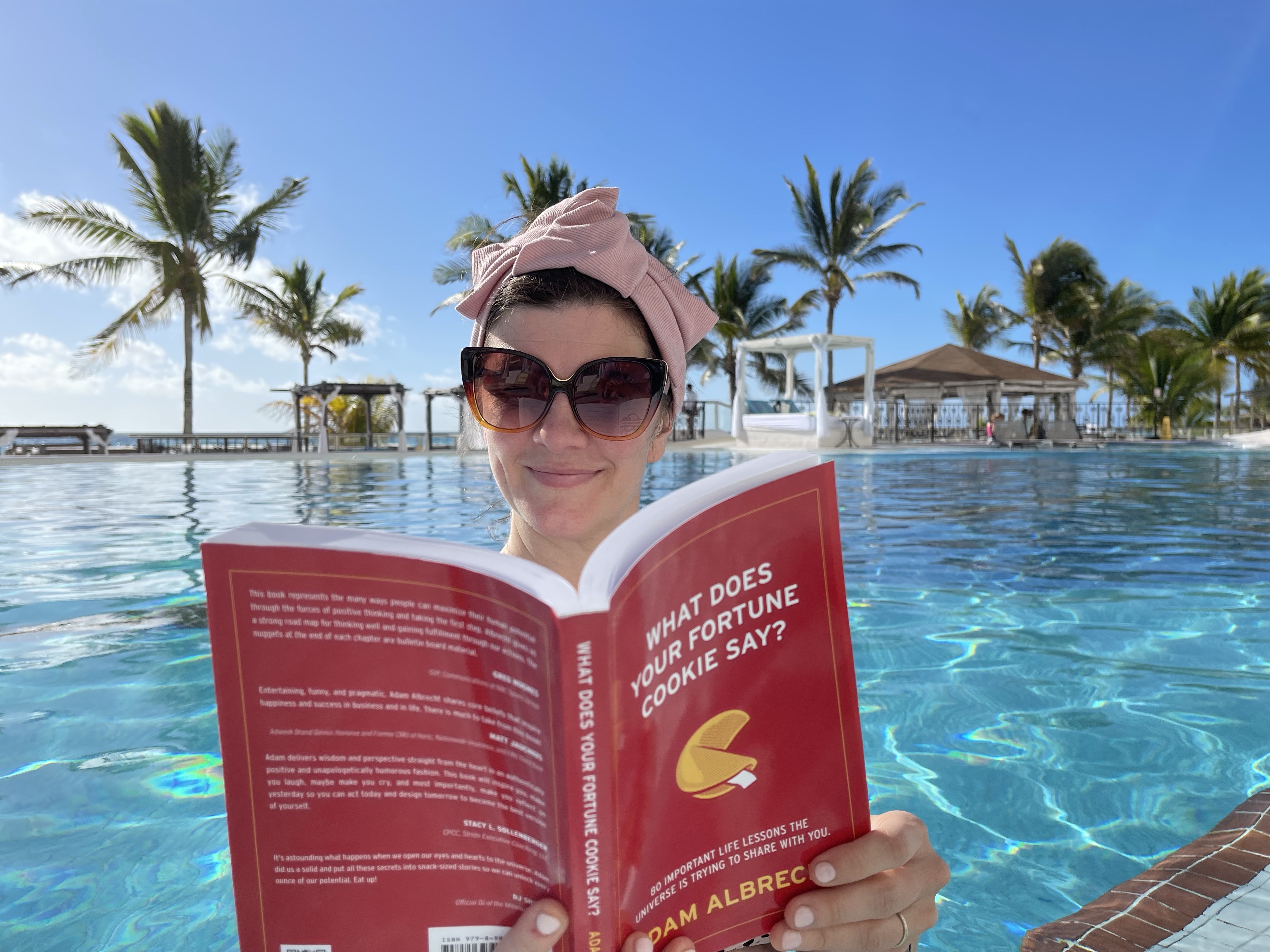
People enjoy reading my book on vacation. But then again, you can enjoy anything while relaxing in warm weather surrounded by palm trees, while wearing something cute on your head.
Dawn dramatically improved the odds of the store carrying my book simply by suggesting it. During sporting events, there is a tracker of the probability that one team will win or lose the competition based on the current score and the time left to play. Imagine that same tracker offering the odds of the store carrying my book. Before Dawn mentioned my book the odds were zero. In the moments afterward, the probability increased dramatically. Whether that was 10%, 50%, or 99 Luft Balloons, I don’t know. But even a 10% chance is infinitely better than 0.
Key Takeaway
Promote the people, products, businesses and causes you believe in. Tell people about them. Share your good news and recommendations. Awareness is key. And a word-of-mouth recommendation is the most valued endorsement because it is a first-person testimonial tied to your reputation. A simple no means you move on to the next thing. No harm done. But a yes or tell-me-more changes the future. And changing the future prospects for the better is what we are all here to do.
*If you know someone who could benefit from this message, please share it with them.
++ If you find yourself in Seaside, Florida stop into Sundog Books. The store is fun and smells like books and beach. And ask them if they carry What Does Your Fortune Cookie Say? It’s a great book to read on vacation.
When I was 16 years old I enrolled in a driver’s education course so I could get my driver’s license, my freedom and my own pair of fuzzy dice to hang from the rearview mirror.
I took the class over the summer so it wouldn’t interfere with the spring track season or the fall football season. Both of which were far more important to me than the fuzzy dice.
My great friends Greg Rozycki and Marcus Chioffi were also in the class, which made it hilarious. I still remember us trying to control ourselves when the instructor said that to make a left turn at a green light you should nose into the intersection and perch like a beaver.
Enrolling in that class paid dividends for years to come. Not just in the lessons I learned, but in real money too. In fact, the owner mailed me a check years later when I was in college when it was determined that he had overcharged students and was forced to offer a refund many years later. Ouch.
But there is one lesson from that course that sticks with me today. In one class a police officer came in to talk to us about the dangers of speeding. He said that speeding doesn’t really get you there faster. Because ultimately stoplights and traffic, even things out. And even when you speed you end up getting to your destination about the same time you would have if you just drove the speed limit.
Decades later as I reflect on this lesson I realize it was total garbage. I appreciate the sentiment, the theory, and the fact that they were trying to slow us down. After all, they had to reprogram what we learned watching TheDukes Of Hazard and Smokey & The Bandit. #yeehaw!
But the Everyone-will-get-there-about-the-same-time-anyway Theory is a lie.
In driving, and everywhere else in life, pace matters. I don’t advocate speeding on the road. And I limit myself to 8 or 9 MPH over the posted speed. Most of the time. But I know that the faster you go the quicker you will reach your goal. It works in cars. It works in career advancement, self-improvement, and wealth accumulation.
If you want to separate yourself from the crowd pick up the pace. The world rewards those who put in the extra work. You have to be ahead of the average to get noticed. And that doesn’t happen unless you move quicker.
Key Takeaway
Move faster. You have a lot to accomplish. And if you don’t pick up the pace you won’t get it all in. Separate yourself from the pack by moving faster than they do. Work harder. Work smarter. That’s what the elite in every field do. Compare yourself to them. Even if you don’t become the best of the best, you will become a whole lot better than the masses. And the rewards will be substantially better.
*If you know someone who could benefit from this message, please share it with them.
When I was in high school I participated in track and field each spring. It was the perfect sport for someone like me who lives at the Venn diagram intersection of interested-in-self-improvement and terrible-at-baseball.
Track & field is simple to understand. It provides clear and immediate feedback on both your performance and your improvement. If your times go down, or your distances go up, you improved. If your measures go backward, you are going backward. As Jerry Reed sang, ‘When you’re hot you’re hot. When you’re not you’re not.’ Nothing is subjective.
However, at the end of each season, there was one subjective element: The Awards Banquet.
At Hanover High School in Hanover, New Hampshire, there were 4 awards handed out at the Track & Field Team banquet.
1. Freshman Of The Year.
2. Most improved.
3. MVP
4 The Samuelson Award for Oustanding Athlete (The award was named after the Samuelson family that Olympic gold medal marathoner Joan Benoit Samuelson married into. Her husband Scott has now held our high school’s pole vault record for 47 years.)
During my 4-year high school track and field career, I won 3 out of 4 of our school’s awards. But there was only one of them that I really wanted.
Freshman Year
I was totally forgettable my first year. While I scored enough points at meets that season to earn a varsity letter I wasn’t turning any heads. My good friend Ben Soderholm was the Freshman Of The Year. No contest. Ben was special right out of the blocks. Looking back now I figure that God knew that his life would be a sprint and he better get started fast to get as much in as he could during his relatively short life. (I miss you bro. Also, I realize that you probably don’t read my blog posts anymore. Or do you…)
Sophomore Year
My sophomore year I improved 30 feet in the discus and 7 feet in the shot put. I placed well in our conference meet and in the state championship meet in the discus. At the banquet, I was named the Most Improved Athlete.
Junior Year
My junior year I improved another 31 feet in the discus, and another 6 feet in the shot put. I was the state champion, New England Champion, and broke our school record in the discus. I also ran some hurdles, sprints and high jumped too. None of those performances would have won me any awards other than Most Willing To Be Vulnerable. At the banquet, I was named the team MVP.
Senior Year
My senior year I won a state championship, repeated as the New England champion, and set a state record that would stand for 12 years. At the banquet, I won the Samuelson Award as the Outstanding Athlete (male or female).
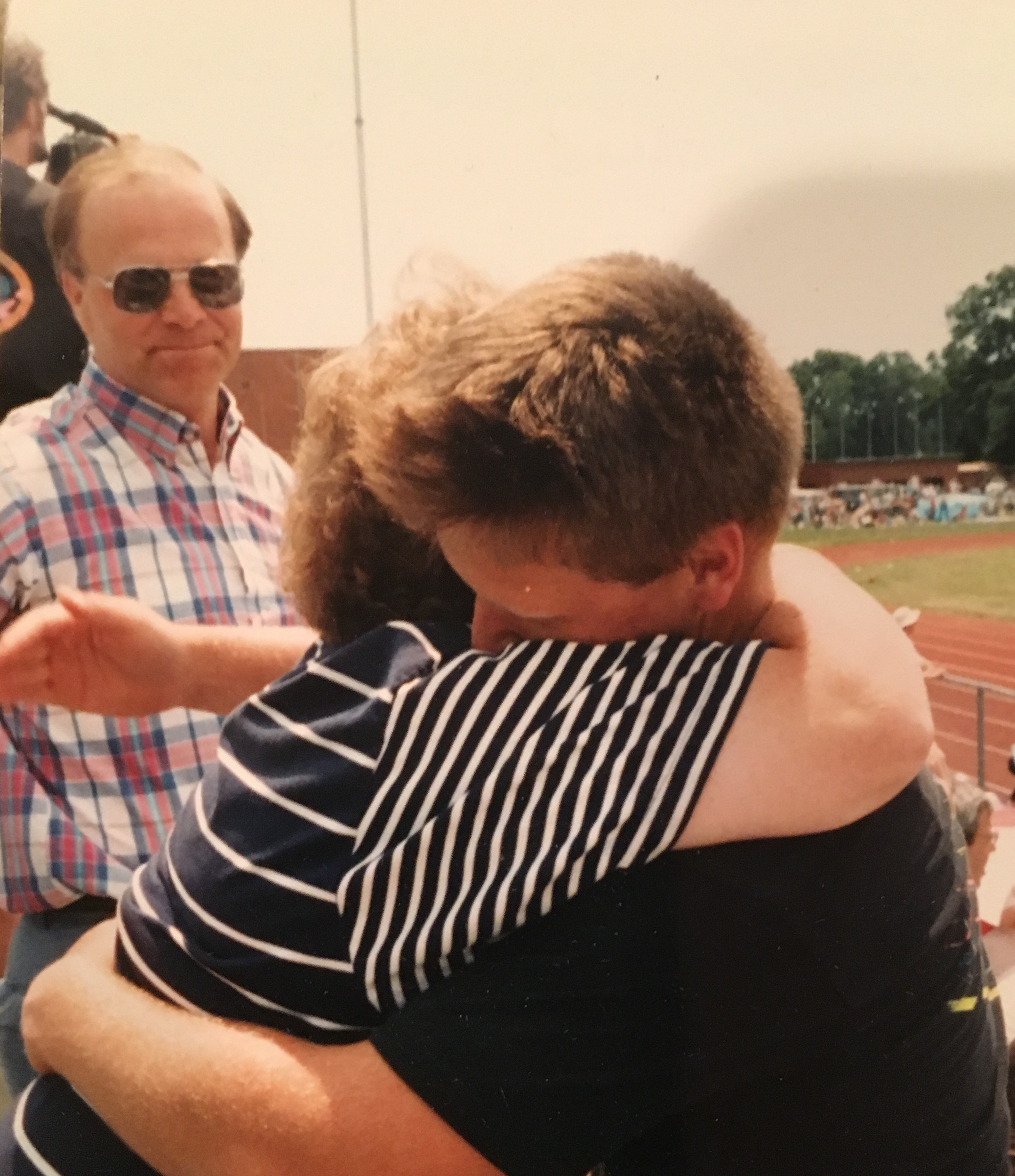
Me and my Mom and Dad after my last high school track meet in East Hartford, CT where I defended my New England title in the discus and broke the state record.
While I was certainly honored to win the Samuelson Award, I was envious of my teammate who won Most Improved. I was obsessed with that award. It was my personal quirk. But that quirk served me well. And the obsession with the MIA award is what won me the other 2 awards.
Reflection
I wanted to improve so much each year that I would be the obvious and undisputed Most Improved Athlete each year, no matter how good I became. It was a healthy obsession. (Not a case of possession obsession.) I loved the work. I loved the sacrifice. I loved the process. And I loved the results like Joan Jett loves rock n’ roll.
Looking back several decades later, I also loved what the process of improvement in track and field taught me about improvement in the rest of my life. The desire to greet each day a little better than the day before is core to my mission and my self-image.
Today, I am focused on self-improvement in various roles including:
Husband
Father
Friend
Entrepreneur
Marketer
Investor
Coach
Author
Speaker
Person who has a body. (I am focused on improving my fitness. But this construct made it awkward to state that. Sorry.)
List maker
Today, much of my self-improvement comes from reading, studying, and reflecting on what works and what doesn’t. It comes through listening to the wisdom of others. And through trial and error. It is a product of accumulating knowledge. As a result, I get better at things slowly, but steadily.
The most encouraging part of my journey is that I can feel the improvement. Just as I could tell that I was improving as an athlete thanks to the tape measure, I can tell that I am better at the 10 roles listed above. And as I get better at these, other people inquire about my approach to each of these roles. I have found that the simplest measure of your improvement in any area is whether or not people are asking you for insights and advice on that topic.
Key Takeaway
Life is one long self-improvement journey. Take what you learned about self-improvement through athletics, music, dance, acting, scouts, or any other childhood activity and apply it to your adult roles. Get a little bit better every day. The compounding effect of your improvements will change your life in ways that you can’t even imagine.
*If you know someone who could benefit from this message, please share it with them.







 Adam Albrecht Blog