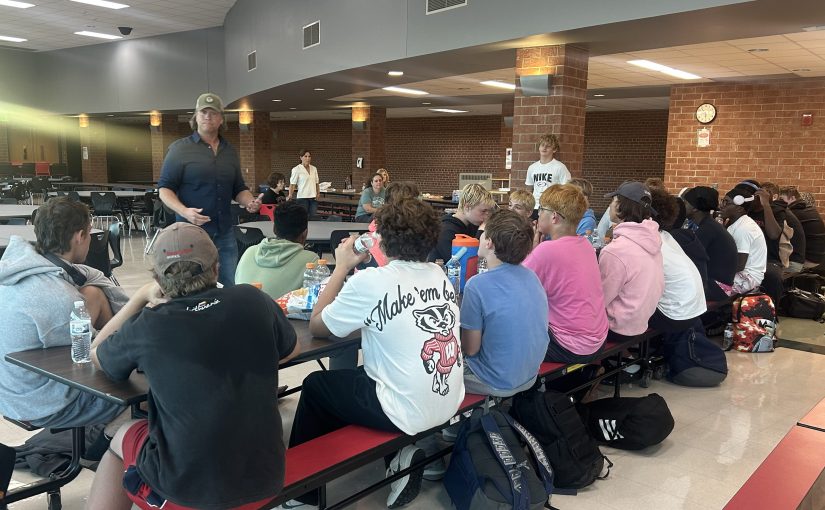
Last week I had a fun and unique opportunity. Some of the coaches and parents of my son Magnus’s freshman football team asked me if I would come speak to the team at their Wednesday night team dinner before their final game of the season on Thursday. I jumped at the chance, nearly pulling a hamstring in the process.
The team had a frustrating season and hadn’t lived up to their own expectations. Despite good coaching and plenty of talent, they were going into their 8th game with a 2-4-1 record. They were just 5 points away from being 4-3. Which is like the difference between being cute and having a nice personality.
So on Wednesday night, I talked to them about two things that could have a major impact on their final game.
First, I talked about the energy and enthusiasm they brought to the field. The psychological force you bring to the game offers a major advantage. I noticed that they weren’t bringing their full allotment of energetic horsepower to their games, and that hurt their play. (It was like their 10-gallon hat was feeling 10-gallons flat, and they hankered for a hunk of cheese.)
Then I talked about the importance of playing as a team. Even when you make mistakes, and everyone makes mistakes, you have to support each other and move forward. You have to include everyone in the team huddle, treat each other like a band of brothers, because you are stronger when you play together. Otherwise, you’ll all end up living in a van down by the river.
I also shared that when I played football and the other team started pointing fingers and fighting with each other, we knew we had won. Because when teammates fight each other, they beat themselves.
To add color, I told the team that my freshman football teammates were still many of my closest friends. We stood up in each other’s weddings. We helped each other start businesses. And even though we are scattered from New England to California, we still have a group chat, do team Zoom calls, and get together back home every few years. And we have more inside jokes than most people have outside jokes.
This group of 14 and 15-year-old boys listened intently as I encouraged them to bring their best energy and enthusiasm to the field on Thursday. They paid attention as I urged them to end the season on a high note, with the right trajectory going into the offseason, their next sports, and the next football season. I encouraged them to play like a team, feed off each other’s energy, and good things would happen.
So what happened?
From the moment the boys took the field, I could see the difference in their attitude, energy and team dynamics. They were fired up, they were connecting with each other, and ready to bring the heat. (And maybe da noize, and da funk.)
And they did.
On the opening drive, the Homestead Highlanders’ freshman team was hitting on all 11 cylinders. The boys marched down the field with attitude and scored a touchdown and a 2-point conversion to go up 8-0.
On their following defensive series, they bent, but they didn’t break. They played united as a team. Then, cornerback Markey Walker intercepted the opponent’s pass at the 3-yard line. With a key block from my son Magnus and an escort of teammates, Markey returned the interception 97 yards for a touchdown. Boom!
That play fanned the flames of their team spirit. (Not Teen Spirit.) And they just kept rolling. The score at halftime was 20-0.
They came out sharp and aggressive in the second half. Like aged Wisconsin cheddar. In fact, when the opponent fumbled the opening kickoff, our boys jumped on it. A minute later, we punched the ball in for another touchdown.
At that point, the opponent began fighting with themselves and blaming each other. And our boys knew they had won.
Our team scored again. Everyone got significant playing time. The sideline was spirited and the play on the field was inspired. The camaraderie was palpable. And the boys were a force to be reckoned with. The coaches were pumped up. The parents were proud. And when the final whistle blew, the scoreboard accurately summarized the story of the game with the final score of 33-8.
After shaking hands with the opponent, a fired-up group of young men rushed to gather in the endzone, as a team, one last time. The team energy was palpable. The pride and togetherness hung like a halo over the huddled players and their coaches. It was the perfect ending to an imperfect season. A great step in the right direction. And proof of what happens when you play together, with energy.
I am thankful for the opportunity to talk to the boys the night before their last game. I was extremely proud of the way they took full ownership of their mental approach to the game. And I am delighted to see this group finish on such a high note. I hope that over the course of their high school careers they create deep and lasting relationships with each other that last a lifetime. Like the relationships I have with my high school football teammates. And I hope that they learn the most important lesson of all. And that is that the same things that make you successful in sports, make you successful in life. Which is why youth sports are so important.
*If you know someone who could benefit from this message, please share it with them.
10 years ago, in the fall of 2015, when Donald Trump was still best known as the star of The Apprentice, I began publishing the Adam Albrecht Blog.
I had just read a book by Jeffrey Gitomer called Little Black Book of Connections, where Gitomer wrote about the importance of having a platform to broadcast your ideas. By doing so, you can share your experience and perspective with many people at once. Which is a far more effective and efficient way of connecting and staying in touch with people than communicating one-on-one. Like Hall & Oates.
At the time, I was planning the launch of The Weaponry, the advertising and ideas agency I have led for the past 9.5 years. I had already dabbled with 6 different blog attempts at that point. In each case, I stopped writing almost as quickly as I started. I simply didn’t have the motivation or the habit to keep them going.
But The Adam Albrecht Blog stuck. Like bubble gum in hair. I spend as much time writing each week as I do eating food or exercising. I spend as much time writing as I do commuting to and from work each week.
All this writing has changed my life. The blogging has led to writing books, which have led to amazing speaking opportunities all over the country. (I would also be happy to speak in any of the other 135 countries where my blog has been read.)
The writing keeps my thinking sharp, like aged cheddar. It creates something of value to contribute to the world 2-3 times each week. Remember, your value to others is directly related to your contribution.
Additionally, because I share all of this writing on broadly visited platforms, I am often top of mind when other people have relevant opportunities. Which means I get more than my fair share of great opportunities. Which is the whole point of advertising.
The Math
This is my 1,100th blog post. It’s a crazy big number to think about. But it’s a simple example of small, consistent efforts compounding over time. 1,100 published blog posts over 10 years equals 110 posts per year. That means, on average, I have published a new blog post every 3.3 days. Or 2 blog posts per week, consistently for 10 years.
If all this math talk sounds like the teacher from Charlie Brown to you, just know that I have written a lot over the past decade. And while I have shared a pile of ideas, lessons and insights with the blog-accessing world, the person who has learned the most through this process is me. Because if you don’t learn a great deal from writing that much, you probably aren’t all that smart to begin with.
11 things I have learned from publishing 1,100 blog posts.
You can’t get to 1,100 without the first step.
1. Get started.
While a journey of 1000 miles begins with a single step, a blog of 1100 stories begins with a single post. I started with a post titled The Perfect Agency Project, which I published on November 9th, 2015. (That was also the name of the blog for the first few years.) Two days later, I followed up with a post titled The perfect agency could be like the DMV. On November 17th, 2015, I published the seminal work, The A-holes Rule. And I was off and writing.
Those first 3 posts gave me a taste for what could be. Just like Neil Armstrong said, it was the first small step that mattered most. If you want to create a blog, podcast, YouTube channel, newsletter, column or any other knowledge share, don’t overthink it. Just get started. That is the pass/fail of any undertaking. Action is the best teacher. You can figure out the rest as you go. Need more help here? Try reading Why you should be an Imperfectionist, like me.
This is my blogging in-action shot.
2. Write About Things You Really Care About.
This makes all the difference. Don’t just write about things you think you should write about. Choose things you really care about, and really think about. It will mean you have a deep well of inspiration. I write regularly about advertising, entrepreneurship, business, creativity, and self-improvement and human relationships.
Unlike a magazine, newspaper or professional blog, the beautiful thing about a personal blog is that you don’t have anyone telling you what you can and can’t write about. I have developed a rule not to complain in my blog posts. But other than that, anything goes. Including these random posts about the fly that landed in my ranch dressing and a strange encounter I had at my local Piggly Wiggly.
3. Create A Strong Writing Habit.
I quickly realized that the best time for me to write is first thing in the morning. I wake up at 6 am and write for an hour, Sunday through Thursday. I don’t think about it. I just do it, automatically. Like Nike.
My writing habit was created in the first year, and it made everything easier. Find a time that works for you every day, or every weekday, or every weekend day, and make it happen. Then watch the production pour in. As Will Durant (not Aristotle) wrote, “We are what we repeatedly do. Excellence, then, is not an act, but a habit.” If you consistently write, you are a writer. And as Matthew McConaughey said, “All write, all write, all write!”
4. Don’t Worry About Readership.
I would love it if every blog post was read by millions of people. But I learned early on that even when you write really good posts on really important topics, you never know what is going to be read and what won’t. You’re blog relies on a series of algorithms to get in front of people. Whether you are posting it on WordPress, sharing on Facebook, LinkedIn, Medium or other platforms, the algorithms play gatekeeper. So write to positively impact just one person, and you have created real value. I also learned that it is valuable to create your own newsletter so that you control the channel. So write good posts that offer value. That is all you should ever care about. Well, that and human rights.
I’ve never heard this guy sing, but I can tell he has a distinct voice. Or he couldn’t rock that hat.
5. Create Your Own Voice.
I have discovered that my favorite writing style mirrors my speaking style. So I write the way I talk. Which is full of random asides and pop culture references. Because that’s the way my mental machine works.
But I have also landed on a recipe that creates a distinct flavor for my writing. I want everyone who reads my work to learn a little, laugh a little and lift a little. Which means my writings should be educational, humorous and optimistic. Most non-fiction writing is educational. It’s the addition of humor and optimism that makes my writings more Rocky Road than vanilla. Find your own flavor. Blogging is great for helping you find it. Just keep writing and experimenting until you find a style that suits you. Like a business suit, jumpsuit or birthday suit.
6.Start A Draft Whenever You Have An Idea.
Inspiration for posts can come from anywhere. When inspiration strikes, write the basic idea into a quick draft on your phone, computer or notebook. I currently have hundreds of unpublished drafts. In fact, my blog is so drafty I am regularly served ads for weather-stripping. Your ideas are likely to disappear if you don’t write them down. Having several drafts started gives you plenty of options to work with on days when you are less inspired to write something new.
7. Posting Brings Good Things.
Every time I publish a post something good happens. I get an opportunity or an introduction. I hear from a friend or family member. Or I get a kind, thankful or supportive comment from a reader. And sometimes, I get asked to emcee a charitable luncheon by my friend Stacy Sollenberger (second from right), where I meet a future employee who helps bring great new opportunities to The Weaponry. Or my friend Tim McKercher forwards a post to Vanilla Ice, who tweets the post out to the world. You know, that kinda stuff.
8. There Is Always Something To Fix.
When I look back at my published posts I feel like Michael Jackson looking at his face. Because there is always something I want to change. Always. I would add another example, smooth a transition, insert another joke. (Or take out a joke I would no longer make.) But the blog posts must get published. Published is better than perfect. It’s a blog. Not a book. You get a round of writing. A round of improving. And then you have to push that post out of the nest to fly or flop.
9. The Real Impact Is Not Measured In Views, Follows, Likes Or Comments.
Let me address measurement one more time. After having published 1,100 posts, I am certain that you can not measure the impact of a blog in views, followers, likes or comments. The true impact of a blog is in how it impacts a life. It is in how the story, insights, information, motivation or inspiration you share improve the lives of your readers.
Blog posts are meant to help in some way. That help is not measured in likes and comments. It is measured in things like confidence, reassurance, life lessons learned, successful actions taken, and opportunities seized. Never lose sight of this. The real impact of your blog may not be recognized for years, or even decades. Be patient. And just keep writing.
10. The Blogger Learns More Than The Reader.
When I first began writing my blog I expected to teach others a bit about the things I write about. But I learn more than anyone else. Regular writing forces a lot of self reflection, and analysis. You start viewing everything in life as lessons and insights worth sharing. The writing and editing process teaches you to clarify and refine your thinking. You draw scores of new connections and aha’s along the way. #takeonme So regardless of whether or not anyone ever reads your writings, you will profit from the writing itself.
11. You Can Create A Massive Library Of Knowledge.
My regular blogging habit over the past decade has resulted in an estimated 550,000 words published. That is the equivalent of 11 full-sized, 50,000 word books. That means I have written a shelf worth of books for your home library. It is my contribution to the compounding pile of human knowledge. And it would take you a long time to read it all. The quantity of information, insights and experiences I have shared is almost beyond my own comprehension. But, like Sonny Bono, I am glad I have shared so much. It has provided as least one more perspective for others to consider as they navigate their own adventure.
Key Takeaway
Blogging pays off. But it pays off slowly. You have to be patient. And persistent. When you are, the cumulative effect of writing and sharing good work regularly increases your value to others. Which in turn becomes valuable to you in ways that are both monetary and life-i-tary. Blogging keeps your voice and your viewpoint top of mind for others. Which means that you are both recently and relevantly recalled when opportunities surface. It works for me. It can work for you too. And despite all the tips it really comes down to this:
Think, Write, Review, Publish, Repeat.
Thanks for reading. I really appreciate your time.
*If you know someone who could benefit from this message, please share it with them.
The more options you create, the more success you will find.
Comedians know this.
The more jokes you come up with, the more likely you are to have really funny jokes.
To be a raging success, you write lots of jokes. Perform those jokes in front of small crowds. Keep only the ones that work. Toss the rest. Repeat.
If you want more innovation, explore more what-ifs. While it may only take 3 licks to get to the center of a Tootsie Pop, it took Thomas Edison 10,000 attempts to create a light bulb. (And it took Natalie Merchant 10,000 Maniacs to create a hit song.)
The more people you know, the more likely you are to know a person who can help you open the next door, overcome a challenge, or offer you a kidney.
To find your prince or princess, you must kiss a lot of frogs. Or frogettes.
To catch one muskie, studies show you have to cast an average of 3,000 times.
To create a bag of tricks, you need many tricks. (And a bag.)
At The Weaponry, the advertising and ideas agency I lead, one of our hallmarks is that we explore a lot of options.
We explore a wide variety of strategies.
We explore as many creative options as the time and budget allow.
Great advertising doesn’t come from crafting one great headline. And designing one look.
There are often hundreds of headlines explored when creating a single ad. And dozens, if not hundreds, of looks.
It creates a large population of options to choose from. And large populations increase the potential for greatness.
So consider many strategic options.
Consider many, many creative options.
Consider many candidates.
And life partners.
Write a lot of jokes.
Pick only the very best ones.
That’s how you do smart things that set you apart.
Key Takeaway
To be successful, you first have to be productive. Create lots of options. You will both become better and create better by doing more. So drill more holes. That’s how you find the gusher.
*If you know someone who could benefit from this message, please share it with them.













 Adam Albrecht Blog