All successful results are a product of these 2 simple factors.

I have competed all my life. As an athlete. As a businessman. And as a coach. I have seen how some teams and businesses always generate great results, while others never do. (Coughing: Cleveland Browns.)

I have learned what it takes to achieve great results. And like Bennifer, Hall & Oates, and Gin n’ Juice, successful results are a product of two things.

The System and The Subject.

The System is the way of doing things.

It is the process. The expectations. The values. The technique. It is the school of thought. The philosophies. It is the declared purpose and priorities. It is the tolerances permitted. It is the culture. It is the rituals and norms. And the people with other names besides Norm.

The Subject is the person being coached, led or taught.

Subjects vary in skills, talent, commitment, attitude, experience, determination, resolve and grit. They vary in natural ability and capacity. They vary in tolerance for pain and suffering. They vary in height, weight and speed. And subjects vary in loyalty, royalty, and the price they are willing to pay.

What This Means.

The system will determine how much you can get out of the subject.

The subject will determine how much you can get out of the system.

A better system will generate better results for a subject.

A better subject will generate better results within a system.

Key Takeaway

For the team to create the greatest results, continuously improve your system, and attract better subjects. For the individual to achieve the greatest results, find the greatest system.

*If you know someone who could benefit from this message, please share it with them.

+For more of the best life lessons I have learned check out my book, What Does Your Fortune Cookie Say? from Ripples Media.

5 Fast reads to get you fired up the day after Labor Day.

The day after Labor Day is one of my favorite days of the year. It’s not because we no longer have to wear sunscreen. (We don’t, right?) And it’s not because wearing white pants is now the sweetest taboo.

I love this day because it is the real start to the new year. All students are finally back in school. Football is back at all levels. And today, offices return to full strength after being down players throughout the summer.

From today until Thanksgiving, pumpkin spice joins the realm of gold, frankincense and myrrh the way Neil Young once joined Crosby, Stills and Nash. (Side note: Did you know Neil Young is now married to Daryl Hannah? How weird is that?)

I have written a lot about how freakin excited I am about this real new year. If you need a little motivation to kick off your September-centric year, here are a few quick and timely reads I suggest checking out.

5 Motivational Post-Labor Day Reads

  1. Why September 3rd is the real New Year’s Day.
  2. Why September 6th is the most important day of the year.
  3. Right after Labor Day is the best time for all professionals to do this.
  4. Two questions to refocus your career every Labor Day.
  5. Why there has never been a better time to wear white.

Have a great day! Have a great year! Keep rocking those white pants. And enjoy the no-sunscreen days! (Unless you value your skin health and prefer to avoid those avoidable diseases.)

*If you know someone who could benefit from this message, please share it with them.

+For more of the best life lessons I have learned check out my book, What Does Your Fortune Cookie Say? from Ripples Media.

One of the keys to accomplishing a lot is lazy time.

Like Morris Day, I am trying to make the most of my time.

So I try to stay busy and do a lot of stuff.

  • I am an entrepreneur. (TheWeaponry.com)
  • I write a blog and publish 3 new posts every week. (adamalbrecht.blog)
  • I have published 2 books and am working on a third. (You can find them here.)
  • I travel the country as a professional speaker. (That is still awesomely weird to write.) 
  • I coach youth football in the fall.
  • I coach high school track in the spring.
  • I have 3 kids that I try to parent right.
  • And I have a great wife that I love spending time with, and that I really want to keep.
  • Plus I try to work out at least 4 times per week.
  • And I am trying to read 3 books every month.

During my talks I am often asked how I get so much done.

Ironically, one of the keys to doing a lot is rest. (Although, like Alanis Morissette, I may have used ironic incorrectly here. Maybe it’s a paradox. Or maybe even 3 dox.)

Rest

Rest means getting good sleep at night.

It means taking quick naps in the afternoon or evening when I can.

And it means enjoying downtime. 

Sometimes downtime means a lazy few minutes, or a few lazy hours. 

Sometimes it means a lazy day.

Or a vacation.

Regular rest allows you to sustain your efforts over a longer time. It helps you avoid burnout, Spicoli. And it helps you look forward to getting back to work.

I plan to take some lazy time this weekend to rest, recharge and prepare for a strong push to the end of the year. I encourage you to too. And if Bono and The Edge are reading this, I encourage U2 to too. 

Key Takeaway

Rest is an important part of any success program. It may be counterintuitive, but rest allows you to maintain a stronger, faster and more sustainable pace.

*If you know someone who could benefit from this message, please share it with them.

+For more of the best life lessons I have learned check out my book, What Does Your Fortune Cookie Say? from Ripples Media.

How to be wildly successful through 7 seconds of effort.

This fall marks my 6th year of coaching football. I never had any interest in coaching. I started when my son Magnus’ flag football program needed parent coaches. It was only a Saturday morning commitment back then. But like the mythical slowly boiled frog, who forgot to jump out of the pot, I am now the defensive coordinator for Magnus’ 7th grade tackle football team. Which is an everyday-in-August commitment. Oy.

As a coach, I am really a student. I am trying to learn as much about football as I can to help my players play well, have fun, and be safe. But like Uncle Rico, I still have a strong desire to win.

Back to School

2 weeks ago I had a great opportunity to learn some new things about the game of football. On Varsity Day, Coach Tom Price, President of Cardinal Football, brought the local Varsity football players from Homestead High School in Mequon, Wisconsin to practice to work with the 5th-8th grade players in the Cardinal football program that feeds players into Homestead. While the high schoolers were working with our athletes, one of the outstanding Homestead football coaches on Head Coach Drake Zortmans’s staff talked to the Cardinal coaches about football.

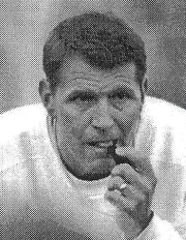
The coach, Dan Juedes, is a 70-something who is not only in the Wisconsin Football Coaches Hall of Fame, he is in the National Football Coaches Hall of Fame. He coaches at football camps across the country, including at many of the Big Ten schools. In fact, Dan has been coaching so long that when he started the Big 10 conference only had 5 teams.

Coach Dan Juedes looking very coachy.

Dan’s Lessons

As the novice coaches gathered around Dan, he shared a few gems about coaching football. His first lesson had been passed along to him by the legendary Bo Schembechler, the former head football coach at the University of Michigan. Dan told us:

‘The average football play lasts 7 seconds. All players look pretty much the same during the first 2 seconds. What separates great players from the ordinary is what they do in seconds 3 through 7.

-Coach Dan Juedes

When Dan shared this I felt like I had heard Einstein explain the Universe with E= MC2. Because Dan’s 7-second rule took a very complex game and broke it down into a very simple formula for success.

Coach Juedes carried off the field, presumably because he was tired from coaching so hard.

Josh Hunt, our 7th-grade teams’ head coach, and I couldn’t wait to share this valuable insight with our players. So once we were reunited with our athletes (and it felt so good) we eagerly shared our new insight with our team. And we have been resharing the 7-second secret every day since.

Applying the 7-Second Success Formula

On Saturday we had our first game of the season. The last thing I told the players before they took the field was to give a full 7 seconds of effort on every play and great things would happen.

But the much bigger opponents overwhelmed our team out of the gate. They ran around us and over us until they were knock, knock knocking on the endzone’s door.

But with our backs to our own endzone, defending a first and goal play from the 6-yard line our team gave a 7-second effort. My son Magnus fired across the line from his defensive end position and engaged with a tight end. He shed the blocker at 2 seconds and attacked the opposing team’s quarterback. What happened over the next 5 seconds changed everything.

Magnus sprinted after the quarterback, and not only did he tackle him deep in the backfield, he punched the ball out of his hands in the process. Our middle linebacker Jaden Daniels was also giving a 7-second effort and pounced on the loose ball. This meant that we went from our opponent having the ball on first and goal from the 6-yard line, to our team having a first and ten at the 17-yard line. Boom!

Then our offense became a 7-Second Squad. We put together an 83-yard scoring drive that led to a 6-0 lead.

It turns out that’s all we needed to win the game. Because thanks to our 7-second efforts we held our formidable and much bigger opponent to 0 points. A shutout.

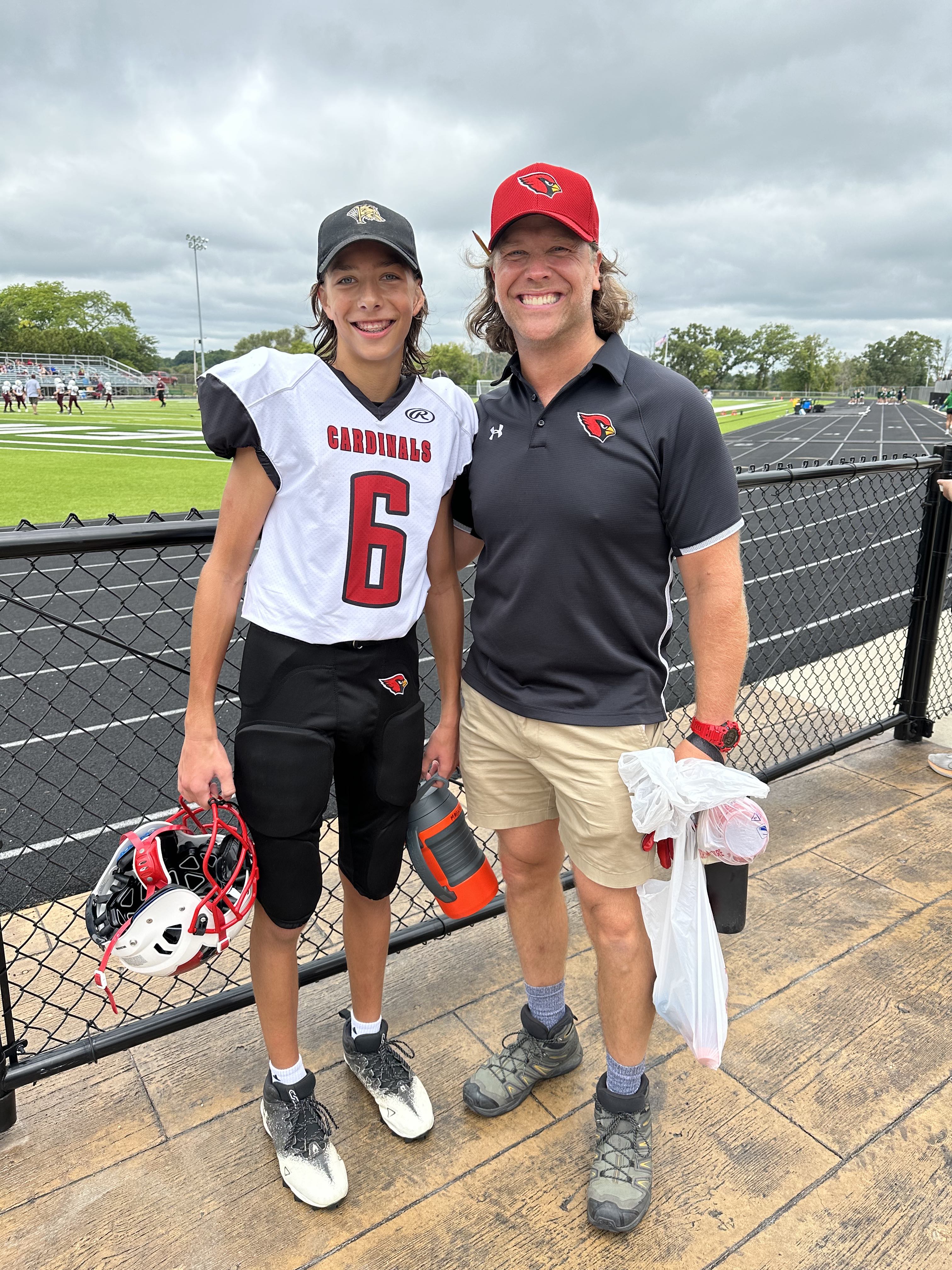
Me and Magnus after our opening game win.

The 7-Second Life Lesson

Dan’s 7-second rule teaches us to go hard to the end of every play. While everyone starts out doing the right thing on nearly every play, at some point, most people stop giving maximum effort and forfeit the advantage to those who go hard until the whistle blows.

But the 7-Second rule doesn’t just apply to football. The basic concept applies to success in all areas of life. Most people start out strong. But they give up too early. They stop or quit just when their effort is needed most. It is true in sports and in your career. It is true in marriage and in parenting. And it is true anywhere effort is needed to create results.

Key Takeaway

The difference in life is not made at the start. It is what you do after the start. Don’t stop 2 seconds in. That’s when most people let up, thinking they have done their job. Don’t fall into that trap. True success comes from your effort during seconds 3 through 7. So play the full play. Give a full effort every time. That effort and the advantage it creates compounds, play after play, day after day, year after year. Play until the end. And the end will be sweeter than you could have imagined. Just like the donuts I will bring my team today to celebrate the donut they put on the scoreboard on Saturday. Boom!

Final Note

Over the weekend as I reviewed the game film to provide feedback, I saw the 7-second rule over and over again. The great plays were made by those playing hard for 7 seconds. The best results of all came when the entire team played hard for 7 seconds. And as a proud Dad-Coach, I saw that Magnus had 3 sacks in the game and the game-winning tackle on 4th down in the 4th quarter. All of which came from giving full effort all the way to whistle. And I was amazed as I counted to 7 seconds over and over on our biggest plays. It turns out that Dan and Bo really know what they are talking about.

Also, I want to note that Dan Juedes and Tom Price have been a great help to me as track and field officials running the shot put and discus events at Homestead’s home meets in the spring. Thanks guys!

*If you know someone who could benefit from this message, please share it with them.

+For more of the best life lessons I have learned check out my book, What Does Your Fortune Cookie Say? from Ripples Media.

Why your talent alone is never enough to be successful.

There are talented people everywhere.

There is talent in the richest neighborhoods.

And in dirty tent villages.

There is talent in the best schools.

And in maximum security prisons.

Don’t ask me how I know…

Talent is not a rare gem.

It is as common as stone. Just ask Cold Steve Austin.

The great rarity is the will to invest time and energy to develop your talent.

The will to work, sacrifice, and stay the course over a prolonged period makes all the difference. It transforms your talent into valuable skills and desired results. It is that investment that separates the masses from the wildly successful.

Key Takeaway

Everyone has talent. It is what you are willing to invest to develop your talent that makes all the difference.

*If you know someone who could benefit from this message, please share it with them.

+For more of the best life lessons I have learned check out my book, What Does Your Fortune Cookie Say? from Ripples Media.
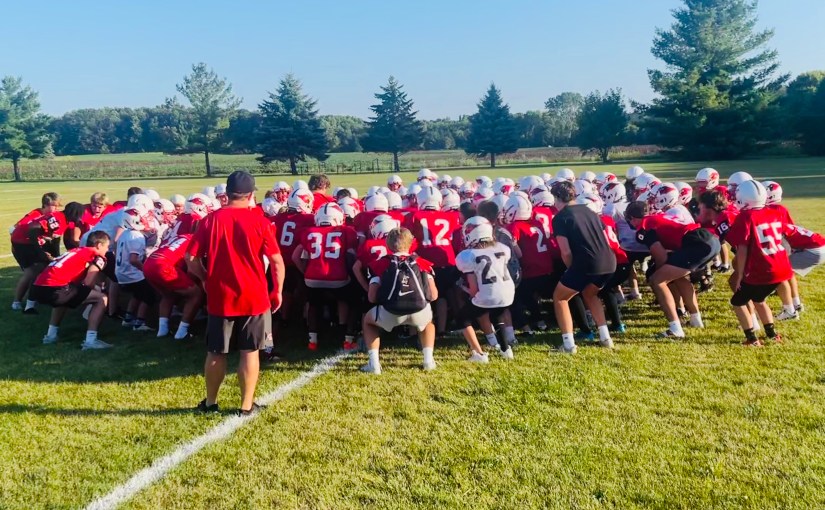
Here’s who really has my daughter excited about a $200,000 purchase decision.

My daughter Ava is about to start her senior year of high school. So this spring and summer we have toured college campuses like Goldilocks, trying to find one that is just right.

Choosing your college can be as life-altering as deciding who to marry. And as expensive as buying a house. I am expecting our costs to be between $160,000 and $200,000 for 4 years. That’s assuming Ava isn’t inspired to get a fancy pants graduate degree, which could double the cost of college, without doubling the fun.

We have taken actual tours at 6 schools. And we have done window shopping tours at 6 others. All of the campuses we have visited are roughly the same size. They are all beautiful. And they all have strong national reputations. However, one of the schools stands above the rest on Ava’s list.

But what is really driving her strong brand preference on this purchase of a potential $200,000 education is interesting.

She is not attracted to her favorite school because of the university President. Or the Chancellor. Or the Provost. (Whatever that is.) She didn’t buy the school’s t-shirt because of the Dean or because of a world-renowned professor. It’s not even the athletic director, football, basketball or track & field coach, or the politically inert mascot that excites her about this particular school.

Then Who Was It?

Ava has a strong brand preference for a specific university despite the fact that she has only met 3 people at the school.

The first is the person from the recruitment office that gave the welcome presentation. She was phenomenal. She sold me too. I wanted my daughter to go to this school to turn out like her. And I’m considering enrolling at the school myself if I find an extra quarter of a million dollars in my couch cushions.

The other 2 people that had a major impact on Ava’s brand preference were the 2 students who led her campus tour. The 2 guys, Drew and Drew (seriously), were fun and funny and friendly, and knowledgable. They ran a great 2-hour walking tour. Not only did they show us around, but they also showed us what the students on campus are like. And they were excellent ambassadors for the institution.

Who Are Your Real Brand Ambassadors?

If 2 students and the assistant director of admissions were the people who made Ava (and her parents) love one college more than the others, it begs the question, who are the real brand ambassadors in your organization?

  • Who are the people in your business that really attract or repel customers?
  • Who are the people in your association that make others want to join?
  • Who are the members of your team that really recruit great new teammates?
  • Who attracts new residents to your community?
  • Who draws attendees to your event?
  • Who put the ram in the rama lama ding dong?

Sometimes it is a strong leader that sells an organization. But it is often a store associate, a customer service rep, a receptionist, a call center employee, or the greeter at church that makes the most important impression.

The Happy Factor.

A happy team member attracts more great teammates. The smiling face draws people to an organization, regardless of wear that face falls in the pecking order.

Pay attention to your public-facing roles. They are your magnets, your money makers, and your brand builders. They will directly impact more purchase decisions than your top dog.

But if you are the top dog, recognize that the tone you set, the expectations you bring, the system you install and the processes you preside over influence the type of people you have on the front line, their happiness, and the impressions they make on others. Your job is important. But it is most important because of its impact on the way the front line represents your brand to your most important audience.

Key Takeaway

Know who your most important brand ambassadors are. Recruit for those positions well. Train them well. Empower them to do their jobs well. And treat them right. They are the lifeblood of your business development program.

*If you know someone who could benefit from this message, please share it with them.

+For more of the best life lessons I have learned check out my book, What Does Your Fortune Cookie Say? from Ripples Media.

Here’s the very best way to get revenge on your enemies, legally.

I don’t need everyone to like me.

And neither do you.

When I was a kid I recognized that there were people with whom I got along well, and others who were like a downer to my upper. Or oil to my water. Or plumbers crack to my suspenders. In other words, we just couldn’t exist in the same space.

As an adult, I am fortunate to have a lot of friends. But I still have people that don’t like me. I bet you have people who don’t like you too. It’s a sign that you are doing things the right way. Or that you are a psychopath. (If you are a psychopath none of the rest of this lesson applies to you.)

I have found that the people that clearly don’t like me have a different value system than me. For example, I think people should be honest and kind. While I find that most people I don’t get along with don’t value honesty and kindness. And neither do their feral children.

While I tend to make friends quickly, I make enemies just as fast. I don’t attempt to convert my enemies into friends. Instead, I think about getting revenge. And the best way to get revenge on your enemies is to constantly disappoint them.

How I disappoint my enemies:

I disappoint my enemies with my successes.

I disappoint my enemies with my continuous improvement.

I disappoint my enemies with my resilience to setbacks.

I disappoint my enemies by not responding to their invitations to stoop to their level.

I disappoint my enemies by amassing more friends who align with my values.

I disappoint my enemies with my indifference to them.

I disappoint my enemies by smiling, laughing, and enjoying every day, especially in front of them and their feral children.

Key Takeaway

Use your enemies to your advantage. They are excellent sources of motivation. Disappoint your enemies with your successes. It’s the sweetest form of revenge.

*If you know someone who could benefit from this message, please share it with them.

+For more of the best life lessons I have learned check out my book, What Does Your Fortune Cookie Say? from Ripples Media.

Why it’s important to know what you would do with more downtime.

Are you busier than ever, or not busy enough? A tight labor market, high demand for your work, and a strong push for an efficient workplace will keep you running from the time you clock in until you clock out, and Fred Flinstone down your dinosaur each day.

However, in an economic slowdown, there is a good chance you will not find yourself so busy. In fact, you may already have more time on your hands than you ever wanted. Or ever needed. Which sounds like the lyrics to a Depeche Mode song.

It is valuable to think about what you would do to improve your job, business or career if you suddenly found yourself with more free time on your hands. (Or wherever you carry your free time.)

Many of us have forgotten what a slow work week is like because we have been juggling all day every day for years. But a slowdown and even a layoff can be a gift if you are prepared to use your time wisely.

During slowdowns, you can:

  • Learn new skills
  • Read and catch up with the industry
  • Develop or maintain relationships
  • Improve your processes
  • Amplify your business development efforts
  • Enjoy a little rest
  • Alter the trajectory of your career
  • Get involved with industry associations
  • Start a new business
  • Volunteer your time and expertise
  • Make the moment last and feel groovy
  • Realize you move too fast, you’ve got to make the morning last. So kick down the cobblestones,
    look for fun and feel groovy.

Key Takeaway

Prepare a list of things you want to do when the next slowdown occurs. Whether that is a slow day, a slow week, a slow month, or a layoff. The plan means you will make the most of your time. The slowdown becomes an opportunity to accomplish things in your plan. Remember, time is your most valuable commodity. Use it. Don’t waste it.

*If you know someone who could benefit from this message, please share it with them.

+For more of the best life lessons I have learned check out my book, What Does Your Fortune Cookie Say? from Ripples Media.

How many times do you need to succeed to know your approach works?

When I started my career as an advertising copywriter I learned about the power of a campaign. While it is relatively easy to come up with a single idea to promote your client’s offerings, it is much more difficult to come up with a campaign.

To determine if an idea was campaignable, you had to come up with at least 3 executions based on the same conceptual idea that would allow you to broadly extend the advertising message. Think of the Got Milk? campaign, Allstate’s Mayhem campaign, or the way KFC recently reintroduced Colonel Sanders without the use of CGI, AI, or a mortician.

The campaignability of an idea is the difference between having a one-hit wonder, like Chumbawamba, and having something bigger and more useful, like Taylor Swift’s 44-song Eras Tour. (It’s funny that the Tubthumpers, who admitted to getting knocked down but claimed to get right back up again, only had one hit. Maybe it was the Whiskey drink, or the Vodka drink, or the Lager drink, or the Cider drink that did them in.)

The Rule of 3s

The campaignability rule of 3s is a great rule to apply to other areas of life as well. Because until you have had success in a specific area 3 different times you don’t have proof that you have a repeatable process for success.

For example:

Investors don’t know if they have a valid investment strategy until they have applied it successfully 3 times and gained the targeted rate of return on their money invested.

A coach doesn’t know whether their system truly works until they have had 3 teams or 3 athletes achieve great success following their process.

An artist doesn’t know how to create commercially viable or critically acclaimed art until they do it at least 3 times, without their parents buying their work.

A blogger can’t claim to have proof for their theory of 3s unless they can provide 3 examples, like the 3 I’ve listed above.

What Success 3 Times Means

Once you have had success with an undertaking 3 times, you have proven that you have a repeatable process. Once you have proof that your way works, your opinion carries more weight. You become a credible authority on that subject. In discussions and debates, your perspective has more value because it has been validated by your track record of success.

Investing

As an investor, I have had success buying stock in great companies in industries that have run into bad times. My first success was buying banking stocks during the housing crisis of 2008. I repeated that success with oil stocks in 2020. Then cruise line stocks in 2021. All of these have proven to be great investments. Which provides me with a validated approach that I could share with you.

Coaching

As a track coach all 3 of the girls who I have coached for 3 years have improved their discus throws by at least 45 feet. So I am confident in telling any young athlete I work with that wherever they start out, we will be able to improve at least 45 feet if they follow my system.

Advertising

In advertising, the approach that my team uses for developing brands has proven effective and helped drive business for our clients over and over and over again. So we are confident that our process can be applied to virtually any brand to help drive growth through marketing.

Key Takeaway

If you can achieve success in an area 3 times you have a proven process. Your experience is valuable and transferrable. Remember that you should only take qualified advice from someone who has successfully implemented the advice they are sharing with you at least 3 times. This indicates credibility and a high probability of future success. Anyone can get lucky once. But luck is not a safe bet.

*If you know someone who could benefit from this message, please share it with them.

+For more of the best life lessons I have learned check out my book, What Does Your Fortune Cookie Say? from Ripples Media.

Here’s my favorite kind of table for my favorite kind of gatherings.

When my family and I lived in Atlanta we bought a new patio table. There were a crazy number of options to choose from for something as simple as a table. Because for a table to properly perform its job it simply has to have a flat top and reliable steadiness, so the meatballs don’t roll onto your lap.

We decided on a 5-foot round table with a lazy Susan built into the middle. (Although I like to spin the center as fast as I can, so it’s more like a crazy Susan.) It was the first round table my wife Dawn and I ever bought. And it was the best furniture decision we ever made. In fact, we love that round table so much that we recently replaced our kitchen table with a new round stone-top table. (Perfect for serving stone-top stuffing.)

I have a family of five. And the round table is ideal for our family. We gather around the table and it feels like a huddle. Like a true meeting of equals. There is no head of the table. No bad or lesser seat. Eye contact is easy. And conversation flows most naturally around and across a round table. That’s why they are preferred by knights.

Key Takeaway

Remember the power of the round table. There are no lesser seats. You sit next to, or across from everyone. It is great for families. It is perfect for social gatherings. And it is a powerful setting for professional meetings. Because the round table offers a microcosm of equality and inclusion, by placing everyone on equal seating.

*If you know someone who could benefit from this message, please share it with them.

+For more of the best life lessons I have learned check out my book, What Does Your Fortune Cookie Say? from Ripples Media.