How to create your own best practice approach to practice.

My 13-year-old son Magnus plays the cello. He has been playing for 4 years and I can tell that he has a natural talent for it. But he doesn’t typically practice the way you need to to Rumplestilskin your raw straw talent into golden skill.

Last week, I tried a different approach to Magnus’ practice routine. I asked him to tell me what he thought an effective practice schedule looks like. He said, ‘I should play all 3 of my songs for the week twice every day. And I should listen to my songs once every day.’ Like everyday people.

While I thought playing the songs twice seemed too light, I wanted his practice plan to be driven by him. So I overruled my judgy internal objection and sustained his proposal.

Following our discussion, something interesting happened. Magnus followed his own prescription for a successful week of cello practice. While it was not Yo-Yo Ma level, The Yo-Yo Magnus approach got good results.

Last night Magnus had his cello lesson. He had the best lesson ever. It happened because he followed his own formula for success. And his formula was self-prescribed at a strength he felt he could sustain for a week. Which is the best way to start. Then, as you enjoy the return on your time invested you are more likely to increase the input to enjoy an even better output.

Key Takeaway

Practicing is the key to self-improvement. But the key to getting yourself to practice is spelling out what you think appropriate practice should look like in your world. Create a plan that works with your timing, your energy and your desired outcome. Once you have set your own plan based on those criteria, you are more likely to follow through and enjoy the return on your invested time.

*If you know someone who could benefit from this message, please share it with them.

+For more of the best life lessons I have learned check out my book, What Does Your Fortune Cookie Say? from Ripples Media.

How to think about your future like a great new home.

I have bought 5 homes in the past 20 years. I know a lot about the process. After all, I do it every 4 years. Which means every time you watch the Summer Olympics, vote for president, or admit you were wrong, I am buying a house.

The critical first step to buying a home is considering how much you can afford. You start with a price range, that includes the minimum and the maximum amount you would spend. You know, like something between $200,000 and $300,000. Ish.

Then you shop for your home. The final price of the house you buy falls in one of two places:

  • A. At the top of your price range
  • B. Above the top of your price range. (Am I right?)

The challenge is that once you see how good the homes at the top of the range are it is hard to settle for anything less.

Applying this to the rest of your life.

To maximize your life, approach it the same way you approach purchasing a new home.

This means that you should have minimum expectations for your life. And you should have maximum expectations for your life. This includes relationships, careers, adventures, investments, health and anything else that leads to your happiness and sense of achievement, accomplishment and fulfillment. (Basically all the ments.)

Then, like with the home buying example, push yourself to the top of your range. Or beyond. Don’t settle for less. Always strive for the upper limit. Because when you do, you will often find yourself above it.

Key Takeaway

Imagine what you are capable of at your best. Then don’t settle for less.

*If you know someone who could benefit from this message, please share it with them.

+For more of the best life lessons I have learned check out my book, What Does Your Fortune Cookie Say? from Ripples Media.

Why it’s important to give yourself credit for small victories.

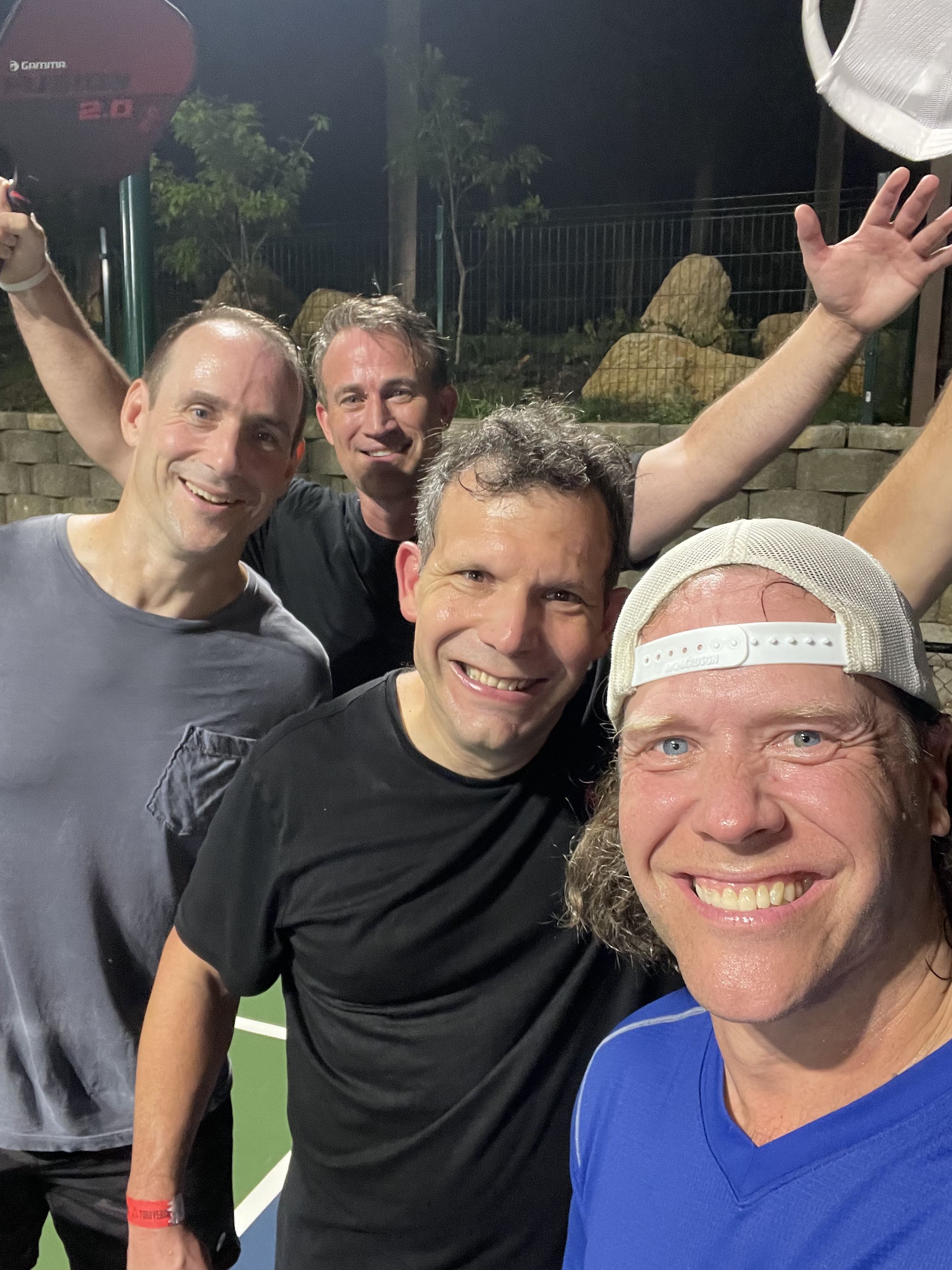
I went to Puerto Rico on a Guys’ Weekend recently. During the action-packed adventure, my friends Dan Richards, Matt Prince and James Colligan played 11 games of pickleball. I had only played the game twice before. I am not good. But that weekend I played enough to get more intelligent about the game. I am now starting to have ideas on strategies. And techniques. And excuses.

One of my greatest problems, among many others, is that I hit the ball long a lot. As I played more I wouldn’t say I stopped hitting it long. But I could see that I was hitting it less long. My shots or pickles or whatever you call them were inching closer and closer to being in the area I was trying to hit. I recognized that progress as my true, but subtle victory.

pickleball
Me and my guys on our Guys’ Weekend. Despite the fact that I know 4 guys named Guy, none of them joined us on our trip.
I guess if your name is Guy, every weekend is a Guys Weekend.

When you are learning a new skill it is important not to simply see success and failure. Pass and fail. Or right and wrong. It is valuable to recognize your progress. To note your closer and closer approximations. To identify your good misses. Like Doubtfire, Butterworth and Fields.

Skill acquisition doesn’t happen overnight. It happens as a creep towards correct. The key is to increase the percentage of times you get it right. And to shrink your range of variation. Recognize your improvement along the way, even when you are still not doing things correctly. Because it proves that you are on the right track. And it provides the encouragement you need to keep going.

Key Takeaway

When learning new skills look for small wins. Recognize the improvements that don’t show up on the scoreboard. Give yourself permission to be an amateur. It’s not about hitting the bullseye. It’s about throwing the dart, taking feedback from where it hits, and correcting accordingly. Then just keep adjusting, attempting and learning until you can’t miss. But be patient. It will take a while. All worthwhile things do.

*If you know someone who could benefit from this message, please share it with them.

+For more of the best life lessons I have learned check out my book, What Does Your Fortune Cookie Say? from Ripples Media.

How do you compare to other successful people?

There are people who are doing life better than you. They are more successful than you. They are happier. They have better careers and better relationships. And they are more enlightened on their spiritual journeys. They even have better teeth than you. Not that there is anything really wrong with your teeth. Most of your teeth are good.

But you are also doing life better than a lot of other people. In fact, there are people who would trade places with you in a hummingbird’s heartbeat. They envy your success, happiness, career, and relationships. They are also jealous of your good teeth.

Perspective Calibration

It’s important to remember both of these groups. Those who are doing better than you give you something to strive for. They provide a higher standard for you to hit. They are valuable reminders that you can do better and be better. (You better, you better, you bet.)

Those ahead of you help spur your growth. Which is a valuable gift. Plus, when you catch up to these people, and then pass them, it makes for a great scene in the movie version of your life. Which can now be made thanks to the end of the Hollywood actors’ strike.

However, just as you look to those ahead of you, others look to you as a model to strive for. Yes, others aspire to be on your level. These people provide a valuable perspective on how much you have, how good you are, how far you have come, and how much you have to be grateful for. Remember this as you dig into your cranberries and yams.

Key Takeaway

Always look both ways. See those who are better than you, and let them inspire you to grow and improve. But also see those who are behind you on the continuum of growth and development. They help you recognize your own successes, accomplishments, and gifts. Appreciating your strengths and successes yet seeing all that is still possible ahead is the golden spot in life. That valuable real estate is available to everyone willing to recognize that they are already there.

*If you know someone who could benefit from this message, please share it with them.

+For more of the best life lessons I have learned check out my book, What Does Your Fortune Cookie Say? from Ripples Media.

Create a new and improved version of yourself every day.

The world is iterative. There are new and improved versions of everything all the time. Software, apps, iPhones, laundry detergent, and watermelon. It all just keeps getting better, more valuable, and more seedless.

You have to do the same thing. Every day you should go to bed as a better version of yourself than you were when you woke up.

You will naturally learn something new every day. But if you are not actively directing your learning then the things you learn may be of little value. By following the tabloids you might learn that Matthew Perry died. But that won’t help you much unless you are a funeral director, casting director, or tabloid publisher.

Force yourself to learn something new and valuable every day. Read. Study. Subscribe to a newsletter. Listen to a helpful podcast. Get one of those 365-day Calendars. Some of my best learnings have come from those things. Seriously.

Work on your habits. They make improvements automatic. Like that Pointer Sisters song.

Improve your physical, mental, emotional, and psychological fitness too. Never settle. Settling is for dust. And 1800s pioneers.

They say that you can’t teach an old dog new tricks. But you are not a dog. Humans can learn tricks and improve themselves all the way to the last station. So let’s do this, dawg!

Key Takeaway

Always be improving yourself. Today. Tomorrow. And every day after that. You do this by starting to do better things. You stop doing bad things. Read. Study successful people. Educate yourself. Learn from your mistakes and missteps. This creates new and improved versions of You every day. And there is no limit to how great you can ultimately be.

*If you know someone who could benefit from this message, please share it with them.

+For more of the best life lessons I have learned check out my book, What Does Your Fortune Cookie Say? from Ripples Media.

The best way to be successful is to find and focus on this one thing.

You have a valuable talent. Everyone does. You probably have more than one. But just being born with a valuable talent doesn’t make it valuable. Sorry, Charlie.

To unlock the value of your natural talent you need to do 3 things:

  1. You have to recognize what your valuable talent is.
  2. You have to develop that talent.
  3. You must find opportunities to put your talent to work where it creates value.

Valuable talents could be anything. Here is a non-exhaustive list to get your introspector introspecting.

  • Listening
  • Organizing
  • Remembering
  • Strategizing
  • Pruf Reeding
  • Creativity
  • Drawing Attention
  • Details
  • Humor
  • Caring
  • Impersonating Arron Neville.
  • Managing
  • Sales
  • Art
  • Picking Locks
  • Throwing Parties
  • Music
  • Teaching
  • Making Long Lists Less Boring To Read
  • Math
  • Words
  • Energy
  • Vision
  • Mechanics
  • Relationships
  • Looking good (This talent pairs well with all others)
  • Discovering talent in others

Key Takeaway

Don’t waste time trying to strengthen your weaknesses. That doesn’t unlock the kind of value that will make you highly successful. Instead, focus on your talents. Discover them. Develop them. Put yourself in situations where you can use them every day.

*If you know someone who could benefit from this message, please share it with them.

+For more of the best life lessons I have learned check out my book, What Does Your Fortune Cookie Say? from Ripples Media.
How to respond to your imperfections like a manufacturing facility does.

I am trying to get better all the time. But the reality is that I am not always better.

I’m building good habits. But I still have bad habits too.

I try to be patient and kind. But I still get angry, lose my temper, and say naughty words.

I try to be a doer. But too often I procrastinate. (Although sometimes I don’t procrastinate until later.)

I try not to let my phone take attention away from my family and friends. But then I’ll find something hilarious on social media, or wonder about the Wordle word, or get a notification about the famous person from the 80s who got eaten by a snake, and just have to click on it to find out if it was David Coverdale.

Why? Why?

Tell em that it’s human nature.

But I keep trying.

And I don’t let my lesser actions and behaviors define me. Or confirm that I am not actually getting better. I know I am.

Instead, I always think about those signs you see in a factory that count the number of days they have gone without a workplace injury. They are reminders of your accumulated success. And encouragement to keep the streak alive. And presumably the people too.

So I have counters in my head, on my phone, and on pieces of paper around my house tallying my successful days doing or not doing various things. The streaks feel good. So I focus on extending them and not breaking the chain. But when I do, I reset the clock, start again, and try to go longer, if not forever.

Key Takeaway

Self-improvement is directional. It is not about absolutes. Increase the number of days and times you do the right things the way you want to do them in your head. Do the good things more. Do the bad things less. Focus on building your streaks. A winning streak is an uninterrupted sequence of successes. That should always be your goal. Just keep adding days. Go as long as you can without messing up. The goal is to be better for the rest of your life. But if you break the chain, always start a new chain and try again.

*If you know someone who could benefit from this message, please share it with them.

+For more of the best life lessons I have learned check out my book, What Does Your Fortune Cookie Say? from Ripples Media.

Enjoy the great results of taking just a little action every day.

Success is a stacking exercise. It is about taking a little action every day. (The way Elvis Costello wrote the book.) Just take a little action, day after day. And watch the results stack up.

Here are the types of actions you should take every day.

Reading. Read a page a day, 5 pages a day, or 10 pages a day. At 5 pages each day you will read over 1500 pages in a year. At 10 pages you will read 3650. That’s a lot of knowledge gain in the membrane.

Exercise: Exercise strengthens your body and helps you burn calories. By taking a little action every day, you stack strength gains and weight loss, or weight control. And look better naked.

Meet Someone New. If you stack a new person into your life every day you will meet 365 new people this year. That would transform your life, both personally and professionally. It would also increase the cost of your Christmas cards. And you would need a bigger budget for ham sandwiches at your funeral. But the rest is upside.

Reach out to someone in your friend circle or network every day. Make contact, rekindle a friendship, or start a conversation every day. That’s relationship maintenance. And it’s just as important as making new friends, in the same way that it used to be important to not just take pictures, but get the film developed back before digital photography came along and ruined my analogy.

Write. A journal, book, plan, blog, play, movie, whatever. Writing a little each day will help you create. And it will help you improve your own thinking. Writing my ideas down helps me more than it helps those who read what I write. Sorry.

A step on a master plan. You have a big plan, goal, or idea. I know you do. Commit to taking one action towards it every day and that master plan will come to life. That’s exactly how I built my business, The Weaponry, from dust. It’s how I wrote my book What Does Your Fortune Cookie Say? And it’s how Eric B. and Rakim went from thinking of a master plan to getting paid in full.

Play an instrument: Playing an instrument every day for just 5 or 10 minutes will stack into a valuable and enjoyable skill. Anyone can do it. You can teach yourself with learn-to-play books and online videos. Start now and you’ll be able to play Christmas songs by Christmas time. Especially if you play a kazoo.

Learn a new word in a different language. When you travel internationally you realize how many words there are to know beyond your native tongue. If you add 365 new words in Spanish, Chinese, French, Norwegian, or the language of your choice each year you would add significantly to your understanding of the world and your ability to communicate with people. Plus it’s the best way to avoid ordering Veau or Escargot if you are not into such things.

Key Takeaway

The rewards of simple actions, done every day, stack into huge and powerful piles of value. Just like money saved and invested. And little by little, they transform your life. So start today. It doesn’t take much. It just takes a little every day.

*If you know someone who could benefit from this message, please share it with them.

+For more of the best life lessons I have learned check out my book, What Does Your Fortune Cookie Say? from Ripples Media.

The 7 simple steps of the self-improvement process.

If you want to get better at anything it is important to understand the self-improvement process. Like a week, and a house full of dwarfs, it is made of 7 parts.

1. Desire is the root of all self-improvement.

If you have no desires you have no life force pushing you to improve or achieve. Or reproduce. So make sure you have a desire. Like U2. Or that streetcar in New Orleans.

2. Your desire leads to goals.

Goals are your wants clearly stated. This gives you a target. Which provides focus and direction. Or obsession. Like Calvin Klein.

3. Goals lead to plans.

Plans define a course of action to bridge the gap between you and your goals. The plan declares how you will get to your goal. It determines how you will change yourself or the world to obtain your goal. So make sure you plan, Stan.

4. Plans drive your calendar.

Your calendar determines what you need to do and when. The when, or the time you carve out to act, is critical. Time is the stage for change. You must first find and protect the time needed to act. Just like an Under Armor athlete must protect this house.

5. Your calendar drives your actions.

Action is the key ingredient of progress. It is the doing. Action is the step on the 1000-mile journey. Repeated actions create habits. Habits create more action. And more action and more action, Jackson.

6. Your actions drive your results.

Your actions create progress and momentum. Actions build the bridge. As you build the bridge you reduce the gap between you and your desire.

7. Your results deliver your desires.

Performing the right actions for long enough will create the results needed to attain the things you desire. Keep going. And keep investing your time until you get what you want.

Key Takeaway

Desire –> Goal –> Plan –> Calendar –> Action –> Result –> Attainment

Remember, the process is simple. Not easy.


If you know someone who could benefit from this formula, please share it with them.

+For more of the best life lessons I have learned check out my book, What Does Your Fortune Cookie Say? from Ripples Media.

How you can make great improvements the easy way.

When I was a kid there was a lot of motivational material around our home. Most of it was in the form of cross-stitch art. Because during my childhood cross-stitch was a popular form of philosophical expression. And my home was a hotbed of the cross-stitch movement.

Over the past several weeks one of those pieces of cross-stitch motivation has been sparkling my brain again. Here’s the memorable and rhymey message:

Progress by the yard is hard. But by the inch, it’s a cinch.

As an entrepreneur, I love this message, because it reminds me that we can build a successful business brick-by-brick, action-by-action, and day-by-day. As long as we bring the IRS along for the ride.

As a writer, it reminds me that my books and blog posts are created word-by-word. Even my 290-page book What Does Your Fortune Cookie Say? was created one word at a time. (Ok, so it was actually written one letter at a time, but that would be measured in fractions of an inch, and that makes for a clunky cross-stitch message. So we will stick with words.)

As a coach, this message reminds me that great performances are built on tiny improvements in technique, strength, explosiveness, speed, endurance, focus and mental toughness. These are almost imperceptible individual improvements, that add up, in aggregate.

As a discus thrower in high school, I improved by 30 feet each year. When you convert 30 feet into inches you get 360. Which is an inch of progress every day for 1 year. (While also allowing a day off for Christmas, New Year’s Day, My Birthday, Thanksgiving, and Tubestock on the Connecticut River.)

As a person who wants to lose weight, the inch-by-inch approach translates to an ounce-by-ounce approach. This mindset has made it fairly easy for me to lose 20 pounds in the past 11 months. I’ll be sharing more about what I’ve done to accomplish this as I reach the 12-month mark of my weight-eviction plan. (Unless I accidentally lose all of my weight and have nothing left to type with.)

As parents, my wife and I teach the progress-by-the-inch mindset to our children. It has helped them excel in academics, athletics, music and hair growing.

Key Takeaway

Set long-term goals. And create a long-term, inch-by-inch action plan. Small gains made day after day add up to big differences over time. Because the easiest way to make great gains is simply by focusing on the smallest increments of progress.

If you know someone who could benefit from this message, please share it with them.

+For more of the best life lessons I have learned check out my book, What Does Your Fortune Cookie Say? from Ripples Media.