To become a great problem solver, create backup plans for your backup plans.

I love meeting new people. And I love helping people solve problems. I got to do both of those things early one morning in 2016, and I still think about the story often.

The Story

I arrived at Hartsfield Jackson International airport in Atlanta just before 6:30am for a flight to New York City. I was flying to meet with Rachael Ray on the set of her TV show. I was neither a guest nor an audience member on her show. We were meeting between tapings so that I could present scripts for some new commercials we were going to film together. But as I stepped out of my car in the airport parking garage a panicked woman approached me saying, 

“I’m so sorry to bother you. But I just locked myself out of my car. My phone, purse, laptop and suitcase are all locked inside. I don’t know what to do.”

Talk about an exciting start to your day! The woman’s name was Kelly Harbin. She said she was flying to St. Louis on an 8:00 am flight. So we started going through our options. And yes, I said OUR options. Because as a professional problem solver, when someone brings me a problem, it becomes my problem too. Except for maybe hair loss. With hair loss, you’re on your own.

This was the scene that early morning at ATL when Kelly and I went into super solver mode.

So, like a couple of resourceful first-world problem solvers, we sprang into action! I pulled out my trusty smartphone, and we called the airport to see if they had an unlocking service. They didn’t. Boo. But they did offer us the phone number of a locksmith partner who may be able to help. Yay! 

So we called the locksmith. And yes, they could send someone to help. Yay! But not until  9:00am. Boo.

So we looked at other options. 

Me: Do you have a AAA membership?

Kelly: No.

Me: Do you have emergency services through your car manufacturer?

Kelly: No.

Me: Hmmm. Do you have any sevens?

Kelly: No. Go Fish.

Me: What time is your meeting in St. Louis?

Kelly: 11:00 am.

Me: So a later flight won’t work?

Kelly: No. And my company is counting on me to be there. We have built a technology product for this client and they are refusing to close the deal because they don’t understand it. I need to walk them through how the product works and solves their problem, or the multi-million dollar deal will fall apart! (Dun-Dun-Dun!)

Me: Do you have your driver’s license? 

Kelly: No.

Me: Why don’t we go see how we can get you through security without ID. (Heck, I got into bars in college all the time without an ID. How hard could it be?)

Kelly: (reluctantly) Let me check my car one more time just to make sure I’m not losing my mind.

At this point she walked back to her Ford Edge for another check. And I began searching on my phone for a Ford dealership that may be able to help.

A moment later she returned, slumped her shoulders and said, “You should go and catch your flight. And you can tell everyone on Facebook and Twitter that you met the dumbest woman in America. Because I have a Ford Edge. And the Edge has a keypad on the driver door.”

Me: Do you know the code?

Kelly: Yes.

Me: So you’re all set! 

 Kelly Yes!

At this point Kelly and I, strangers only moments ago, hugged, laughed and cheered on the top of the parking deck at the airport in the pre-dawn darkness. We celebrated our victory like we had just won the Showcase Showdown on The Price Is Right.


I made a new friend before 6:45am. Kelly made her flight. I got a test run on a valuable problem solving scenario. The Ford Edge got serious credit for a great problem-solving, flight-catching and potentially deal-saving feature. And as Kelly said, I got to tell all of my friends on Facebook, Twitter and LinkedIn about her morning. Kelly made the meeting! She closed that deal. And she no longer closes her car door until she has her key in hand.

Key Takeaway

Life presents an all-you-can-eat buffet of problems. The key is to become good at solving them. This means coming up with multiple ways to address the problem you face. The more solutions you consider, the more likely you will arrive at a great solve. And chances are, you’re problem isn’t as bad as you first thought it was. Just ask Kelly.

*If you know someone who could benefit from this message, please share it with them.

+For more of the best life lessons I have learned check out my book, What Does Your Fortune Cookie Say? from Ripples Media.
Why you should be an Imperfectionist, like me.

A great business is simply a collection of great people running a great process. But what makes people great, and thus collectible, is certainly a topic of debate. I am sure you have your own trait that you think makes you a valuable addition to a team. You advertise this special trait in job interviews. You are organized. Or ENERGETIC! Or cReAtIve. Or not easily bored…

Throughout my career, I have spent a lot of time interviewing job candidates. And there’s one trait I have heard people brag about more than all others. I couldn’t possibly count how many times I’ve heard people proudly state, ‘I am a perfectionist.’ This proclamation makes me want to throw up. Because if you are looking for creative thinkers and problem solvers, perfection works against you.

That’s why I proudly consider myself an Imperfectionist. So what does that mean? It means I value progress in any form. I am quite comfortable dreaming up and then sharing half-baked ideas. Or writing a first draft and passing it around for a reaction. Why? Because unbaked and half-baked ideas are available faster than fully-baked ideas. And typically, a team simply needs a ‘for-instance’ to get moving in the right direction.

I enjoy sharing ideas that are still in a moldable state. (But not a moldy state.) Sharing wet-clay ideas enables others to help form, modify and improve them before they’re finished. As an Imperfectionist, I embrace the process of creating, testing, learning and improving.

Today, speed is king. In the advertising agency business, we need to act quickly to help our clients take advantage of short-lived opportunities and thwart threats. This puts a premium on quick thinking. It’s why I like swift action as much as Travis Kelce does.

We no longer live in an era that rewards you for sitting alone in your office, with your Swingline, making sure your ideas are bulletproof before you share them.

Now don’t get me wrong. Once our team has determined a direction and we move into the execution phase, every detail matters. (Because you hate to get an execution wrong…) I will question the kerning, analyze the delivery of a line, and poke at a transition in an edit until I’m convinced we have it right. There is a time and place for this type of scrutiny. And it’s at the end of the process.

Being an Imperfectionist is what enabled me to launch The Weaponry. It is what allowed me to start this blog. It was the key to writing my first book What Does Your Fortune Cookie Say? And it is the great enabler behind all of my creative and business projects yet to come.

Key Takeaway

Be an Imperfectionist. Explore more. Fail fast. And improve faster. Share what you think are good ideas earlier in the process so that others can contribute their good ideas too. Imperfectionism is the difference between doing and dreaming. Action and inaction. It is the key to entrepreneurial thinking. And it has the power to change the world.

*If you know someone who could benefit from this message, please share it with them.

+For more of the best life lessons I have learned check out my book, What Does Your Fortune Cookie Say? from Ripples Media.

How to lean in to team building at work and at home.

I come from a large family. Actually, I come from two large families. My Dad is one of twelve children. My Mom is one of nine. Both sides of my family have made family a priority. Not only have they committed to a lot of procreating, they have committed to a lot of recreating too. Both The Albrechts and The Spraus have made pilgrimages to the Snow Mountain Ranch in Winter Park, Colorado, which has been rated as the #1 location in America for family reunions. Although how one mountain in Colorado is known as Snow Mountain confounds me. Don’t all of Colorado’s mountains have snow?

Bonding and Building

Family bonding and team building are the focus (or is that foci) of our reunions. We stay in large family cabins that house 40 to 80 people each. We play together, eat together, and enjoy general togetherness together.

On one of the days at each reunion we participate in organized team building exercises. The ranch offers a wide variety of activities that require you to learn how to work with a partner, or an entire team, in order complete a challenge.

One of two 40-person cabins we occupied at the Not-So-Snowy Mountain Ranch

The Cable Walk

One of my favorite challenges is the partner cable walk. In this challenge two partners stand on separate cables suspended 18 inches off the ground. Facing each other, the partners have to move as far along the cable as possible without falling off. The kicker is that the cables are arranged in a V-shape, so they spread farther and farther apart as you walk.

Taking Notes

When we took on this challenge several years ago with my Mom’s family, I sat back and observed the other pairs as they navigated the cables. I studied what worked and what didn’t. The best performance (farthest distance traveled) was from my brother-in-law Uriah, and my cousin Jacci’s husband, Mike. If you laid Uriah and Mike end-to-end (which to my knowledge we have never done) they would be close to 13 feet long. All things being equal, height was a major advantage.

But wait…

But all things were not equal. I quickly spotted what I thought people were doing wrong. All of the pairs who went before me held hands and started inching down the cables. While holding on to each other seemed like a good strategy, I could tell it was not the best strategy. And eventually it became a limiting strategy.

Our Attempt

Finally, using the insights from our observations, my wife Dawn and I took our turn. Unlike everyone else, we didn’t hold on to each other. Instead, we leaned against each other. As we started, we looked as if we were doing standing push ups against each other. Or maybe we looked like we got caught playing Patty Cake with crazy glue on our palms.

As we made our way along the v-shaped cables we became a human hinge, with our hands forming the connection point. As the cables formed a large and expanding V-shape, Dawn and I also formed a V-shape that allowed us to match the angle of the cables. This made all the difference. In fact, our lean-on-me technique enabled Dawn and I to travel twice as far as any other pair. Or pear. Or Pierre.

Dawn and I basking in our glory, while being shot by a very short photographer.

The Difference

It is easy to think we are teaming with others when we are in the same office, or on the same court or field. But proximity and contact are not enough. You have to reorient yourself to rely on your partners or teammates to do their jobs. You have to sacrifice your individual posture in order to create an even stronger team, machine, company or partnership.

Applying This At Work

As we grow the advertising and idea agency, The Weaponry, I know we need to continue building and operating as an interdependent team. In order to thrive we need to create a scalable organization that gets larger and broader and deeper to accommodate the increase in demand. Which means that each of our members must do what is best for the entire team. And each of us must be able to trust our teammates to do their jobs, without handholding. It is the only way to achieve our ambitious goals.

Key Takeaway

In order for the whole to be greater than the sum of its parts, we can’t simply hold on to each other. We must lean on each other. We must trust that our teammates will lean back on us. By creating this dynamic, we create a structure of support that can produce much greater results than we could ever create on our own. This is true at work, in athletics and in families. It is certainly true within our marriages. 18 years ago today Dawn and I had our very first date. Ever since then, we have been leaning on each other, and accomplishing more together than we ever could have on our own. Just like we did on the partner cable walk at the family reunion in Colorado.  


5 reasons brainstorms are a waste of your time and money.

I have an idea. Let’s not do brainstorms anymore. Most organizations believe brainstorm sessions are a great way to generate a lot of ideas quickly. While you may feel like you see a lot of new thinking in these sessions, you don’t see what you don’t see. As a professional creative thinker, I consider the brainstorm session a highly visible, but highly inefficient way to develop new ideas. I thought about hosting a telethon to raise awareness of this problem. But I didn’t know where to find ten landline telephones. So this post will have to do.

Dissecting the Brainstorm Problem

One of the reasons brainstorms are so popular is that in a one hour session you can generate a visible collection of new ideas. But the pile of ideas you leave the meeting with is misleading. Because brainstorm sessions are like gathering 100 horses and only generating 50 horsepower. You would be better off letting those ponies run alone.

horse-herd-fog-nature-52500.jpeg

 5 Problems With Brainstorms

1. Brainstorming is made for extroverts.

Brainstorming is a game where you rapidly blurt out half-baked ideas in front of a small crowd. For extroverts this is good sport. But to the other 50% of the planet this is an uncomfortable and unnatural activity. The quieter half of the population thinks more than they speak. They generate a lot of ideas on their own. Which means that the brainstorm is simply not their natural habitat for idea generation.

QGWNg5J

2. The 80/20 Rule

In line with the core tenants of the 80/20 rule, 80% of the good ideas in a typical brainstorm come from 20% of the people. Brainstorms give the false impression that everyone is birthing ideas. But this is not the reality. If you conducted a brainstorm in a petri dish, and observed it under a microscope, you would see a small population of valuable idea generators, a larger collection of evaluators, and a smattering of cheerleaders and spectators. Of course, they would all be wondering why you were staring at them through a giant microscope.

Screen-Shot-2016-09-14-at-16.02.29

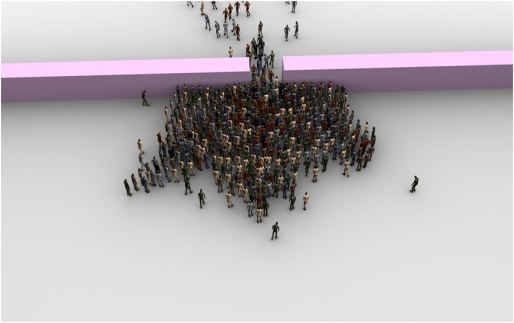
3. The Brainstorm Bottleneck.  

In a polite and orderly brainstorm session you have one person speak at a time. This is also a necessity when you have one scribe capturing the ideas and mounting them on a giant flip pad. The flip side of that orderliness is that when one person is talking, no one else is contributing ideas. There is simply not enough air time for all the ideas that should be generated by just three productive thinkers over the course of an hour.

Bottleneck

4. Invisible Clay Pigeons:

There are not supposed to be any bad ideas in a brainstorm. Participants are not supposed to evaluate or criticize ideas. But there are a whole flock of less-obvious ideas that never get tossed to the group because the thrower is afraid their idea will get shot down in the minds of the other participants. Even if the group adheres to the rules of brainstorming during the session, participants will still feel judged by the group, in silence.

Clay-pigeon-shooting-2

5. Great Brains Storm On Their Own

Great ideators generate ideas at a faster pace, with greater range and push more boundaries when working alone. A good thinker will quickly gather the low hanging fruit. Then they get to work on the rest of the tree. Then other trees. Then other orchards.  Then they harvest fruit on other continents. And finally, on other planets. You are far less likely to get a bushel basket full of Uranus Apples in a traditional brainstorm.

0bac9fb929ebc6897a1d78a4a71b47c1


The Solution

To generate the most, best and broadest range of ideas, people should always think alone first. Give your team members a quiet place, a pen and a pad of paper. The ideas will flow and fill the pages. Only after the team has thought on their own should you bring them together to share their sparkly new brain gems. During The Thinkers Reunion, you experience the Reece’s moment, when people can get their chocolate in someone else’s peanut butter. The mash-ups, surprise combinations, epiphanies and amplified ideas at this stage are far more valuable.

Key Takeaway

Stop wasting time and money on brainstorm sessions. They are not the Holy Grail of idea generation they are thought to be. Work in isolation. Then pour all the ideas together. You’ll get more and better ideas every time. If you have other idea-generating ideas  you’ve thought of on your own, please share them in the comments section.

The most common phrase you should never say.

At the Perfect Agency Project we have a fairly obvious goal. In case you’re not great at reading comprehension, the goal is to create the perfect agency. And at the perfect agency people collaborate and are nice to each other.  Which means they don’t do or say jerkilicious things.

That’s why we are banning a very common phrase you probably hear or say all the time. Ready for it? Still ready?  Further ado. Even further ado  Okay, here it is:

I don’t disagree.

Please stop saying this.  This is one of the jerkiest statements we can make to each other.  It paints your reaction in a negative light. Both don’t and disagree are negative words.  Which makes it a double negative.

As most of you don’t not know, the double negative actually makes a positive. So this statement actually says, I agree.  But it states it in the most negative, reluctant, non-affirming way possible.

Instead let us say things like I agree. Or You’re right.  Let us support each other. Let us acknowledge our alignments positively. And most importantly, let us eat more lettuce. Now if you agree with me, please respond to this post by saying, completely don’t disagree with you. It won’t make me not laugh. But it will let me know who read all the way to the end.

I Owe My Career To The Vanilla Ice Philosophy

I have a philosophy about philosophies.  It’s that everyone should have one. I believe we all need something to ground our actions, beliefs and decisions. It is our philosophies that create the bedrock of our character and our personal brands.

I also have a philosophy about the work I do as a professional creative. It encompasses why I believe advertising and marketing exist. And I stole it from Vanilla Ice. Yes, I am an evangelist of the Vanilla Ice Philosophy. What? You’ve never heard of it?  Right now consultants at Deloitte, Accenture and McKinsey are looking at each other asking, “Do you know what hell he’s talking about?” (And I know you guys read this. #analytics!)

Allow me to explain. The Vanilla Ice Philosophy was first introduced 25 years ago in Mr. Ice’s hit song, Ice Ice Baby. The philosophy emphatically states, “If there was a problem, Yo! I’ll solve it!”

It’s that simple. And it reminds me that there is only one reason agencies exist: To solve our clients’ problems. Fortunately for us, our clients always have problems (some more than others).  Sometimes they are really difficult challenges. Sometimes they are good problems to have.  But they are always there.  And solving them puts food on our tables.

I also love the attitude of this philosophy. You know, the “Yo! I’ll solve it!” part.  Because like an athlete who wants the ball, puck or frisbee when the team needs a big play, I always believe I can find a solution. So throw me the problem! Business is now my competitive sport. And I build teams full of people with the same competitive mindset.

Clients constantly warn us of big challenges or tight deadlines that make their problem difficult to solve. But our team never flinches. We’ve seen too much and overcome too many challenges. In short, we are hard to scare.

So what makes the perfect agency good at solving problems?  Again, we turn to Vanilla Ice. He doles out important instructions in the opening line of Ice Ice Baby. Because he knew in his infinite icy wisdom that the key to solving problems is to collaborate and to listen.

Collaborating means we work together. Our agency huddles together to put the best minds to work as one. We also collaborate extremely well with our clients. By representing all perspectives in the solutions we know we come up with better options than we ever could alone.

Listening means we hear the real problem to be solved. We listen for understanding. We listen for insights. We listen to hear the key problem we are trying to solve. In corporate America too much time is wasted by not hearing, identifying or responding to the real problem.

So thank you Robert Van Winkle. Over the past 25 years you’ve made great music. You’ve made us dance. And you have penned some solid philosophy that I follow every day. Word to your mother.