Take a little time to save yourself a lot of time.

A few months ago, something coo-coo happened with my default search browser on my laptop. This is not something I would typically write about. (Or read about.) But stay with me. There is a valuable lesson at the end of this techno-rainbow.

Instead of defaulting to Google for search, suddenly my computer was defaulting to Yahoo’s search engine, as if it were 1995.

For months, I would type a search into the search bar and it would take me to Yahoo’s results page, which, unlike a Snickers, was not very satisfying.

So I began to simply type Google into the search bar, then click on Google, and then perform my search once I had arrived at the Googler.

This was inefficient. And a waste of time. (But you already knew that.)

So one day I went to Google, and googled how to make Google your default search engine.

I got the answer immediately.

Because Google is good like that.

The process of changing my search engine took about 20 seconds.

And every day since then I have enjoyed a highly efficient search process.

The Bigger Lesson

The experience served as a reminder that we all have unnecessary inefficiencies that are slowing us down, wasting our time, and negatively impacting our productivity or our quality of life.

Recognize those inefficiencies and eliminate the time-wasting workarounds. Look for opportunities to improve your processes to save you time, energy and money over the long haul.

This may include improving your processes. It may include training others to do tasks so that you don’t have to. It may include fixing a broken or worn-out thing you have been working around. It may involve cleaning or organizing so that you can easily find the things you need when you need them. Which is kind of like Google in the physical world.

Key Takeaway

There are unnecessary inefficiencies in your world right now. Addressing them will take a little bit of time now, but save you a lot of time later. Seek out ways to improve your professional and personal productivity by improving your processes, training others, fixing, and organizing. It will eliminate your time-stealing workarounds. And decrease the friction in your work and in your life.

*If you know someone who could benefit from this message, please share it with them.

+For more of the best life lessons I have learned check out my book, What Does Your Fortune Cookie Say? from Ripples Media.  And consider subscribing to Adam’s Good Newsletter.

Why you need to have a need for speed.

If there is one defining factor of how the world works today versus any other time in history it is speed.

Today, everything happens faster. Not just Jimmy John’s. And Tinactin.

Communication technology has advanced from mail, to email to Slack and texting. Information arrives instantly.

News can be reported with a tweet, just seconds after it occurs.

You can stream practically anything you want to watch on demand, anytime.

AI has squeezed the gestational period of our research, discovery, query and analysis down to a mere burp.

So Why All The Slow Motion?

Yet, with all of the technology enabling us to move at Lightning McQueen-speed, I am constantly surprised by how slow many organizations move.

Nearly all technological friction has been taken out of our systems, yet human friction is still ubiquitous. K, why is that?

Human decision making, prioritization and hesitation still kill momentum, push deadlines and slow progress to a snail-mail’s pace.

The Weaponry, the advertising and ideas agency I lead, was launched 9 years ago, and the urgency of the social era was baked into our DNA. Because in the social era, opportunities come and go in a flash. In the social era, you must harvest social opportunities during the very short season when the opportunities are ripe. This can be as short as a few seconds, but never longer than a couple of days.

One of the mandates for our organization is to operate with the urgency of social media. Move quickly. Jump on opportunities. Thwart threats quickly. Move faster than other organizations. It was programmed into our genomic code from the start.

When we present timelines in our proposals, we share aggressive timelines, and note that this timeline only works if the client can keep up, and turn approvals around within our reasonable, but not generous, turnaround periods.

Yet as much as we hear about how important the work we do is to our clients’ success and how they want to get it done quickly, organizations can rarely keep up with their own ambitions. They are simply not built for speed and urgency.

While not all windows of opportunity close as quickly as social media does, all opportunities are finite.

When you fail to get your advertising in market in time, you also fail to drive sales during that time. For seasonal businesses, that is revenue lost forever. For non-seasonal businesses, it means your sales slide later in the year or into the next year. When you delay decisions, your overall revenue numbers for the current month, quarter or year are lower than they should be. That’s a loss. And an avoidable one.

My friend and client Bob Monnat, Senior Partner at Mandel Group Inc, shared some insights with me about one of his organization’s best partners. He revealed that they are great partners because they are always pushing them to move faster, to decide quicker, to get the work done so that they can ultimately turn their projects into cash-flowing assets.

Never lose sight of the reason businesses exist. They are created to make money. And time is money. The quicker you move, the more money you are likely to make.

Key Takeaway

Move faster. Today, advanced technology means that the slowest part of the process is the humans who have the most to gain. Slow actions and slow decisions cause wasteful delays. Identify the bottlenecks and pinch points in your process. Then attack them. Address your delays to help move your organization faster so that everyone can enjoy the success of speed. It is today’s competitive advantage.

*If you know someone who could benefit from this message, please share it with them.

+For more of the best life lessons I have learned check out my book, What Does Your Fortune Cookie Say? from Ripples Media. And consider subscribing to Adam’s Good Newsletter.

The greatest adapter in the world is already in your home.

Humans continuously innovate. We are always looking for better, faster smarter ways to do everything. And we keep finding it. (Which makes it odd that Bono still hasn’t found what he’s looking for.)

As a result of progress and innovation, our technology and infrastructure systems keep evolving. And to make our old stuff work with the new stuff we need adapters. In fact, there is a huge market for adapters.

But humans are the ultimate adapters. We are equipped with both hardware and software that enables us to adapt to our constantly changing environment. Darwin, Jesus, and David Bowie all knew it.

As your conditions change, always remember that you were built to adapt. You can handle whatever comes next. It is true at work, at school, at home and everywhere else you plug in. Just look at what happened as a result of the pandemic. We didn’t fall apart. We simply adapted to the new set of rules. It’s what we do.

Key Takeaway

Change is constant. Progress is inevitable. With each new wave of change there will be a new you, ready for whatever comes your way. You are not just built to survive, but to thrive. As a human, you are the greatest adapter the planet has ever known. So no matter what tomorrow brings, you will be ready to buh-ring it too.

*If you know someone who could benefit from this message, please share it with them.

For more of the best life lessons the universe is trying got share with you, check out my new book What Does Your Fortune Cookie Say? from Ripples Media.

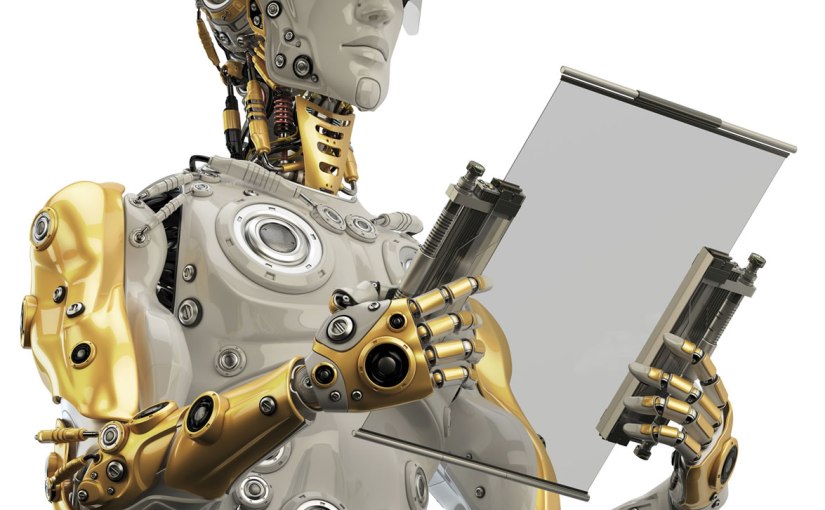
Great news! Robots are coming to take your job!

The robots are coming!  The robots are coming!  

If you’ve read anything about technology trends lately, you know that R2D2, C-3PO and their posse are rolling into the workforce like the next generation of whippersnappers, ruining things for the old guard. This is really freaking people out. Most workers respond to all this robot-revolution talk with one of two standard reactions:

  1. Robots can’t do MY job!
  2. This is terrible!

These reactions are both wrong. Eventually almost every job will be improved, if not replaced, by robots. Seriously. Lawyers, real estate agents, actors, doctors, truck drivers and singers. Don’t believe me? Let’s try a little imagination.

Robot Lawyer

A computer-brained robot can tap into a database, find and learn all of the relevant legal cases necessary to defend or prosecute a case. They can learn which arguments work most effectively, most often, by studying data. The robot’s facial recognition software will allow it to respond to witnesses and jurors. Thus, it can, and will adjust its delivery to the most impactful style, based on data. Best of all, the robot will actually listen to the human feedback, because it has been programmed to do so.

Robot Doctor

Your surgeon, who must perform incredibly precise maneuvers will be out-precisely maneuvered by Sparky the Surgical Robot, who isn’t impacted by an itchy nose, an aging body, and a crummy night of sleep. Oh, and this is alreay happening.


Robot Redford

There will no longer be an interpretation gap between directors and actors. Or casting sessions. The precisly-programmed robot actors will generate the perfect emotion on take one. Cut. That’s a wrap.

So yes, all of our current jobs will be impacted. If you can’t imagine how your job or your industry could be handled by a robot, I encourage you to use my imagination. I will walk you through the possibilities.

But this is good news.

In the beginning of humanness there were only 2 jobs:

  1. Hunter & Gatherer
  2. Home Maker

We had to find a way to free some people up to do more important work.  The key was agriculture. As soon as cave-men started cultivating crops, domesticating animals and wearing FFA-jackets, many more people were free to do non-essential work.

200 years ago, 90% of Americans lived on farms and grew their own food. In the year 1900, 40% of Americans worked in agriculture. Today, due to advances in technology, only 2% do.

Yet over the past 117 years we didn’t experiencing a rural apocalypse. Previously farm-bound Americans were freed to pursuit other interests. So they did. They went to college and created plastics and silicon and vacuum tubes. Then they created computers, rocket ships, microchips, smartphones and robots. Someone also created the Pet Rock. So it hasn’t all been useful.

At The Weaponry, we believe that the human mind is the most powerful weapon on Earth. Our minds will always reign supreme on this planet. We will continue to mechanize and automate the jobs that can be performed as well, or better, by machines. So that we can rise to an even higher standard of living, quality of life and take on even greater human challenges. We will never run out of things for humans to do. So don’t be scared. Be excited. The best is yet to come.  Isn’t that right R2?