A couple of weeks ago, I saw the band Bombargo. They were playing a free concert in a park 2 miles from my house. The band is a bundle of energy and entertainment from the off-off Broadway, town of Saskatoon, Saskatchewan. Which is also one of the cartooniest place names ever invented. The band was on their Disco Surf Rodeo Tour, because any one of those things on its own is just not enough.
For a flavor of their fun music, check out Let It Grow or Oxygen. (Songs I assume were inspired by The Lorax.)
An hour into their set, the band told an interesting story as they introduced one of their signature songs.
During the winter months, Saskatoon is often among the coldest places on the planet. And during one of those cold spells, the lead singer stopped by his brother-bandmate’s igloo home. His brother-bandmate was playing a new song idea on the piano. The lead singer really liked what he was playing and decided that they should write a song to it.
So they wrote the full song that day.
The next day, they recorded the song, shot a video for it, and shared it online.
Then something swiftdiculous happened. Taylor Swift, the most influential musician on the planet, heard the song, loved it, and added it to her Spotify playlist.
The song immediately blew up thanks to Swift’s endorsement.
The band shared that it was rare for them to work so fast and not tweak a song to death. But it was exactly this speed of creating and sharing that led to the success of the song Mr. No Good.
Reminder
Each of the ideas you bring to life is like a lottery ticket. It has the potential to pay off in a big way. So create it, share it and move on. Don’t analyze it to death. Great work doesn’t have to take a long time. Focus on creating work that you love. If you love it, there is a great chance that others will love it too.
Key Takeaway
Create things you love and share them quickly. It’s the key to being a successful artist, innovator, or entrepreneur. The world benefits from your ideas. And your ideas benefit from real-world exposure. Successful ideas are a percentage game. The more ideas you bring to life, the more likely you are to produce hits. And when you love your creations, there is a great chance others will too. So don’t die with your song in your head, your art in your heart or your startup in your soul.
*If you know someone who could benefit from this message, please share it with them.
The greatest way to increase your value to yourself and others is through reading.
You could just stop reading this post now and go grab a book to read instead.
But I am going to drop some new reading knowledge on you that is worth 90 seconds of attention.
Why Should You Read?
Bill Gates reads about 50 books a year. Or about a book each week.
Warren Buffett famously reads about 500 pages per day.
Lin-Manuel Miranda bought the book Hamilton to read on vacation in Mexico.
So read books that expand your thinking and your knowledge base.
Read to understand how things work.
Read for inspiration, motivation, and all the other great ations.
Read to understand how successful people became successful.
Read about what worked in the past in your field of expertise.
And read to learn what is changing in your field, so you can surf that change, rather than get pummeled by it.
Read to improve your writing and expand your vocabulary.
Read to develop your focus and your patience for long-term goals.
But most importantly…
Read To Separate Yourself From The Pack.
Despite all of the mental nutrition and long-term success that sprouts from reading, a new study just released by researchers at the University of Florida and University College London (which sounds like the fakest British school name ever) found that reading for pleasure among Americans has declined by 40% over the past two decades.
In 2004, 28% of Americans said they read for fun.
In 2023, only 16% said they read because they wanted to.
It is not lost on me, or the researchers, that Facebook launched in 2004 and the iPhone was released in 2007. Together, social media and smart phones may be accomplices, killing reading softly, like Roberta Flack or the Fugees.
This all means that people who read books have a greater competitive advantage now than ever before.
However, this is massively skewed by the avid readers.
In fact, estimates reveal that between 25-46% of adults READ NO BOOKS each year.
And the median number of books read annually by adults is only about 4. That’s how much the average person hates paper cuts.
Which means there are fewer and fewer people after the pot of gold at the end of the Reading Rainbow.
There are fewer people who are willing to do the slow, steady, yet transformational work of knowledge gain through reading. While others are settling for bite-sized bits of video, podcasts, and tweetable wisdom served by algorithms, readers are accumulating broad and deep knowledge that helps make them more capable, valuable and irreplaceable.
The new study also revealed that those who do read for fun are spending more time doing so. Because while haters gonna hate, readers gonna read.
And in the era of artificial intelligence, it is the humans who can contribute more than the machines that will be in greatest demand.
Key Takeaway
Now more than ever, reading is your great competitive advantage. Your self-directed education makes you a valuable and irreplaceable resource. It improves your thinking. Which drives smarter decisions and actions. And it draws other people to you who want to tap into what you know.
*If you know someone who could benefit from this message, please share it with them.
Last week, I talked to my friend Ashley Skubon about her fun wine-focused business in Austin, Texas, called Snooti. Ashley and I worked together at Engauge. The first time I met Ashley, she said, ‘My name is Ashley, by the way.’ So naturally, I asked her if she was related to any other Bytheways.
I had seen through social media that Ashley and The Snooties had introduced some exciting new offerings recently, and I wanted to get the scoop.
During our conversation, she said something that has stayed with me.
As she told me the story about the big idea she recently launched, she shared that she felt that she had been playing small ball.
Which is a way of saying that she hadn’t been thinking big enough.
In baseball or softball terms, small ball is a careful approach that focuses on small opportunities for singles, walks, bunts and stolen bases. But when you play small ball, you are not swinging for the fences. You are not hitting home runs or grand slams. And AC/DC won’t sing songs about you.
The small ball mindset can keep you in the game. But it will also prevent you from recognizing when a home run opportunity is perfectly teed up for you.
Remember, Hank Aaron and Babe Ruth are American legends for their home run hitting prowess. While Brett Butler, the all-time leader in bunt hits, is the baseball player most likely to be confused with a character from Gone With the Wind. Or Grace Under Fire.
It is easy to buy into the safety of small-ball thinking. It keeps the lights on. It allows you to live to fight another day. But it doesn’t change the world. It won’t change your fortunes, your career or your tax bracket.
Key Takeaway
If you find you are playing small ball in life, in your career, as an entrepreneur, leader, innovator or artist, it’s time to carve out time to think bigger. Consider the smash hit opportunities right in front of you. See the benefits of your big swings. They can change your trajectory and your life in an instant.
*If you know someone who could benefit from this message, please share it with them.
This spring, I began a Misogi Challenge. These are demanding personal challenges that push your limits in order to develop character, confidence and self-reliance. Win or lose, they create great stories that make your obituary a more interesting read.
Such challenges are meant to push your outer limits, with a high likelihood of failure. The 2 basic rules for a Misogi Challenge are that they should be really, really hard. But you are not supposed to die. I have found that there is plenty of room for suffering within those boundaries.
To bench press 300 pounds. Because it is hard. And it’s a nice round number. Especially the two zeros at the end.
To bench press 315 pounds. Because this is three 45 lb plates on each side of the bar, and it looks freaking awesome.
To bench press 335 pounds. Because this was my maximum bench press when I was an 18-year-old high school student. Today, I am 52 years old, and have a white collar job that requires practically no physical labor beyond keyboard tickling.
To live to fight another day. Because I also want to be smart and not push myself to an injury.
This past Sunday, I made my final push to complete my Misogi Bench Press Challenge. #punalwaysintended
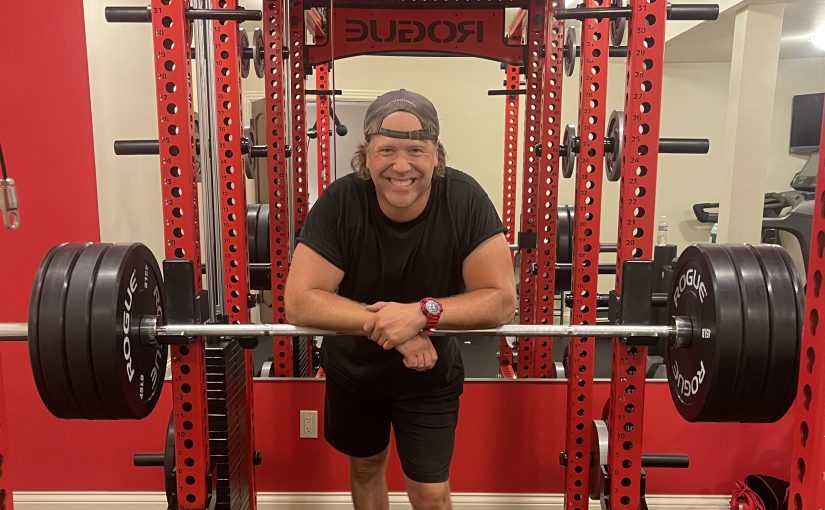
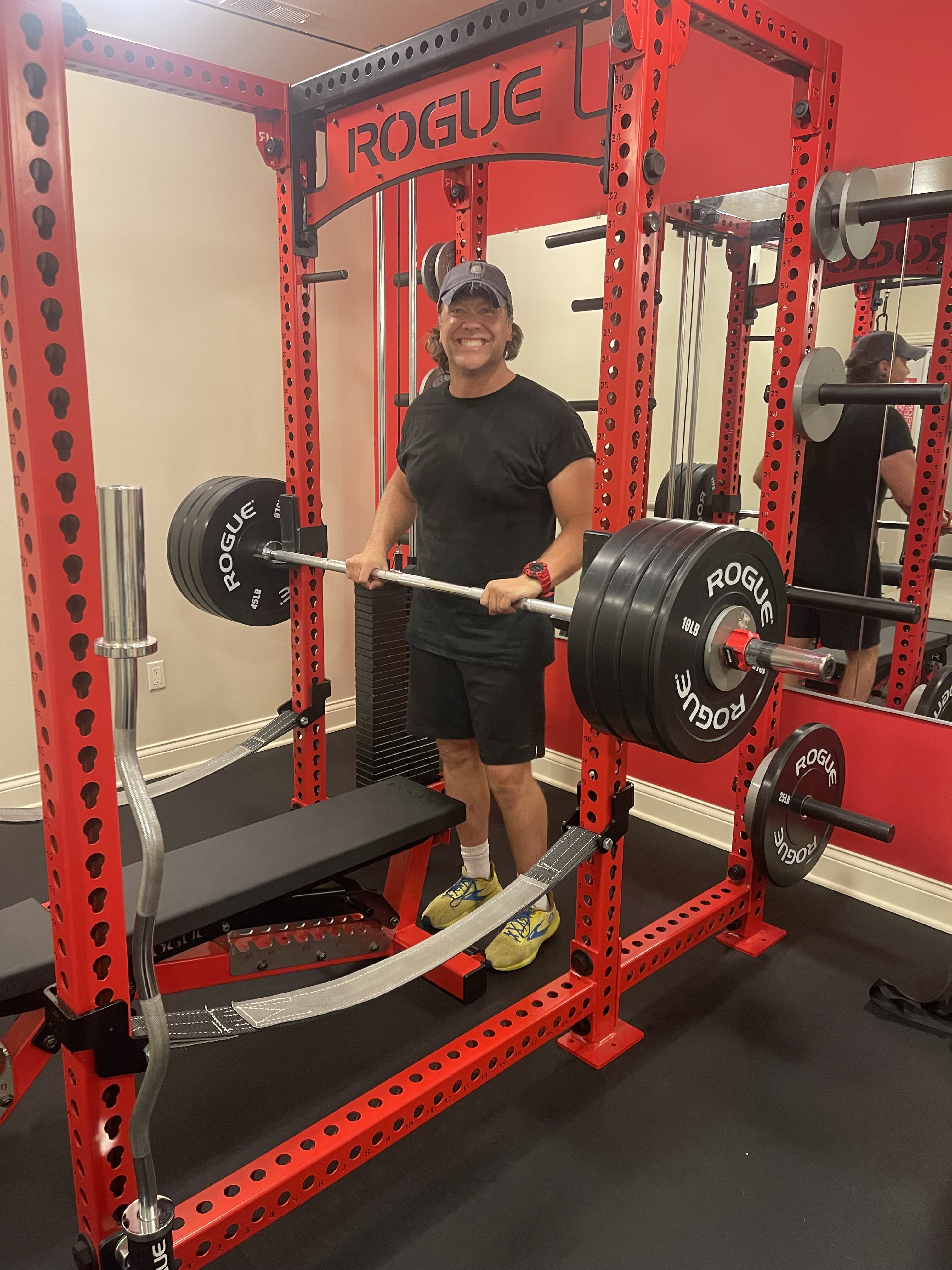
I took on the final challenge in my home gym, with my 3 teenage mutant children Ava, Johann and Magnus as witnesses. Not only did I want them with me to spot me, but I knew that having my kids in the room watching would provide additional motivation. And I needed all I could get.
If I succeeded, I would be setting a great example of hard work, determination and personal accomplishment for my kids. If I failed, I would be showing my kids that sometimes we set lofty goals for ourselves, and we fall short. But it’s the attempt that matters. It isMan In The Arena stuff. Which is also Woman In The Arena stuff.
I started with a 10-minute warmup on my Matrix elliptical machine. Then I stretched well. I believe that my commitment to warming up and stretching before my workouts has been key to my performance, injury prevention and longevity. My body still works and feels mostly the way it should. And I still have most of my original factory parts.
So I readied myself for the goal weight of 335 pounds. This was the weight that I had been focused on for months. It would answer the question, ‘Can you be as strong at 52 years old as you were when you were a high school kid, training during the peak of your high school career?’ I was a strong 18-year-old kid. I was the state champ in the shot put. I was the New England Champion in the discus. And I never saw another kid in my high school bench 335 lbs or more.
To hit that same weight 34 years later was a daunting task. But a major win if I could do it. Because coming up just 5 lbs short of the mark would mean that I wasn’t quite as strong as I was at 18. Certainly understandable. But also a bummer to lose the competition with my 18-year-old Zubaz-wearing self.
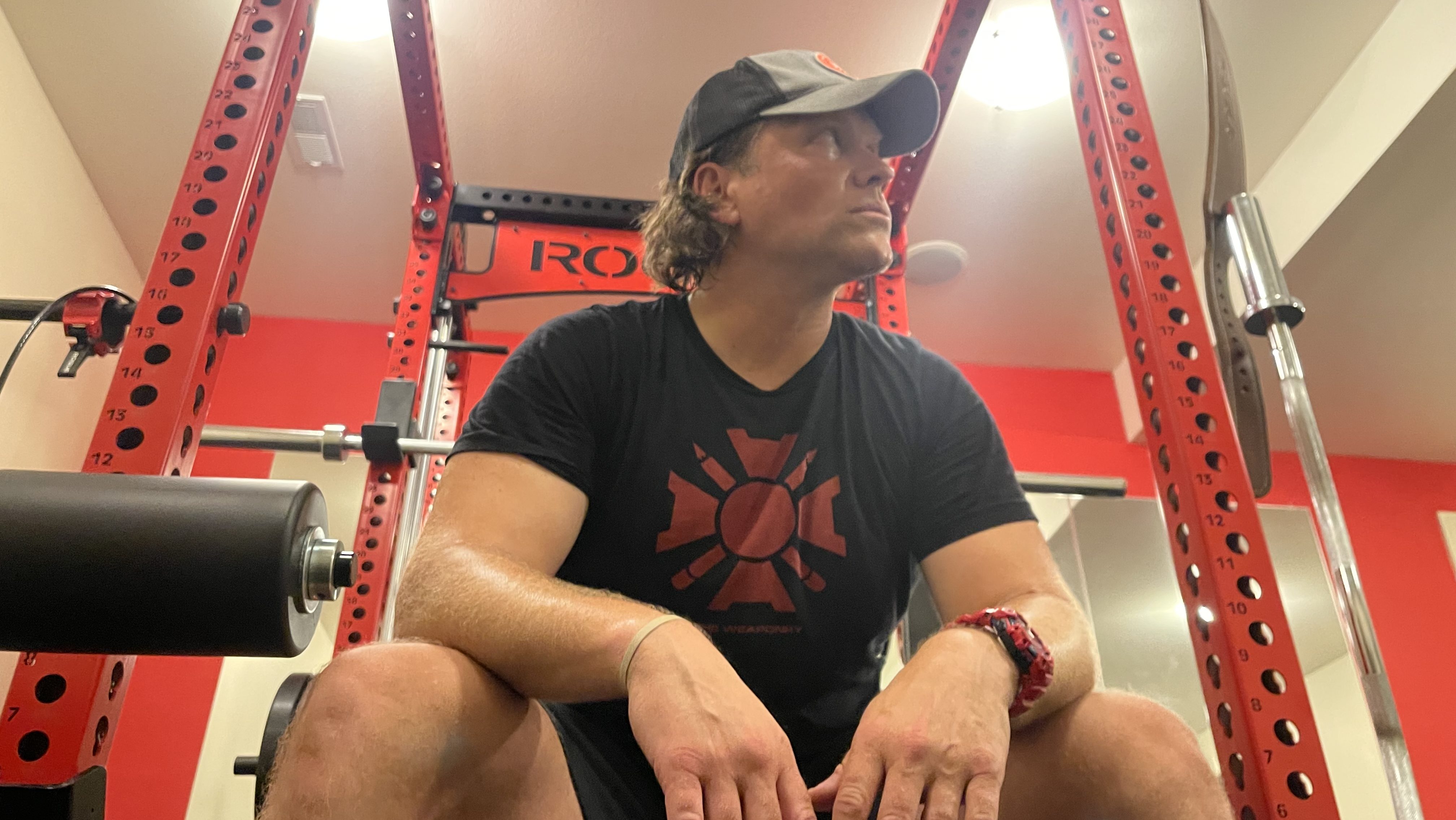
I prowled around the room, yelling motivation to myself. I have always been my own best hype man. I worked myself into a lather in a process I call Summoning. The basic premise is that we all have some maximum physical capability. The key to acheiving the maximum physical performance is to summon as much of your capacity as you can. So I summon as much energy, focus and fury as I can. It may be a little embarrassing to see on film, but it has always driven results. So I go with it.
I had Limp Bizkit’s Rollin’ (Air Raid Vehicle)on 11 in my AirPods. This is my go-to bench press song. Something about the lyrics (Breathe In now Breathe out, Hands up now Hands down…) feels highly appropriate for bench pressing. Plus, swear words get me hyped. (Sorry, Mom.)
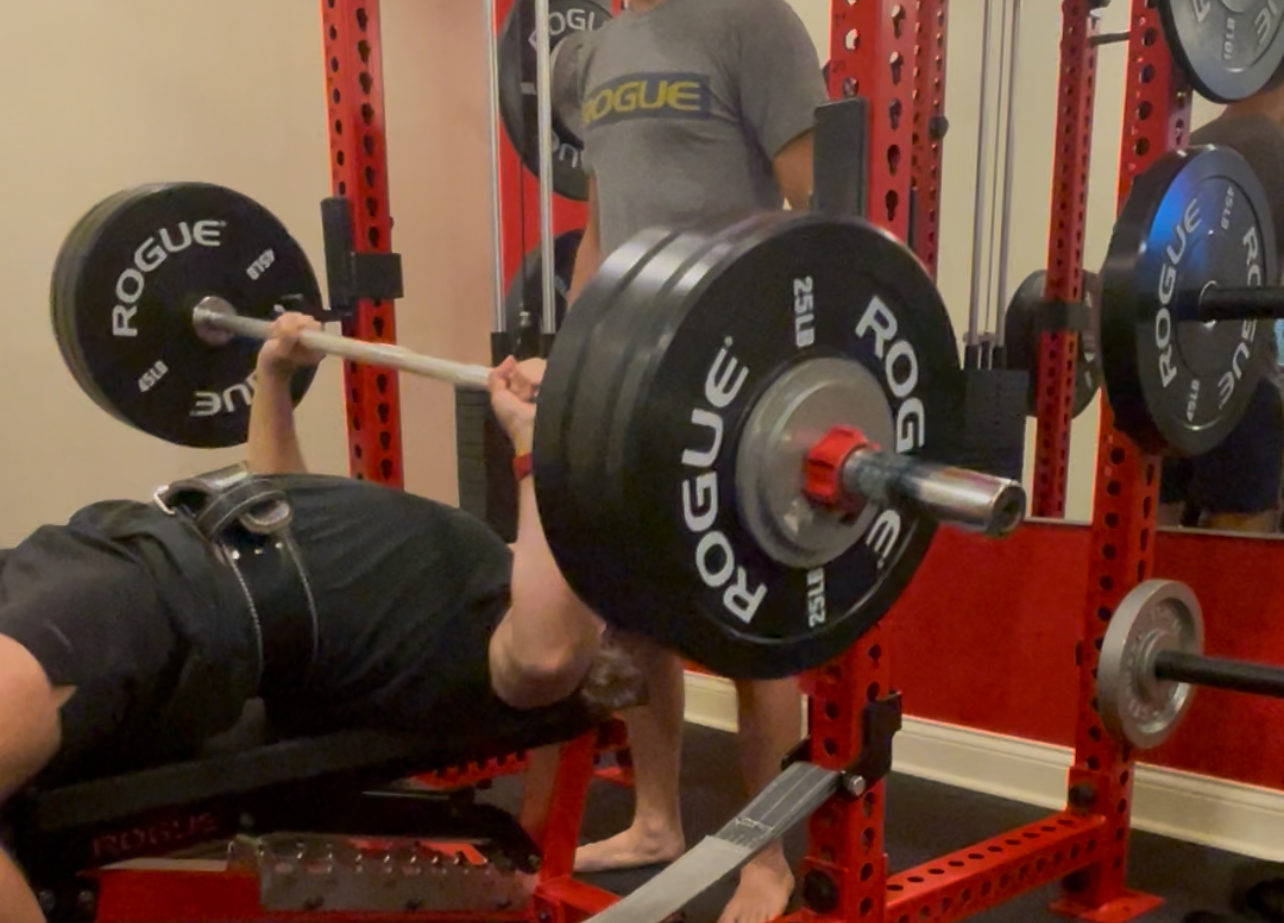
I lay down on the bench, gripped the bar, and twisted it until it felt just right. I counted aloud, 1…2…3! And hoisted the bar off the red Rogue rack. I lowered the fully-loaded bar down to my chest and pushed with everything I had.
And the bar began to rise off my chest.
I knew I had it.
I began to yell as I pushed the bar through the full range of motion.
My kids didn’t even get a chance to yell encouragement at me, because I was yelling at myself. And the bar was obviously moving north.
I locked out the top position, re-racked the bar, and went freaking nutz-o!
I was so hyped I just kept yelling, and celebrating. I grabbed the hands of each of my 3 kids who were spotting me. Johann, then Magnus then Ava.
Then I turned and yelled at the camera. It was a Seven-Yeah Celebration. Like Usher would do.
I was so freaking hyped!
I had set a high bar for this Misogi Challenge.
And I met it.
With all 3 of my kids as witnesses.
And 2 cameras rolling, to catch the result, win or lose.
But I knew I hadn’t hit my limit. So I decided to try one more attempt. This would be above my goal weight. So I turned to Ava, my most experienced offspring in the iron arts, and asked, ‘Should I go for 340 or 345 lbs?’
Without hesitating, she said, ‘340. You always tell me to make sure I get the lift, rather than stretching too far.’
So she served up the good advice I had been dishing out. And I took it.
Now I was playing with house money. Plus, at that point, I had happy-hype coursing through my system.
5 minutes later, with Black Sabbath’s Iron Man sawing through my AirPods, I lay down under the bar, again. I un-racked the bar, lowered it and pressed. The weight moved. My kids blasted me with encouragement. I pushed at full strength until I had locked out the weight. Then I re-racked the bar.
I was instantly flooded with my favorite feeling: MaxHap. It’s the term I use for maximum happiness. It’s my version of self-actualization. Or flow. Or euphoria. It’s the drug that Huey Lewis was seeking. And I still haven’t found a negative side effect.
Everything had gone right. I set and met a hard goal, with a high chance of failure. Then I exceeded it. Which meant that I can say definitively that I am stronger at 52 than I was at 18. And I was 6 feet tall and 215 pounds back then. And headed to the University of Wisconsin to throw for the Badgers. Yet somehow, 34 years later, I was still pushing myself. That’s some crazy train stuff, Ozzy!
But even better, I experienced this with my kids. They were all in the room where it happened. They saw me attempt something hard and succeed. They saw me working towards my goal for months. They saw me fail reps along the way, but I kept on going. They saw the focus, determination and craziness that I tapped into to rise to the occasion. They were there to encourage me. And to catch me if I failed.
That was an amazing experience.
Now I am done with this challenge. I have banked the results in my list of life experiences. It has bolstered my confidence and my belief that I can handle hard things. So I move forward, mentally stronger than I was before I started. Which is the whole point of the challenge.
Key Takeaway
Push yourself to do hard things. Stretch your limits. Test yourself. Make commitments to yourself that are hard to keep. Then keep them anyway. It will build your confidence and self-reliance. It will toughen you up. The work and the suffering and pushing past your past limits make you feel alive and ready for anything. Give yourself a Misogi Challenge. Because when the world becomes too comfortable, you need to seek out discomfort to grow and experience life more deeply. Make it a regular part of your life. It will help you live a life worth talking about. Which means that whether or not you win or lose your self-challenge, you win at life.
*If you know someone who could benefit from this message, please share it with them.
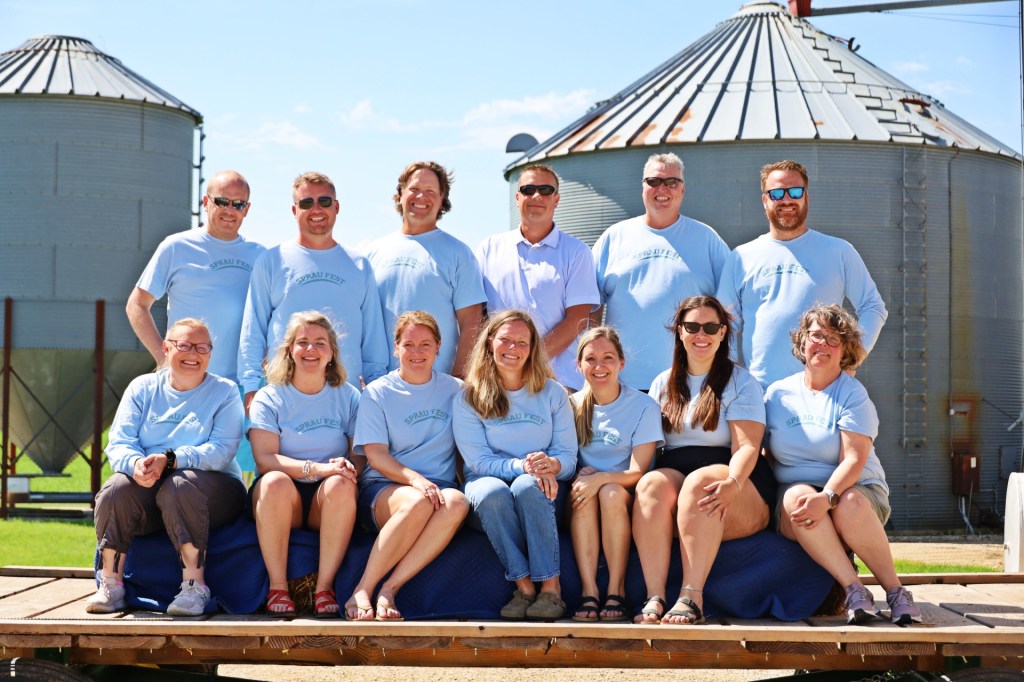
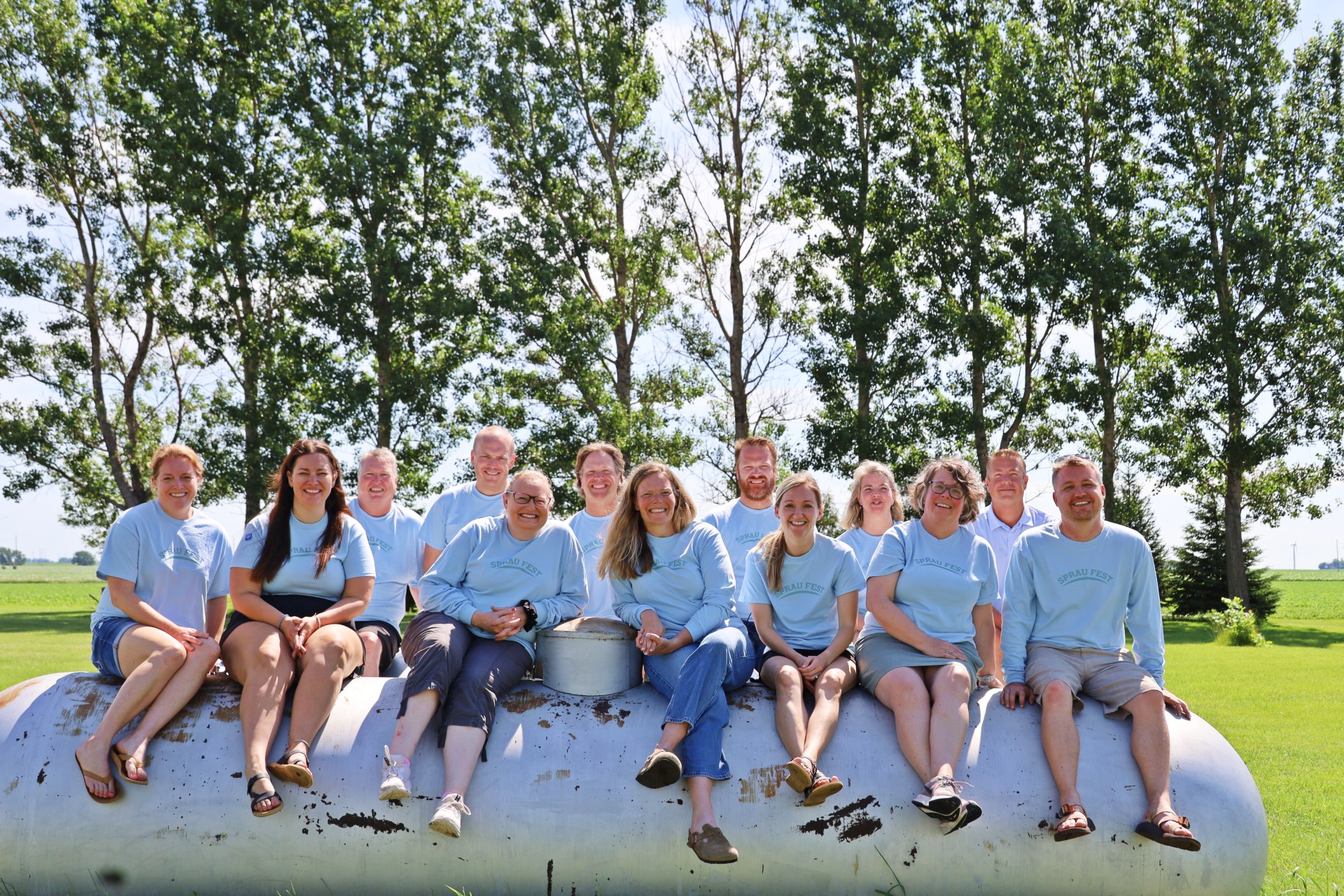
A few weeks ago, I attended a family reunion. It took place in the tiny but personally significant town of Elkton, Minnesota, where my mom Jill (Sprau) Albrecht was born and raised. Elkton is a town of 130 people. My mom is one of 9 kids. So the Sprau family made up a significant percentage of the town.In fact, the town was so small that the gerrymandering lines were drawn between the bedrooms in my Mom’s childhood home.
The Sprau family reunion took place at my Uncle Jerry’s farm. Which is next to my Uncle Randy’s farm, which is next to my Uncle Rod’s farm, where my Grammy’s family, The Andersons, first settled in Mower County, Minnesota. Straight outta Norway.
In addition to the typical cheek-pinching, wow-you’ve-gotten-talling, hot dog and burger eating, photo-taking, game playing and storytelling, we did something else that really got me thinking thoughty thoughts.
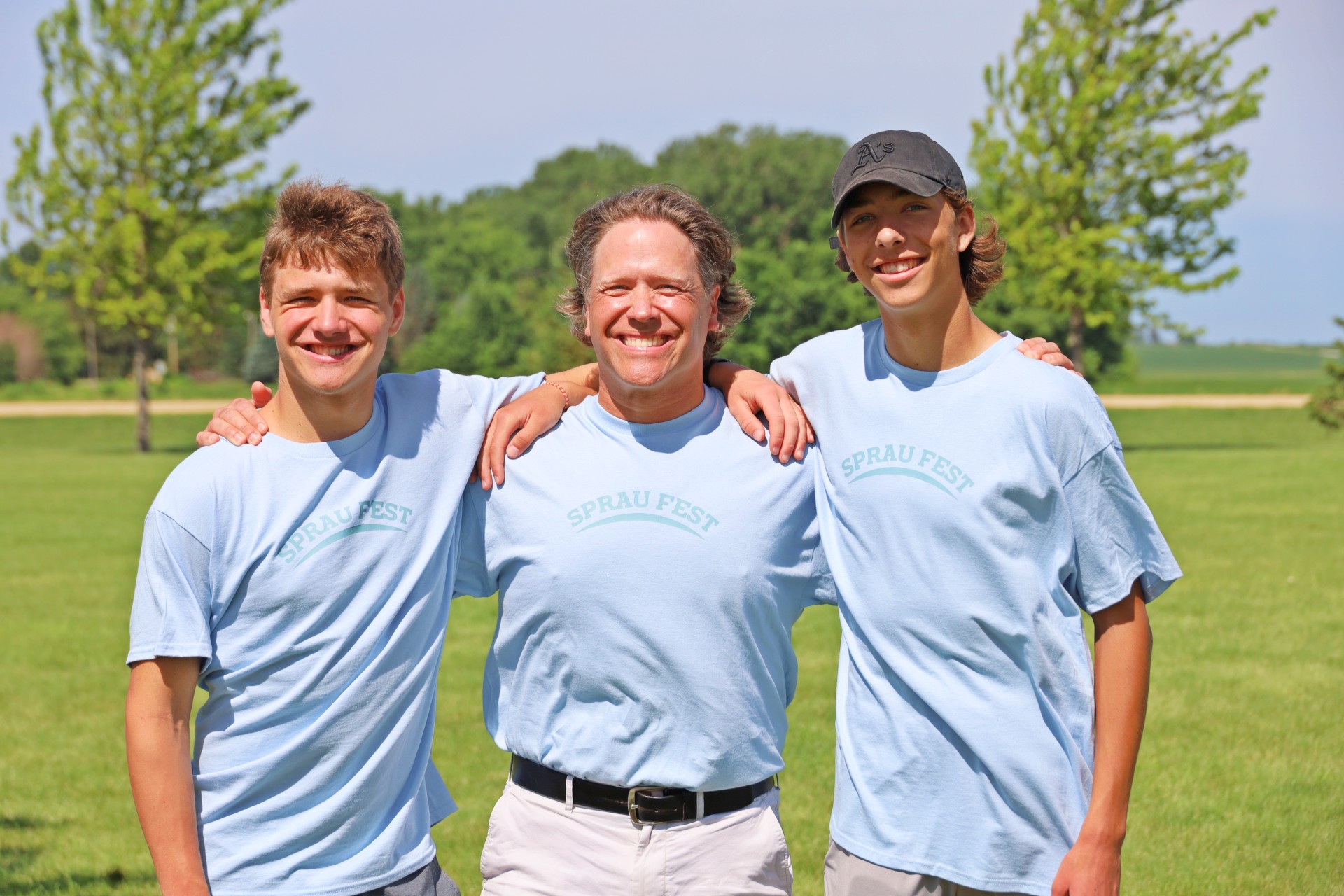
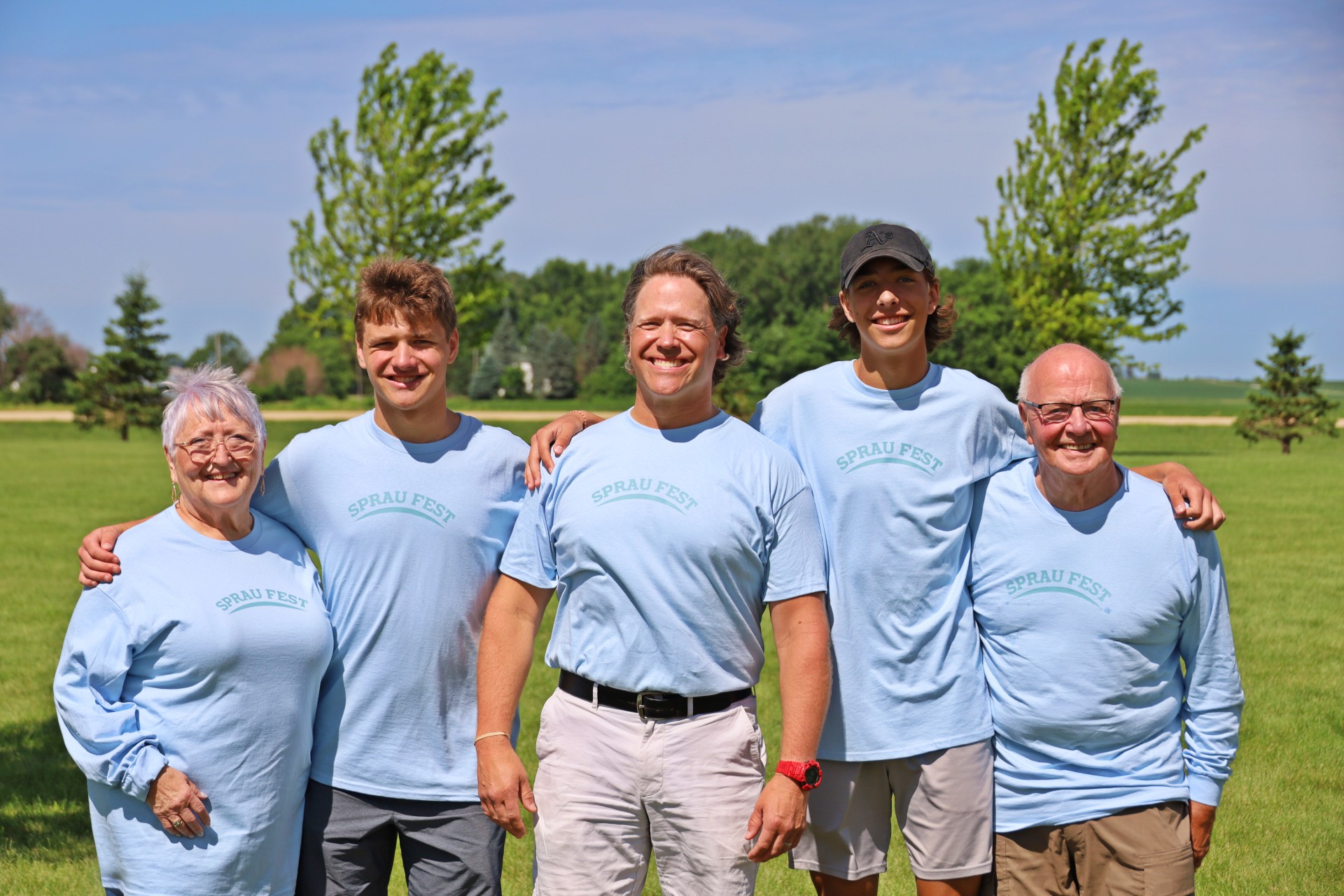
Me, my sons Johann and Magnus, and two hands growing out of my neck.
I was asked to lead a session on our Sprau and Anderson family history. I am an amateur genealogist and probably the closest thing we have to a family historian. Much of this started when I was younger and I was told how important my first name, Adam, is on my mom’s side of the family. And of course, my last name, Albrecht, is significant on my Dad’s side of the family. And my middle name, Robert, is both my dad’s first name and my maternal great grandfather, Robert Anderson’s, first name. So it’s not hard to see that I got tangled into this family history through a few well gifted names.
Following my Shed Talk on Friday, which is like a Ted Talk, but in a shed, I had an aha moment. (It was not about a black and white hand drawn music video.)
As a result of my family history talk, and the genealogical homework I did to prepare for the weekend, I started to visualize a model of my life and my place in my family history that I had never considered before.
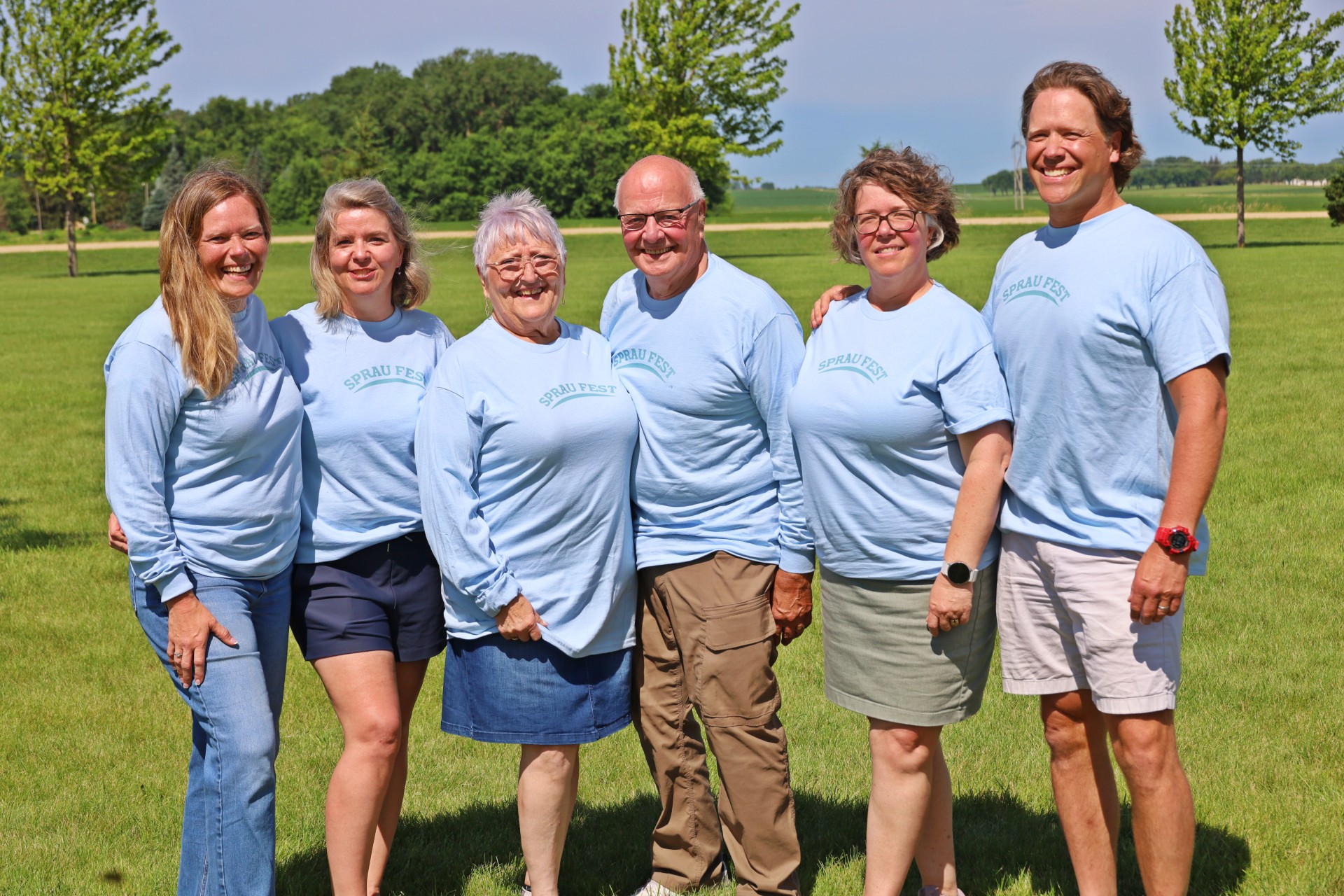
Me and my sisters, Donielle, Alison, and Heather, my Mom and Dad, and me. But none of our feet.
I imagined a simplified version of my family tree that led to me.
Here’s what I pictured:
Above me on my family tree are my 2 parents. So my simplest genealogical tree is an inverted triangle with my parents at the top, and me at the lower point. (Which makes me the low point in our family’s history.)
When you add the layer above that, you find 4 people atop my parents. Obviously, those are my 4 grandparents. And the level above them holds my 8 great-grandparents. Which makes that a pretty great level.
Me and my cousins and sisters about to be hauled off.
As you trace your family history you just keep building a taller and wider triangle. And by the time you rise 7 generations you have 128 grandparents. By 10 generations, you have 1,024 grandparents on a single level of your tree. That’s like compound interest, in reverse. And we are all a product of this construct. It’s nature’s math.
My realization over the weekend is that all of the genes and traits, skills, lessons, strengths and abilities of the generations before me have poured into me like a funnel. All of these people have been learning and teaching, improving and growing and passing along what they learned in the best way they knew how.
They also accumulated flaws and habits that didn’t serve them. But much of that got passed along too, through the bottom of the family funnel.
I got the accumulated nature and nurture of countless generations before me from as many as 3 different continents.
That is wild.
However, what happens next is just as wild.
Me and my cousins and sisters getting tanked.
Because I married and decided to have children, the pyramid flips over. I am now at the top of a triangle of my own descendants.
My wife Dawn and I will forever sit at the top of a triangle of our own creation.
We know that pyramid has 3 descendants on the next level: our kids, Ava, Johann and Magnus.
The Three Generation Station
The pyramid may stop right there. Like that woman said to Meatloaf. Or it may continue until the end of time. Like Meatloaf was praying for.
But regardless of how long it builds, all of the nature and nurture that follows flows from me and Dawn.
As the next generations grow and multiply it becomes evident that our genealogy really looks like an hourglass.
There is an inverted triangle above us, that funnels down to us.
Below us is the pyramid of accumulating generations.
This means that many, many ancestors have poured not only their genetics, but their experiences, decisions, strengths and accumulated wisdom into you.
It is hard to say where the sayings, prayers, traditions, terms of affection, mannerisms or womanerisms you use today really started. But there is a strong chance they are deeply rooted in your family tree.
If you choose to have your own children, you are not only passing along your genetic traits, but you are also pouring your habits, values and lessons into the next generations.
This means that you are the center of the hourglass.
You are the filter.
You are the gate keeper.
You are the seed of all that comes after you.
Your decisions, biases, lessons, choices, habits and behaviors will influence everyone who comes after you.
Choose wisely what you pass along to the next generations.
Give them your best.
Filter out the worst. (Although, if you are Germanic, you should give them the best wurst.)
Share as much knowledge and wisdom as you can.
Pass along great habits.
Pass along strong traditions.
Eliminate the things that don’t serve you and won’t serve them.
Ensure that your offspring get the best of what is available to them.
You are the teacher.
The coach.
The prioritizer.
And the great example.
They say sex is hereditary. If your parents didn’t have it, it likely you won’t either.
But the same is true for religion.
And a love for books.
And quality time together.
And games.
And travel.
And sports, culture and music.
And love and kindness.
And generosity.
And friendship.
And braveness
And humor.
And resiliency.
And work ethic.
And grit.
Pass the good stuff along.
It’s how you can pass the best of you along deep into the future.
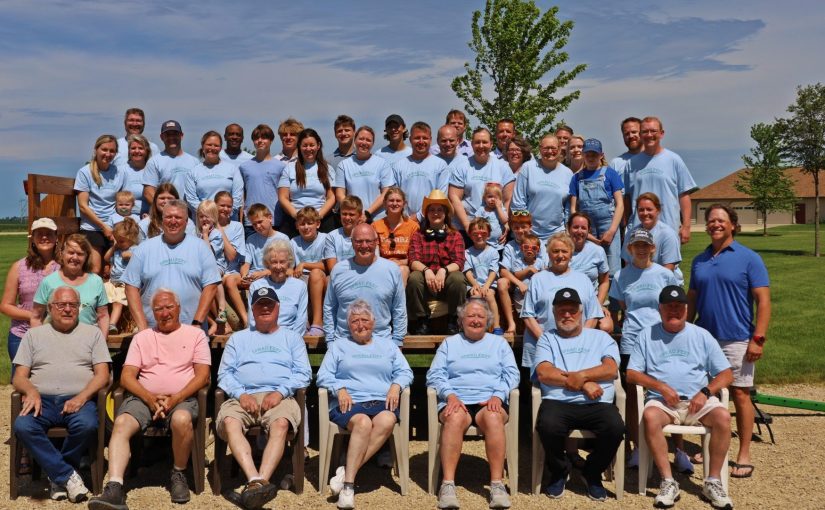
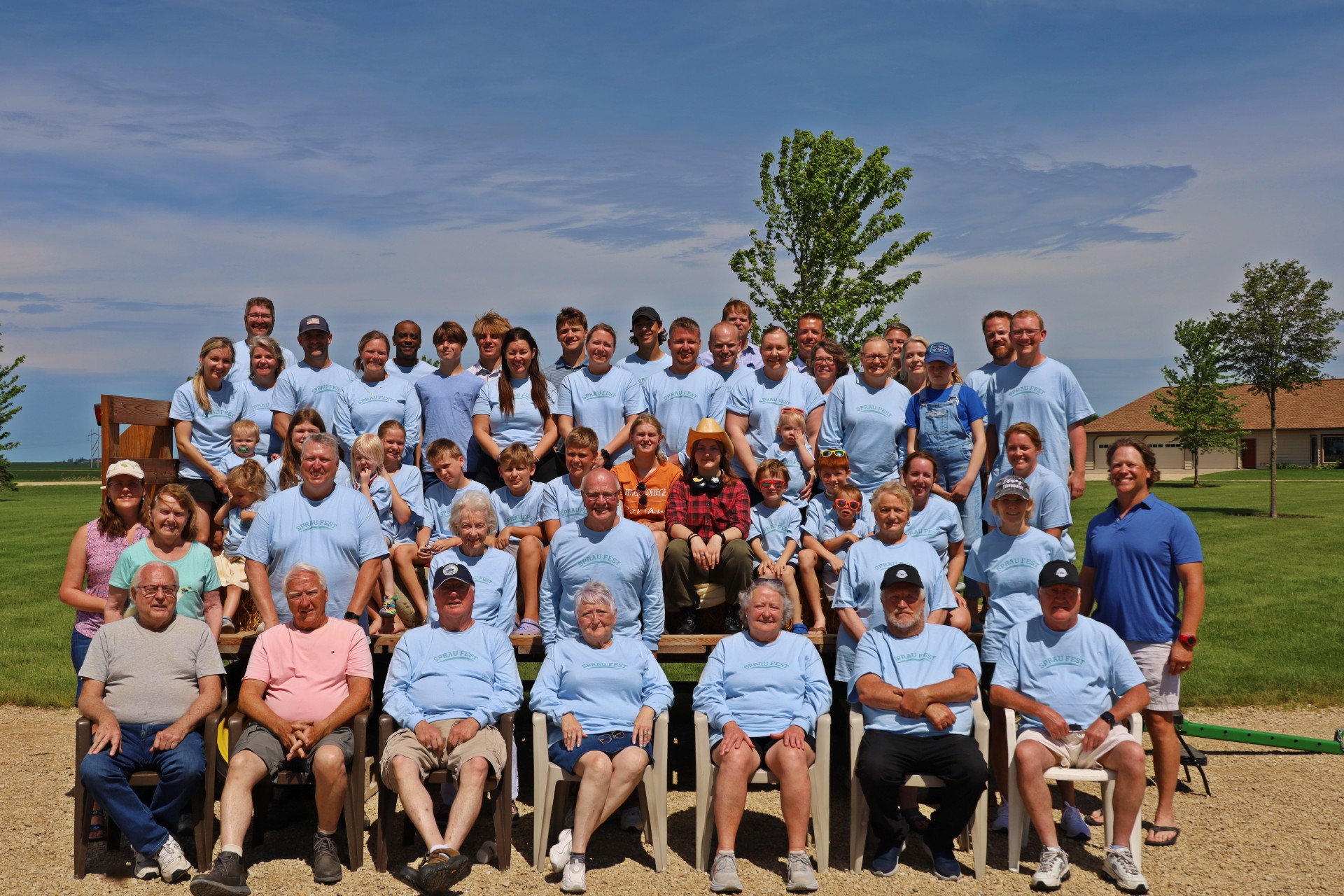
A healthy portion of the Kenneth and Lilian Sprau Family in Elkton, Minnesota on June 28, 2025.
Key Takeaway
Your ancestors have poured the best they have into you. Now you get to pour the best of you into the future generations. Make sure you carefully consider your contributions. And pass along the best inheritance you can.
*If you know someone who could benefit from this message, please share it with them.


 Adam Albrecht Blog