Why it is so darn important to be patient with yourself.

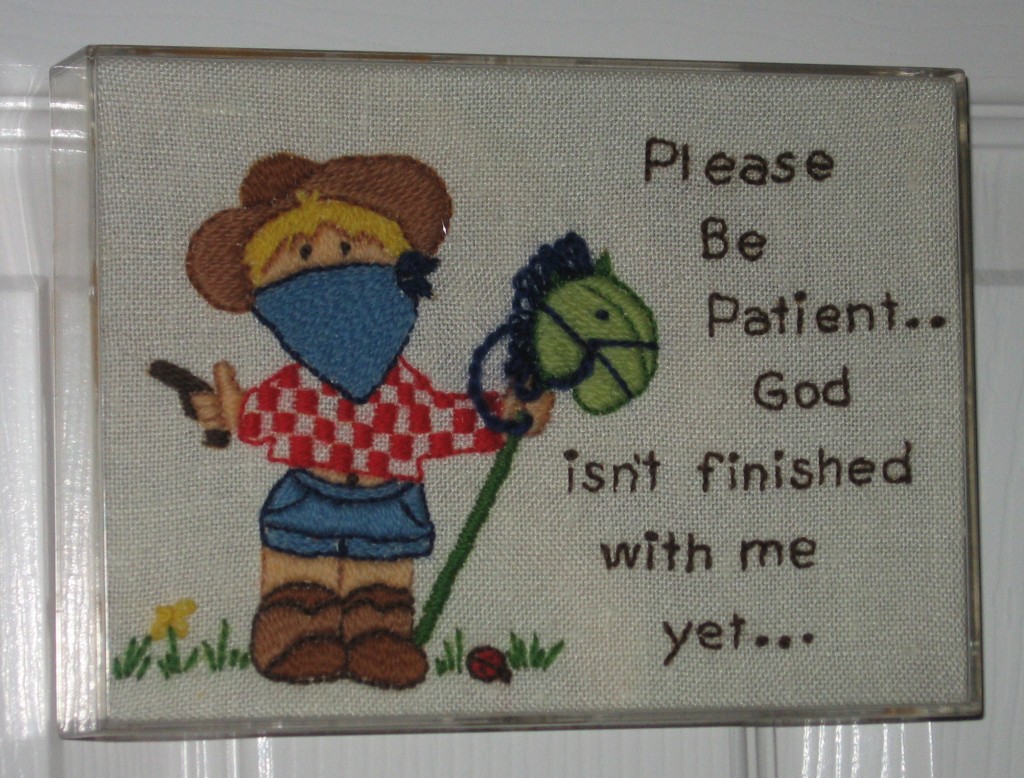
When I was a little boy I had a piece of needlepoint art hanging on my wall. It featured a simple image of a little cowboy and his broomstick horse. On the needlepoint were the words, Please be patient… God isn’t finished with me yet… It was a daily reminder to a growing boy that I was a work in progress.

My art looked a lot like this. Except it had a wooden frame. And both of my ellipses had 3 dots.

Today, most people would consider me a full-grown man. After all, I can grow a full beard and mustache. I am over 6 feet tall and can reach the highest shelves on my tippy toes. I am married with 3 children. I own my own business. I can legally drive a car, vote, and drink alcohol. Although I vote not to drink alcohol because my tastebuds stopped maturing when I was 13, right in the middle of my chocolate milk/ Fun Dip/ Pop Rocks phase.

Despite the fact that I have been wearing the same shoe, pant, and shirt size for multiple decades now, I can proudly say that I am still growing. I am still learning new things every day. I ask questions. I read books and magazines. I listen to audiobooks and podcasts when I drive. And I watch a lot of hilarious videos that teach me things, like how much human weight is too much for a porch swing.

Plus, I still make mistakes. A lot of mistakes. But I learn from them. In fact, I get better by making mistakes. Because my mistakes help me discover more things I didn’t know. Like the fact that dickssportinggoods.com is a better place to find running shoes than dicks.com.

I am willing to bet that you are still learning and growing and making mistakes too. I hope you are. It is how the human machine continuously improves itself. It is the hallmark of intelligent life. And it is how we can all end each day a little better than we were when we woke up.

Key Takeaway

Let’s all remember that we are all still works in progress. Let’s be patient with ourselves and with each other. Because as I was reminded daily when I was a boy, God isn’t finished with me yet. And he isn’t finished with you either.

*If you know someone who could benefit from this message, please share it with them.

How to move your most important initiatives down the track.

We all have big goals we want to achieve. However, the goal setting isn’t the hard part. It is not enough to know what you want to do. It’s what you do do that matters. In order to achieve your goals, you have to take action. A lot of action.

The good news is that to accomplish your most important goals you don’t need to make things happen in giant steps. You simply have to make steady progress. I find it useful to think of my most important initiatives as trains. The objective is simply to move the trains down the track.

The Process

1. Identify your trains.

Start by focusing on your 1 to 5 most important initiatives. Remember, 5 is the max. More than 5 dilutes your attention and your energy. This is why we don’t have the Jackson 6, or go around high six-ing each other.

2. Start each day with your list of trains.

They could be businesses you want to build, fitness goals, work projects, passion projects, volunteer efforts, or travel plans. In fact, your trains can be anything you want to do, make or accomplish. Heck, your train could be to catch drops of Jupiter or to meet Virginia.

3. Write down an action you can take that day to move each train down the track.

Determine the next step in the process that will help you make progress. Always be thinking about the next task to take on, like A-ha said.

4. Take that action.

Some actions will move you inches. Some will move you feet. Some will move you yards. And others will move you miles down the track. However, all actions, large or small, will get you closer to your goal.

Keep Moving

The key is to get your trains movings. Your biggest goals, hopes, and dreams are like locomotives. They are heavy, powerful, and hard to get going. Simply getting the wheels to start turning can feel like a monumental task. Especially if your goal is to build a monument.

But once your trains start moving it is easier to pick up speed, like Sandra Bullock. You will soon find yourself taking more and bigger actions faster. Before you know it you will have momentum on your side. Your actions become habits. And you will start ticking off tasks like the clicking and clacking of a train speeding down the track. (By ticking off I mean completing. Not making-mad, like my parents used to say to me.)

At the end of each day, check to see if you moved your trains down the track. The answer should be clear. You either took action or you didn’t. If you did take action, note whether you moved inches, feet, yards, or miles. Of course, these are meant to be symbolic relative measurements. They translate to small, medium, large and Neil Armstrong-sized steps forward.

If you take no action your train will remain in the station. But through consistent action, your trains will reach their destination. It’s as simple and certain as that.

Key Takeaway

Move your most important initiatives farther down the track every day. Small, consistent actions start the wheels turning. Then come bigger actions with bigger results. Which ultimately help you build momentum. A train with momentum is very hard to stop. A person with momentum is nearly impossible to stop. Make yourself that person.

*If you know someone who could benefit from this message, please share it with them.

20 things I learned from the most unique year of my life.

One year ago today, on Monday, March 16th, 2020, I began the strangest, most interesting year of my life. My team at The Weaponry, an advertising and idea agency, abandoned our perfectly good offices in Milwaukee and Columbus and began working from home.

I had no idea what the future would hold. We were facing a mandatory government-enforced quarantine. In an unprecedented move, healthy people were being forced to quarantine at home in an attempt to prevent the relentless spread of a novel coronavirus called covid-19. Schools and businesses were closed. Everything imaginable was canceled. And hair began to grow wild and un-colored.

It was clear we were facing a historic global event. But I would have been shocked to know that one year later we would all be wearing masks in public and that we would be just beginning to crawl out of our year-long covid-induced hibernation.

The past 365 days have been fascinating. To mark the anniversary I sat down to reflect on what I have learned from this experience. Here’s what I came up with.

20 things I learned from the year of covid.

  1. Always have a rainy day fund. You can sleep easier at night knowing you are financially prepared for the unknown Whether it’s a rainy day fund or a virusy day fund, surprises can happen at any time. So have money on hand. (Well, not literally on your hand.) Because you never know when your income is going to stop coming in.

2. Crisis is full of opportunity. The past year presented an incredible opportunity for thinkers, inventors, problem solvers, and risk-takers. It has been a time for leaders to lead. It has been a golden era for innovation, upheaval, and for hand sanitizer salesmen. It has provided a great reminder to not stare at the problem. But instead, look at the new options available.

3. Good teammates are good teammates. Surround yourself with good people in good times, and you’ll appreciate them even more when things go bad like LL Cool J or Michael Jackson. #shamone. Even when my team was working from home they were accountable, responsible, dedicated and proud of the work they put out.

4. Adversity brings people closer. Despite the social distancing, we now have a tighter bond with our clients. It feels as if we went to war together and we were all fighting for our businesses. And for our right to party.

5. Marry someone you love spending time with. My wife and I got to spend more time together over the past year than ever before in our 20-year relationship. I loved all the extra time with her. Throw in my 3 kids and we had a great Quaranteam. There is a lot I will miss about our bonus time together.

6. Good advice is priceless. In tough times people need advice. Those who offer good counsel will always be sought after. Side note: Those who storm the Capitol will also be sought after. So don’t wear a distinct horned -helmet and face paint that draws additional attention.

7. We are all more adaptable than we thought. Things we thought we couldn’t do without we can do without. There is a huge difference between wants and needs. And we can all get used to new conditions quicker than any of us like to admit.

8. Toilet paper is super important Absence makes the heart grow fonder. But it makes the bum feel more bummed out. The toilet paper crisis of 2020 made us all reconsider the role these valuable rolls of squeezable softness play in our daily lives.

9. I am more productive without spectator sports. When all sports were halted I found a lot of other valuable things to do with my time. Remember to spend more time playing your own game. Because life is not a spectator sport. (But it is a board game from Milton Bradley. Batteries not included. Or necessary.)

10. A mask mandate is better than a mask suggestion. I was much happier wearing a mask when it became a requirement than I was when it was an elective. I appreciated us all looking dorky together. Thanks for making it non-negotiable, so I could negotiate other things.

11. Awards shows are not the same without the crowds. I have now watched parts of several different awards shows over the past couple of months. And they have all disappointed me. They are just not the same without playing to large crowds of famous people. Because I can see a small crowd of non-famous people in my own family room anytime.

12. We need to watch out for each other. I did a lot of Zoom socializing over the past year. I wanted to check in on my family and friends. I organized a lot of online events to make sure people knew they were not alone. We should keep doing that. Because technology will enable us to continue to stay connected to our friends who don’t live nearby. At least our non-Amish friends.

13. I miss almost everyone. Everyone I interact with is like a character in the play that is my life. When I don’t see you, my play feels less interesting. All of the characters together help make my life the rich story that it is. I can’t wait to see everyone regularly again.

14. I am happy to have a nice yard. When you are confined to just your home and your yard it is nice to have a nice yard. For a couple of months in the spring and early summer, it was like we were in prison. But if your prison yard is a full acre on a pond full of largemouth bass you feel like you are doing time like Martha Stewart. And it’s a good thing.

15. Isolation is great for accomplishing personal goals. When the initial lockdown was announced I began working on my first book. I now have a 50,000-word manuscript. I’m hoping to get it published without the need for more quarantining.

16. Rules are only rules under current conditions. All kinds of hard and fast rules changed during covid. Heck, even taxes weren’t due until mid-summer. I hope we remember this and remain more flexible moving forward.

17. Church from home offers larger communion portions. St. Albrechts Couchthedral serves up some tasty and abundant body of Christ that tastes remarkably like caramel rolls. And we have bottomless blood of Christ in whatever flavor you prefer. But nothing else about church from home is better. In-person church services are among the things I miss most.

18. There is light at the end of the tunnel. Over the past month, it is finally looking like we are closer to the end than the beginning. I can now imagine life returning to normal-ish by this summer.

19. We all have different tolerances. We all respond to crises in different ways. We all have different rules and risk tolerances. Don’t force people to conform to yours. We are all running our own race. Even if we are running it from the couch.

20. Humans are amazing. The fact that we whipped up these vaccines in less than a year and got them thumbed up by the approvers is incredible. Once again we have proven that the human mind is the most powerful weapon on Earth.

*If you know someone who could benefit from this message, please share it with them.

Never stop competing.

When you were young you competed all the time. You competed in the classroom and on the playground. You competed in the sports you played, or for the part in the play.

You competed for the best position in the band, orchestra or choir. Or you competed in chess, robotics, or forensics. Perhaps you competed for student council votes, in milk-tasting, in dance-offs, and with your Uncle Rico.

Then you competed for the attention of the boys or girls you were attracted to. You dressed nicely, took care of yourself physically, hygienically and follicly. You were thoughtful, kind, and you smelled good.

You competed to get into the good school or program. Then for the great job, the promotion, the raise. You competed to attract the great customer, client, project, or assignment. And you cared about the obscure awards that only your industry cares about. Like Outstanding Use of Whiteout in The Annual Low-Tech Secretary Awards.

Today, ask yourself Am I still competing?

Am I competing with my personal best? Am I still trying to learn, grow and improve? Or am I slowly coasting to a stop like a car that has run out of gas? Or like a skateboard that has run out of skateboarder?

Am I competing at work? Am I pushing to win for my customers and my teammates? Am I still trying to add more value? Are my biggest contributions still ahead of me. Or am I still milking my success from the 1900s?

Am I competing for my spouse or significant other? Am I taking care of myself? Am I treating my snuggle bunny in a way that makes me hard to beat? Am I still being thoughtful? And romantic? Do I buy flowers on non-holidays and when I don’t have to apologize for something I did, said, forgot, or broke?

Am I competing against time? Am I trying to do as much as I can within the limited time I have on this planet? Or at least during my pre-embalming fluid-filled time on the planet? (I have no idea how to properly hyphenate that last statement. If you are still competing in hyphenation let me know).

Key Takeaway

Never stop competing. Keep growing and improving. Keep pushing yourself and finding new ways to contribute. Keep competing for your spouse or significant other as if they have lots of other great options. Because they always do. Re-earn your role and your respect from others every day. Compete to make the most of every day. It is the best way to live your best life.

*If you know someone who could benefit from this message, please share it with them.

An inspiring reminder to never give up on your dreams.

A few years ago Andrew Young spoke at my office in Atlanta. I was thrilled by the opportunity to hear him speak. Young is a political rockstar. He was a U.S. Congressman, U.S. Ambassador to the United Nations, and mayor of Atlanta. Before all that, Young was a key figure in the American civil rights movement. And he was the first person mentioned by the Village People in the song Y.M.C.A.

I knew Young’s talk would be inspiring. But like so many memorable moments in life, one of the greatest sources of inspiration from his talk came from an unexpected surprise he shared.

As Young recounted the excitement and profound significance of the civil rights movement, he talked about just how impressive Martin Luther King Jr. was. He said that the whole movement was full of leaders. But Martin, as Young called him, was the clear leader of leaders.

However, it was a quick and simple fact thrown in for humor that still sticks with me 5 years later. Young shared that when King was in college at Crozer Theological Seminary school he got a C in public speaking. And no, a C in Seminary school does not stand for Christ-like, or Crazy-good.

Drink this in for a moment. As a pastor, reverend, priest, or rabbi your number one job skill, other than knowing a hell of a lot about God, has to be public speaking, right? And King was struggling in that department.

Yet we all know how the story ends. Ultimately, King is best known for his public speaking. In fact, there may be no one in American history better known for their public speaking skills than MLK.

If you asked me to name the 3 most famous speeches in American history I would say Lincoln’s Gettysburg Address, Kings ‘I have a dream’ speech, and then I would probably throw in Billy Madison’s ‘The Puppy Who Lost His Way’ speech, because I can’t really think of any others.

The fact that King, who became one of the most inspiring speakers in history got a C in public speaking in college adds to his inspirational legacy. It reminds us that where we start is not where we end. It reminds us to unearth our hidden talents, develop our skills and think about where we are going. Not where we have been. It also reminds us that disappointment and dissatisfaction can be powerful motivators.

In other words, have a vision of your fully realized dream state, and work to make it your reality. Which is exactly what MLK Jr. did.

If you are willing to focus, practice and work there is no limit to how great you can become. Overcoming initial discouragement is critical. Recognizing where you are in your journey and visualizing how much more you are capable of is key.

Remember, the worse you start out the more you are capable of improving.

Key Takeaway

Where you start is not where you will end. Focus on the process of improvement. If you are willing to put in the work, effort, learning, and practice there is no telling how much you are capable of. In other words, if you have a dream, keep at it until it is real. It is really up to you.

*If you know someone who could benefit from this message, please share it with them.

Are you accepting your destiny or making it happen?

There are two ways to think about life. The first is to think that everything that is happening to you, or going to happen to you, is already predetermined. Your story was handed to you, fully written, and you are simply following the script. The second way to think about life is that nothing is written. You are the one doing all the writing. The world is waiting for you to figure out the next chapter.

Driver or Passenger?

The first approach assumes that nothing is up to you. The second approach assumes that everything is up to you. Your position on this issue leads you take on two very different roles. One allows you to be passive. The second requires you to steer. It says that nothing happens until you make it happen. Like Mariah Carey.

However, there is a third option. One of the most accomplished Americans of the 20th century, and one the most quoted philosophers, said this:

“I don’t know if we each have a destiny, or if we’re all just floatin’ around accidental-like on a breeze, but I, I think maybe it’s both. Maybe both is happenin’ at the same time.”

-Forrest Gump

This Gumpism is useful in explaining the universe and our role in it. It says that there are multiple forces at play at all times. It says that there are things we get to decide and things that are out of our control. It acknowledges that we all come into this world with some predetermined conditions, whether the insurance companies like it or not.

The Dealing

We are dealt a hand of cards that we have to begin the game with. Some hands are more advantageous than others. But the game isn’t over when the dealing is done. The dealing is just the beginning.

The You Factor

Gumpian doctrine allows for our own choices and decisions. It provides room for our grit, determination, motivation and action. We have the ability to set our minds on our own course, with our own goals and our own strategic plan. We simply must recognize that we don’t get to march unimpeded towards our goals, like Michael Strahan’s phony sack of Brett Favre in 2002 (as seen in this 20 second video clip).

The Cross-Traffic

There are too many people on this planet, all with their own goals, hopes and dreams for us not to get caught up in cross-traffic and competition on the way to what we want. There are natural phenomena and acts of God (or maybe Morgan Freeman or George Burns) that become obstacles in our way. All of which make life more challenging, and more interesting.

All Things Considered

Acknowledging that there are both pre-determined and self-determined forces at play is both a comfort and a frustration. It allows you to go after what you want. But it also means you may not find it, or that it will take longer, or be different than it was in your head. Because there are nearly 8 billion bees in this hive we all share. And some of them will occasionally get in your way. When they do, you may have to yield, but you never have to stop.

Key Takeaway

We all deal with a combination of destiny and autonomy. So set your own goals, chart your own course, believe in the greatest you that you can possibly imagine. But know that you are going to experience resistance and disappointment. Perseverance is king. You may need to try again, or take a detour to get where you want to go. Don’t be easily deterred. You may simply need to wait until it is your turn to complete your mission. That is half the fun.

*If you know someone who could benefit from this message, please share it with them.

If I could do it all again I would make more friends.

I always laugh when someone says ‘If I could go back in time I wouldn’t do anything different.’ I appreciate the conviction of such a statement. But it shows that they have not learned and grown much during this dress rehearsal. So they obviously wouldn’t profit much from a life mulligan anyway.

My Re-do

I can find a seemingly endless supply of things I would do differently on my life do-over. I would have slowed down that night when I lost control of my car and flew it into a pasture full of cows Duke’s of Hazard-style. I would have skipped that Wednesday football practice when I tore my ACL my senior year. I would NOT have bought that cheap home printer that constantly jammed and guzzled ink like a drunken donkey. And I would NOT have taken work from that client who was like a real-life Mikey, and really did hate everything. Even Life cereal.

I have been thinking a lot lately about things I would change If I could do it all again. And there is one clear answer that rings out every time I ponder this question. It’s not a regret that haunts me. It’s not a mistake I would fix. And it’s not a detour I would take to avoid pain or punishment. It is something I wish I had more of.

More, More, More

If I could go back and do it all over I would make more friends. There is no greater asset on Earth. There are nearly 8 billion people on the planet. But when I think about the tiny percentage of those people I actually know it gives me a major case of FOMO.

When I was younger I remember people saying that the person who dies with the most toys wins. That couldn’t be further from the truth. It is the person who collects the most friends, who develops and maintains the most and best human relationships that really wins this game. And if those friends have lots of toys, even better.

Friends With Benefits

Friends deliver on our most basic needs. They offer a sense of home and belonging. They offer support, encouragement and inspiration. They make us smile and laugh and sometimes blow things out of our noses involuntarily. And as I have gotten older I have found you can never have too many people in your friend column.

Collecting Friends

I still maintain friendships from pre-school, elementary school, middle school, high school and college. I am still in touch with friends from all 9 cities I have lived in. I have friends I have met on airplanes, while on vacation, and while playing at the park with my kids. But I can’t help but think of all of the amazing friends I haven’t met. Especially the ones who have kidneys just like mine.

Work Friends

Friends have been the most important ingredient of my career success. My coworker-friends, client-friends and partner-friends have not only contributed immensely to my workplace wins, they have made me feel as if I am hanging out with friends all day long. In fact, I met my all-time best friend Dawn at work. And we have now been married for 18 years. #CompanyPicnicsAreTheBest

Entrepreneurship

When I launched The Weaponry, my advertising and idea agency, it was my friends who became my first clients, coworkers and champions. Today, the business and all of the peripheral activities that come with it are a great source of new and growing friendships. In fact, I think of the ability to develop and maintain strong relationships as the greatest input to entrepreneurial success and the greatest fringe benefit of entrepreneurship.

The Greatest ROI

I have friends in every state in America and in dozens of countries around the world. They offer the greatest return of any investment I have ever made. But like the dollars I have squirreled away in my 401(k) plan, I wish had invested even more. Alas, if wishes were fishes we would all have a fry. So the best we can do is make more in the days and years ahead.

Key Takeaway

Keep growing your tribe. Make as many friends as you can in as many places as you can. Connect your friends to each other. Invest in your relationships. Make them deep and wide. At the end of our days, the only thing that matters is the impact we have made on each other. So create more impactful relationships, and enjoy the positive impact they have on you.

*If you know someone who could benefit from this message, please share it with them.

Find people who ask you questions you didn’t know to ask.

I have a new startup business idea in the embryonic stage. I know what I want it to look like fully-formed, but I don’t know some of the most basic details that will help me get there. Or at least I didn’t until yesterday (when all my trouble seemed so far away).

Good Call

Yesterday morning I had a call with an expert that I would need to partner with to make this idea a reality. He asked me many important questions about my plan that I simply had no answers to. There were a lot of TBDs. But with each of the TBDs, I became more D to find the answers.

One Giant Leap For Startupkind

That conversation was a huge leap forward for me. Because now I have my homework assignments. I know the answers I need to find. I know the boxes I need to chickity check. I know what I don’t know, you know. And like Robert Frost said, that makes all the difference.

Move Forward.

Entrepreneurship, and growth of all kinds, are adventures into the unknown. The most important thing is to start moving forward. Take a step and the next step will reveal itself. Kinda like a striptease.

Don’t be afraid to be asked questions you don’t know the answers to. Those questions are gifts. They tell you what you are looking for next, where you need to go next, what you need to do next. Because growth is all about what’s next.

Grow vs. Wade

Get in over your head. It is the fastest way to discover the next step. Getting into a conversation that makes you feel dumb is the best way to get smart. Stepping out of your comfort zone is simply the first step to expanding your comfort zone. That is how you grow.

Key Takeaway

When you step into the unknown growth is inevitable. It helps you collect questions. In the beginning, the questions themselves are the answers you are looking for. Learn the questions. Find the answers. Then find yourself where you always envisioned you would be.

*If you know someone who could benefit from this message, please share it with them.

Don’t spend your whole life busy and not make progress.

Being busy is not the same as being productive. In fact, busyness is like Fool’s Gold. It looks like business to the uniformed. But it is easy to be busy without getting ahead. In fact, you can spend your whole career extremely busy but not make any progress. The same thing can happen in your personal life too.

The 80-20 rule says that 80 percent of the results come from just 20 percent of the work. (And that 80-year olds seen with 20-year olds have money coming out of the wazoo.) In other words, if you are spending your time on the wrong things you could get little to no results. 

Earlier in my career, when I was with a very large advertising agency, the majority of my time was sucked up with meetings. And meetings about meetings. And to the uninformed, it looked like we were all super busy beavers. But very little wood was actually chewed. And we weren’t building any damn dams.

Today, as an entrepreneur, I see a direct link between how I spend my time and the value that time creates. The goal of any business is to make money. And if you are spending time on anything that ultimately is not helping your organization make more money, you are wasting your time.

Your wasted time and wasted motions at work hurt your career. Because they rob you of time that could be used for self-improvement, networking or creating value for your organization. Those are the 3 keys to making your company more successful, rising within your organization, and earning more for yourself.

If you find yourself in meetings that are not adding value, do one of the following:

  1. Change the meeting. Take the initiative to alter the meeting to make it more valuable to your organization and the people in it.
  2. Shorten the meeting. Help fast forward to the information that needs to be shared or decision that needs to be made, and be done. Often we take a lot of time to do what could be done in just a few minutes. 
  3. Pull the cord. Just like riding the bus, you can pull the cord and ask to get out of the meeting at any time. Be polite, but clear that you don’t feel it is a valuable use of your time. If you feel that way, it is likely that others do too.
  4. Text someone outside the meeting to pull the fire alarm. That works every time.

Key Takeaway

Time is your most precious commodity. Evaluate the way you are spending your time. Look for inefficient and ineffective uses, then eliminate them. Don’t let others waste your time. The opportunity cost is too high with this non-renewable resource.

*If you know someone who could benefit from this message, please share it with them.

To experience far greater success adapt an experimentality.

If you are like most people, you have enjoyed some success in life. But if you are like almost everyone, you haven’t enjoyed as much as you would like. To enjoy greater performances, better results, and more success you have to experiment. And this requires an experimentality.

An experimentality is a growth mindset. It is willing to learn and try new approaches in order to get better results. It is believing that good is not good enough. And that there is always a better way, José.

Constants

There are 2 parts to your experimentality. First, there are the constants. These are the aspects of your approach that don’t change. Your constants are the parts of your plan that are proven to work. These become elements of your repeatable process. Not only should you have constants in your approach, you should be constantly increasing the number of constants, like Constance.

Variables

The other part of your experimentality is your variables. These are the things you change to test the possibility of driving even greater results. There is more risk in the variables. But you will never change the magnitude of your success without adjusting the variables.

Like a David Copperfield show, this is where the magic happens. Changing the variables is the only way to experience breakthroughs. You have to be willing to try new ways, or you will always get old results.

10,000 to 1.

Thomas Edison said he never failed in his lightbulb experiments. He simply discovered 10,000 approaches that didn’t work. But through experimentation, and changing the variables, he found 1 approach that not only worked, it changed the world.

Without Edison and his experimentality, the world wouldn’t have known the lightbulb, the phonograph or the electric grid. And without Edison, nothing would appear above your head when you have a good idea. Plus, we wouldn’t have, ‘How many (blanks) does it take to change a lightbulb’ jokes. Scary right?

Whether you are trying to change the world, or simply change your world, keep changing the variables. The new approaches, techniques, and inputs are certain to impact your outputs. Some of them will lead to significant, vast, or even epic improvements. It’s up to you to determine which inputs those are.

Key Takeaway

Adopt an experimentality. The only way to get different results is to try different approaches. Keep track of your experiments. Note the impact of each adjustment. Because each one will get you closer to your goals. And one of them is likely to blow things wide open. Keep pushing until you find it. Don’t stop until the lightbulb burns bright.

*If you know someone who could benefit from this message, please share it with them.