On a recent Saturday morning, I was really lazy. Like, pro-level lazy. I was lazy like a boy in an overstuffed recliner.
I got up early, as usual. I made my son Johann breakfast and made sure he had everything he needed to take the ACT’s that morning. Basically number 2 pencils. But hey…
After Johann left, my wife and I had an empty nest. Our daughter Ava was off at college. Johann was testing at school, and then would be off to practice music with his bandmates. And our youngest son, Magnus, was at a water park for the weekend with his friend Phineas and his family. I assume Ferb was there, too.
So Dawn and I were alone. And we sat in our living room and read. We read for a long time. It was great. And lazy. It felt as if we were finally recovering from our very active trip to Arizona. I hadn’t allowed myself to feel that lazy for a long time.
But then something quite predictable happened. I got itchy to do something. I had sat long enough that I was now compelled to work, to do, to be productive.
So I went outside with a rake and trimming equipment. I cleaned up, cut down and spruced up all of the beds in the back of my house. I then took 3 loads worth of yard waste to the dump.
After that, I came in the house and had a light bulb moment, which sent me on a mission to replace every burned-out light bulb I could find in the home.
Before I knew it, I had 5 hours of productive work done on the laziest Saturday in recent memory. Because for me, laziness serves as a springboard to productivity. I saturate with laziness, and then I have to do something. I lounge until I must labor. Then I labor until I must lounge. It’s a strong and satisfying approach that I recommend everyone have in their playbook.
Key Takeaway
Everyone needs a little downtime to recharge. It provides both a physical and mental reset. As soon as your batteries are fully recharged from rest, get right back to it. Then go until you need a good rest. The cycle will leave you feeling both productive and restored. That’s a win-win.
*If you know someone who could benefit from this message, please share it with them.
Recently, I was asked to speak to my son Magnus’s freshman football team the night before their last game of the season. Preparing for the talk offered an opportunity to go back in time and reflect on the feelings and thoughts I had at the end of my own freshman football season. But this time I had fewer pimples, my voice didn’t crack, and I had a much longer lens with which to view the whole experience. I wrote about the talk and what happened in The Power of Enthusiasm and Teamwork.
The major insight I gained was that my own reflection at the end of my freshman football experience created one of the most valuable experiences of my life. And it still benefits me today. (Or at least it benefitted me yesterday. It’s too early for today’s results to be tabulated.)
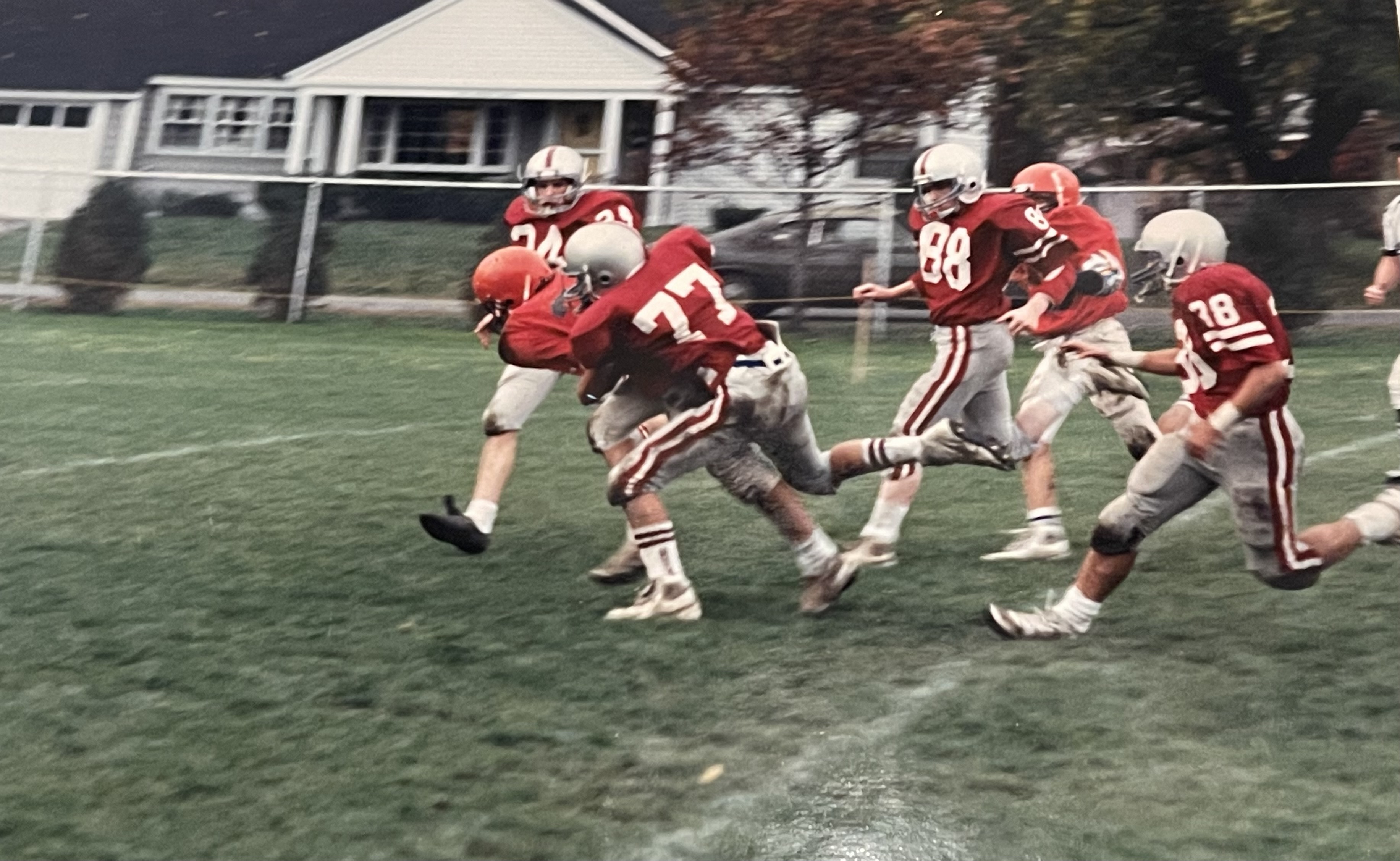
That’s me (77) making the tackle during a game my freshman year of high school. Our uniforms used to get dirty, because we played on real grass and dirt.
The Reflection On My Freshman Football Experience.
By the end of my freshman season of football at Hanover High School in Hanover, New Hampshire, I realized a few things.
First, I loved playing football.
I realized I loved the brotherhood of playing a team sport. Going into battle with a group of badass boys creates a bond. A brotherhood. An identity.
I realized we played better when we played as a team.
I realized how much practice helped. (Yes, Allen Iverson, we’re talking about practice.)
I realized that after a bad play, or a lost game, you had to learn from what you did wrong, but then put that behind you and move forward.
I learned that bringing energy to the game made a huge difference. And I run better on positive energy than negative energy.
I recognized that encouraging each other made a significant impact on our play and our relationships.
I learned that I represented my high school and my community when I wore that uniform. And I could either add to it or reduce it through my actions. (It was this 14-year-old’s first lesson in branding.)
And I realized that I needed to get stronger. There were guys who were a lot bigger and stronger than me. And while I was quick and athletic, sometimes big and strong won. And I wanted to be the bigger guy. Or at least stronger.
What Happened Next?
When my freshman football season wrapped, I was 6 feet tall and 150 pounds. The following Monday, I started lifting weights. And that simple decision, and the strong workout habit I created that year, set in motion the self-improvement journey I am still on today. (Or at least I was yesterday.)
I never got any taller. But by the start of football season my sophomore year, I weighed 170 pounds. My junior year, I weighed 190. By football season my senior year, I weighed 210 pounds. And by the time I graduated from high school, I weighed 215 pounds. I got a lot of new clothes in the process.
My first day in the weight room, I bench pressed 95 pounds. And that was really hard. But my senior year, after years of slow and steady improvement, I benched 335 pounds. It was hard to believe I was the same guy. But slow, steady actions compound in ways that are hard to imagine, unless you read the book The Tortoise And The Hare.
That’s me (78), my senior year. The weight lifting had added 60 pounds, and a lot of grip strength.
The Broader Impact.
My love for football and desire to get better didn’t just help me on the football field. The strength and conditioning that I did to get better at football helped me as a track and field athlete. (Which I chose because I was terrible at baseball.)
By my senior year, I broke 2 school records and a conference record, I was a state champion in both the shot put and the discus, I won the New England Championship in the discus twice, and I set a state record in the discus that stood for 12 years.
Discus throwing my senior year of high school.
But perhaps more importantly, I grew my personal relationships with my football teammates. We became a band of brothers. (A band with no instruments or spandex.) We went to battle together. We made it to the state semi-finals together both my junior and senior years. Both years, we came within one score of the state championship game. But that journey, even with an imperfect ending, brought us closer together. And we have great stories to share every time we are together.
Then we stood up in each other’s weddings.
And we helped each other in our careers.
When I started the advertising and ideas agency, The Weaponry, my very first client was Dan Richards, one of my football teammates from my freshman year in high school, and one of my best friends in the world. (Dan is the other guy making the tackle in the cover photo for this story.) He had also used the lessons he learned through athletics to help build an amazing business called Global Rescue, which does what the name says it does.
The relationship I developed with Dan has had a huge impact on my adult life. And it all started by being a strong, supportive, reliable teammate in football. Which made us trust each other in life and in business.
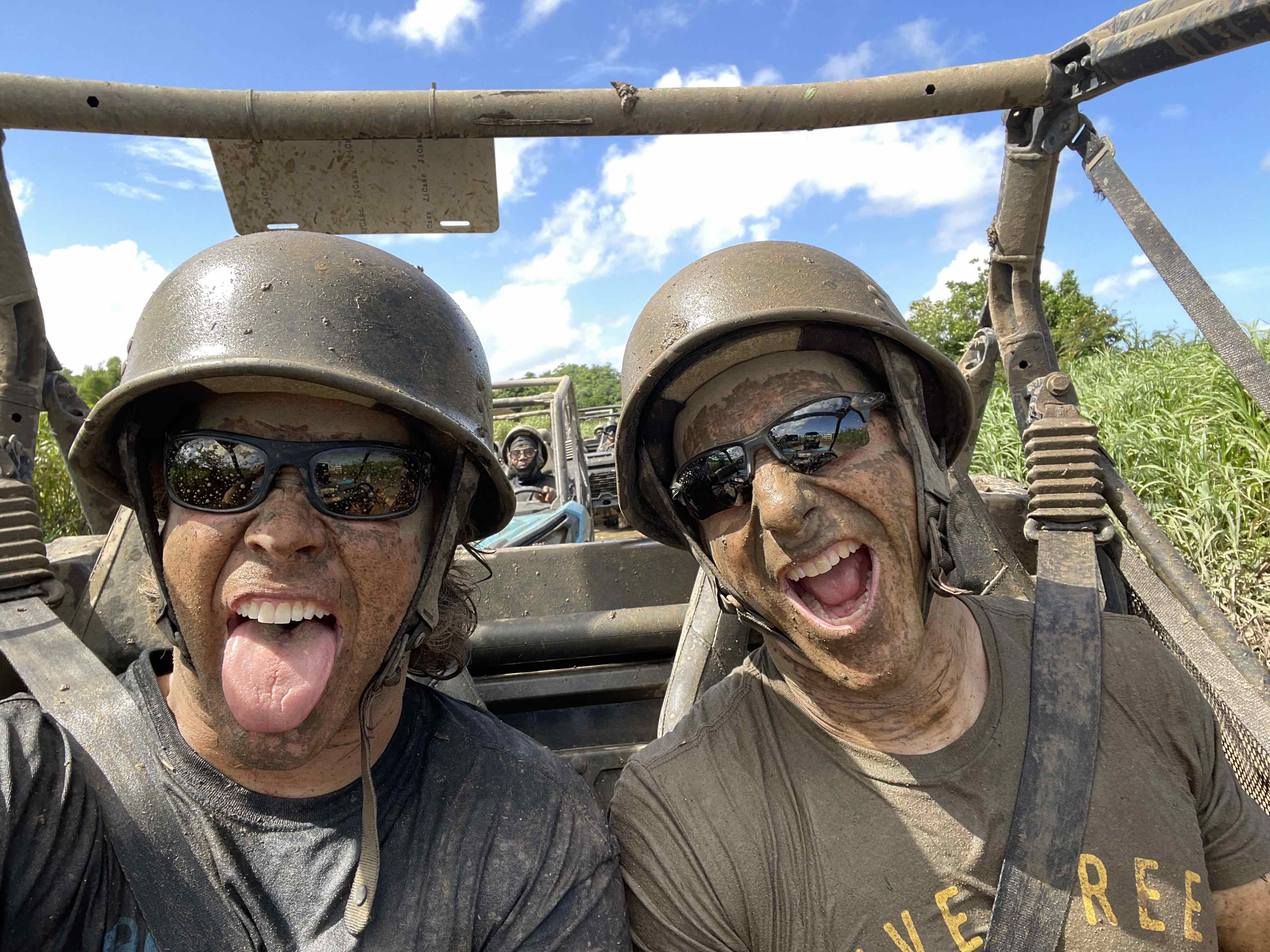
Dan Richards and I, getting muddy in Puerto Rico.
Key Takeaway
Don’t miss your great opportunities. To improve yourself. To create strong bonds and friendships. To use your drive to become better at sports or other competitions. And at life. Become a winner in your mindset first. And you will be a winner on the field and off. Use the same drive to improve in sports to win in your classwork and in your career. Bring the same relationship-building approach you bring to your team, to your family, to your friendships, coworkers, children, and spouse. And you will live a life you can be proud of, that is full of wins every day.
*If you know someone who could benefit from this message, please share it with them.
The more options you create, the more success you will find.
Comedians know this.
The more jokes you come up with, the more likely you are to have really funny jokes.
To be a raging success, you write lots of jokes. Perform those jokes in front of small crowds. Keep only the ones that work. Toss the rest. Repeat.
If you want more innovation, explore more what-ifs. While it may only take 3 licks to get to the center of a Tootsie Pop, it took Thomas Edison 10,000 attempts to create a light bulb. (And it took Natalie Merchant 10,000 Maniacs to create a hit song.)
The more people you know, the more likely you are to know a person who can help you open the next door, overcome a challenge, or offer you a kidney.
To find your prince or princess, you must kiss a lot of frogs. Or frogettes.
To catch one muskie, studies show you have to cast an average of 3,000 times.
To create a bag of tricks, you need many tricks. (And a bag.)
At The Weaponry, the advertising and ideas agency I lead, one of our hallmarks is that we explore a lot of options.
We explore a wide variety of strategies.
We explore as many creative options as the time and budget allow.
Great advertising doesn’t come from crafting one great headline. And designing one look.
There are often hundreds of headlines explored when creating a single ad. And dozens, if not hundreds, of looks.
It creates a large population of options to choose from. And large populations increase the potential for greatness.
So consider many strategic options.
Consider many, many creative options.
Consider many candidates.
And life partners.
Write a lot of jokes.
Pick only the very best ones.
That’s how you do smart things that set you apart.
Key Takeaway
To be successful, you first have to be productive. Create lots of options. You will both become better and create better by doing more. So drill more holes. That’s how you find the gusher.
*If you know someone who could benefit from this message, please share it with them.
So you know it’s not the cash register code for a sandwich at Arby’s.
Or a pennant and banner industry term for rainbow flag.
RBF refers to Resting Bitch Face.
It is a default facial expression that makes a person appear unfriendly.
It makes people think you are irritated, annoyed or angry. Even when resting.
And it appears in both women and men. (See Kanye.)
RBF makes people think you are unapproachable
It may be unfair. It may be the furthest thing from the truth.
But if you have RBF, it makes a negative first impression. And it builds a personal brand that works against you.
It sends a message to the people around you that you don’t want to talk.
And Jack White can tell that we aren’t gonna be friends.
Unfortunately, you never get a second chance to make a first impression. (Head and Shoulder’s taught me that.)
But there is another default facial expression that gets far less attention.
And it is far more valuable.
RFF
People with RFF have a friendly default countenance.
It may be a smile.
Or a warmth.
Or kindness.
They look like they would be happy to talk to you.
People with RFF look like they want to be your friend.
Resting Friend Face.
I am talking to this guy in a room full of strangers.
When I was a kid, I lived in 5 different states by the time I started 7th grade. So I learned how to make friends in a room full of strangers. And it always starts by looking for the person with the resting friend face.
Remember when you used to play Red Rover when you were a kid? You would look for the weakest link in the lineup.
Making friends works kinda like that. Only it feels less Lord of The Flies-y
I would ask her for directions.
When you walk into a room full of strangers, you look for someone with RFF as the best person to approach.
They are the person least likely to give you the cold shoulder. And most likely to be interested in having a conversation.
At networking events, people with RFF are approached first.
At a dance, someone with RFF gets invited onto the dance floor first.
At a bar, the person with RFF gets approached. (So be careful if you don’t want to be approached in a bar.)
In business, when the person with RFF walks into a pitch or a sales call, they are immediately likable.
Humans are programed to discern friend from foe.
We do this unconsciously.
Automatically.
It’s coded into our historic software.
That’s why RFF offers an unfair advantage in relationship development.
This guy gets it.
So train yourself to develop your Resting Friend Face.
Smile.
Or Smize.
Train yourself to default to a friendly pose.
Put a pleasant look on your face. It doesn’t have to be toothy.
Uncross your arms.
Put your phone away.
And look like a friend other people would like to have.
Practice in front of a mirror.
Film yourself to find what looks friendly on camera.
See what others see.
That’s a pro RFF!
By developing a RFF you will increase the potential for developing more friendships.
You will develop a better social and professional network.
People will choose to talk to you in a room full of other options. Which will make you feel like Sally Field at the `1985 Academy Awards.
You will be the person others will approach at a trade show, job fair, conference or seminar.
It’s how you get people to approach your booth, table or tent.
You will be the person others will choose to sit next to at a dinner party full of strangers.
And ultimately, you will benefit from attracting more good people into your life.
Key Takeaway
Develop your Resting Friend Face. Practice looking friendly and approachable as a default. You will stand out in a crowd. It will help you grow your brand, your network and the number of great opportunities that come your way.
*If you know someone who could benefit from this message, please share it with them.
A few months ago, something coo-coo happened with my default search browser on my laptop. This is not something I would typically write about. (Or read about.) But stay with me. There is a valuable lesson at the end of this techno-rainbow.
Instead of defaulting to Google for search, suddenly my computer was defaulting to Yahoo’s search engine, as if it were 1995.
For months, I would type a search into the search bar and it would take me to Yahoo’s results page, which, unlike a Snickers, was not very satisfying.
So I began to simply type Google into the search bar, then click on Google, and then perform my search once I had arrived at the Googler.
This was inefficient. And a waste of time. (But you already knew that.)
So one day I went to Google, and googled how to make Google your default search engine.
I got the answer immediately.
Because Google is good like that.
The process of changing my search engine took about 20 seconds.
And every day since then I have enjoyed a highly efficient search process.
The Bigger Lesson
The experience served as a reminder that we all have unnecessary inefficiencies that are slowing us down, wasting our time, and negatively impacting our productivity or our quality of life.
Recognize those inefficiencies and eliminate the time-wasting workarounds. Look for opportunities to improve your processes to save you time, energy and money over the long haul.
This may include improving your processes. It may include training others to do tasks so that you don’t have to. It may include fixing a broken or worn-out thing you have been working around. It may involve cleaning or organizing so that you can easily find the things you need when you need them. Which is kind of like Google in the physical world.
Key Takeaway
There are unnecessary inefficiencies in your world right now. Addressing them will take a little bit of time now, but save you a lot of time later. Seek out ways to improve your professional and personal productivity by improving your processes, training others, fixing, and organizing. It will eliminate your time-stealing workarounds. And decrease the friction in your work and in your life.
*If you know someone who could benefit from this message, please share it with them.
Like many avid self-improvers, I’m trying to grow into the best version of myself. This means adherence to healthy and productive habits. Which is hard. Because there are a lot of fun things on this planet that are unhealthy and counterproductive. Like sweet tea and turtle sundaes.
But I have found that if you gamify your life, your life becomes more fun and you get better results. This doesn’t simply mean playing more games. It means turning everything into a game. Like Milton Bradley. Or compulsive gamblers.
My life games start when my alarm first goes off in the morning. And they don’t stop until I am in bed again at night. These games help me feel like I am scoring points and winning all day long. It’s an easy way to make the actions that I know I should take each day more enjoyable and rewarding.
Fill Your Day With Games
Your work is packed with opportunities to win every day. But so is your home life, your social life, your health, your wealth, and your general self-improvement activities.
Consider the following ideas to get started.
You can gamify your sleep. Get to bed by a certain time, and you win. Wake up at a pre-set time and you win. Get a set number of hours of total sleep and you win. Don’t get kicked out of bed for snoring, and you win.
You can make weight loss a competition. Or make weight maintenance a game. I track my weight every day with the Happy Scale app, which gives me the opportunity for daily, weekly, monthly, yearly and even lifetime wins. Plus, you get bonus wins when you look in the mirror. And every time you can button your pants.
You can make your good habits a game. Stacking days in a row of consistently completing your good habits at work or at home is a win. There are so many good habits worth developing and maintaining that there are hundreds of ways to win every day. Like Lotto games say. (But don’t play Lotto. Bet on yourself.)
You can turn meeting new people into a game. Gamifying people-meeting incentivizes you to expand your circle of friends and grow your network. Give yourself points for every new person you know by name. Having more friends expands your opportunities, supports your mental health, and gives you more phone-a-friend options if you are ever a contestant on Who Wants To Be A Millionaire.
Grow-Your-Net Worth is a game that pays you a cash prize. And increases your peace of mind. Definitely track and stack your assets. And if they hate, then let them hate and watch the money pile up.
I play the Drink-A-Glass-Of-Water-First-Thing-Every-MorningGame. And I am crushing it at this game. Proper hydration is key to great health and human performance. So play this drinking game every morning.
I gamify annual adventures with friends. Gamifying it makes scheduling our time together a priority.
I play the Start-Each-Day-With-A-Smile game. And I’m happier as a result.
I try to be the first one to apologize when I get into a quarrel with a friend or loved one. I also compete to keep the word quarrel in use, since it has been decreasing in popularity for like 500 years.
I track my time on my phone each week and try to keep it below a winning standard.
I try to get to church every Sunday during Advent and Lent to win the Advent and Lent games.
By turning the positive behaviors you want to see from yourself into a game, they become fun to-dos. You can quantify your positive actions. Through small actions, you can put points on the board every day. Which means you can always count the good things you did, even on bad days.
Key Takeaway
You win at life in small ways, every day. By gamifying the actions, habits and behaviors you value, you are giving yourself a fun and easy way to track them, and stack them. It’s a great way to make yourself feel like a winner every day. It’s builds confidence and positive self talk. And it creates a clear and easy guide that you can use to measure your life. So start gamifying your life today. You can play every day. And like the state lottery commission, you can add new games every day to keep your interest up and to encourage the behaviors you value most.
*If you know someone who could benefit from this message, please share it with them.
I have been listening to a lot of Parker McCollum lately.
The country singer just released his 5th studio album, titled “Parker McCollum.” I am not sure how you decide to name your 5th album after yourself. Unless you are The Jackson 5.
One of the songs on the album is titled, “My Own Worst Enemy.”
The song is interesting. And entertaining.
But I can’t relate to it.
I realized while listening to the lyrics of the song that I am definitely NOT my own worst enemy. I have other people for that.
I am not self destructive.
I don’t talk smack to myself.
I don’t beat myself up.
I don’t have a cluster of bad habits or vices that I can’t unscrew.
Unfortunately, my relationship with myself will not inspire a classic country song. Or anything blues related.
But acknowledging that I am not my own worst enemy led to an interesting new question in my squishy gray matter.
Who am I to me?
Since the worst enemy title doesn’t fit me, I started wondering if the opposite was true.
So I asked myself:
Am I my own best friend?
I found that I could make a strong case for the affirmative.
The conversations I have with myself are supportive.
I give myself pep talks.
I encourage myself.
I remind myself of the reasons to believe in myself.
I keep a list of examples of success close at hand for regular reference.
I keep a list of examples of success in my Rolodex to call on when needed.
I start each day with an encouraging talk. Sometimes in my head. Sometimes aloud. Sometimes I can’t tell the difference.
I turn to myself in challenging situations.
I don’t suffer from imposter syndrome.
Instead, I always ask, “Why not me?”
And as much as I enjoy spending time with others, I am quite happy in my own company.
When people don’t like me, I typically consider it to be their issue, not mine.
I laugh to myself and at myself a lot. Which also feels a little loony.
I reminisce a lot with myself.
I reflect a lot on myself.
In fact, this writing is a reflection on my reflection. Which is totally metta.
When I was considering starting the advertising and ideas agency The Weaponry, I really believed I could do it. And I sent myself out to talk to people I thought would corroborate that belief.
I trust myself.
And while I know I am not perfect, I forgive myself for my shortcomings. I work on getting better every day and focus on the potential and the progress. Which is a friendly thing to do for yourself.
Key Takeaway
For better or worse, I act like my own best friend. (Which may also be a sign that no one else wanted the job.) I encourage you to strive to be your own best friend. Encourage yourself. Forgive yourself. Believe in yourself. Trust yourself. Be kind to yourself. The rest of the world will throw enough challenges your way. Don’t make your relationship with yourself another obstacle to success. Treat yourself as if you were your own BFF. It will make you happier, more confident and more resilient. And you will find there is no limit to what you can accomplish together.
*If you know someone who could benefit from this message, please share it with them.
This spring, I began a Misogi Challenge. These are demanding personal challenges that push your limits in order to develop character, confidence and self-reliance. Win or lose, they create great stories that make your obituary a more interesting read.
Such challenges are meant to push your outer limits, with a high likelihood of failure. The 2 basic rules for a Misogi Challenge are that they should be really, really hard. But you are not supposed to die. I have found that there is plenty of room for suffering within those boundaries.
To bench press 300 pounds. Because it is hard. And it’s a nice round number. Especially the two zeros at the end.
To bench press 315 pounds. Because this is three 45 lb plates on each side of the bar, and it looks freaking awesome.
To bench press 335 pounds. Because this was my maximum bench press when I was an 18-year-old high school student. Today, I am 52 years old, and have a white collar job that requires practically no physical labor beyond keyboard tickling.
To live to fight another day. Because I also want to be smart and not push myself to an injury.
This past Sunday, I made my final push to complete my Misogi Bench Press Challenge. #punalwaysintended
I took on the final challenge in my home gym, with my 3 teenage mutant children Ava, Johann and Magnus as witnesses. Not only did I want them with me to spot me, but I knew that having my kids in the room watching would provide additional motivation. And I needed all I could get.
If I succeeded, I would be setting a great example of hard work, determination and personal accomplishment for my kids. If I failed, I would be showing my kids that sometimes we set lofty goals for ourselves, and we fall short. But it’s the attempt that matters. It isMan In The Arena stuff. Which is also Woman In The Arena stuff.
I started with a 10-minute warmup on my Matrix elliptical machine. Then I stretched well. I believe that my commitment to warming up and stretching before my workouts has been key to my performance, injury prevention and longevity. My body still works and feels mostly the way it should. And I still have most of my original factory parts.
So I readied myself for the goal weight of 335 pounds. This was the weight that I had been focused on for months. It would answer the question, ‘Can you be as strong at 52 years old as you were when you were a high school kid, training during the peak of your high school career?’ I was a strong 18-year-old kid. I was the state champ in the shot put. I was the New England Champion in the discus. And I never saw another kid in my high school bench 335 lbs or more.
To hit that same weight 34 years later was a daunting task. But a major win if I could do it. Because coming up just 5 lbs short of the mark would mean that I wasn’t quite as strong as I was at 18. Certainly understandable. But also a bummer to lose the competition with my 18-year-old Zubaz-wearing self.
I prowled around the room, yelling motivation to myself. I have always been my own best hype man. I worked myself into a lather in a process I call Summoning. The basic premise is that we all have some maximum physical capability. The key to acheiving the maximum physical performance is to summon as much of your capacity as you can. So I summon as much energy, focus and fury as I can. It may be a little embarrassing to see on film, but it has always driven results. So I go with it.
I had Limp Bizkit’s Rollin’ (Air Raid Vehicle)on 11 in my AirPods. This is my go-to bench press song. Something about the lyrics (Breathe In now Breathe out, Hands up now Hands down…) feels highly appropriate for bench pressing. Plus, swear words get me hyped. (Sorry, Mom.)
I lay down on the bench, gripped the bar, and twisted it until it felt just right. I counted aloud, 1…2…3! And hoisted the bar off the red Rogue rack. I lowered the fully-loaded bar down to my chest and pushed with everything I had.
And the bar began to rise off my chest.
I knew I had it.
I began to yell as I pushed the bar through the full range of motion.
My kids didn’t even get a chance to yell encouragement at me, because I was yelling at myself. And the bar was obviously moving north.
I locked out the top position, re-racked the bar, and went freaking nutz-o!
I was so hyped I just kept yelling, and celebrating. I grabbed the hands of each of my 3 kids who were spotting me. Johann, then Magnus then Ava.
Then I turned and yelled at the camera. It was a Seven-Yeah Celebration. Like Usher would do.
I was so freaking hyped!
I had set a high bar for this Misogi Challenge.
And I met it.
With all 3 of my kids as witnesses.
And 2 cameras rolling, to catch the result, win or lose.
But I knew I hadn’t hit my limit. So I decided to try one more attempt. This would be above my goal weight. So I turned to Ava, my most experienced offspring in the iron arts, and asked, ‘Should I go for 340 or 345 lbs?’
Without hesitating, she said, ‘340. You always tell me to make sure I get the lift, rather than stretching too far.’
So she served up the good advice I had been dishing out. And I took it.
Now I was playing with house money. Plus, at that point, I had happy-hype coursing through my system.
5 minutes later, with Black Sabbath’s Iron Man sawing through my AirPods, I lay down under the bar, again. I un-racked the bar, lowered it and pressed. The weight moved. My kids blasted me with encouragement. I pushed at full strength until I had locked out the weight. Then I re-racked the bar.
I was instantly flooded with my favorite feeling: MaxHap. It’s the term I use for maximum happiness. It’s my version of self-actualization. Or flow. Or euphoria. It’s the drug that Huey Lewis was seeking. And I still haven’t found a negative side effect.
Everything had gone right. I set and met a hard goal, with a high chance of failure. Then I exceeded it. Which meant that I can say definitively that I am stronger at 52 than I was at 18. And I was 6 feet tall and 215 pounds back then. And headed to the University of Wisconsin to throw for the Badgers. Yet somehow, 34 years later, I was still pushing myself. That’s some crazy train stuff, Ozzy!
But even better, I experienced this with my kids. They were all in the room where it happened. They saw me attempt something hard and succeed. They saw me working towards my goal for months. They saw me fail reps along the way, but I kept on going. They saw the focus, determination and craziness that I tapped into to rise to the occasion. They were there to encourage me. And to catch me if I failed.
That was an amazing experience.
Now I am done with this challenge. I have banked the results in my list of life experiences. It has bolstered my confidence and my belief that I can handle hard things. So I move forward, mentally stronger than I was before I started. Which is the whole point of the challenge.
Key Takeaway
Push yourself to do hard things. Stretch your limits. Test yourself. Make commitments to yourself that are hard to keep. Then keep them anyway. It will build your confidence and self-reliance. It will toughen you up. The work and the suffering and pushing past your past limits make you feel alive and ready for anything. Give yourself a Misogi Challenge. Because when the world becomes too comfortable, you need to seek out discomfort to grow and experience life more deeply. Make it a regular part of your life. It will help you live a life worth talking about. Which means that whether or not you win or lose your self-challenge, you win at life.
*If you know someone who could benefit from this message, please share it with them.
Earlier this week, I took the day off from work to take my son Magnus to Six Flags for his 15th birthday. We invited Magnus’ friend Phineas along for the day of adventure. I had to go because they can’t drive. And also because I FREAKING LOVE ROLLER COASTERS! (Did I type that too loud?) In fact, if I could take a roller coaster to work, I would be living my ideal life.
I picked Magnus and Phineas up after their strength and conditioning session in Mequon, Wisconsin, at 9:30 am. We drove a giddy hour to the park, which is just north of Chicago. We chattered about all the rides we couldn’t wait to hit.
Then we arrived at the park, and crushed it!
In fact, I didn’t drop Phineas off at his home until 11:30pm. (This is the point where I warn you that if I invite you or your kids to an amusement park, we are going to stay until they kick us out.) By the time those boys got to bed, it was midnight in Mequon. And Montgomery.
But early the next morning, when I dropped Magnus off for strength and conditioning at Homestead High School, I saw Phineas bouncing across the parking lot with his large jug of water, ready to run and lift weights.
Phineas and Magnus were roller coaster riding pros.
I love what these high school freshmen did in those 24 hours.
First, they worked out hard in the morning.
Then they played all day, and practically all night long. Like Lionel Richie. They rode 11 different roller coasters that flipped, spun and dropped them until the park closed. Neither of them ever hinted at wanting to quit early. Or barfing.
They got home late.
They got to bed late.
But the next day, they woke up early and got right back to work.
That is a work hard, play hard, work hard approach to life. Wiz Khalifa-style.
The Mid-Week Coaster Crew. And my coaster hair.
Through their own actions, those boys are telling themselves that they are the kind of people who will soak up as much fun as they can. And they will still keep their commitments the next morning.
They will do hard things, even when they don’t necessarily feel like doing them.
Because to be highly successful, you do what you have committed to do, even when you don’t feel like it.
Through such actions, you tell yourself that you are resilient, determined and focused. And when you believe your positive self-talk, you stick to your commitments. And you build momentum. Like a roller coaster on that first drop.
That type of discipline will get you everything in life.
Keep up the strong work, boys.
You’re training. yourselves to be great.
My daughter Ava also joined, because roller coasters, like pickle ball, are better with 4 people.
Key Takeaway
To achieve great things, you need to take action. You need to commit to hard work. Even when you are tired. Even when you have good excuses not to. Even when you don’t feel like it. Even when you played hard the night before. But when you stick to your personal commitments, you send a powerful message to yourself. You tell yourself that you do do hard things. That you are committed, disciplined and determined. Those actions build trust in yourself. They build self-confidence. And they lead to outstanding results.
*If you know someone who could benefit from this message, please share it with them.