It’s time to find new ways to meet new people.

Business development is a vital function of any healthy business. And it is dependent on interactions with non-customers. This is why trade shows exist. They are like massive dates for people with problems and people with solutions. They are the male and female counterparts that make business work. #Bowchickabowbow Lots of business opportunities are created at trade shows. Because people get to meet, mingle and leave non-single.

Trade No-Shows

Right now, thanks to the Covid-19 curveball, in-person trade shows are simply off the table. As are most in-person networking events. Which creates a major impact on new business prospects for most companies. This is a significant problem to solve. And a significant business opportunity.

Calling It Off

New sales calls are challenged right now too. You can’t simply ask if you can swing by someone’s office to show off your cart of potions and elixirs. Because the people you want to meet with are not there. In fact, most of my clients at The Weaponry have not been in the office for 7 months. Some of them have even moved far from the city they work in, because it doesn’t matter where people live when no one goes into the office.

With all of the Zooming that is happening now, it isn’t easy to get prospects to jump on yet another video conference either. Especially since video conferencing today means inviting people into your home, where families are hosting a 3-ringed circus of work, school and personal life.

Where Do We Grow From Here?

This means that to continue growing your network and your new business prospects you have to find new ways to interact with people. So it’s time to adopt new approaches. Or act like Chubby Checker and put new twists on old ideas.

What I Have Been Doing

Over the past 2 months here is what I have done to expand my network during a time of social contraction:

  • I spoke to the quarterly gathering of Spearity clients. Spearity is a great management consulting organization. This introduced me to 40 impressive people I didn’t know.
  • I gave an in-person speech at a country club to a group of 70 people participating in a fundraiser for Chapman Basketball Academy.
  • I did 3 virtual workshops on leadership during a crisis for University of Wisconsin student athletes and staff.
  • I guest-lectured on creativity to a Marquette University marketing class via video conference.
  • I guest lectured on creativity to a Carroll University marketing class via video conference.
  • I was a guest on The Positive Polarity Podcast with Dave Molenda: You can listen to the episode or read the transcript here.
  • I was a guest on the Sport Coats Podcast with Will Jurgensen. (podcast coming soon to a podcast player near you)
  • I published 25 new blog posts.

The Results

As a result of these actions I have grown my LinkedIn network. I have received new introductions, I have had in-person, yet comically-physically-distanced meetings. I have developed great new relationships. In fact, it looks as if I will have developed at least 4 new clients as a direct result of these activities.

I didn’t make a single cold call. I didn’t ask anyone for their business. I simply gave away my time, knowledge and expertise. I gave value first. And as a result I got even more value return. Anyone can do this. Even today.

Key Takeaway

Remember it is not who you know. It is who knows you. During these unusual times you have to make sure more people know who you are in order to grow your network and improve your long term prospects, opportunities and sales. Provide value first. And good things will come your way. Even in 2020.

*If you know someone who could benefit from this message, please share it with them.
Everything there is to know about me in 52 minutes.

Everyone has a story. I recently sat down with Dave Molenda on the Positive Polarity Podcast to tell my story. Ok, so it was more like a series of stories. Kind of like Diary of a Wimpy Kid. Which makes my episode the Podcast of a Wimpy Adult.

If you want to skip the backstory and go straight to the podcast click here.

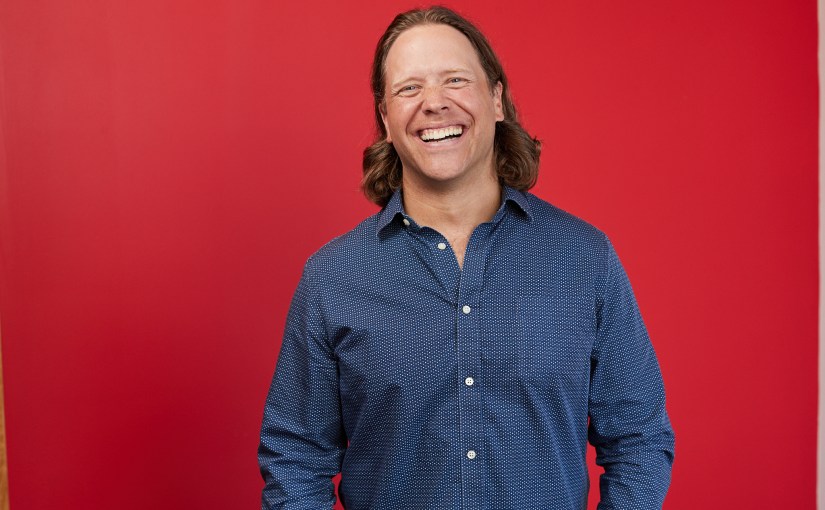
That’s a lot of hair in one square.

Dave Molenda

Dave is a successful entrepreneur who grew a baby startup business into a $10 million beast. Then Dave wrote a book that became a #1 Amazon Best Seller called Growing On Purpose: The Formula to Strengthen Your Team AND Improve Your Customer Experience.

Dave is a really positive guy who is looking to find more positive people with positive ideas to share with the world. (I’m positive about that.) Which is why my friend and public relations expert Monica Baer connected us. Dave is also a great podcast host and found valuable topics to discuss.

Dave is also a member of the Long Hair Boys Club. Which is a club I made up. (But there are real shirts and real stickers coming soon.) In fact, Dave’s flow is so good it makes me look like Telly Savalas.

Why Listen

If you are looking for insights on how to start or grow a business, I share my approach here. If you want to know how to write a blog, it’s in there. If you ever wanted to pick my brain (hopefully not with an ice pick), the insights you are looking for are probably in here. And if you would like to get away from the election and Covid-19 for a while, there is no mention of either of those 2 topics in the podcast.

Topics Dave and I talked about:

  • The process I used to discover my career passion
  • How I got my first job in advertising
  • How I started my own business
  • Where the name The Weaponry came from.
  • How I develop new business opportunities
  • Why I give away the goods for free (like a crack dealer)
  • How I built my blog (which now has 515 posts)
  • How I find time to write
  • Where my ideas come from
  • My favorite blogging topic
  • My goals
  • Positivity
  • My tip of the week.
  • The Weaponry’s fake website we had for 3 years.
  • Why Laverne & Shirley are part of The Weaponry
  • How I applied my athletic background to business.
  • The strength of a good name
  • Being a dude with long hair.

If you want to hear the podcast click on the link below. And don’t miss my Tip Of The Week at 46:40.

The link to hear Adam Albrecht sharing everything he knows with Dave Molenda

Thanks for having me Dave! (And thanks for the introduction Monica.)

An unpublished post I wrote on March 16th, 2020.

This morning I was scrolling through a folder of unfinished blog posts. I came across the following story that I wrote on the morning of March 16th, which for much of America was the first day of the lockdown/shelter-at-home/house arrest era. I found the story particularly interesting because it was written at what I would now consider the end of pre-covid normalcy. And it was interesting to look back at my mindset as we entered the great unknown.

The event referenced occurred on Thursday, March 12th, just prior to catching a redeye flight home. Which would be the last time I flew for 6 months. I expect the drop in redeye flights has hurt Visine sales.

The Event

Thursday night I grabbed a bite to eat at a restaurant in Las Vegas. I was by myself, so I sat at the bar and ordered my food and drink. I had a burger and tots, like Napoleon Dynamite.

The guy beside me and I started talking. We were both in Vegas for CONEXPO/CON-AGG, the enormous construction industry trade show. I told him I owned an advertising and idea agency that worked with the trade show. He told me he owned a mine in Texas, between Dallas and Houston. Which means his business mined the earth. And mine mined the mind. (Which I think is what the seagulls were saying in Finding Nemo.)

We discussed then newly emerging and unfolding challenges of COVID-19, and what it meant for our businesses. I told him that it would have very little if any impact on our ability to operate. (Meaning our ability to operate as a business. We still wouldn’t be any good at surgery.)

We transition fluidly between working in our offices in Milwaukee and Columbus, to working from home or wherever our work-travel takes us. As long as we have a computer and an internet connection we are good to go.

Tex, my bar-mate, had a pained expression on his face when I finished my evaluation of our business. Then he replied, ‘Until I can figure out how to run a backhoe, dozer and dump truck remotely I need my people on site.’

This simple barstool conversation in Las Vegas made me extremely thankful for being in the business I am in. I am thankful that when we planned the launch of The Weaponry we put systems and technology in place that would allow for maximum operational flexibility. It also helped that we didn’t include backhoes, dozers or dump trucks into our operating system.

On Sunday I sent a note to the 10 core members of our team telling them that we would transition to remote work as our standard until further notice. I am sure the current situation will pass, and we will get back to standard operating procedures.  But I am not sure how organizations can declare that a remote arrangement is going to last for the next 2, 3, or 4 weeks. The only thing certain right now is the uncertainty of the timeline.

The Impact

Right now we have plenty of work to do. We have 3 or 4 major presentations this week. The work needs to be done, because it is vital to our clients’ long term plans. The release dates may shift. But we are marching on. Because on the other side of the unknown we know we need to keep moving forward with our plans for business and life. We will present our work via Zoom video conference. Which we have used for presentations several times per week since our founding. Because our clients are as far away as California, Texas, Georgia, Pennsylvania and New Hampshire.

We have also seen some work quickly evaporate thanks to the current climate. We have had a few events canceled. Which means that film and photo shoots tied to those events have been canceled or postponed. Those things may never be rescheduled.

Like so many businesses, we are adjusting to a new normal. For our team, it is almost as simple as a Mr. Rogers wardrobe change when he enters or leaves the set of the show. We put on a sweater, change our footwear and we are ready to work in a new location. I expect we are luckier than most as we head into the new unknown.

Key Takeaway

Things will be abnormal for a while.

(this is where my draft stopped)

New Note:

The flexibility we built into the operation of The Weaponry meant that we didn’t and haven’t missed a beat during the new normal. Other companies around the world have adopted many of the same technologies and approaches we baked in from the beginning. Our comfort with the uncertainty of the future has been key to our ongoing success. Seven months later we still don’t know if we are closer to the beginning or the end. But we are ready for whatever comes next. I hope you are too.

Here’s the key to launching a successful business now.

The latest numbers on new business creation are staggering. New business registrations in Q3 of 2020 are up 77% over Q2. Which means there have been more new businesses registered in the past few months than at any comparable time in history. The Covid-19-induced disruptions have created all kinds of new opportunities for entrepreneurial-minded earthlings to capitalize on.

There are suddenly great interests in face masks, Non-Brooke shields, plexiglass, distance learning, contactless-anything, at-home entertainment (which sounds dirty, and maybe is), home remodeling, camping, food delivery and a hundred other things.

Of course all this new business creation isn’t purely good news. Much of the new business development is from displaced employees whose best, if not only option, is to start their own business and give it the ole college try. (Or, in some cases, the ole high school or GED try.)

As an entrepreneur, I find this extremely exciting. There will be great businesses that come out of this time. But not all the stories will have happy endings. (Meaning fairy tale-style, not Robert Kraft). I predict that the brave women and men who are now embarking on their entrepreneurial journeys will have one of three outcomes:

  1. Little To No success: This is due to an inability to attract customers or clients. Costumers are the helium in a startup. If you can’t find customers the business won’t float.
  2. Great Initial Success, Then Dramatic Failure: This is because they found initial customers, and delivered the initial product or service, but then couldn’t keep it going and build momentum.
  3. Huge Success:  These startups will quickly mature into real businesses and will flourish for years if not generations to come.

What Makes The Difference?

Anyone can start a business. If you can find customers you can do the work yourself and make your customers happy. But that’s not where the long term, sustainable, flywheel-style magic happens.

To build a business you have to create a system. Create Your Way. Make it repeatable. Your repeatable system is what enables you to both deliver for your current customers and attract new customers at the same time.

The system, your system, creates order, predictability and a clear division of responsibilities. It creates room for continuous improvement. It allows you to bring in help (employees) with little to no experience and contribute in meaningful ways.

The system allows you to step out for a bathroom break without the business also springing a leak. If fact, with a good system in place you should be able to take a monthlong vacation in Europe and the business will keep humming along. (Assuming American’s are allowed to visit Europe again. And assuming businesses are allowed to hum.)

Failed business owners realize too late that they didn’t have a repeatable system. A system that could be used to attract new customers, and keep them happy in a profitable way. They didn’t have a system that worked in both good times and bad (Think JJ Walker and Michael Jackson times). The didn’t have a system that enabled them to scale up and down when needed. Don’t let this happen to you.

Key Takeaway

Don’t just do the work. Or all you are is a worker working without a net. From the beginning you need to create and use your system. Think about what works now, document, follow it, and continuously improve it. It should allow you to use other people’s time to get the work done. Because if you have to do all the work yourself it is not a business. You simply own your own job. Which will be hardest, most stressful job you’ve ever had. But a system that sets you up for long term success will create a great work environment for everyone in your business. And you’ll wonder why you didn’t start your own business years ago.

If you want results stop chipping and start chopping.

Not all actions are equal. Which means the return on your invested time and energy is not equal. Occasional effort put into an activity, practice, or exercise is not the same as fully-dedicated effort with a plan, a schedule, and a timer. #TimeToMakeTheDonuts

Chipping

Chipping is the occasional effort you put towards a task. Sometimes you go for a run, eat a salad, read, or play an instrument. Chipping is going to church at Christmas and Easter, which makes you a  Chreaster. Chipping is shooting hoops in the driveway, sometimes, in your flip flops.

Chipping means you partake occasionally, when you feel like it. You write, sometimes. You study, now and then. You work late once a month.    

Chipping lets you say you tried. But it doesn’t move the needle. It doesn’t build momentum. And it won’t help your New Year’s resolution survive until February.

Chopping

Chopping is focusing on your goals, making a plan, writing it down, creating a schedule. Chopping means declaring a goal. Or declaring war. Chopping means setting a timer to your activity. Chopping is creating a habit. Chopping is swinging away and working up a sweat like clockwork. Over and over again. Like Nelly and Tim McGraw.

Key Takeaway

Chipping allows you to say you tried. Chopping brings down the tree.

How to be a better leader during a crisis.

It’s 2020, and we are all taking a crash course on crisis management, whether we want to or not. This is a crazy time. But life is full of crazy times. And when the crazy times come they create opportunities for leaders to step up and lead their people through the experience. So as Prince once said, let’s go crazy.

The Crisis Question

The great question that we all have to ask ourselves when we face a crisis is: What role will I play?

There are always many roles available to us. We can be The Complainer, The Blamer, The Eye-Roller. The Conspiracy Theorist, Negative Nancy, Debbie Downer, or RBF. These are easy roles to take on. But they add no value to others.

However, there are also these roles:

  • The Optimist
  • The Cheerleader
  • The Rock (the Dwayne Johnson role)
  • The Person of Few Words.
  • The Sage
  • The Jester
  • The Father Figure (George Michael called dibs on this)
  • The Mother Figure.
  • The Big Brother or Sister (Not the CBS version)
  • The Listener
  • The Stabilizer
  • The Rebel (Billy Idol and James Dean role)

These can all be valuable leadership roles that help your organization, team or family through challenging times.

When to Choose Your Role

The best time is to decide which role you will take on is before a crisis occurs. It’s good to think about which of these roles work with your natural tendencies and personality. It’s also good to understand which roles your team, group or organization already have covered, and what is available to you. Just like in Dungeons & Dragons.

Consistency

Once you pick your role, never waiver. I have spent my career building brands for some of the world’s best companies. And the most important factor in developing a strong brand is consistency.

So as you develop your strong crisis leadership brand always be who your team needs you to be.  Don’t be the optimist some days and the complainer other days. That spoils everything.

De-escalation*

In a crisis, emotions naturally escalate. Which simply exacerbates the problem. That’s why there is tremendous value in those who can help decrease the pressure in a situation. Always focus on making things better. Not worse. Others will recognize that, and seek you out in challenging times.

*This is not the down escalator.

Conflict Resolution.

My wife and I recently celebrated our 18-year wedding anniversary. I attribute much of our successful marriage to the fact that we resolve our conflicts quickly. We recently both agreed that in the 20 years we have been together as a couple, including 2 years pre-ring-wearing) the longest we have been in conflict with each other is 24 hours. We swear by the following conflict resolution formula to help get through our sticking points. (I also swear when I am not by the following conflict resolution formula.)

The Sure-Fire Formula

  1. The first person speaks without interruption.
  2. The second person plays back what they heard.
  3. The second person speaks without interruption
  4. The first person plays back what they heard.

Why this works:

  1. You both get to say everything you want to say.
  2. You both feel heard.

Try this the next time you have a conflict with another person. If it doesn’t work I’ll refund the money you spent on this blog post.

Leadership Is Lonely.

As a leader and an entrepreneur, I can’t show indecision or weakness to my team. They have put their trust in me, and I can’t waiver in front of them. Instead, organizational leaders need to find their own support group. This consists of a person or people outside your organization, team or family who you can share your challenges with.

I am part of a CEO roundtable that meets once a month to discuss the challenges we are facing, support each other and offer advice and guidance. It has proven to be a highly effective way of supporting leaders who don’t have a natural support structure within their own organization. And research on roundtables groups has indicated that any shaped table will do.

I have also created a meetup group of men who live in my community. All of them are either successful entrepreneurs or top leadership within their businesses. They are all husbands and fathers. We talk about issues that dudes don’t typically talk about. In this environment we can discuss the real challenges we face, the uncertainty we feel and share thoughts on how to be better businessmen, family men and members of our community.

Taking Care Of Yourself In Crisis.

There are stresses, frustrations and losses that accumulate every day. We are drained by daily setbacks. And 2020 has taken things to 11. So we have to prevent the stress gunk from building up and fouling our systems. The key is to figure out how to reboot, regenerate, and respond positively. 

The following 3 activities provide a proven formula for positively dealing with stress.

  1. Sleep helps your body and mind refresh and recover.
  2. Exercise helps you burn the stress off.
  3. Worship helps you rebalance and offers big-picture perspective.

You need to get rid of the stress gunk that builds up like WD-40. These back-to-basics keys help you find your balance again when you start to weeble or wobble. Try them for yourself. They will make you feel like a better human.

Key Takeaway

  1. Crisis is unavoidable.
  2. Crisis creates opportunity (Remember, chaos is a ladder).
  3. Find your most valuable role and play it consistently.
  4. Learn to de-escalate.
  5. Use the 4-Step approach to conflict resolution.
  6. Leaders need to find their own support system.
  7. Decrease your stress through, exercise, sleep and your own spirituality.

*If you know someone who could benefit from this message, please share it with them.

Answers to 9 questions about me that I wasn’t asked on a recent podcast.

Last week I was a guest on 2 podcasts. Both hosts were great and I expect the shows will be worthwhile listens when they come out in the next month. One of the hosts sent me a list of pre-questions to consider. Because I like to be prepared, I wrote out brief answers to the questions. But once the interview began we quickly found different topics to pursuit. Since I already had the answers ready I am sharing them here for a little more insight about me, my career and the 7 books I dig.

  1. How did you get started with your product/service/area of expertise? 

I studied journalism and psychology at the University of Wisconsin and wanted to become an advertising copywriter. A college professor of mine, Roger Rathke, introduced me to his college buddy Paul Counsel, who was the CEO of the advertising agency, Cramer Krasselt. I asked for an informational interview. I borrowed a suit from my college track teammate, now the Honorable Judge Greg Gill. The interview lasted 5 hours. Including an adventure to Paul’s house to meet his mudjacker. (Who goes to the CEO’s house on their interview? This kid!) A month later I finally sent a thank you note. And in response, they offered me a job. It was like the end of Willy Wonka And The Chocolate Factory when Charlie hands back the little covid-looking candy and wins the chocolate factory. Make sure to always send a thank you note.

2. Why were you drawn to this area of expertise? 

I am just wired for it. In college, after a couple of rough semesters, I mapped out my natural talents and how I could get paid to put them to work. The work of an advertising creative seemed to fall right at the intersection of my talent and sought-after skills.

3. Which hurdles did you personally face, and how did you overcome them?  

Generally speaking, none. I really haven’t had any major hurdles in my career other than the garden variety, like figuring out when and where my next chances for growth and promotion were. Maybe I was too unfiltered at the beginning of my career. I also developed a sweet tea addiction, which almost made me too wonderful for a while. Today I try to keep that between the ditches.

4. What do you think your unique skillset or superpower is that has helped you become successful? 

There are probably 4 things that have helped create my career success:

  1. My abundant enthusiasm. I can get excited about anything. Clients appreciate that.
  2. My ability to make and keep friends.
  3. My ability to think strategically
  4. The creative way my brain works. I make connections that others don’t. It glitches in a good way.

5. Are there any tools or books that have really helped you on your journey? 

Yes! I read a lot. Here are a few books that profoundly influenced me.

  1. The E-Myth
  2. Call Me Ted
  3. Rich Dad Poor Dad,
  4. Think And Grow Rich.
  5. 7 Habits of Highly Effective People
  6. The Alchemist.
  7. The Little Engine That Could

6. What advice would you give someone wanting to pursue a career similar to yours? 

  1. Build and maintain your friendships, relationships, and network.
  2. Continue to self educate.
  3. Live an interesting life. It fuels your creativity.

7. What’s one thing you wish you had known when you began your career? 

How valuable my skills really were.

8. Who are the three people who have been the most influential to you? 

  1. My parents Bob and Jill Albrecht molded the clay. They worked as one unit. So I count them together.
  2. Roger Rathke: My College Professor. He taught me all the basics of advertising strategy and creativity. I was well prepared for the real world of advertising when I graduated.
  3. Paul Counsell: Former CEO of Cramer Krasselt, who gave me my start in advertising. He is a great people person. I liked him the instant I met him. And I loved being part of his team.
  4. Dan Richards: One of my closest friends since middle school. And the first of my friends to become an entrepreneur. I was very close to Dan as he began his entrepreneurial journey. And Dan was also my first client when I launched The Weaponry.
  5. My high school track coach Jude Dutille, and my college track coach Mark Napier.  They helped me focus and develop my limited natural talent into meaningful results. What they taught me about competition and continuous self-improvement I have applied to the rest of my life and my career.

9. What is your best tip for someone struggling to take their idea forward?

Sharpen the idea until it is very clear and easy to understand. Then talk to the people you are making the idea for. See if your idea meets an unmet need. If not adjust it.

Key Takeaway

Always show up prepared. And if you don’t use everything you prepared for a podcast, you can turn it into a blog post.

This is how many people I hope to reach with each blog post.

When I first started writing this blog 5 years ago I thought a lot about the growth of the blog. I focused on how many subscribers I was getting. I thought about how many people liked, commented on, and shared my posts. But over time, as I should care more and more about such things, I find myself caring less and less.

It’s not because I don’t think growth and significance are important. It’s because I have thought more about the power we all have to add real value to just one person.

A Critical Post

Back in 2015, as I was preparing to launch my advertising and idea agency, The Weaponry, I read a blog post that unlocked a critical door for me. It was written by my friend Christien Louviere. Christien is an entrepreneur in Atlanta. And he wrote a blog post about the top 10 things you don’t need to do to start your own business.

In the post he conveys that it is a lot easier to start a business than you thought. He encourages readers not to worry about the many things they likely thought were speed bumps, or impediments to entrepreneurship.

It was a very useful post. And it contradicted Johnny Paycheck’s take-this-job-and- shove-it philosophy. In fact, one of the 10 points was that you don’t need to quit your job to start your own business. In fact, he encouraged readers NOT to quit their day jobs until they absolutely have to. Instead, start your new business on the side (either side will do), and let your day job fund the night job, or side hustle, as long as you can.

The Entrepreneurial Track Change

When I read that post I already had potential clients encouraging me to start my own business. Which I was excited to do. The problem I couldn’t figure out was how and when to switch from salaried employee to on-my-own entrepreneur, like Patti Labelle. At that point, I was 42, making the highest salary I had ever made. I had a significant mortgage. I had 3 kids, and a wife I really wanted to keep.

Good Advice

The advice to get going while still holding onto my job was exactly what I needed to hear, when I needed to hear it. It unlocked a critical door for me to pass through. (And I have found that passing through is far better than passing out or passing on.)

But the funny thing is that I bet not that many people read Christien’s blog post. Christien wasn’t the French Seth Godin. He didn’t have millions of followers. For all I know I was the only person who read that post.

But Christien had knowledge and insights that I needed. And he shared it, like Sonny Bono. With that one post, I found exactly what I was looking for, unlike U2. I don’t know how things would have unfolded for me given other timing and circumstances. Because so much of life’s success is about getting the timing right. #TWSS

A Better Measure

I no longer concern myself with how many people read my blog. I am not trying to impact or influence the masses like a televangelist. I don’t expect to ever get paid for my blogging. Or be considered an important influencer.

Instead, what I think about is sharing what I know, what I have learned and what I have experienced. I think about sharing my accumulated knowledge on entrepreneurship, creativity, advertising, marketing, networking, positivity, wellbeing, and adventuring.

I expect that what I share will be valuable to one person who reads it. And that’s all that matters to me. I don’t even worry about whether or not they tell me that something I wrote was impactful to them. I trust that there is a person meant to read each post I share. And that it will help them in an important way. Even if it is just getting through a challenging day.

Proper Perspective

At the end of our days, the only thing that really matters is the impact we had on each other. If I can share something I have learned, and have a positive impact on another human, then my effort is well rewarded.

Key Takeaway

If you have a blog, vlog, podcast, newsletter, twitter feed, Pinterest board or Instagram account where you are sharing what you know, what you think, or what you enjoy, don’t be discouraged by a small following. Focus on adding value. If one person benefits from what you are creating you are positively impacting a life. That is our highest calling. Thank you for answering. And keep sharing. Someone is listening. And that someone is everything.

*If you know someone who could benefit from this message, please share it with them.

Want more tips on blogging? I think you’ll like these:

What I have learned about blogging after 200 posts.

12 things I’ve learned from writing 300 blog posts.

One day I started a blog. Now I have published 500 posts.

One day I started a blog. Now I have published 500 posts.

When I first heard about blogging I loved the concept. Thanks to the internet, suddenly you could write and publish your thoughts as often as you wanted, without having to own your own newspaper, magazine, or bathroom stall.

I knew this was a great platform for me. Because I could fill my writings with silly comments and there would be no editor to edit them out. Then again, there would be no editor to catch my spellng mstaks. And I have a type-O personality.

Over the following decade I took several good swings at blogging. I now have 9 random blogs to my credit. But to 7 of them I’m just the Bloggy-Daddy. You know, the guy who created that poor little abandoned blog and, like Tom Petty, don’t come around here no more.

Sailing The Entrepreneurship

In the fall of 2015 I began plans to launch my own advertising agency. I loved the idea of sharing my experience with the world through a blog. I figured the creative inspiration would be endless. So I began writing The Perfect Agency Project blog. I applied the same proven success formula to both my business and my blog. Which is to say I started and never stopped. #DontStopGetItGetIt

The Weaponry

Today, my advertising and idea agency, The Weaponry, is set to have our best year ever. Which is amazing considering that 2020 the year is nothing like 2020 the TV show.

What began in my home office in Atlanta now has offices in Milwaukee and Columbus. We have clients in Atlanta, Los Angeles, San Francisco, Dallas, Raleigh, Philadelphia, Manchester, New Hampshire, Columbus, Cincinnati, Madison, Milwaukee and more.

The Blog

This blog that began my entrepreneurial journey with me is stronger than ever too. Because I just keep writing. However, back in March, just before the world went sideways with Covid-19, I changed the name of this blog from The Perfect Agency Project to the Adam Albrecht Blog.

I made the change for two reasons. First, because I wanted to have greater latitude to write about my learnings, experiences and observations beyond entrepreneurship. Because entrepreneurship teaches you lessons that reach far beyond business.

Second, I wanted the blog to be easier to find. Now, anyone typing my name into a search engine will easily find this blog. Today, I am also working on a book. And connecting your name to your blog creates better connectivity to all of your writing. And some of your wronging.

Mr. 500

The post that you are reading right now is my 500th post on the Adam Albrecht blog. I have shared a considerable collections of experiences, ideas, learnings and observations since the fall of 2015.

What I have enjoyed most is that the process of writing this blog forces me to think. It makes me think about what I am learning and experiencing. It makes me think about my life and career and the journey I am on. Which means that life isn’t simply passing me by. I’m evaluating it, studying it and appreciating it every day. And like a tech-enabled Elvis Costello, every day I write the blog.

Thank You!

Thank you for reading this blog. I know your time is valuable. The fact that you have spent some of your time reading my blog means a lot to me. I appreciate your support, comments, likes and shares. I appreciate it when you challenge my thinking. I appreciate it when you find a spelling mistake for me. And I appreciate it when you let me know that you picked up on the obscure reference I dropped in the story.

Key Takeaway

The key to success is simply starting and never stopping. If you do those 2 things, you can build a business from dust. You can write 500 blog posts. And you can do anything else you set your mind to. Far too many people come to the end of their days and regret the things they didn’t do. Don’t let that be you. Start today. And just keep going.

*If you know someone who would benefit from this message, please share it with them.

I’m in the process of creating a process for creating processes.

Most businesses fail at some point. That is just a fact. I knew that 5 years ago when I began making plans to launch my own advertising agency. So I bought the book The E-Myth, because a bunch of smart people recommended it as a way of, well, not failing.

The E-Myth

The book is great, and I always recommend it to anyone thinking of starting their own business of any size or shape. I also recommend it to any business owner who hasn’t read it yet. In fact, The E-Myth is like my Frank’s Red Hot. I recommend that sh#t to everyone.

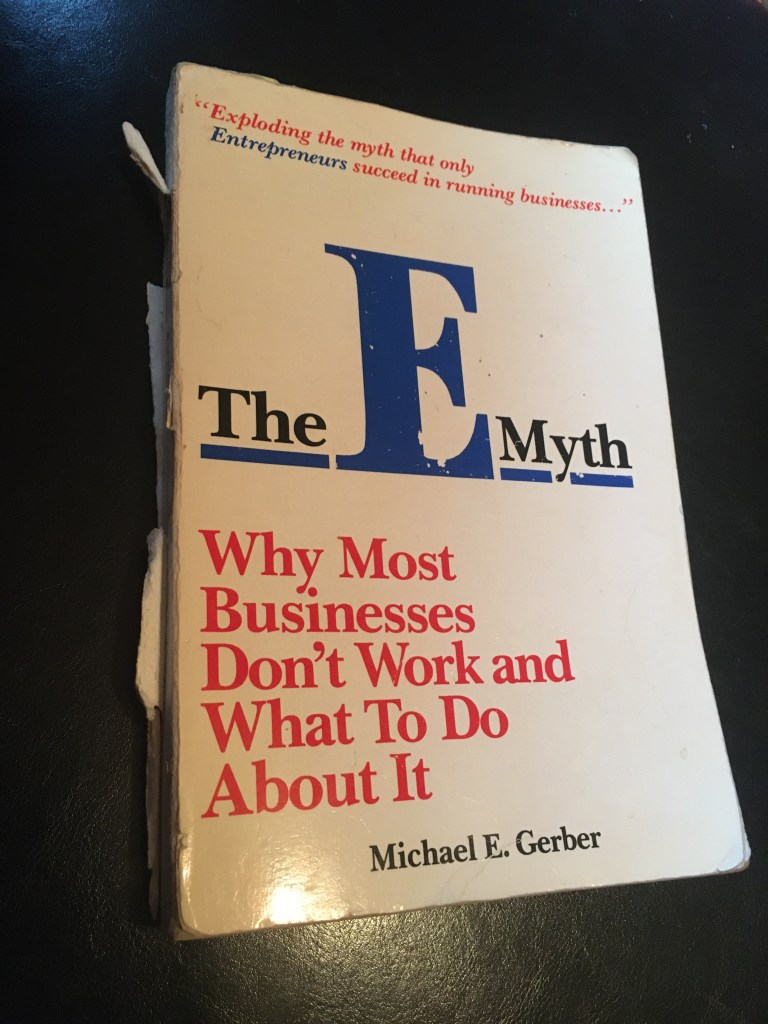
But I didn’t just read The E-Myth once. I study it. It has become one of my most important reference books. In fact, I handle this book so much it looks like I don’t know how books work. See the pic below. It looks like I tried to open it on the binding side until someone suggested that the other side might offer less resistance.

My copy of The E-Myth indicates I don’t know the proper way to open a book.

One of the key tenants of the book is that there should be a predictable, repeatable process for everything. I fully believe this. From the beginning, I established processes for my team at The Weaponry to follow. I have regularly revisited those processes, modified them, and added new processes.

But I have never been satisfied that our processes are as good as they should be. Which is the point. When people tell you to work on your business, not in your business, they typically mean, improve your processes. Unless those people are roofing consultants. In which case they probably mean you need to do some work up on top of your business.

Back to Business

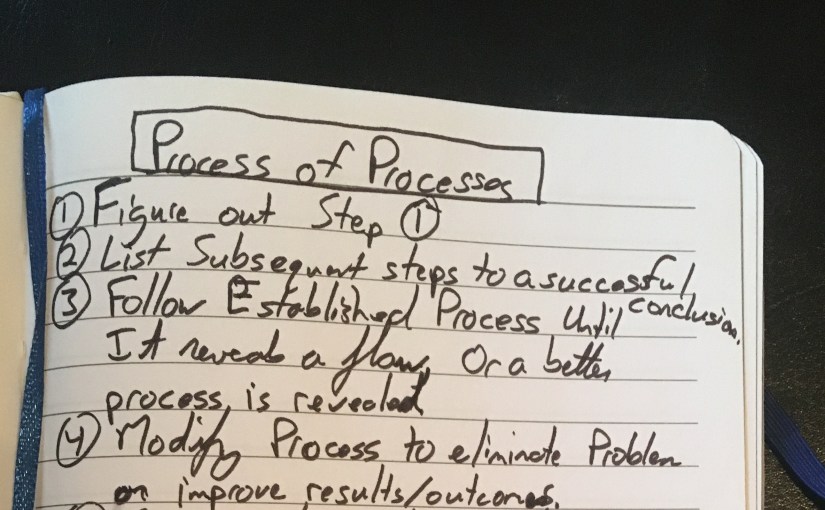
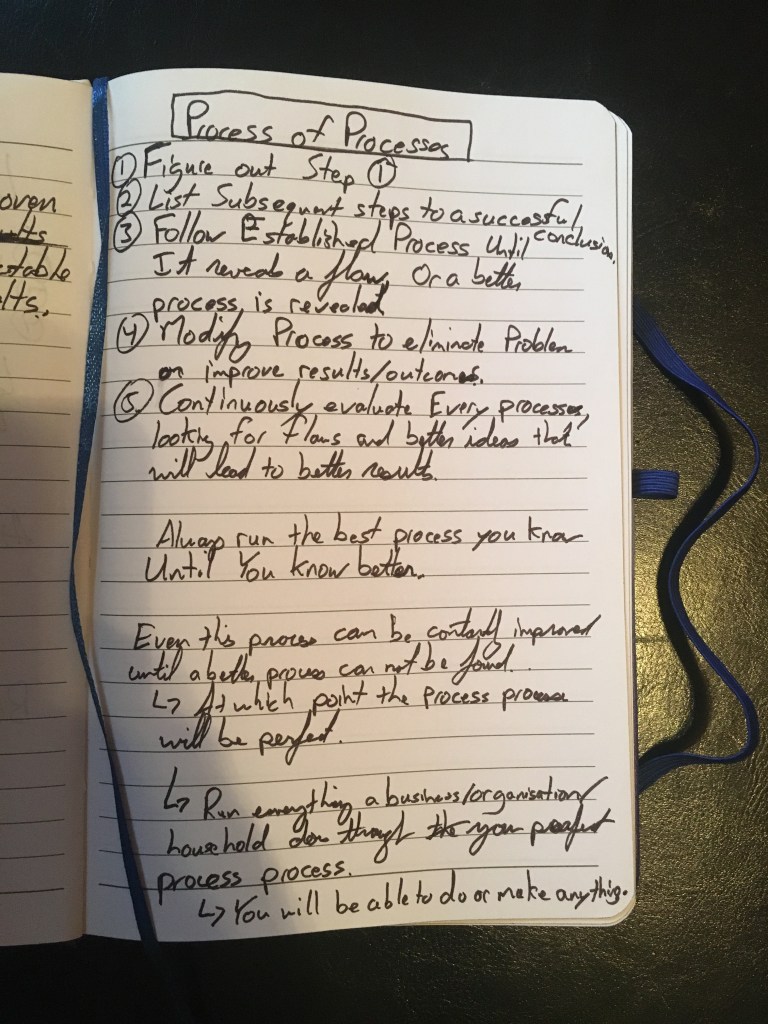
Today, I am revisiting our processes again. In fact, last night, just before I went to bed, I went all the way back to the beginning, again. I asked myself, ‘What is The Weaponry’s process for establishing processes?’ And here is what I wrote in the notebook on my nightstand. (I translated it into type below so that non-chickens can also read it.)

My nightstand notes.

Process of Processes

  1. Figure out Step 1
  2. Write down Step 1
  3. List each subsequent step to a successful conclusion
  4. Follow established process until it reveals a flaw. Or until a better process is revealed.
  5. Modify process to eliminate the newly discovered problem, or to improve outcomes.
  6. Continuously evaluate each process, looking for flaws, and better ideas that will lead to better results.

Note: Always run the best process you know until you know better.

Note: Even this process process can be constantly improved until a better process process can not be found. At which point the process process will be perfect. (Then check the Vector Victor.)

Note: Run everything the organization does through The Perfect Process Process. 

Note: You will be able to do, make, and deliver anything with this process.

Key Takeaway

Creating a well-run business requires great processes. Creating great processes requires a strong process process. Figure out yours. Then use it. And perfect it until it can’t be improved any more.

*If you know someone who could benefit from this message, please share it with them.