Which of your beliefs will make you legendary?

Last week I visited a fascinating company in Bangalore, India. My team at The Weaponry was hired to tell the story of this impressive organization that has grown from 50 people to 5000 employees in just over 12 years. This kudzu-style growth fascinated me as a business owner. And I was determined to learn all I could from studying this organization.

The Campus

The business has a beautiful, 500,0000 square foot campus that includes multiple interconnected buildings, two giant cafeterias, a walking path through a forest garden, a rainwater reclamation system, large art installations and a transportation system that moves employees between home and work that operates like a school’s bus system, but for business. And presumably without spit balls.

The Posters

Throughout the campus of this remarkable organization there were posters of the grandfather of the two Founders. Each of the posters highlighted one of the Grand Patriarch’s core values. This iconic businessman was born in 1903, before the airplane, television and computer. He died 25 years ago. Yet his approach to life and business is very much on display as a source of inspiration to this progressive organization’s employees and visitors. And none of the posters simply said ‘Hang in there Kitty!’

As I read each of the posters I kept asking myself:

Which of your core principles could inspire great success in your grandchildren and the organizations they run 100 years from now?

Something to think about.

Do you have such principles, values or beliefs? Have you identified them, written them down and shared them? I think about my beliefs and philosophies often. But I had never thought about capturing them as a source of guidance and inspiration for future generation of my family, and future generations who will work in my business.

Key Takeaway

In light of what I saw in India, it seems like a great idea for us all to identify our core beliefs and share them with our children, friends and team members. You never know what you may inspire.

3 easy things you can do to prevent stress gunk.

Entrepreneurship is like joining the Stress Of The Day Club. Because entrepreneurship is hard. But motherhood and fatherhood and living in the hood are also hard. That’s because life is hard, and stressful. No one is immune. And not to spoil the ending, but none of us will make it out alive.

Stress Gunk

We accumulate stress during regular operating hours every day. If we are not careful, that stress leads to the accumulation of a funky gunk. That gunk prevents us from performing at our best. In turns us into cranky pants. It also prevents us from being able to handle more stress.

I have found 3 things that help me eliminate the stress gunk in my trunk. Together these 3 ingredients form my de-stress recipe. Or destressipe.

1. Exercise

When I started lifting weights when I was a freshman in high school it changed my life. I tend to have a lot of energy. But when I lift weights it helps me burn off my excess, pent-up, or silly energy. Stress is a form of energy too. You can use it like a workout supplement to move more weights or endure longer endurancey things. The key is to workout until you’ve burned off the stress energy. It’s a great way to prevent your mind and body from going all Chernobyl.

2. Sleep

Sleep is your giant reset button. It is what helps replenish your store of energy, your tolerance for craziness, your focus, your stamina and your eye boogers. Whenever I get 7 hours of sleep at night I feel like I am unstoppable. I often nap on the weekends too. Because it is an investment in a better me. When I don’t feel quite right, sleep is my go to prescription. Because it is how your body naturally regenerates the best you.

3. Church.

Stress often causes us to lose perspective. Or maybe it is the loss of perspective that causes the stress. Either way, attending church is the best way I know to regain a healthy world view. I believe there is a greater power than me. And I don’t just mean the IRS or Dwayne Johnson. I’m on Team Christian. But I believe all of the major religions provide great perspective and guidance on how to be a better you and live a better life.

I try to attend church regularly. It helps me refocus, refresh, relax, feel supported, and forgiven for my mistakes. Communion also makes me feel a bit like a cannibal when I eat and drink JC. But that’s a different issue.

Key Takeaway

There are stresses, frustrations and losses that accumulate every day. We are drained by daily setbacks. So we have to prevent the stress gunk from building up and fouling our systems. The key is to figure out how to reboot, regenerate, and respond positively.  Exercise, Sleep and Church are the back-to-basics keys that can help you find your balance again when you start to weeble or wobble. Try these proven approaches. They just may make you feel like a better human.

How to balance your priorities like a student athlete.

Even 22 years after graduation I have not found a school I would rather have attended than the University of Wisconsin. There is no other town like Madison. And no other culture like the University and its work-hard, play-hard, jump-around-hard students and alumni.

Student

In college I double majored in Psychology and Journalism. I think I also set some sort of school record for most bars and parties attended without drinking alcohol.

Athlete

When I wasn’t studenting I was a proud member of Wisconsin’s Men’s Track & Field team. I threw the discus, the hammer, the 35-pound weight, and the occasional hissy fit. 

The Kickoff Meeting 

Every fall, the track year would kick off with a mandatory team meeting in an auditorium in the athletic center. We had to fill out various forms in order to be cleared to participate. It was more businessy than athleticy. But it signaled the start of the season, and it was the first time the team assembled each school year.

Coach Nuttycombe

My favorite part of the meeting was when our head coach, Ed Nuttycombe, addressed the team. When I joined the program, Nutty had already won several Big Ten championships. By the time he retired in 2013, he had amassed 26 Big Ten titles, more than any other coach, in any sport in Big Ten history. I was proud to be part of that history, as our team swept the Big Ten Cross Country, Indoor and Outdoor track titles both my junior and senior years.

Nutty’s Accolades

  • 26 Big Ten Titles
  • 2007 NCAA Indoor National Team Championship
  • 165 Big Ten Individual Champions
  • 11 NCAA Individual Champions
  • 6 Olympians

Priorities

There was one part of this annual meeting I will never forget. Nutty always made a strong point about his expectations of our priorities. He said:

‘Gentlemen, as a member of this team, always remember that academics come first. You are a student at the University of Wisconsin first. Track & Field comes second. Let me be absolutely clear about that. But if you want to be on this team, track better be so close behind your school work that you can barely tell a difference. Academics are priority 1. Track and Field is priority 1A.’     -Ed Nuttycombe

Oh Snap!

I remember being surprised the first time I heard this speech. I thought he was going to say academics are always the priority. Athletics come second. But that’s not the Nutty way. In his world, if you can’t fully dedicate yourself to both high academic and athletic achievement, then you don’t belong on his team. That was a badass statement. And we all felt badass for living up to his standards.

Hall of Fame

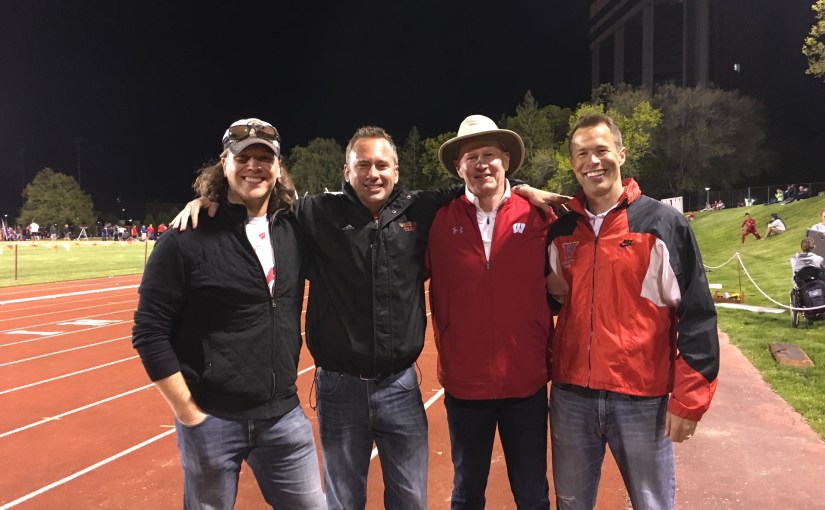
Last Friday, Nutty was inducted into the University of Wisconsin Athletic Hall of Fame. And with great reason. But I would also induct Nutty into the Prioritizing Hall of Fame for the way he pushed us to achieve great things in multiple areas of our lives. My teammates were impressive on the track, in the field and in the classroom. But I am just as proud of all the successes my teammates are having today in their careers, and as husbands and fathers.  

Takeaway

I carry on Nutty’s dual commitment today to my family and my work. I don’t think about balancing the two. I think about prioritizing them both. I must succeed at both. There is no way around it. There are no shortcuts to take. There are no excuses. That’s what Nutty taught me. And just look at his track record. #PunIntended

It’s time to tell the full truth about the business I made up.

Three years ago I started writing the story of a fictional advertising and idea agency. I dreamed up the details of the business and then wrote them down in a notebook. I would fire up my laptop, open a google doc, and fill it with vivid descriptions of this company that only I could see. In the same way that children have imaginary friends, I had an imaginary ad agency. I thought about that agency all the time. I was obsessed.

The more I thought about it, the more I wrote about it. And the more I wrote about it the more vivid this fictional business became to me. So I did something crazy. I started talking to other people about my imaginary agency. I described it as if were absolutely real. I told people what kind of services it offered, what kind of people worked there. I talked about its culture and why it was the perfect agency. I even gave it a name.

Then a funny thing happened. Other people began talking about this completely fictional agency like it was a real business. They started asking questions about it. Smart, talented,  sane people wanted to know if they could work there.

So I began talking to marketing professionals and business owners about my imaginary agency. Then something unbelievable happened. Someone asked if they could hire this imaginary agency to create some real advertising.

Suddenly, this agency that was completely made up had a real client, a real project to work on, and a real deadline. I quickly filled the imaginary roles within the agency with real people, who did the real work and delivered real ads to a real business for real money.

From that moment on, this fictional story of mine became non-fiction. People started referring to my imaginary agency by name. They called it The Weaponry. The United States Government started sending it mail. Businesses started sending it money. People started listing it as their employer, and banks started calling it to make sure it was ok to offer applicants mortgages. How crazy is that?

Key Takeaway 

If you want to create a real business you start by creating a fictional business. Imagine every detail. Write it all down. Paint a picture so vivid it feels absolutely real. Talk about it in such detail that others start to see it too. Give it a name. Others will start calling it by that name too. Talk about your fake business to real customers and clients. It will be weird and surreal. It will warp and bend your sense of reality for a while. But if you believe in it enough, others will too. Then suddenly, and undeniably it will all become completely real. I know it sounds crazy. But it’s true.  

Sometimes the most important thing to work hard at is patience.

Hard work is important to almost every variety of success. Unless you aspire to be an outstanding subject in a sleep clinic, you have to put in a lot of effort to achieve your goals. That’s why it is so important to pursuit the things you are most passionate about. It is much easier to put in long days of work when you are genuinely excited about the work and the mission.

However…

While hard work is important, it is not the only contributor to business and personal success. Since I launched my advertising and idea agency, The Weaponry, I have found that the most surprisingly important ingredient to our success has been patience.

Patience

There have been dozens of times over the past 2.5 years when putting in more hard work would have worked against us. That’s because our clients and customers, (and potential clients and customers) have their own timing that has nothing to do with us.

I have had exciting conversations about great opportunities that then took a long time to materialize. I am talking about gestational periods of a year or even 2 years. There are other opportunities that I still expect will materialize 3 years or more after our initial conversations.

That’s a long time to wait for a cake to bake. But there is nothing I, or any of my teammates can do to speed the process along. In fact, calling and asking and pressing the client, or potential client, would only hurt the opportunity.

Key Takeaway

Recognizing when you have done all the hard work you can to generate a new opportunity is an important skill that pays huge dividends over time. Because once you have reached a critical point, less is more. Let the timing that is out of your control take its course. But don’t give up. This is a hard perspective to master. Master it anyway.

*If you have a story to corroborate this need for patience instead of more work, please share.

**Also, this post had nothing to do with people in need of medical care. Thanks anyway spellcheck.

Do you know that your smart phone is robbing you every day?

Digital devices are amazing. They enable you to find the answer to virtually any question, any time. They help you fill in knowledge gaps like grout. Or mortar. Or caulk.

So we end up filling our free time by answering questions: What is the weather like tomorrow? Tap. What’s the balance in my bank account? Tap. What is Debbie doing? Tap. Is she still in Dallas? Tap. What was Gregory Hines famous for? Tap. What do you call water from the faucet? Tap.

The Dark Side

But these omnipresent digital devices have a significant downside too. They are depleting one of our most valuable resources: our free time. That precious time when we can let our minds wander in empty space. The time we can use to imagine exciting new ideas is disappearing at an alarming rate. In fact, the planet is losing free time faster than we are losing rain forest (acutally I just imagined that fact in my free time).

If we are not careful we will squander our most fertile time to invent, improve and inspire. That time lost can never be recovered. Not even with LoJack.

The world needs more great ideas. So do businesses, communities, schools and households. Great ideas are born in the quiet spaces in between. Those spaces that are now being filled in with screen time.

Key Takeaway

Starting today, take back some of your thinking time. While you are waiting for something to start, or something to end, or someone to show up, keep your smart phone in your pocket or purse. Instead, let your mind go wherever it wants. If you give it enough time it is sure to arrive somewhere exciting and new. Once it does, pull out your phone and tell me all about it.

*If you know someone who could benefit from more free time and less screen time, please consider sharing this post.

16 important life lessons I learned from boogie boarding.

Vacation time is the most important time in your career. If you squander your vacation time it will have a negative impact on your work, your happiness, your family, your friends and your tan lines.

I spent last week on vacation at the beach in Hilton Head Island, South Carolina. My family of 5 loaded up our Family Truckster and drove from the western shore of Lake Michigan to the Eastern Shore of the second largest barrier island on the east coast. We drove because we bring 5 bikes and 5 boogie boards, which are hard to stuff in the overhead compartment on a plane.

Boogie On Board

I spent a lot of time boogie boarding. It is one of my favorite ways to spend a vacation day. Boogie boading is like life (#gettingdeep). I have thought a lot about why I enjoy boogie boarding so much, and what it has taught me. Here’s what I came up with.

IMG_6902
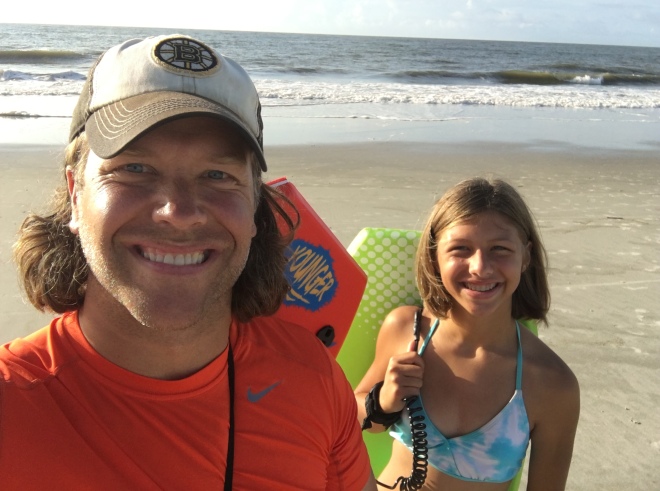
My daughter Ava and I about to boogie.

Top 16 lessons I have learned while boogie boarding.

  1. Be present. When you are boogie boarding you become totally absorbed in the moment. Like Bounty. Being present makes you feel alive. Feeling alive feels good.
  2. You have to choose the waves you want to ride.  Opportunities come at us over and over. We have to decide which ones are best for us. Others around you will jump on waves that aren’t right for you. Let them.
  3. You have to kick to get started. To catch a wave you have to start with a little forward momentum. Which means you need to get moving first. Never forget that. My son Johann (11) says ‘If you don’t start kicking you’ll just float.’ #truth
  4. Sometimes you are too early. We often get excited about an opportunity too early. Oh well. We tried.
  5. Sometimes you are too late. You don’t know what you’ve got till it’s gone. I’ve missed many a great wave because I didn’t time it right and it got away.
  6. Sometimes what looks great isn’t. A job, a client, an opportunity can look perfect. But it doesn’t turn out that way. This will happen. A lot. But on the other hand…
  7. Sometimes what looks bad isn’t. I have caught waves that I thought would be forgettable, and they turned out to be the best rides of the day. My career has been like that too. Some of my favorite clients and opportunities started inconspicuously. Don’t write them off.
  8. There will always be more waves to catch. Whenever you miss an opportunity, know there will be an endless supply of others. You just have to paddle back out and get ready for them.
  9. Sometimes a great ride ends with a spectacular crash. This is part of the fun. It’s part of the story and the experience. Take the ride anyway.
  10. Sometimes you lose your suit. Waves and jobs and life all have a funny way of trying to return us to our natural state of nudity.
  11. Sometimes you get stung by jellyfish.  3 of the 5 members of my family were stung multiple times by jellyfish on our latest trip. The sting is temporary. The story is forever. And now we include a bottle of vinegar in our beach bin. #nobodygotpeedon
  12. Sometimes you swim with sharks. When you wade into the ocean you are entering the shark’s world. I have seen sharks several times while boogie boarding.  Look for fins. Listen for the Jaws music. If you see or hear these signs, quickly back out of the water while not smelling tasty. The sharks will pass. There are sharks in businesses and social circles too. Keep an eye out for them.
  13. Sometimes you just have to close your eyes and hold on. Really great waves can get gnarly. In those cases you have to get primal. Hold on to your board. Shut your eyes to keep the saltwater and sand out, and try to outlast the chaos. The rest of life works the same way.
  14. The scarier the wave the more exciting the ride. That’s all I have to say about that.
  15. Rip currents are real.  There is always a chance you will get sucked out to sea. We review how to swim out of rip currents and rip tides with our kids every time before we boogie. We also talk to our kids about how to avoid drugs and drinking and the wrong crowds. Which are the rip currents of dry land.
  16. People on the beach wish they were doing what you are doing. But people boogie boarding are never jealous of those lying on the beach. The same holds true of entrepreneurship and exercise and all kinds of adventure. Because Active > Passive.

Key Takeaway

Take your vacation time. Enjoy as much life as you can. Take chances. Be Present. Learn from everything you do. And come back better than you left.

What is the defining event of your life?

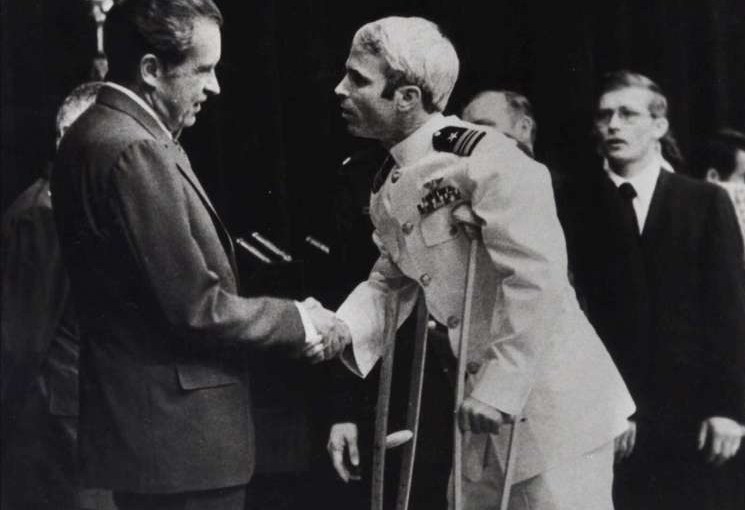
John McCain died of brain cancer this week. In the first alert I received on my mobile phone announcing the death of this long time senator from Arizona, there was a lengthy summation of his life. Which was remarkable to say the least. But there was one new thought in the summation that jumped off the screen at me. Figuratively, that is. There was no literal jumping.

McCain was a Naval fighter pilot who was shot down, captured, imprisoned and tortured for 5 and a half years in Vietnam. But upon his release in 1973, he was determined to make sure that his experience as a POW was not the defining event of his life.

This is a great reminder not to allow bad things to be the things others remember about us. It is a great reminder to continuously push ourselves to do more and be more. We have the ability to add so much good to our life story, our careers, and our relationships that it minimizes the bad.

McCain’s story also reminds us that even in a life full of happiness and success we have the ability to do more and be better. I’m working at it. I hope you are too.

Is there enough adventure in your career?

In 2006 I had a 365 day calendar. You know, the type of calendar that has 365 sheets that are stacked like a thick pad of post it notes. I don’t remember the theme of the calendar. In fact, I have forgotten 364 of the pages. But there is one page that I will never forget. At least until the Alzheimer’s kicks in.

My life in 2006

The date was Friday, July 21, 2006. I had been at my first job out of college for nearly 10 years. I had been married to my wife, Dawn, for nearly 4 years. We had owned our first home for 2 years. And our first child, our daughter Ava, was about to celebrate her first birthday by smashing a cupcake into her face.

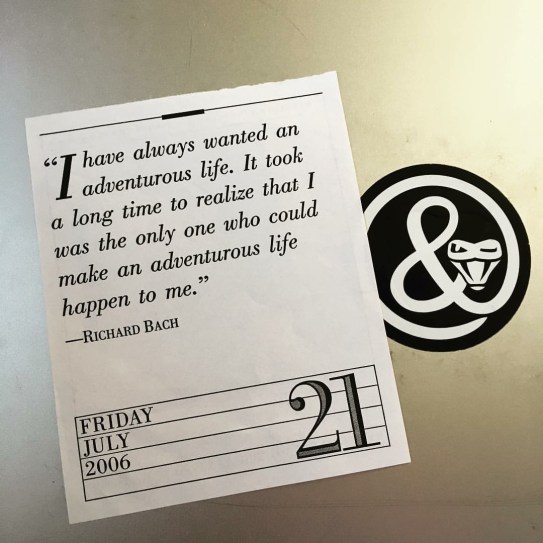
That July morning I tore off the July 20th page on my calendar like it was yesterday’s news (because it was), and revealed the following message:

“I have always wanted an adventurous life. It took a long time to realize that I was the only one who could make an adventurous life happen to me.” -Richard Bach

The Quote

This quickly became one of my favorite quotes. It serves as a constant reminder to adventure. To try new things. To move beyond our comfort zones. To make our insurance premiums worth paying.

IMG_2061
I keep this little square as a constant reminder to adventure.

We should adventure on our weekends, on our vacations and holidays. But we should also adventure at home on Wednesday nights. We should adventure in our reading and eating and driving. We should try new things, and semi-dangerous or even full-strength dangerous things on a regular basis. We should do the things Rupert Holmes sings about in The Pina Colada song (I know it’s called Escape, but who really calls it that? His lawyer?).

My Career

Shortly after reading this quote I turned my career into a legitimate adventure. After 10 years at my first job I moved on to my second job. I also moved to a new state, and took on 3 successively larger positions over the next 4 years. 7 years later, Engauge, the ad agency I worked for, was bought by Publicis Groupe, and I moved to Atlanta in a new role in a new company. Then, in 2015 I began planning to start my own business. Because that seemed like the natural next step.

Entrepreneurship

There is no career adventure like owning your own business. In April of 2016 I launched the advertising and idea agency, The Weaponry. And it has been the most exciting chapter of my career. As an entrepreneur, you learn like a college student on a daily basis. Which means that you are constantly growing and pushing yourself into unfamiliar situations.

It is in the pushing and growing and unfamiliar that the adventure happens. Threats and opportunities and excitement now surround me every day. And I love it. It is better than a television show, movie, or book. Because it is happening to me. I am not feeling someone else’s drama. It is very much my own.

Key Takeaway

Before you know it we will all be dead. So while we are here, create your own adventure.    Take that new job. Make that move. Go on that trip. Change careers completely, or get more schooling if you need to do what you really want to do. Start your own business or consult of side hustle or whatever it takes to add more venturing to your life. Give the person who delivers your eulogy something to write about. Give the rest of us great stories to read about.

Remember, no one makes it out of here alive. So there is no use in playing it safe. But as Richard Bach told me in 2006, no one else can give you an adventurous life. You have to make it yourself.

How to enjoy the best results from your reading.

 As I began planning to launch my advertising and idea agency, The Weaponry, in 2015, I could tell something was changing in me. In hindsight I now know that this is when I became an entrepreneur. I still had a full-time job, but I was creating The Weaponry in my spare time. I was transitioning from dreamer to doer.

I wrote the blog post below at that time. But I think about the basic lesson in this post often, and felt it was worth re-sharing. Especially since it was one of my very early blog posts, and very few people read it (Besides Joe, Jessa and Jeff, who all commented on it. Apparently it appeals to the J-crowd). 

Originally posted to The Perfect Agency Project on January 7th, 2016

books

I love to read.  Like most people I was born highly uneducated. Reading has become an instrumental part of my plan to overcome my early shortcomings. I love to learn and to become inspired. And if you are reading this I expect you do too.

I like reading classic literature because it makes me feel worldly. I liked reading the first three Harry Potter books because they made me feel magical. But then I realized my life is too short to read four more books about a fanciful wizard boy. Today I read a lot of books on self-improvement, business, and biographies. I also read healthy portions of magazines like Fast Company  and Inc because I find them both creatively stimulating and educational (and I like the pictures).

Your Reading Changes You

Several years ago I read an interesting quote from Charlie “Tremendous” Jones that said,

“You are the same today as you’ll be in five years except for two things: the books you read and the people you meet.”  -Charlie “Tremendous” Jones

This reading about reading encouraged Adam “Ordinary” Albrecht to read even more.

The Revelation

But today I’m trying to read less. Because I have found that too much reading leads to too little doing. If I fill my time with learning and inspiration I leave no time for action.

When I began The Perfect Agency Project I created a simple rule of thumb that influences my reading today:

Read just enough to learn something new and become inspired. Then act on it.

Since I started following this rule I have accomplished more. I’ve wasted less time. And I’m more excited about my work.

Let’s Go!

I think of reading now like a pregame speech. One that I listen to just long enough to become properly motivated. And as soon as I am lathered up, I jump to work, acting on the inspiration.

That’s when I start writing, planning, structuring, detailing, calling, creating, wizarding or potioning. And what I’ve found is that when I have one hour available, instead of one hour of reading, I can do 10 or 15 minutes of reading. And then I can spend the rest of the hour implementing. And the return on that one hour is significantly higher.

Key Takeaway

I encourage you to try this for a week. Read enough each day to want to do something new and exciting. Then do it. Then repeat the process. And let me know how it works for you. I’ll read at least part of whatever you write me.