
Two valuable money-making skills you need to develop now.

Sunday afternoon I told my 14-year-old son Magnus we were going for a drive. He looked both confused and curious as he followed me towards the garage, pulled on his shoes and hurried out the door behind me.

As we tore out of the driveway like Bo and Luke Duke in my White Ford Bronco Expedition I explained that I had just seen a brand new listing on Facebook Marketplace for 3 large boxes full of 1980s-era baseball cards. The woman selling them posted that she didn’t know what was in the boxes. She simply wanted them out of her house. $25 took all 3 boxes. And I was hyperventilating. (Well, I was actually just hyper while I was ventilating.)

I collected these baseball cards when I was a kid. And I knew this created an opportunity to teach Magnus a valuable lesson. As we sped down the rural Wisconsin highway I told Magnus that one of the most valuable skills you can develop is a sense for undervalued assets. Those assets could be baseball cards. But they could also be stocks, real estate, businesses, antiques, coins, stamps, equipment and countless other things. Including undervalued people. (Especially undervalued people.)

The other valuable skill I encouraged Magnus to develop is the ability to move quickly. You have to act on your detection of undervalued assets before other people do. Hence the quick reply on Facebook and the Smokey and The Bandit-style driving.

You can’t do what Warren Buffet calls thumbsucking, and lose time re-contemplating when you already know what the right action is. Because as you wait, other people are discovering the undervalued asset. And only one person will be able to grab that asset at that price. So you gotta act like Sir Mixalot when they toss it. And leave it. And pull up quick to retrieve it.

When we arrived at the seller’s home the couple selling the cards were already in the garage, ready to tote the large boxes of cards to my vehicle. After some quick pleasantries, the woman shared that right after I responded to her listing she was flooded with others who also wanted to buy the cards. This confirmed my suspicion of undervaluedness. And it underscored the importance of acting quickly. From the time I first spotted the baseball card listing to the time they were in the back of my vehicle was less than an hour. Boom.

When we returned home, we estimated that there were 9000 baseball cards in the collection we just bought. We began picking out a few random cards from one of the boxes and immediately discovered 3 Randy ‘The Big Unit’ Johnson rookie cards from 1989 that were rare and desirable because they were printed with his wrong birth year. (But his correct height of 6′ 10″!) One of those cards alone was worth more than we paid for the entire collection.

Key Takeaway

Develop a sense for undervalued assets. This comes from understanding markets just well enough to have an undervalued item ping on your radar. All you need is that ping. Because once you sense it, you can perform quick research online or by phoning a friend to get a better sense of the specific value and opportunity. As soon as you have a high degree of confidence that you have discovered a good deal that you can capitalize on, you have to act. Commit and complete the sale swiftly. Because gold doesn’t lie on the sidewalk for long.

*If you know someone who could benefit from this message, please share it with them.

+For more of the best life lessons I have learned check out my book, What Does Your Fortune Cookie Say? from Ripples Media.

How to do hard things.

When I was in college I had a summer job setting up large party tents in Vermont. I loved pitching a tent. It was hard. But looking back, that’s what I loved about it.

The hardest part of the erection process was driving the 4-foot-long steel stakes into the ground. The stakes create the foundation for the tent. You tie the tent ropes to the stakes to help hold the tent upright and sturdy.

To drive the stakes into the ground we used sledgehammers that were 8, 12 or 16-pounds. Size mattered. Because if you swung a bigger hammer you could get the job done in fewer swings.

Sometimes, when the ground was soft, the stakes would go in smoothly. But in Vermont and New Hampshire where I drove most of my stakes, the ground was very hard. They don’t call New Hampshire The Granite State for nothing. (And they don’t call Vermont the Granite State at all, but that’s just because New Hampshire already took it, for granite.)

But during those college years, I learned a valuable lesson about how to do hard things. Because the only way to get those 4-foot stakes in the ground was to keep pounding away until the job was done. More often than not the stakes went in an inch or less at a time. And sinking a 4-foot shaft neck-deep at that rate can be exhausting. But it was the only way to finish the job.

I applied that just-keep-swinging-till-it’s-done lesson in my athletic career as a track and field athlete at the University of Wisconsin. Today, I apply the same lesson to building the advertising and ideas agency, The Weaponry, writing my blog posts, newsletters and books. And simply not stopping until the work is done has never failed to produce results. Even when things get really, really hard.

Key Takeaway

The only way to get a job done is to just keep pounding until you are finished. Hit the task again and again and again. This is true when you are driving stakes in the ground in Vermont, building a company, advancing your career, trying to meet your fitness goals, or getting your education. Focus your efforts. Pound away. And just don’t stop until the job is done.

*If you know someone who could benefit from this message, please share it with them.

+For more of the best life lessons I have learned check out my book, What Does Your Fortune Cookie Say? from Ripples Media.
5 Things you should always be working on for a happy, fulfilling life.

If you met a genie who could grant you 3 wishes do you know what you would ask for? I do. I would wish for happiness, fulfillment and a lifetime supply of cheese curd flavored Pringles. Unfortunately, when I was in 3rd grade, my friend Todd Brudos told me that genies are not real. They are just something lamp polish manufacturers made up to get you to polish your lamps.

So today, I no longer dream of genies. Instead, I now realize we must work for the things we want. And if you want happiness and fulfillment, the key is to figure out what brings you those things well before you are in hospice care or the electric chair.

Through my own research, trial and error, and a couple of lucky guesses I have discovered that there are 5 things to work on for a happy, fulfilled, and rewarding life.

Here they are, in a particular order.

5 Things You Should Always Be Working On.

1. Your Health: When you stop working on your health, your health stops working on you. Eat right. Sleep right. Exercise. Drop habits that are hard on your health. Keep your weight in the healthy-and-feels-good zone. See your doctor and dentist regularly. Get naked and do the uncomfortable exams when you are supposed to. (Although if your dentist asks you to get naked for an exam consider getting a second opinion first.) If you could use a little help with your mental health see someone there too.

2. Your Relationships: At the end of our days the only thing that will really matter is our relationships and the impact we have on each other. Develop more relationships. Develop better relationships. And see your people in real life. Live life like you want to have a packed house at your funeral. And not just because people want to make sure you are really dead.

3. Your Time Utilization: Time is your most valuable resource. And it’s constantly slip-sliding away. Make sure to use your time wisely, old owl. Do things now. Plan your days, weeks, and adventures in advance. Recognize the things that waste your time and eliminate them now. You’ll thank me later, when you have time.

4. Your Growth: Growth means getting better. Aim to get better every day in every way. Read and learn. Reflect on your experiences to gain wisdom. Surround yourself with great people who you can learn from and model. Develop great habits. Improve your listening skills. And your compassion. Become a better model of yourself every day. Even if you are already a supermodel.

5. Your Wealth: When you grow your wealth, your other opportunities grow too. So does your peace of mind, freedom, and the size of the duffel bag you need to carry all of your money when you leave the country. And like the old saying goes, ‘Mo Money, Mo Pringles’.

Key Takeaway

To make the most of your short time on Earth focus on what matters most. Take care of your health to maximize the quantity and quality of your life. Develop and maintain your relationships. Make great use of your time while you have time. Focus on growing your wealth to grow your opportunities, freedom and peace of mind. And get a little better every day.

*If you know someone who could benefit from this message, please share it with them.

+For more of the best life lessons I have learned check out my book, What Does Your Fortune Cookie Say? from Ripples Media.
When you feel good, share that feeling with others.

On Saturday morning I was sitting at home when Lola, my Border Collie, started barking like there was an intruder. A moment later my doorbell rang, and I understood why Lola was going off. I got up and walked to the front door. I could see through the glass there there were two pleasant-looking middle-aged women standing on my front porch, with what looked like ‘materials’.

I unlocked my front door, while Lola lost her canine mind. Then i opened the door just enough to slip out onto the front porch without Lola following me. I pulled the door shut, then turned to face the two strangers on my steps.

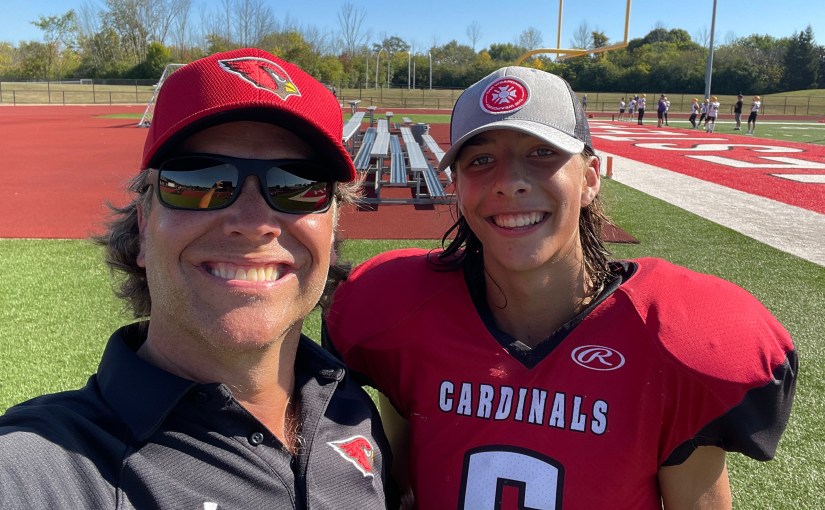
What the ladies at my door didn’t know was that I just returned home from coaching a football game that morning and was still in full Coach Albrecht mode.

I boomed in my energetic youth football coach voice, GOOD MORNING LADIES!!! HOW ARE YOU DOING TODAY?’

The women were clearly surprised, and delighted by the enthusiastic, greeting they received.

They both smiled and inquired, ‘Are you a coach?’ Clearly, the women picked up on the fact that I was still wearing my team cap and polo, both of which featured our team’s Cardinal mascot.

I boomed, ‘YES I AM! AND I JUST GOT HOME FROM COACHING OUR GAME THIS MORNING! WHICH WE WON!!! BETTER YET, I AM THE DEFENSIVE COORDINATOR, AND WE WON OUR FOOTBALL GAME 2-0! AND MY SON MAGNUS SCORED THE SAFETY!’

The women, Ruth and Chris, both smiled broadly and offered warm congratulations. (I may have just thought those were their names because I was hungry for steak.)

Then I clapped my hands loudly, dropped into a linebacker-stance and said, ‘HOW CAN I HELP YOU, LADIES?’

The women revealed that they were Jehovah’s Witnesses. And they were there to invite me to study the bible with them.

I responded like Matt Foley giving his van down by the river speech, ‘LADIES, I ALREADY HAVE A BIBLE! AND I AM GOING TO CHURCH EVERY SUNDAY (this month)! YOU DON’T NEED TO WORRY ABOUT ME! NOW I WANT YOU TO GET OUT THERE, LADIES! AND GET EVERYONE ELSE ON THE TEAM! CAN YOU DO THAT FOR ME?!?’

The women lit up and laughed at my over the top response to their sales pitch. They thanked me for sharing my energy with them that morning. Which I am sure is a welcomed departure from the typical response the JWs get on their Ding-Dong-Divinitiy Tours.

As they waved and wished me a good day, I shouted out one last bit of coaching, ‘NOW MAKE SURE YOU GO TO CHURCH TOMORROW! YOU’VE TO GOT TO PRACTICE WHAT YOU PREACH, LADIES!

And with that, they left with big bright smiles on their faces.

Key Takeaway

When you feel happy, energetic, or optimistic, share it with others. Brighten the day of those around you. We can all use a little more of the good stuff. So when you having a great day, break off a little piece and pass it around. You never know who might need what you have.

*If you know someone who could benefit from this message, please share it with them.

+For more of the best life lessons I have learned check out my book, What Does Your Fortune Cookie Say? from Ripples Media.

Lottery Tickets vs. Hard Work

My 17-year-old son Johann is a great musician.

He enjoys sharing videos of himself performing music online.

Each video he shares on social media is like a lottery ticket.

He never knows which video might pay off in a Kardashian way, and which videos will fall flat, like Jeb Bush’s ‘Please Clap” speech.

However, the hard work Johann puts into practicing, performing, and recording his music is guaranteed to pay off, like hard work always does.

No luck required.


Here’s a video that my son Johann posted 2 weeks ago on TikTok that, as of this posting, has more than 780,000 views.

This has been a 7 Sentence Sunday Post. Just 7 sentences. (At least just 7 sentences before the little 3-dot divider thingie.) These are quick thoughts before church. Or after church. Or before football if you don’t mark your Sundays with church. Or, if you don’t do church or football, it’s simply 7 sentences before Monday. (Plus this rambling descriptor of how simple the post was supposed to be before I overcomplicated it.)

+For more of the best lessons I have learned check out my book, What Does Your Fortune Cookie Say? from Ripples Media.

Are you creating Onion Days?

I had a pretty bad day on Saturday. I coach 8th-grade football on Saturday mornings. And we lost. Like nothing-went-right lost. Like The-Bad-News-Packers lost. Like that-TV-show-about-the-plane- crash-on-that-island lost.

Then I couldn’t get myself motivated to do anything productive the rest of the day. By Saturday night I felt like I not only lost the football game, but I lost the rest of the day as well. Unfortunately, when you lose a day you never get it back, Jack.

But on Sunday, I bounced like Flubber. Before I went to bed Sunday night, I reflected on my day. And I realized that my Sunday was as good as my Saturday was bad. I had created an Onion Day. A day with layer after layer after layer of good stuff.

My Onion Day.

I woke up early to write and publish a blog post about the importance of planting yourself in soil that enables you to thrive.

Then my family and I went to the 9am church service. (God knows that service helps you get the most out of your morning.)

We took the slow Sunday drive home along Lake Michigan, avoiding the usual interstate route. It’s the automotive version of stopping to smell the roses. Although you can’t actually smell roses at 25 miles per hour.

I cleaned out a significant part of our basement that had become cluttered with random stuff during the renovation we did on our home over the past year.

I watched some of the Patriots -Bengals game, and watched my Pats look like a real team again for the first time since Tom Brady left to spend more time looking at himself in the mirror.

I helped my son Johann think through a writing and research project for an AP class he is taking.

I took a long walk with my wife Dawn, son Magnus and dog Lola along Lake Michigan. Which looks like an ocean, but is unsalted and shark-free.

I picked up fun food for dinner for the family, because I was too hungry to wait for the ribs Dawn was planning to make for our Sunday dinner. (And apparently, a commercial I watched during the football game worked on me.)

I broke down game footage from our team’s ugly loss so we could coach the team on how to do things better next time. (If they don’t do better I will cry myself to sleep every Saturday night until November.)

I talked to my daughter Ava on the phone on the last day of her 18th year and caught up on her day at college.

I worked out, like LFMAO would say.

The Reflection

I looked back at my day. And I realized that I had a near-perfect Onion Day.

  • I created
  • I churched
  • I meandered
  • I familied
  • I worked
  • I taught
  • I explored
  • I treated
  • I coached
  • I connected
  • I exercised

It was a great Onion Day, a great way to bounce, and a great example of time well spent.

Key Takeaway

The best days are Onion Days. Those are the days when you layer in as many of your favorite and most important activities. Know what your perfect Onion Day entails. Then work to create as many of them as you can. That’s how you build a great and rewarding life without regrets.

*If you know someone who could benefit from this message, please share it with them.

+For more of the best life lessons I have learned check out my book, What Does Your Fortune Cookie Say? from Ripples Media.

Are you in soil that supports your seed?

There are many types of soil.

And there are many types of seeds.

But not all seeds thrive in all soils.

In fact, some seeds get packaged in a bag and sent to a ballpark to be chewed up and spit out before they get their chance to blow, like Eminem said.

The key to growth, happiness and success is to plant your seed in soil that supports you.

Then sink your roots down deep, and bloom baby bloom!

So if you aren’t thriving and blooming, onion, it’s time to find new soil.


& This has been a 7 Sentence Sunday Post. Just 7 sentences. (At least just 7 sentences before the little 3-dot divider thingie.) These are quick thoughts before church. Or after church. Or before football if you don’t mark your Sundays with church. Or, if you don’t do church or football, it’s simply 7 sentences before Monday. (Plus this rambling descriptor of how simple the post was supposed to be before I overcomplicated it.)

+For more of the best lessons I have learned check out my book, What Does Your Fortune Cookie Say? from Ripples Media.
The latest lesson I have learned as an entrepreneur is an expensive one.

Since I first launched The Weaponry, the advertising and idea agency I lead, I have learned a lot of interesting lessons. I didn’t become an entrepreneur for the life lessons. But entrepreneurship has a funny way of teaching you new things, whether you want to learn or not.

The Learnin’

Over the past few months, we have had to replace several computers. The Weaponry’s computers are not cheap. We are all Macs all the time. Like Roni and Cheese.

Many of our computers are supped-up machines built for high-end design, art, and video work. The kind of creative work we do requires serious machinery and significantly more storage than your garden-variety Apples. (Or would that be orchard-variety?)

But with all the computers we have had to replace lately I am not mad, frustrated, or worried. After all, this isn’t a quality problem. The computers were not stolen. And they did not run away to join the circus. (Do computers still do that?)

The reason we are replacing so many machines is the best reason of all.

We simply wore our computers out. We worked them hard. Our Weapons have kept our machines busy with demanding work for a long time. We have been slinging advertising, branding, videos, logos, design and illustration work for 8 years.

Many of our team members have been with us for 6 to 8 years now. All that work has been crushing our equipment. And like that popular TV show from the 70s with those classic hairstyles, it seems that when it comes to computer hardware and software, eight is enough.

Replacing our computers is a sign of success, demand and longevity.

And I am grateful for it all.

Key Takeaway

Businesses require investments in equipment and resources. One great reward of success is staying in business long enough to wear out your stuff. Don’t lament the new expenses. Recognize them as a sign of demand and longevity. You have earned the privilege of replacing your resources because you are still here. Still needed. Still sought after. The same is true in our personal lives. When you have to replace equipment it means you have outlived your stuff. That is a blessing not to be taken for granted.

*If you know someone who could benefit from this message, please share it with them.

+For more of the best life lessons I have learned check out my book, What Does Your Fortune Cookie Say? from Ripples Media.

How to put Charlie’s Rule of opportunities to work for you.

Last week I was talking with my good friend Charlie Wills about business. Charlie and I met through The W-Club, the University of Wisconsin varsity athlete alumni group. Talking with Charlie is a pain in the neck. Literally. Because Charlie is really, really tall. He is a former University of Wisconsin standout basketball player, who played in the 2000 Final Four against the Flintstones. #IYKYK

Today, Charlie towers over the real estate world in Madison, Wisconsin where he has been putting people before profits for over 20 years. Not only is Charlie a close friend of mine, but he is also a client of The Weaponry, the advertising and ideas agency that I lead.

Charlie shared an interesting statistic with me about where his clients come from. He told me that 96% of his organization’s clients come from within their sphere. That includes current and past clients, recommendations, friends, family and acquaintances.

If you are good at math, you also realize that only 4% of opportunities came from outside their sphere. Which is a shockingly small number. In fact, if that number was 4 sizes smaller it would be nothing.

I love the fact that Charlie uses the term sphere instead of network or circle. It’s very basketbally of him. And it gives the group more dimension.

Charlie’s Rule: The vast majority of your opportunities in business and in life originate within your sphere.

This rule, while surprising, is also logical.

People in India whom you have never met and have no real connections to, are highly unlikely to come to you with a life-changing opportunity. (The same goes for the dude from the royal family in Nigeria.) But your past client, your cousin, and the person you know from that thing you do in your spare time are likely to think of you when they need a You-Like person to help solve the kind of problem you are great at solving.

Armed with the knowledge that we all benefit from some variation of Charlie’s Rule, what are you supposed to do about it?

1. Develop more relationships. Whenever you are dealing with success as a percentage game, and it always is, increase the base number. The more people you know the more opportunities will come your way. Because opportunities come to you through humans. Kinda like COVID-19 and invitations to Tupperware parties.

2. Maintain the relationships you have. Not all relationships are equal. The kid you knew from kindergarten who you haven’t spoken to since you stopped napping together in class is not very valuable. So stay in touch with your people. Reach out via phone, email, text, or social media to keep your relationship active. Write a newsletter, blog, or other way to share what’s happening in your life. Social media is great for maintaining relationships across a broad spectrum of familiarity. Use this amazing resource.

Key Takeaway

Your relationships are critical to your success. Remember, Charlie’s Rule says that the vast majority of your opportunities in business and in life originate within your sphere. So bring more people into your sphere. Keep the relationships in your sphere active by staying in touch through any appropriate means. As a result, more good opportunities will find their way to you. Just like Charlie said.

*If you know someone who could benefit from this message, please share it with them.

+For more of the best life lessons I have learned check out my book, What Does Your Fortune Cookie Say? from Ripples Media.

9 Random things I share about myself in a new podcast.

I love to share stories. That’s probably why I started blogging in the first place. Over the 1001 blog posts I have published, I have shared a small country library worth of stories. But recently I sat down for a fun podcast interview to share stories with Kory Dogs, of ActionCOACH. (I kept thinking he sounded like the action hero Kory whose superpower would be saving Corey Feldman and Corey Haim from themselves.)

Kory asked me questions I don’t often get asked. Which means you hear some little-known details about my life.

9 Things You Learn About Me In This Podcast

  1. The 5 States I lived in as a kid.
  2. My connection to the Shawshank Prison.
  3. My unique experience on a bull stud.
  4. The surprising comment my boss made 2 years into my career that inspired me to start my own advertising agency. (No, it was not You’re Fired!)
  5. How I describe my leadership style.
  6. What I would do differently if I could go back and do it all again. (Which sounds like a Garth Brooks song.)
  7. The new things I want to learn.
  8. The book I recommend to all entrepreneurs.
  9. Who I would give a shoutout to at the end of a podcast when surprised with the question, ‘Who would you like to give a shoutout to, right now?’

You can read or watch the interview here.

Why listen or read when you can watch?

The Book Recommendation

During the podcast I talked about a book I suggest every entrepreneur, or aspiring entrepreneur, or spiraling entrepreneur should read. Here’s the excerpt, in case you don’t have time to watch, read or listen to the full podcast:

Kory: What advice do you have for business owners trying to do everything on their own?

Adam: I often advise business owners and entrepreneurs to read The E-Myth by Michael Gerber. This book offers a fantastic framework for developing your business through systems and processes. It teaches you how to structure your business so that it can operate on a larger scale, similar to a franchise.

By thinking through your business in this way, you ensure that all aspects are well-organized. You create a mature system where you’re not overwhelmed by every detail. Instead, you take on specific responsibilities and avoid getting bogged down by tasks outside your main role.

For example, you don’t want to be the person who not only bakes pies but also handles HR, sales, and operations. The book helps you define your role clearly and understand what additional roles are needed in your organization.

I read The E-Myth before starting The Weaponry, and it provided a strong foundation for me. For any business owner feeling stuck in a cycle of chaos, I recommend this book to help you assess and address your challenges effectively.

For those who aren’t familiar, the book is called The E-Myth and its subtitle is “Why Most Small Businesses Fail and What to Do About It.” Essentially, it argues that if you don’t get the business fundamentals right, it won’t survive. But if you do, it can thrive. The E-Myth refers to the belief that only certain people are born to be entrepreneurs. Michael Gerber challenges this idea, asserting that anyone can be an entrepreneur. He presents a process and approach that can make entrepreneurship work for everyone.

Thank You!

Thanks to Kory Dogs of ActionCOACH for the interview. And for making me feel like I know a real-life action hero.

Thank you blog readers for reading this blog. It’s the only way to earn your title.


If you know someone who you thing could benefit from listening to this podcast, please share it with them.

+For more of the best life lessons I have learned check out my book, What Does Your Fortune Cookie Say? from Ripples Media.