There are not enough hours in a day to do all of the things you would like to do. That is just a fact. Time is the most precious commodity on Earth. It’s worth more than diamonds, helium and CBD. At the end of your days you won’t wish for more money, a nicer car or a fancier home. You would trade all your worldly possessions (and some of your purely regional possessions) for more time.
Bonus Hour
Today marks the end of Daylight Saving Time. Most people focus on the negative fact that the sun now sets earlier. But don’t be a Debbie Sundowner. Today is a great day. It is the one day a year when the universe, Father Time, and the American Clocker’s Panel give you a bonus hour.
At 2am local time you received your annual 1-hour time bonus. With that additional hour the universe also handed you an important question:
‘What will you do with your bonus hour?’ -Universe
When you receive a work bonus, a tax refund or a lottery payout, you spend a lot of time thinking about what you will do with the money. But have you spent any time thinking about what you will do with your extra hour? You should. Because until you can buy a time machine from Marty McFly, your hour is more valuable and more precious than any monetarybonus you will ever receive.
Invest Your Time
Take a moment today to think about how you will invest your bonus hour. If you came to Albrecht Time Investment Advisors LLC, we would encourage you to invest your time in one of the following areas:
Your health
Your family
Your faith
Your friendships
Your personal growth
Your peace of mind
Your community
Your future
Your career
Your hobbies
Your bucket list
Your experiences
Your personal legend
Anything that will make you laugh.
Key Takeaway
Don’t waste time. Invest it in the most important areas of your life. By spending your time wisely you will enjoy a richer, more fulfilling and more impactful experience on Earth. Remember, you will be dead sooner than you want to be. So take advantage of all the time you can get while you are still here.
*If you know someone who could benefit from this message, please share it with them.
There are many amazing people who have had a significant impact on my career. There have been CEOs I admire. Entrepreneurs that inspired me. Creative Directors who have guided me. And successful marketers of all sorts that have provided me with important lessons and insights.
My Wife
But there is one person who has had the greatest positive influence on my career, by far. My wife, Dawn Albrecht. Dawn and I have a special relationship. I fell in love with her at first sight. Then, just seconds later I realized that she was actually my new coworker. It was a little like the moment Kelly McGillis walked into Tom Cruise’s classroom in Top Gun. #SoYoureTheOne
My wife Dawn serves up career magic.
The Downside
Initially the fact that we worked together was a negative. It made it awfully hard to ask her out. Because a failed office romance provides a constant reminder of your failed office romance until one of you quits or gets fired.
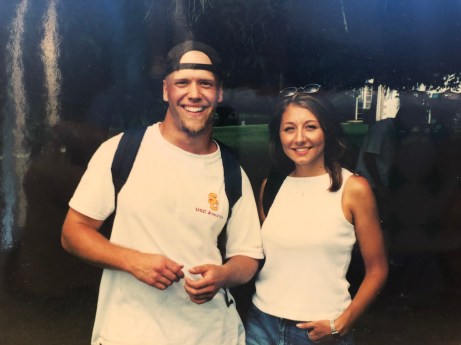
The last picture of us before we became BF &GF.
The Upside
But once we became an actual couple, not just a couple in my imagination system, the fact that we worked together became a major advantage. Dawn fully understood my job, my industry and my career path. She understood the workplace dynamics I faced. She saw my untapped potential. And she knew just how to push me forward.
Dawn always coordinates her shirt with seasonal gourds. #nextlevel
You know I thought I had it so good.
When we first met I was just 4 years into my career. I thought I had a great title. And I was very proud of my salary. But I didn’t know what I didn’t know. Dawn, on the other hand, had spent 7 years working for great companies in New York City and Chicago, including the Lifetime Channel (television for women), Times Mirror Publications, Discovery Networks and Cars.com.
Simply put, Dawn knew more than me. She recognized my growth potential and she pushed me to realize it.
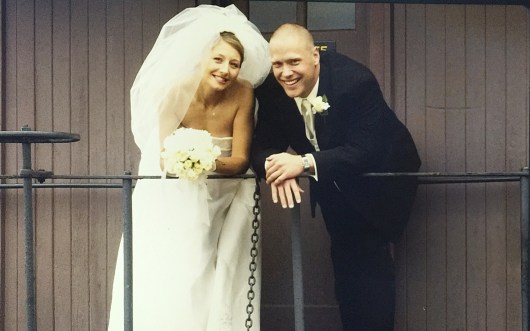
Our wedding day. (You knew it was either that or Halloween, right?)
Here We Go
Over the course of the next 10 years Dawn went from my coworker, to my wife and best friend, to the mother of my 3 children. But she also became my career coach. And my personal motivator. She made me think about whether I was stretching and growing. She made me think about my professional skills and abilities. She taught me about the true value I brought to my clients and employers. And she called me out when she thought I had grown too comfortable. And she was always right.
An Endorsement For Coaching
Dawn taught me the value of having a strong career coach. And over the first 10 years of our relationship my title grew from Senior Writer at Cramer Krasselt to Chief Creative Officer at Engauge, an agency with 4 office locations and 275 people in Atlanta, Columbus, Pittsburgh and Orlando.
The Agency Takes Off
13 years after Dawn and I met, Halyard Capital, the private investment firm that owned Engauge, decided the agency was on the right trajectory to sell. I was part of the 4-person leadership team that represented Engauge as we met with 15 potential buyers. In August of 2013 the agency was bought by Publicis, the world renowned ad agency holding company in Paris. And I was ready for my next chapter.
Entrepreneurship
I always wanted to start my own business. And just 2 years later I began plans to launch my own advertising agency. Despite the fact that I would be trading in a nice salary, and comfortable benefits, Dawn was 100% behind the plan. She never questioned or doubted that an agency I created would be successful. Her total confidence in me added to my healthy confidence in myself.
The Weaponry
I launched The Weaponry, my advertising and idea agency, when I was 42 years old. Today, I am frequently asked what the scariest moment of my entrepreneurial experience has been. But I really haven’t been scared at all. I credit much of that to Dawn. Because she has had full confidence that this would work out exactly as planned. And if Mama’s not worried, nobody’s worried.
Our tribe at The Weaponry.
Birthday Girl!
Today is Dawn’s birthday (at least it is if you are reading this on October 29th). I will take the day off, just like I do every year. We will spend the day together. And I’ll reflect on how I wouldn’t have made it this far down my path this fast if it wasn’t for her. She has encouraged me, inspired me and challenged me. She has put her complete faith in me (and maybe my life insurance policy).
She has fully supported the decision to walk away from a comfortable life in search of an adventurous and even more rewarding experience. Dawn is like the Jelly of The Month Club. Because she’s the gift that keeps on giving the whole year. In friendship. In family. And yes, even in business.
Key Takeaway
If you want to be do great things, find someone great to go with you. Someone who believes in you. Someone fun and funny. Someone who won’t let you get comfortable. Someone who challenges you to grow and become all that you were supposed to be. If you find someone like that never let them go. Never take them for granted. And if you can take their birthday off every year and spend it with them, do it. You’ll never regret it.
My 14-year old daughter Ava has been studying The 10 Commandments during her confirmation class. She has lots of questions. Like, ‘How did we arrive at these 10?’ (I said God and David Letterman decided.) And, ‘Which one is the most important of all?’ (I told her it’s the one about honoring thy mother and thy father.) Her many questions are hard for humans to answer. But they serve as great kindling for meaningful conversations.
Rules For Life
I try to live my life according to The 10 Commandments. I’m so-so at it. I haven’t killed anyone. I haven’t worshipped any golden calves. But I sometimes use the Lord’s name in vain. (Sorry Big Guy.) And I have definitely coveted my neighbors house. But come on, my neighbors have sweet houses!
Rules For Career Success
I love simple rules. And all of our recent talk about The 10 Commandments got me thinking about my own rules. So I wrote down my 10 rules for business success. Here’s my list. These are short enough enough to be carved on just one stone tablet. Which means that you could carry these rules and a gallon of chocolate milk at the same time.
10 Simple Rules for Business Success.
Always do what you know is right.
Develop and maintain strong relationships.
Solve problems.
Deal with the decision maker.
Hire people whose results make you jealous.
Collect Dots and Connect Dots.
Add value.
Focus for greatest results.
Add energy.
Start with the end in mind.
Overdeliver.
Key Takeaway
It is important to develop a strong set of rules to help you perform your best. The rules serve as reminders, guides and inspiration. They stand as pillars that support great people and great performance. If you ever lose your way, go back to your rules. They will never let you down.
What are your go-to rules?
What pieces of career advice would you write in stone and have delivered by Charleston Heston? Please share in the comments section. Or send me a note. If you do I will create another post called The Top 10 Rules I Learned From Readers, and I will give you credit. It will be a collaboration. Like Band Aid, USA For Africa or Dionne and Friends.
Just like every party has a pooper, every bottle has a neck. You learn that in Bottle Anatomy 101. But what you might not have known is that every business, machine and human has a bottleneck too. The bottleneck is the singular constraint that limits an organization, object or person from accomplishing more, creating more and earning more.
Lessons of Entrepreneurship
I spend a lot of my time thinking about bottlenecks. It started when I first launched my advertising and idea agency, The Weaponry. As an entrepreneur, you have to spend a lot of time working on your business, not just in your business. By doing so you find that both you and your business have limitations. Unless you are Master P. #NoLimitSoldier
Finding Bottlenecks
A great way to know what areas of your business you should work on is to simply look for the bottlenecks. These are the areas that limit everything else a business can accomplish. They can be processes, equipment, people or money. In some cases your bottleneck could be too many long necks. (You can learn all about that by listening to Garth Brooks music.)
Delivery
The Weaponry’s bottleneck is not how much work we can deliver. Because we are organized in a way that allows us to scale our team when necessary to meet surges in demand. I am confident we have the right kinds of people too. So that is not our current limiter either.
Business Development
Our bottleneck is related to business development. We have discovered our businesses limiter is about awareness that we exist and what we can do for our potential clients. Which is perhaps the most common bottleneck in business. It is why advertising and marketing agencies like us exist in the first place. Alanis Morissette would say this is ironic. Don’t you think?
They Don’t Go Away. They Move.
Because we know awareness is our bottleneck we make it The One Problem To Solve. By increasing our awareness we can increase demand, which increases our business. Once awareness is no longer our limiter, our bottleneck will move somewhere else in the business. It may become our bandwidth, financial resources, location, skill sets, or the types of snacks we have in the break room.
As the business grows and evolves the bottleneck will continue to move. But by paying close attention to the business we will identity the new bottleneck, and the solutions needed to improve our business. Which is like winning at Whac-A-Mole.
Key Takeaway
The single most important thing you can do today is identify your bottleneck. Ask yourself what your greatest limiter is. Then address that limitation. Because if you open that limiter you open all kinds of new possibilities. This is true in business and in our personal lives. So find your bottleneck. Widen it out. And you will find new levels of success.
*If you know someone who could benefit from this story, please share it with them.
When I first became a parent I was prepared to drop knowledge on my kids. I had prepared a syllabus of over 30 years worth of life lessons. They were sorted into 3 files. The first was labeled Smart Things I Did. The second was labeled Dumb Things I Did That You Should Avoid. And the third file was simply labeled Bill Cosby.
Magnus
What I wasn’t prepared for were are all of the lessons that my children would teach me. My latest lessons have come from my 9-year old son Magnus. Magnus, has taught me a lot about socializing. He has a remarkable ability to make instantaneous friendships anywhere. His social intelligence is as good as the best adults I know. He’s like a little Dale Carnegie on the playground, just winning little friends and influencing little people.
Losing Teeth
But as impressive as Magnus is at socializing, he is world class at losing teeth. It’s an odd thing to be great at, I know. But lately Magnus has lost teeth at a meth addict rate. I think he has lost 8 teeth in the last 2 months. In fact, I don’t know how he actually chews anything anymore. #popsiclesfordinner
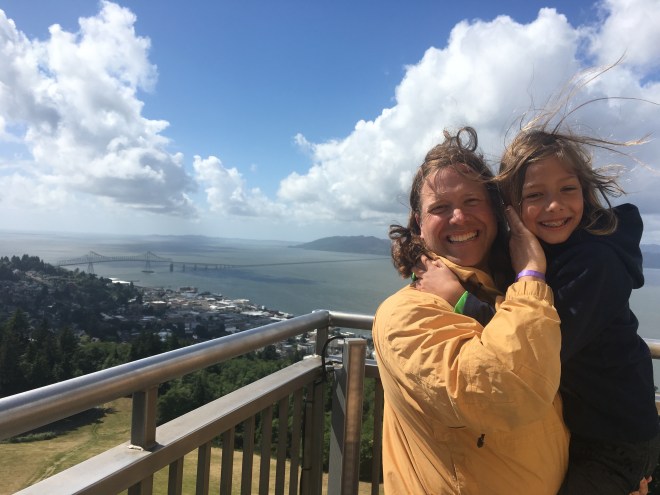
Me and Magnus and all of our hair at the top of the Astoria Column in Astoria, Oregon.
Talk Is Cheap
However, it is not his quantity of tooth loss that impresses me. It is the style. You know how I know when Magnus has a loose tooth? He puts the tooth in my hand. Before that he doesn’t talk about it, complain about it or brag about it. He says nothing until the tooth is out. Even then he doesn’t really talk about it. He just shows me the results, and smiles an ever toothlessier smile. And every time he surprises me (and the Tooth Fairy) with absolutely no advanced warning, I am more impressed by his ability to quietly take care of business.
The Reminder
I meet people all the time who go on and on, (like Steven Bishop, down in Jamaica, with lots of pretty women), about their big dreams, lofty goals and ambitious plans. But talk doesn’t bring a dream to life. Discussions don’t achieve goals. And ambition doesn’t execute a plan. Talk is the cheapest of all commodities. Action is the the most valuable. And it’s the only currency you can use to buy your goals and dreams.
Key Takeaway
Success requires action. To be successful do more. Talk less. Complain less. Analyze less. And focus on results. Don’t tell the world what you are going to do. Show them what you’ve done. Then, after the work is all done, you can sit back and enjoy the rewards. Just like my son Magnus does.
*If you know someone who could benefit from this story, please share it with them.
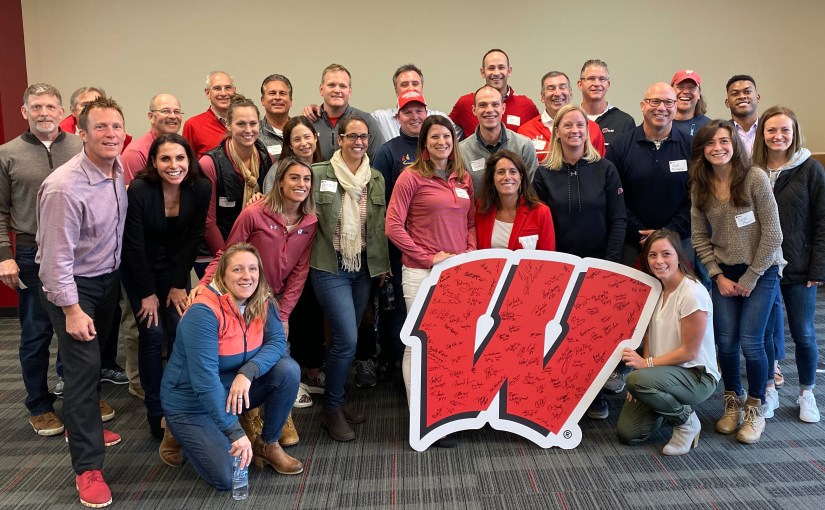
The legendary motivational speaker Jim Rohn once said that you are the average of the five people you spend the most time with. That’s why it’s so important to spend your time with the best people. This past Friday, during the University of Wisconsin homecoming weekend, I spent 6 hours with an amazing group of former University of Wisconsin varsity athletes. These Badgers are some of the brightest, most driven, most fun, and most successful people I know.
Business Up Front
I kicked off homecoming weekend in Madison with a 2-hour advisory board meeting for the W Letterwinner’s Club. The advisory board is like Noah’s Ark. Because it features two former athletes from every varsity sport.
We meet to discuss how we can help our members develop more meaningful relationships with each other, both personally and professionally. We discuss how we can offer assistance, guidance and mentorship to graduating Badger student athletes. And we explore ways that our network can add value to the mission of the University of Wisconsin and its world class athletic department.
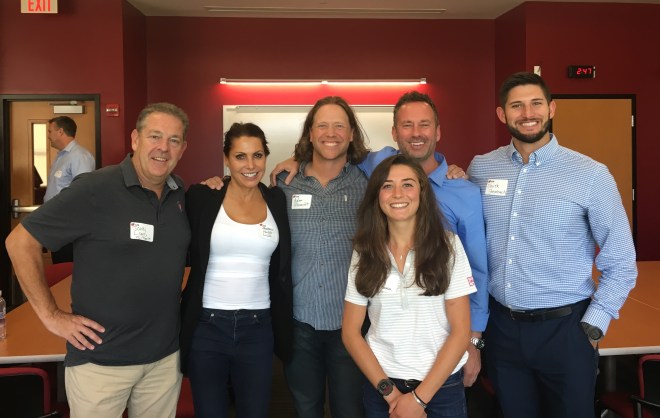
The Dub Club representatives from track & field and cross country. And the handsome profile of a tall soccer alum in the top left.
Up In Da Club
The former Badger student athletes on the board are inspiring. They include Big 10 Champions and National Champions. They include All-Americans and professional athletes. They include school record holders and Hall of Famers. They include athletes who made it to the Final 4 and the Frozen 4.
Our youngest members just graduated from Madison. And our most senior members used to get run with Crazy Legs Hirsch, Alan ‘The Horse’ Ameche and Paul Bunyan when he was just a babe himself.
Today these W Letterwinners are crushing it in their post-collegiate careers. They are executives and entrepreneurs. They are administrators, professors and coaches. They are leaders and volunteers. And they are great parents, wives and husbands. Just spending time with these badasses enhances my own false sense of badassery.
Party In The Back
On Friday night, after the work was done, we did what Badgers do. We played. We migrated to the iconic State Street Brats, and joined hundreds of others at the annual Badger Athlete Reunion. We spent the next few hours together, talking, laughing, sharing memories, making new friends, connecting dots, drinking beer and eating brats.
While it certainly looked as if we were having fun, we were doing more than that. We were strengthening our personal bonds. The bonds between former student-athletes who know just how hard it is to live up to the demands of academics and athletics at the Big 10 level. We were strengthening the bonds between Badgers who know that if you can excel in both the classroom and athletic arena at The University of Wisconsin, you have the critical tools and the skills to be successful for the rest of your life.
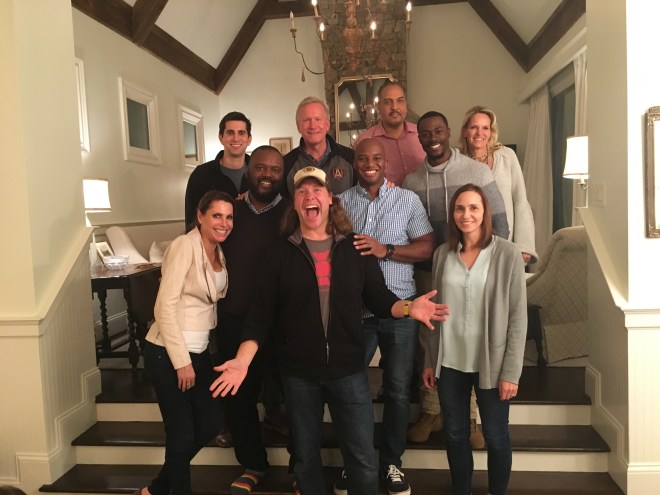
Former Badger athletes at an impromptu meetup in Atlanta. Badgers are everywhere.
Key Takeaway
If you want to be great surround yourself with great people. Find rockstars who inspire you. Spend as much time with those special people as you can. It will make you a better person. I know it will. Because I learned that lesson in Madison as a student athlete at the University of Wisconsin.
*If you know someone you think would benefit from this message, please share it with them.
When I was in school I never wanted to be a teacher. I didn’t want to deal with kids like me. So I chose a very different profession as an advertising creative. But along the way I learned that if you are a manager, leader, coach or parent, you are also a teacher. You teach other people new skills. You teach processes and procedures. You teach them how to not freak out when they don’t get their way. Because sometimes dealing with adults is even worse than dealing with kids like me. #AmIRight
Learning to teach
When I realized that I had indeed become a teacher myself I began studying teaching techniques. I reflected on what tricks my teachers had used on me (like standing in the corner, and wearing a tall pointy hat). Today I keep my eyes open for great teachers and teaching techniques in the workplace, in my children’s sports and in academia. As a result, I found a really great teaching technique from my son Johann’s piano teacher.
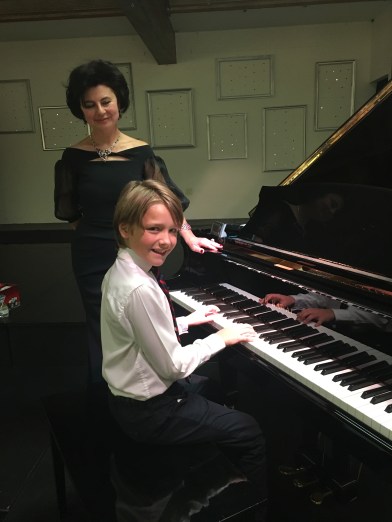
My son Johann is now on his 4th piano teacher. He started playing in Ohio when he was 5-years old. Then had 2 teachers in Georgia, and now has one in Mequon, Wisconsin. All of them have been interesting characters. But the current teacher, Miss Rita, is my favorite. She is Russian, with enough energy and optimism to light up all of Leningrad. She is a wonderful teacher who all the students love. Maybe it is because she tells all of her students that they are “Za best!’ Or more often, “Za Best of Za Best!’
Miss Rita, my son Johann, and a bunch of sparkly rectangles.
However, there is one teaching technique that Miss Rita uses that I love so much that I have stolen it from her. When Miss Rita is teaching a new concept, introducing a new technique, explaining a mistake, or reiterating a point she punctuates the lesson with a short and simple question:
Do you understand, or kind of?’ -Miss Rita Shur
The Magic
There is real magic in that little phrase. First, it is great to check to see if the lesson sunk in. But I really love the ‘or kind of’ section of the question. It is so much easier to say that you ‘kind of’ get something than to admit to not understanding a lesson at all.
The question covers a wide swath of comprehension that ranges from, ‘Whaaa whaaa whaaa, whaa, whaaa whaaa,’ to ‘I heard what you said but I have no idea what you mean,’ to ‘I think I know but we should clarify that I am right.’
Make it easy to learn more
Most people are not comfortable saying I don’t understand. Especially in front of others who do. Using ‘Do you understand, or kind of?’ provides a beautiful detour around a No answer. It also offers everyone partial credit for at least kind of learning the lesson. The question also acknowledges that learning is not always binary. There is often a lot of gray area. And a teacher’s job is to help add color to the gray areas. Like a house that falls out of a tornado onto a witch.
Key Takeaway
Whether you are a professor at Dartmouth, or training a newbie how to make fries at McDonald’s, you have to know how to teach. To be effective you should make sure your lessons land. Following up your teachings with ‘Do you understand, or kind of?’ let’s you know if there is more teaching to do. It tells the student that you know they are smart, and must have picked up at least part of the lesson. It makes it easier for others to express that they could use more explanation. So try this follow-up question the next time you teach something new. I think you’ll find it is za best. If not za best of za best.
*If you know someone who teaches, coaches, manages, leads or parents, and could benefit from this technique, please share it vis zem.
I have a real thirst for knowledge. If you can picture a guy crawling across the desert, in torn clothing, deliriously muttering ‘Agua’, that’s how thirsty I am for knowledge. But I find that drinking it is a bit like drinking water from the ocean. The more you take in, the more you want. Which means you will never be satisfied. Remember not to drink ocean water for realzies. It will dehydrate and kill you (but at least you get to spend your last days at the ocean).
I’m Learning To Fly
I have always liked learning. But in my adulthood I have realized that the more I know the better I am at my various roles and responsibilities. That’s why I am trying to learn how to be a better husband, parent and friend.
Professional Grade
On my professional journey I have learned how to be a better employee, manager, and leader. But today, as an entrepreneur, there is no end to the knowledge that could benefit me, my business, my team and our clients.
What’s In the Fridge, Perry?
To try to quench my thirst I seek knowledge from many different sources. The list includes, but is not limited to, the following:
Books
Magazines
Podcast
Blogs
Speeches
Graffiti
Sermons (Which are like speeches, but from a person wearing a robe.)
Documentaries
Chocolate Milk Meetings (because I don’t drink coffee)
Informational interviews
Meetups
Newsletters
Webinars
Coaches
Headstones
Simplify. Simplify Yourself.
I have learned that my little brain can’t absorb everything I read, see or hear. That’s why I have learned to simplify how I digest all that I devour.
As I read books, listen to podcasts or talk to other humans, I am like a prospector panning for gold nuggets. I don’t need all the gravel. I don’t need the flotsam and jetsam. And I don’t need the pyrite (look at me still remembering terms from my 7th Grade Vermont Resources field trip Mrs. Thompson!)
What I want, what I really really want.
I am simply looking for one great quote. That’s it. I want one great, simple summation of a valuable idea to add to my collection. I want one great mantra. One clear rule. One core philosophy. One great lesson. If I find it then the energy and time I invested in the stimuli were valuable.
Ohhh, Then What? Whatcha Gonna Do?
I add that simple quote to the jukebox* in my brain. I listen to it every time I am in a relevant situation. I play it for those around me when they could use a great quote to encourage or guide them. And I share it in my blog to make it even easier for others to find. *A ginormous iPod.
Key Takeaway
When you thirst for knowledge you don’t have to swallow everything you find. The greatest value comes from the small, nutrient-dense sips. Read and listen for the simple quotes that are dense with value. Right them down or record them on your phone. Revisit them often. Share them with others. Because in those simple quotes lie the directions that enable us to profit the most from a life well lived.
**If you know someone who could benefit from this message, please share it with them.
It’s really easy to start your own blog. I should know. I have started at least 8 of them. But it’s really hard to keep them going. I should know. Because 7 of mine moved like glaciers, until global warming put them out of their misery.
I enjoyed writing the blogs. But I never created a habit that kept them going. It takes time to find your groove, your voice and your writing schedule. Even more challenging, it takes a lot to attract an audience that wants to read what you are writing.
Writing No Matter Whataburger
When I started this blog I made a commitment to myself to just keep at it, no matter what. I was committed to sharing my experience as I launched my own advertising agency from dust. I thought it would help others start their own businesses. Just as I had read other blogs that inspired my entrepreneurial adventure. If the business failed and no one read the blog, at least when it ended I would have the experience and learnings well documented for myself. Which is like seeing the light at the end of my carpal tunnel.
My Twins
In many ways The Perfect Agency Project blog and The Weaponry, my advertising and idea agency, are like twins. They were born at the same time. They have grown together. And they are inseparable. Like conjoined twins. Or regular twins who got into the Gorilla Glue.
Quiet Growth
The growth of The Weaponry has been a shared experience, as we have added team members and clients. But the growth of The Perfect Agency Project blog has been private and quiet.
Writing this blog is a solitary endeavor. It’s just me and my computer. I write down my thoughts, lessons, experiences, observations and insights that stem from working in and on my business. Then I hope that someone, somewhere will read the posts and find some value in them.
Sometimes the posts are well read. And sometimes they are not. It is hard to tell why some posts fly and some flop. Especially when what I consider to be the best, most important ideas gain very little traction.
Write Anyway
But whether a post was extremely popular or went mostly unnoticed, I write again the next day. I have been consistent and persistent. I just kept writing. And just kept posting.
Seeing Obvious Progress
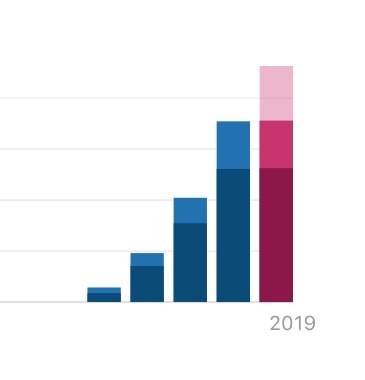
I am proud to say that on September 17th, 2019, the total number of views and visitors to my blog for 2019 surpassed the total number of views and visitors the blog received in all of 2018. Which means that it had the same number of visitors in 8.5 months in 2019 as it did in the 12 months of 2018. #FirstGradeMathYall
This is the growth chart for my blog. It represents the views and visitors (dark and light shades) for each year since 2015. The pink at the top of 2019 is optimism.
Insistence on Persistence
The persistence is leading to progress. I still have 3.5 months of readership growth ahead this year. At the pace of 3 posts per week, that is 42 blog posts left to share in 2019. As a result, I expect a 50% growth in views and visitors for the year. Which for a blog I have been writing for 4 years feels pretty good.
Fun Fact: The Perfect Agency Project blog has been read in 113 countries around the world in 2019.
I attribute the growth to just keeping at it. Slow and steady. Each post, whether it is read by tens or thousands, contributes to that total. And that’s progress. Truly, every little bit helps.
Key Takeaway
Success doesn’t come overnight. It comes in small steps that seem insignificant on their own. But over time the cumulative effect of all those small steps is significant progress. So keep going. Commit to creating a habit of action, day after day. Then give yourself time. Time for the results to pile up and make a difference. If I can do it you can do it. Do a little every day. And just don’t stop.
*If you know someone who could benefit from this message, please share it with them.
When I was a student-athlete at the University of Wisconsin my schedule was booked solid. I was at class every day by 8:55am. Classes lasted until 2pm. At 2:30pm I was at track practice. I left practice at 6pm and went to dinner. I ate at the Sports Buffet until they kicked me out at 7pm. By 7:20pm I was at Helen C. White Library studying in the quiet section (seriously). By 10:30pm I was taking the Drunk Bus home.
Focus Pocus
During this time I had something magical working for me: large chunks of time with completely focused effort. First I was totally focused on my classes. Then track practice. Then on eating (which felt like a job because I was the smallest discus thrower in the Big Ten Conference). And finally, on studying.
All 4 of these time blocks helped me focus my undivided attention on my largest life goals. Plus, there were no smart phones back then to distract me with an Instagram feed full of hilarious Pro Wrestling fails. (@Wrestlebotch)
Scheduling Focused Time
Today, I am revisiting the focused scheduling I employed as a student-athlete. As as result, I hope to achieve the same level of productivity, growth and progress I enjoyed two decades ago. That’s why I have time-blocked my calendar to help create deep focus on my most important tasks. The tasks that will help me achieve my long-term goals.
The Time Blocks On My Calendar Now Include:
An hour of blocked writing time every morning starting at 6am.
2 hours of totally focused work on my most important tasks from 10am to Noon.
1 hour of total focus on my most important issues in the afternoon from 2pm-3pm.
Dedicated open time for meetings, calls and emails to start and end the day.
A 30-minute planning session every Sunday night when I can plan my most important tasks for the week. Tasks that will help me achieve my long term goals.
Make this the next book you read. Then let me know how much you loved it by writing me at adam@theweaponry.com.
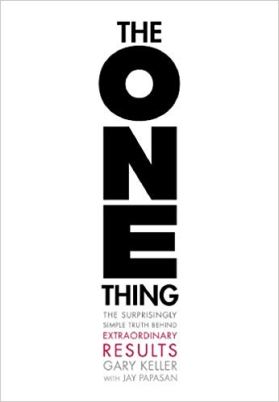
I loved how my calendar blocks helped me in college. But a book I am reading has influenced me to reintroduce this useful scheduling technique again. In fact, The One Thing by Gary Keller and Jay Papasan may be the most powerful book I have read in the past 3 years. It teaches you a system that always leads you to the one, most important thing that you should be doing at any given time, in order to help you achieve your loftiest goals. A critical part of the program is creating calendar blocks that are reserved exclusively for your total focus on your most important activities. Spoiler Alert: The one thing you should be doing at any given time never involves WrestleBotch. #PriortitiesVsDistraction
Key Takeaway
It is not enough to have goals. You need to put in the work required to achieve them. That’s why it is so important to block large chunks of time on your calendar that allow you to completely focus on your most important tasks, every day. Add a chunk of focused time for planning on Sunday evenings, and it will ensure that you make demonstrable progress each and every week. Remember, scheduling your time costs nothing. But the dividends it pays by helping you achieve your goals could be enjoyed for generations.
*If you know someone who could benefit from this message, please share it with them.











 Adam Albrecht Blog