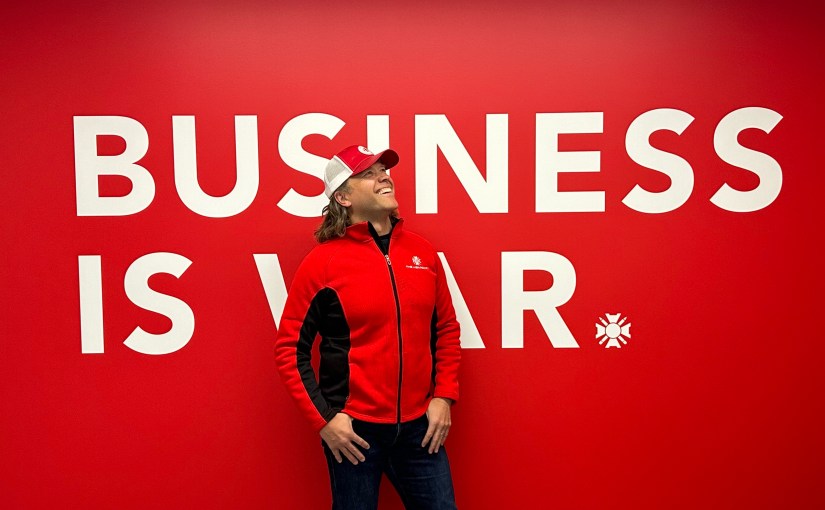
Why you should spend 1 hour each week working on building your own business.

You know who is great at starting a business? (Besides Richard Branson.)

Someone who already works in a business.

Someone who has seen how their employer’s business runs.

They know how their current business wins and how it gets beaten.

They see the flaws to be fixed and the opportunities to improve.

In other words, the best people to start their own business are people just like you. (And Richard Branson.)

Always Be Planning

You should always be thinking of what your own business would look like.

  • Think about the systems and processes.
  • Think about the customer you will serve.
  • Think about your values.
  • Think about your culture.
  • Think of who would be on your team.
  • Think about the epic company parties that aren’t yet restricted by a buzz-killin’ CFO. (I hope Kid Rock, Beyonce and The Rolling Stones are all playing at your party, and asking you to sign their foreheads, because they know you are a rock star!)

Imagining the details of your own business is how you build your own life raft. That way, it will be ready to use when you are ready to jump. (Or if your current business sinks or you get thrown overboard.) You can use your boat to save yourself, create your own epic adventure, or sail off into the sunset.

1 Hour Per Week

Spend an hour per week thinking about building your own business.

Take it from your InstaSnapTok time.

Then, every year, you will spend 52 hours working on your own business.

10 years into your career, you will have spent 520 hours working on your business.

And 2 decades into your career, you will have spent 1,040 hours on your own business. #mathwhiz

That’s how a steady drip of thinking, formulating, and crafting turns into a business started by a veteran with 20 years of experience, a vision, and a valuable network of industry experts, coworkers, partners and suppliers.

I know this approach works. Because it is how I started The Weaponry nearly 10 years ago. And it was the best career move I ever made.

Key Takeaway

Spend a little time each week thinking about what your own business would look like. Capture your ideas in a notebook or a Google Doc. Add a little bit each week. It is a great way to slowly plan your own business before you need it. And if you never need it, it will provide a great roadmap to improve the business you are currently in. It is a win-win that could lead to the greatest adventure of your career.

*If you know someone who could benefit from this message, please share it with them.

+For more of the best life lessons I have learned check out my book, What Does Your Fortune Cookie Say? from Ripples Media. And consider subscribing to Adam’s Good Newsletter.
From Surviving to Thriving: The Power of Daily Commitment.

I have a plant in my office. I inherited it 25 years ago from a coworker who was leaving the company and moving to Canada. I don’t think she was dodging the draft. If I remember correctly, she had a thing for men in uniform on horses. And Tim Horton’s.

The plant in my office hasn’t been faring well.

To be fair, I have been watering the plant just enough to keep it alive.

As a result, it looks like a plant that has been watered just enough to keep it alive. Like the office plant version of a Charlie Brown Christmas tree.

But a couple of months ago I altered my plant care routine.

I committed to watering the plant every day. Or at least every day that I was in the office.

And an interesting thing happened.

By day three, I saw a noticeable difference in the plant’s posture. The spindly little fella stood taller. The leaves looked fuller. And prouder. And chlorophyllier.

By day five, I noticed a new leaf beginning to grow and unfurl.

And then another.

And then another.

As I have continued to water, dozens of new leaves have emerged and added a great deal of canopy to this once-struggling office mate of mine.

It’s like I was feeding the little guy plant Rogaine.

Today, the plant is thriving. It is providing more beauty, more greenery, and more oxygen in my office.

But more importantly, it is providing a valuable lesson.

My plant has reminded me that there is a major difference between living and thriving.

The plant serves as a daily reminder that you can put the minimum effort into your relationships and get the minimum out. Or you can pour as much as you can into your most valuable relationships every day and watch them thrive.

The plant’s regeneration also reminds me that when you put more into your health, fitness, spiritual life, passions, career, business and financial well-being, you get more out of all of them. That’s a heck of a valuable lesson to relearn from an adopted office plant and a daily dose of water.

Key Takeaway

To get more out of life, put more in. Pour more into your valued relationships, your health, and your professional endeavors. And watch them all thrive. Pour more into your faith, and God knows what will happen. And don’t forget to water your plants. Because the things you take care of take care of you.

*If you know someone who could benefit from this message, please share it with them.

+For more of the best life lessons I have learned check out my book, What Does Your Fortune Cookie Say? from Ripples Media.

Jealous of others making a job change? Then it’s time to make your own.

I have mostly loved my career. I have always enjoyed the work I do. But there have been a couple of brief periods when I didn’t like where I worked.

At one point in my advertising career, due to some business loss, we decided to shut down one of our agency’s office locations. Which meant that virtually everyone in that office had to find a new job. The whole experience was right out of a movie.

But I had a very surprising reaction to the situation.

Under those circumstances, it is natural to feel lucky that you are not affected by the office shutdown. That while everyone else is losing their job, you get to keep yours. It should feel like a win. However, instead of feeling bad for that group of my teammates forced to find the next chapter of their careers, I found myself envying them.

I envied that they had to make a change.

I envied that they got to stop what they were doing and find a new situation. That could involve a new company, mission, industry, a new set of coworkers, a new career path, a new level within an organization, or a new attitude, like Patti Labelle.

Meanwhile, I was going to stay in the same job, with the same shortcomings, the same cultural challenges, the same feeling that this place didn’t fit me. The same sense that I was better than this situation. The same feeling that the only reason I was still here was for the money. For the false sense of stability that this salaried employee job offered me.

But something in the feeling of envy for those forced to move on and move forward in their careers, changed something profound in me. I recognized that life is too short to spend unhappy and unfulfilled at work, in a culture, climate and a missionless or purposeless environment.

So my mind shifted.

I knew I needed to find my own next chapter that would make me feel all the things I wish I felt. I spoke to several advertising agencies about the prospect of joining their teams. I explored several different markets to live and work in. The exploration was energizing. And I knew I was on the right path.

Within a year of my profound mindset shift triggered by envy for my teammates who had to make a career change, I had discovered my new path. I started my own business. I launched The advertising and ideas agency The Weaponry. And my life changed in all the ways that I hoped it would.

The past 9 years at The Weaponry have been the most adventurous and rewarding of my career. All because I tuned in to what my envy was telling me. I was willing to make a dramatic change for the better. I was willing to risk the perceived safety and security of my situation for the control and happiness of an unknown adventure. And that has made all the difference.

Key Takeaway

If you are jealous when others are forced to write the next chapter of their career, it means that you have to find your own new next chapter. It is time for greater happiness and fulfillment. It is time to throw off the ropes of your current condition and sail for something better, more fulfilling, more exciting and new. Something that matches your skills and vision for your life’s adventure. Get going. There’s nothing stopping you but you.

*If you know someone who could benefit from this message, please share it with them.

+For more of the best life lessons I have learned check out my book, What Does Your Fortune Cookie Say? from Ripples Media.

It’s time for your next step to a great 2025.

One great day is just one great day.

But if you can string together 4 to 7 great days you have a great week.

And if you can string together 4 or 5 great weeks you have a great month.

And if you string together 12 great months you have a great year.

And if you string together great year after great year, you create a great life.

And if you string together 6 great strings, you might have a guitar. Or an afghan.

Creating A Great 2025

I am trying to make 2025 my best year ever. I call it Project 2025. (Not to be confused with any other Project 2025s you may have heard about lately.) I hope you are doing the same. And if you haven’t been thinking about creating your own great 2025, now is the time to start. Because no one can make it happen but you. (With a strong assist from God, the world’s all-time assist leader.)

As we wrapped up the first 12th of the year, I spent Friday evening evaluating my January. Here are the bullet points in my self-report:

Adam’s January 2025

  • I went skiing 4 times. (That’s an average of once per week and twice the number of times I have skied between 1990 and 2024.)
  • I read 3 books. (More to come on this. But they were all great. And none of them involved coloring.)
  • I published 10 new blog posts.
  • I published 2 new editions of Adam’s Good Newsletter. (Please sign up if you like positive stuff.)
  • I met major milestones on a special writing project I have been working on. (I assume much of the world calls them kilometerstones.)
  • I worked out 16 times (despite being sick for a week with one of those little Gremlins Americans circulated in January. Which made me appreciate my good health even more.)
  • I booked 3 new speaking engagements. (Does that mean I now have 3 new speaking fiances?)
  • I bought a new set of Rogue dumbbells from 5 to 50 pounds and an additional set of 45-pound Rogue bumper plates. Then, I put them all to good use in my home gym. (I also drove from Milwaukee to Columbus to pick them up and save $300 in shipping costs. Plus, I got to see that huge candle in Indiana. #IYKYK)
  • The Weaponry conducted 2 transformative strategy workshops for new brands.
  • My great team added some cool new clients and we have several more about to come aboard, like the opening to The Love Boat.
  • I visited 5 states. And discovered that the new Salt Lake City airport is amazing. Tom Hanks should have been stuck in that terminal.
  • I visited my great friends Amy and Todd Urowsky at their beautiful home in Park City, Utah, and then skied at Brighton.
  • I spent time with my parents Bob and Jill Albrecht, in Lafayette, Indiana. Having parents is the best. Don’t take it for granted.
  • I planned and booked a spring break trip to Arizona. I’d love to hear your favorite things in Scottsdale and Sedona. (I already know about the tall cans of tea.)
  • I spent a lot of quality time with my wife Dawn, and sons Johann and Magnus. Plus, my daughter Ava was home from college for 3 weeks in January. Which was wonderful. Like George Bailey’s life.
  • I added several great new people to my Great People collection. Great people are the most valuable things you can collect.

I share this list to encourage you to create your own. You have to look back at your wins, both large and small, to recognize the great things in your life. The successes, the adventures, the experiences, the relationships, the learnings, the growth, and the commitments kept. By reflecting on them, you both tally your wins, and you get to enjoy them all again.

Let’s Go February!

Now, it’s time for us all to create a great February. I am excited about it. I hope you are, too. It all starts simply by having a great day today, whatever that looks like to you. And then doing it again tomorrow.

Key Takeaway

A great life, a great marriage, and a great career are built one day at a time. Start by knowing what great means to you. Then, live into that every day. String together great days. They create great weeks, months and years. You have to make it happen. And it is never too late to start.

*If you know someone who could benefit from this message, please share it with them.

+For more of the best life lessons I have learned check out my book, What Does Your Fortune Cookie Say? from Ripples Media.

Are you willing to trade a good life right now for a great life later?

I don’t believe in work-life balance. I never have. It’s just a nice mythical idea. Kinda like The Fountain of Youth. Or a happy Kardashian marriage. You can’t divide your life into 3 neat 8-hour blocks of work, personal time and sleep and become rich, successful and fulfilled. To have a wildly successful career you have to throw things out of balance. You need chapters of your life when you put a disproportionate amount of time and energy into your career. That’s what all of the most accomplished people you’ve never met do. It’s why they don’t have time to meet you.

Sometimes this means days of extreme dedication and focus. Sometimes it means weeks. But more likely, there will be many months and years where your career is the thing, Stephen King. You don’t have to ignore the rest of your life the way Michael Douglas ignored Glenn Close in Fatal Attraction. But your career demands to be your priority during certain seasons. Just as farmers must put all their attention into harvesting when it is time to get the crop in, you must pay attention to the opportunity seasons of your career, and make all the progress you can before the window closes.

In the movie about your life, this part of your career would be the montage. You know, the part where they show quick clips of all your hard work, focus, skill development, late night sessions, early morning sessions, and burning-the-candle-at-both-ends kind of work. (You can learn everything you need to know about your montage in this 1-minute video from Team America, World Police.) If you are not willing to have your movie montage chapter (or two or three) you will not be dedicating enough focus and energy to your career to pull away from the pack.

Focusing your time and energy on your career instead of your personal life is like investing your money for greater compounded gains tomorrow rather than spending it on yourself today. That time invested in your professional development and in developing career capital will pay out in massive ways in the future if you don’t scarf your marshmallow today.

The sacrifice is worth it. But you have to keep the primary goal in mind to remember why you are not buying that timeshare in Gatlinburg or knocking off early to meet your friends at Applebee’s. And if you have a family, you and your spouse need to focus on the long-term payoff and be willing to sacrifice whatever nights, weekends, holidays, birthdays, anniversaries and vacations need to be traded now, for better versions of all of those things in the years to come.

One of the great regrets people have in life is that they didn’t do the foundational work they should have done to achieve their dreams. It is important to know about this widespread regret while you still have time to do the foundational work. The work is more than a fair trade. The payout is so handsome, (like George Clooney handsome) that is feels like a small price to pay.

I have experienced enough chapters of significant sacrifice in my advertising career to fill a forthcoming book. In the first chapter of career sacrifice, I wanted to become a stronger writer. So I spent considerable time working on and improving my craft. I read all the time. I wrote far more than my professional peers. I studied other great writers in all John Rahs. (And I learned the word is actually genres.) I read great writers’ writings on writing. I experimented with words, style, structure, tone and humor. Through that focus, my writing got sharper, smarter, and more interesting.

Then I focused a disproportionate amount of time and energy on developing my presentation skills. Because girls only want boyfriends who have great skills. I took courses. I read books. I became a student again. I practiced and applied all that I was learning. This helped make me a strong and entertaining performer in business development meetings, sales pitches and client presentations. Which led to promotions and more responsibility. Because sometimes your hard work gets you more hard work.

Next, I focused heavily on creative direction skills, leadership and management. And within a four year span I motored from my first creative director position to executive creative director to Chief Creative Officer. The only position in my industry left was CEO. And I wanted that job too.

So I began focusing on what it took to run the entire business. I learned as much as I could about accounting and finance. I learned about human resources and non-surgical operations. I learned systems and processes. Project management and IT. I learned stuff that most writers and art directors in advertising never learn anything about. But then again, they get to go to Applebee’s and eat good in the neighborhood.

I didn’t want to wait for a CEO job to open or to wait in line for the CEO in front of me to leave, or die. So I decided to grab the role for myself by starting my own agency called The Weaponry.

As an entrepreneur you not only need to know a bit about all areas of a business, you need to create the whole business from dust. That takes more time, energy, focus, learning, sacrifice and work, work, work, work, work. Like Rihanna said.

Again, I sacrificed other opportunities in my personal life to make this happen. It’s the only way to make big dreams a reality. It’s not easy. But it has been both immensely fun and rewarding.

To share what I was learning through my entrepreneurial journey, I also started this blog. This is the 1023rd blog post I have written in the past 9 years. This too requires sacrifice. I write first thing every morning. I write 5 to 7 days every week. By 6:10 am I am in my office hammering away at another post, another story, another idea. While other people are still in bed or enjoying a cup of coffee and a good social media scroll.

By dedicating so much time to writing I further developed my storytelling skills. And I found my own unique writing style. Which sounds exactly like the way I talk. Now, I write books too. And writing books takes yet another level of dedication and sacrifice. Which is a sacrifice I am willing to make, because I understand the compounding benefits that come from that investment.

Key Takeaway

The great achievements in your career don’t come easy. They don’t come at a natural pace. They come by throwing your life out of balance. By heavying your load. By gorging on learning. And by giving more time, attention and energy to your work than others are willing to give. But by unbalancing your career early your life balance will flip later, and you will receive far more financial and career capital by becoming uncommonly great at what you do. Today, I have no foundational regrets. Instead, I have the rewards of a lot of hard work and sacrifice. And not only can you take that to the bank, you can take it on long, well-deserved vacations with your family and friends.

*If you know someone who could benefit from this message, please share it with them.

+For more of the best life lessons I have learned check out my book, What Does Your Fortune Cookie Say? from Ripples Media.

How to do hard things.

When I was in college I had a summer job setting up large party tents in Vermont. I loved pitching a tent. It was hard. But looking back, that’s what I loved about it.

The hardest part of the erection process was driving the 4-foot-long steel stakes into the ground. The stakes create the foundation for the tent. You tie the tent ropes to the stakes to help hold the tent upright and sturdy.

To drive the stakes into the ground we used sledgehammers that were 8, 12 or 16-pounds. Size mattered. Because if you swung a bigger hammer you could get the job done in fewer swings.

Sometimes, when the ground was soft, the stakes would go in smoothly. But in Vermont and New Hampshire where I drove most of my stakes, the ground was very hard. They don’t call New Hampshire The Granite State for nothing. (And they don’t call Vermont the Granite State at all, but that’s just because New Hampshire already took it, for granite.)

But during those college years, I learned a valuable lesson about how to do hard things. Because the only way to get those 4-foot stakes in the ground was to keep pounding away until the job was done. More often than not the stakes went in an inch or less at a time. And sinking a 4-foot shaft neck-deep at that rate can be exhausting. But it was the only way to finish the job.

I applied that just-keep-swinging-till-it’s-done lesson in my athletic career as a track and field athlete at the University of Wisconsin. Today, I apply the same lesson to building the advertising and ideas agency, The Weaponry, writing my blog posts, newsletters and books. And simply not stopping until the work is done has never failed to produce results. Even when things get really, really hard.

Key Takeaway

The only way to get a job done is to just keep pounding until you are finished. Hit the task again and again and again. This is true when you are driving stakes in the ground in Vermont, building a company, advancing your career, trying to meet your fitness goals, or getting your education. Focus your efforts. Pound away. And just don’t stop until the job is done.

*If you know someone who could benefit from this message, please share it with them.

+For more of the best life lessons I have learned check out my book, What Does Your Fortune Cookie Say? from Ripples Media.
An open letter to junior employees who want to keep their new jobs.

Hey Junior Employees!*

Congratulations on landing that new job of yours! Finding the job may have seemed like the hard part. It is not. The hard part is not getting left behind.

Now that you have the job it’s frick’n go time! You have to start performing and competing like you did in your classes. Like you did in your athletic competitions or music competitions, or art competitions, or dance competitions or beer chugging competitions, or whatever you once did competitively.

As a new employee, you are a liability. You cost the company more than you make it. Because we have to train you to do your job in a way that adds value. You are not an asset to the company until you have learned enough to create more value than we pay you in salary or wages. For some employees, this never happens. And if it doesn’t happen quickly enough you can’t stay with the company.

Remember the line you heard at the bar at closing time in college:

‘You don’t have to go home, but you can’t stay here.’

The same applies to employees who don’t learn, contribute and start providing value that exceeds their wages.

You need to focus on transforming yourself into an asset employee. That means you should be pushing me, your supervisor, or boss, or business owner for more. For more work, for more opportunities for more access, for more teaching and exposure (work-appropriate exposure only.)

You have got to stand up and demand to be noticed. You’ve got to bring ideas to the table. Or wherever ideas should be brought if you work in a table-less organization.

Take initiative.

Ask questions. As many as you can.

Learn and grow faster than anyone else in the organization.

Soak it all up, like Sheryl Crow. (Ask your parents to explain what that means.)

You are starting at a low point. Growth should be evident quickly.

Create your own fast track to the top by moving fast. By learning fast. By growing fast. Like Luke Combs in that fast car he bought from Tracy Chapman.

Don’t wait for me. I may be too busy to help you move fast unless you are requesting it. Or forcing it.

Don’t allow yourself to be ignored for long stretches. (Think about it like developing real-life Snapstreaks with the senior people at work.)

Create stuff.

Add value in ways we never requested.

Because once you become an Asset Employee everything changes.

And your employer will do all they can to keep you.

That’s the goal.

Key Takeaway

New employees, both junior and senior, begin their jobs as liabilities, costing companies more than they earn. To develop job security you have to produce. That means action, initiative, learning and growth. Master the systems and processes. Bring new ideas. Outpace the expected learning curve. Make yourself indispensable and irreplaceable. This is how you transform yourself from a liability into one of the most profitable assets within your organization. It’s really up to you.

*I learned several years ago that you are supposed to call employees with little to no experience juniors. Not young. Or the old people will want to sue you for age discrimination.

**If you know someone who could benefit from this message, please share it with them.

+For more of the best life lessons I have learned check out my book, What Does Your Fortune Cookie Say? from Ripples Media.

Why it is so important to be in the right place at the right time.

I spend a lot of money on gasoline. And airfare. Then there are the trains, subways, ferries, and those incline thingies in Pittsburgh and Chattanooga.

Why do I spend so much on transportation?

Because place matters.

So we pay to be in the place where the thing is happening, Hot Stuff.

We pay to be in the place where people gather.

If you want to be included you have to be in the place.

If you want to be seen you have to be in the place.

If you want to develop or deepen your relationships, you have to be in the place.

If you want to influence the outcome, you have to be the ace in the place, with or without the helpful hardware folks.

Being in the right place at the right time makes magic, Mike.

It unlocks doors. It finishes the job. Or starts the next one.

As Woody Allen said, “80% of success is showing up.”

If you don’t show up your world shrinks. This includes your engagements, relationships, opportunities and learnings. And no one likes shrinkage.

So show up to the places that matter.

Be in the room where it happens.

Put yourself amongst the people.

Be in the human traffic flow.

And good things will happen.

Key Takeaway

Regardless of technological advances that enable you to work from anywhere, physical locations will always be important. Be where the people are. Attend the events. Increase the chances of chance encounters. Increase your familiarity. Be seen and become known. Be missed when you are not there. Better yet, be the reason others show up.

*If you know someone who could benefit from this message, please share it with them.

+For more of the best life lessons I have learned check out my book, What Does Your Fortune Cookie Say? from Ripples Media.

12 Lessons I have learned from 8 years as an entrepreneur.

When I set out on my entrepreneurial adventure 8 years ago I had a lot to learn. So I became a student of entrepreneurship in the same way that I became a student of Journalism, Psychology and Bratwurst at The University of Wisconsin. I read books, magazines, and blogs. I talked to friends who were entrepreneurs and business leaders. The non-standardized tests started in April of 2016 when I launched the advertising and ideas agency, The Weaponry. And I am still tested every day.

8 years later, I can’t imagine my career without this chapter. I have learned a lot about what it takes to launch and run a business. It turns out there is a lot more to it than printing up a batch of business cards and cool company t-shirts. (Although you should do those things too.)

I wanted to share 8 lessons I have learned along the way. Because 8 ideas from the past 8 years seemed well-balanced. But I had too many lessons to stop at The Ocho. So here are 12-ish lessons I have learned that you should know if you are thinking about starting your own business, or if you already have a business and you now need to get your fecal matter straight.

12 Lessons I have learned from 8 years as an entrepreneur.

  1. Don’t quit your day job*. This is the most important lesson. Start working on your new business as a side hustle. Use your nights and weekends to study, plan and create your business. Use the income from your day job to fund your embryonic startup. Start generating revenue from the new entity. Then, as your startup indicates that it will be able to replace your required income, you can transition out of your full-time employment. But allowing your startup to grow as a side hustle will take a lot of pressure and stress off the early stages of entrepreneurship. From my first paid project to leaving my day job was 5 months. But a year or two of side hustling is not crazy. It is time well spent. *Note: This lesson is only for people who currently have day jobs. If you don’t have a day job the next 11 lessons are for you.

2. Good people are gold, Pony Boy. Business is the ultimate team sport. A great business is simply a great team of people running great plays. Find the right people. Treat them well. They will make the company and the culture amazing. As an entrepreneur, you get to pick your entire team. It’s one of the best parts of entrepreneurship. That and picking the dress code.

3. Good processes make it happen. Your systems and processes enable success, reduce friction, and organize the organization. Determine your organization’s way of doing everything. Write it down. Share it broadly. It ensures that everyone in your organization knows that you always pass the Dutchie on the left-hand side. Don’t worry if the process isn’t perfect. You can always improve it when you discover a better way. Read The E-Myth by Michael Gerber and Traction by Gino Wickman to help you dial this in.

4. Great creative thinking is key. As an advertising and ideas agency, creativity is what our clients come to us for. This has to be great or nothing else matters, like Metallica said. However, all entrepreneurial organizations should focus on creative thinking. It is how you get things done when you don’t have all the resources you wish you had. And it is how you beat competitors who always do things the same old way. Because creativity creates competitive advantages.

5. Great customer service is a must. This is why your clients stay. Always think about your service, and how you can make it better. We want to treat our clients so well that they never want to leave. And we want to make sure they hire us again when they leave their current job for a new opportunity. This has happened more times than I can count. And I am relatively good at counting.

6. Business development is critical. You have to put focused effort into expanding your business. There is natural attrition that happens in business, even if your product and your service are great. The economy plays games you can’t control. So do a dozen other influences. Businesses that forget to find new customers eventually die. Sometimes they die slowly. Sometimes they die all at once. But the net result is the same.

7. Trust is everything. At the beginning of your entrepreneurial adventure, people will take a chance on buying from your new entity solely because of you. The company will have no real track record or history of doing what it says it will do. But you do. Be a trustworthy human. That personal trust will be the bridge that gets early customers to try your offering before you have real proof that your business is as good as advertised. (Also remember to advertise that you are good.)

8. Build in a fair profit. It’s not enough to have paying customers. You have to understand the cost of your goods or services. Then you have to build in a fair profit. Which means if your offering costs you $100 to deliver, you must charge $5, $10, $20, or $100 on top of that to make sure the business makes a fair profit. That profit is what keeps the business sustainable. Some customers and most procurement departments will try to beat the profit out of your business. Don’t let them. Know what you need to make, know your value, and stick to it. Like a cocklebur on corduroy.

9. Share the success with your team. Business success is team success. You have to recognize and celebrate the contributions of everyone involved. When you do, a good team is eager to create even more success. That stuff is addicting. Like Dot’s Pretzels.

10. Relationships are extremely important. The personal relationships you create help create your success. Those include your relationships with your team, clients, partners, vendors, bankers, brokers, accountants, lawyers and the media. But all your relationships matter to business. Because you never know where your next referral will come from. And you never know who you may need as a character witness. Or who may be carrying an extra kidney that you may need one day. And don’t neglect your relationships with your family to make the business work. My relationship with my wife Dawn has been the most valuable relationship on my entrepreneurial adventure. And I get to spend more time with my kids now as an entrepreneur than I did as an employee. Which is perhaps the biggest win of all.

11. You have to keep experimenting. Business success is an interesting combination of running tried and true plays and trying new things that create new advantages. It’s kinda like the way you have to keep things spicy in your romantic relationship. Businesses that keep experimenting with new technology, new offerings, and new models survive changes. So stay on your toes. (If you have toes.) Watch the horizon for change, both in your industry and the broader economy. Expect that the future will be different than the past and you will be prepared for the strange changes. Like David Bowie said.

12. Create a newsletter. This is a great way to stay in contact with your community, which includes team members, customers, partners, supporters, potential customers, potential employees, the media, fans, and your parents. Add value through each issue. Share your news and successes. Social media channels are beyond your control, and it can be challenging to get your message in front of your audience there. But a newsletter is your own media outlet. It is like an express train to your audience’s inbox. Choo Choo! We use Mailchimp for our newsletter. There are many good options you can find using the Googler. You can sign up for The Weaponry newsletter here to see how we do it.

Bonus

13. Learn to spell entrepreneur. When you become one you end up writing the word a lot. At least you do if you have a blog sharing your experience as an entrepreneur. To spell entrepreneur, remember that all of the vowel holes start with ‘e’ and you come last. Which is how I remember that there is a ‘u’ after the last ‘e.’

Key Takeaway

Starting your own business is an exciting and rewarding adventure. It enables you to design your own life. It combines the thrill of competitive sports with the satisfaction of having a positive impact on your team members and your community. To start your journey, do some prep work. But then get going. You will learn what you need to know along the way. Remember to always bet on yourself. It is the safest bet you will ever make.

*If you know someone who could benefit from this message, please share it with them.

+For more of the best life lessons I have learned check out my book, What Does Your Fortune Cookie Say? from Ripples Media.

4 Keys to entrepreneurial success I wish I had known before I got started.

I am asked about my entrepreneurial journey a lot. It seems that far more people are interested in starting their own business than ever sail their own entrepreneur ship. If you are considering starting your own business, either as a side hustle or as your main hustle, here are 4 things that I have done that I highly encourage you to do too.

1. I Took Action. 

Everyone has a dream. And I dreamed of starting my own advertising agency for a long time. But to actually start your own business you have to move beyond dreaming to doing. Starting in the fall of 2015 I took an endless series of small actions that led me to today. My business, The Weaponry, will turn 8 years old next month.  So if you want to make sure you don’t die with your dream still inside you, take action to make it real. (Also look both ways before you cross the street.)

Suggested readings to spur your action:

2. I Saved. (Not Like Jesus)

As a professional creative thinker, I take lots of risks with idea exploration. However, I am fiscally conservative. I have been cautious with our expenditures, our office space and our staffing size. I have been conservative about leaving cash in the business, versus taking it home as part of my return. As a result, The Weaponry has strong reserves to outlast downturns. This was a key reason I didn’t panic at the disco in 2020 during the Covid Cray Cray Fest.

3. I Planted Seeds.

Business development is critical to creating a pipeline of opportunities. Over the years I have stayed in touch with old friends. I’ve made one hundred billion new friends. I have had phone conversations, chocolate milk meetings and lunches. I have volunteered my time. I have guest lectured and given talks. I write a blog. I wrote a book called What Does Your Fortune Cookie Say? I co-wrote a book titled The Culture Turnaround with Jeff Hilimire. I have given interviews and served on committees and boards.

All of those things are like planting seeds. You never know when they will sprout or what they will turn into. So keep planting seeds and watch what happens, with Andy Cohen.

4. I Delivered

The best source of new business is a happy client. And you develop happy clients by delivering for them. (Especially if you are an obstetrician, or a milkman.) The Weaponry has grown by keeping our clients happy and expanding our work with them. We are also expanding by having happy clients leave for great new jobs and bringing us with them to their new companies. I have a really great team. And I appreciate all that they do for our clients. It is why we are still here, and still growing strong.

Key Takeaway:

To develop a successful business you have to take action. Without action, you are just a dreamer. You have to save money so that you are prepared to weather the storms that will surely come. You must keep planting seeds by creating and nurturing relationships and providing value to others. Then you must deliver the goods. Nothing grows a business like happy customers. None of it is easy. And none of it is that hard. It is simply the price you have to pay to get what you want in life.

*If you know someone who could benefit from this message, please share it with them.

+For more of the best life lessons I have learned check out my book, What Does Your Fortune Cookie Say? from Ripples Media.