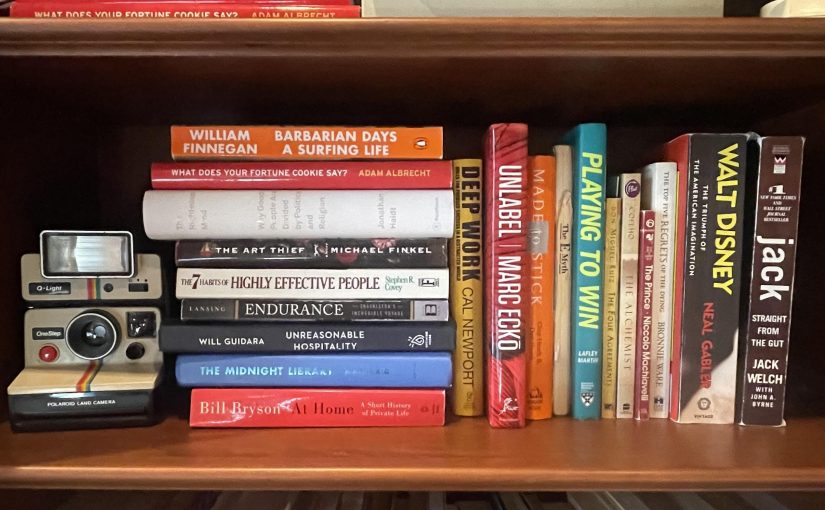
People are reading less. Which is great news for you!

The greatest way to increase your value to yourself and others is through reading.

You could just stop reading this post now and go grab a book to read instead.

But I am going to drop some new reading knowledge on you that is worth 90 seconds of attention.

Why Should You Read?

Bill Gates reads about 50 books a year. Or about a book each week.

Warren Buffett famously reads about 500 pages per day.

Lin-Manuel Miranda bought the book Hamilton to read on vacation in Mexico.

So read books that expand your thinking and your knowledge base.

Read to understand how things work.

Read for inspiration, motivation, and all the other great ations.

Read to understand how successful people became successful.

Read about what worked in the past in your field of expertise.

And read to learn what is changing in your field, so you can surf that change, rather than get pummeled by it.

Read to improve your writing and expand your vocabulary.

Read to develop your focus and your patience for long-term goals.

But most importantly…

Read To Separate Yourself From The Pack.

Despite all of the mental nutrition and long-term success that sprouts from reading, a new study just released by researchers at the University of Florida and University College London (which sounds like the fakest British school name ever) found that reading for pleasure among Americans has declined by 40% over the past two decades.

  • In 2004, 28% of Americans said they read for fun.
  • In 2023, only 16% said they read because they wanted to.

It is not lost on me, or the researchers, that Facebook launched in 2004 and the iPhone was released in 2007. Together, social media and smart phones may be accomplices, killing reading softly, like Roberta Flack or the Fugees.

This all means that people who read books have a greater competitive advantage now than ever before.

The statistics are fascinating.

The average number of books adults read each year is 12. Which was also my favorite song from Sesame Street.

However, this is massively skewed by the avid readers.

In fact, estimates reveal that between 25-46% of adults READ NO BOOKS each year.

And the median number of books read annually by adults is only about 4. That’s how much the average person hates paper cuts.

Which means there are fewer and fewer people after the pot of gold at the end of the Reading Rainbow.

There are fewer people who are willing to do the slow, steady, yet transformational work of knowledge gain through reading. While others are settling for bite-sized bits of video, podcasts, and tweetable wisdom served by algorithms, readers are accumulating broad and deep knowledge that helps make them more capable, valuable and irreplaceable.

The new study also revealed that those who do read for fun are spending more time doing so. Because while haters gonna hate, readers gonna read.

And in the era of artificial intelligence, it is the humans who can contribute more than the machines that will be in greatest demand.

Key Takeaway

Now more than ever, reading is your great competitive advantage. Your self-directed education makes you a valuable and irreplaceable resource. It improves your thinking. Which drives smarter decisions and actions. And it draws other people to you who want to tap into what you know.

*If you know someone who could benefit from this message, please share it with them.

+For more of the best life lessons I have learned check out my book, What Does Your Fortune Cookie Say? from Ripples Media.And consider subscribing to Adam’s Good Newsletter.

Why you need to have a need for speed.

If there is one defining factor of how the world works today versus any other time in history it is speed.

Today, everything happens faster. Not just Jimmy John’s. And Tinactin.

Communication technology has advanced from mail, to email to Slack and texting. Information arrives instantly.

News can be reported with a tweet, just seconds after it occurs.

You can stream practically anything you want to watch on demand, anytime.

AI has squeezed the gestational period of our research, discovery, query and analysis down to a mere burp.

So Why All The Slow Motion?

Yet, with all of the technology enabling us to move at Lightning McQueen-speed, I am constantly surprised by how slow many organizations move.

Nearly all technological friction has been taken out of our systems, yet human friction is still ubiquitous. K, why is that?

Human decision making, prioritization and hesitation still kill momentum, push deadlines and slow progress to a snail-mail’s pace.

The Weaponry, the advertising and ideas agency I lead, was launched 9 years ago, and the urgency of the social era was baked into our DNA. Because in the social era, opportunities come and go in a flash. In the social era, you must harvest social opportunities during the very short season when the opportunities are ripe. This can be as short as a few seconds, but never longer than a couple of days.

One of the mandates for our organization is to operate with the urgency of social media. Move quickly. Jump on opportunities. Thwart threats quickly. Move faster than other organizations. It was programmed into our genomic code from the start.

When we present timelines in our proposals, we share aggressive timelines, and note that this timeline only works if the client can keep up, and turn approvals around within our reasonable, but not generous, turnaround periods.

Yet as much as we hear about how important the work we do is to our clients’ success and how they want to get it done quickly, organizations can rarely keep up with their own ambitions. They are simply not built for speed and urgency.

While not all windows of opportunity close as quickly as social media does, all opportunities are finite.

When you fail to get your advertising in market in time, you also fail to drive sales during that time. For seasonal businesses, that is revenue lost forever. For non-seasonal businesses, it means your sales slide later in the year or into the next year. When you delay decisions, your overall revenue numbers for the current month, quarter or year are lower than they should be. That’s a loss. And an avoidable one.

My friend and client Bob Monnat, Senior Partner at Mandel Group Inc, shared some insights with me about one of his organization’s best partners. He revealed that they are great partners because they are always pushing them to move faster, to decide quicker, to get the work done so that they can ultimately turn their projects into cash-flowing assets.

Never lose sight of the reason businesses exist. They are created to make money. And time is money. The quicker you move, the more money you are likely to make.

Key Takeaway

Move faster. Today, advanced technology means that the slowest part of the process is the humans who have the most to gain. Slow actions and slow decisions cause wasteful delays. Identify the bottlenecks and pinch points in your process. Then attack them. Address your delays to help move your organization faster so that everyone can enjoy the success of speed. It is today’s competitive advantage.

*If you know someone who could benefit from this message, please share it with them.

+For more of the best life lessons I have learned check out my book, What Does Your Fortune Cookie Say? from Ripples Media. And consider subscribing to Adam’s Good Newsletter.
How to Develop a Growth Mindset Effectively, And Grow Baby, Grow!

When I was a little boy, I had a piece of needlepoint art in my bedroom. It depicted a little cowboy, like me, and the words, ‘Please by patient. God isn’t finished with me yet.’ It was my first reminder that who I was as a young boy was not who I was going to be as a full-grown adult. I just didn’t know that I would never outgrow my love for potty humor.

The Growth Mindset

As I grew older, I recognized how much I was changing, learning and growing. First, in elementary, middle and high school. Then, the growth and learning continued at The University of Wisconsin, where I majored in psychology, journalism and cheese curds.

But I liked learning, growing and developing so much that when I graduated from college, I enrolled in Adam Albrecht’s Self-Directed School of Life Long Learning. It’s where I have received all of my advanced degrees. The tuition at AASDSLLL is a great value. But our basketball team couldn’t beat a drum.

Lessons I Have Learned Along The Way.

I have learned that everyone adopts 1 of 2 mindsets.

Those with a fixed mindset believe their knowledge, skills, abilities and limitations are fixed and unchanging.

People with a growth mindset believe that they are continuously growing, evolving and improving. Which sounds way more hopeful. (Pro Tip: It’s also the mindset they are looking for at your parole hearing.)

A growth mindset means you recognize that what you know now is just a tiny percentage of what you could know.

A growth mindset means that you believe that you can feed your brain, your body, and your emotions with better inputs and get better outputs.

It means that if you currently stink at stuff, you are not condemned to a life sentence of stinkage.

It means that you have the superpower to transform yourself into a much better and more powerful version of yourself. Like Ironman.

A growth mindset means that every time you spend time with someone better than you are, their knowledge, skills and mindset rub off on you and make you better.

A growth mindset means that when you read a book, you reach the back cover smarter and more capable than you were when you lifted the front cover.

A growth mindset means you don’t say things like, I can’t or I don’t. And you don’t say Popeye stuff like, ‘I yam what I yam.’ What kind of sweet potato nonsense is that?

A growth mindset means that you see your self-improvement journey as an infinite staircase. The level, step or stair that you are on today is simply where you are today. You have the ability to take another step up in any area of your life, and by any measure you choose, any time you choose.

A growth mindset means having faith in the self-improvement process. Like George Michael. It means that small incremental gains will add up to have a transformational effect. Like compound interest in every area of your life that you invest time and energy into.

Leveling Up

When I entered high school, I was a 6-foot-tall, 150-pound freshman. During my 4 years at Hanover High School in Hanover, New Hampshire, no one spent more time in the weight room than I did. As a result, I graduated as a senior who was 6 feet tall and 215 pounds. (I couldn’t seem to do anything about the height. Maybe I have a fixed heightset.)

In my first track meet as a high school shot putter my freshman year, I finished 28th out of 30 throwers. My senior year I was the state champion.

During my freshman year, my coach didn’t think I was good enough to throw the discus in a meet. But, by the time I was a senior, I was a state champ, New England champ, and held the all-time state record in the discus. All of this happened because I could imagine it happening. So I put in the work to keep climbing that staircase.

How To Develop A Growth Mindset

The first step to developing a growth mindset is to visualize the best version of yourself. Imagine the greatest version of yourself you can conceive of. That is your ideal self. What you are today is your real self. It is the version of you that you have already realized or attained. Now, your job is to simply put in the effort to close the gap between your real self and your ideal self.

The Model And The Path

A growth mindset is simply having an open mind to your ability to improve yourself into someone greater than you are today. One of the best ways to do this is to find a model and a path.

A model is a person whom you aspire to be like. Pick a person you think has the skills, abilities, success, character or mindset that you want to have. (They don’t have to be an actual model, like Heidi Klum, Bella Hadid, or a T Ford.)

Then, examine your model’s path. Learn what work, steps, opportunities and influences helped them develop into the person they are today. (Or, if you choose a historical figure, focus on the path they traveled before they died. And decomposed.) Learn their helpful habits and routines. Learn about their knowledge sources. Which could be books, coaches, teachers, and role models. Learn about their experiences and influences.

Next, reproduce or approximate the helpful forces that pushed them to grow into the model you admire. This provides both a great recipe for improvement, and prevents you from having to reinvent the wheel. Or become a psycho stalker.

A Few Final Thoughts

A growth mindset is about experimenting. It is about adjusting variables to get better results.

A growth mindset means you give yourself permission to be an amateur. You can’t beat yourself up over all the things you don’t yet know or can’t do yet. By giving yourself permission to be an amateur, you allow yourself to start and put a premium on all the growth you experience along the way.

A growth mindset is about developing great habits. You are a product of your habits. Growth-focused habits have the power to help you improve every day. These include reading, practicing the skills you want to develop, time management, exercise, sleep, and gratitude.

Key Takeaway

To become the greatest version of yourself, you have to adopt a growth mindset. Imagine a version of yourself far greater and more capable than you are today. Then continuously work to close the gap. Allow yourself to be an amateur. Develop great habits that help you learn and grow. Experiment. Stay curious. Find someone who you want to be more like and discover their path. It will help you discover your own path to an even greater you.

*If you know someone who could benefit from this message, please share it with them.

+For more of the best life lessons I have learned check out my book, What Does Your Fortune Cookie Say? from Ripples Media.

Are you willing to trade a good life right now for a great life later?

I don’t believe in work-life balance. I never have. It’s just a nice mythical idea. Kinda like The Fountain of Youth. Or a happy Kardashian marriage. You can’t divide your life into 3 neat 8-hour blocks of work, personal time and sleep and become rich, successful and fulfilled. To have a wildly successful career you have to throw things out of balance. You need chapters of your life when you put a disproportionate amount of time and energy into your career. That’s what all of the most accomplished people you’ve never met do. It’s why they don’t have time to meet you.

Sometimes this means days of extreme dedication and focus. Sometimes it means weeks. But more likely, there will be many months and years where your career is the thing, Stephen King. You don’t have to ignore the rest of your life the way Michael Douglas ignored Glenn Close in Fatal Attraction. But your career demands to be your priority during certain seasons. Just as farmers must put all their attention into harvesting when it is time to get the crop in, you must pay attention to the opportunity seasons of your career, and make all the progress you can before the window closes.

In the movie about your life, this part of your career would be the montage. You know, the part where they show quick clips of all your hard work, focus, skill development, late night sessions, early morning sessions, and burning-the-candle-at-both-ends kind of work. (You can learn everything you need to know about your montage in this 1-minute video from Team America, World Police.) If you are not willing to have your movie montage chapter (or two or three) you will not be dedicating enough focus and energy to your career to pull away from the pack.

Focusing your time and energy on your career instead of your personal life is like investing your money for greater compounded gains tomorrow rather than spending it on yourself today. That time invested in your professional development and in developing career capital will pay out in massive ways in the future if you don’t scarf your marshmallow today.

The sacrifice is worth it. But you have to keep the primary goal in mind to remember why you are not buying that timeshare in Gatlinburg or knocking off early to meet your friends at Applebee’s. And if you have a family, you and your spouse need to focus on the long-term payoff and be willing to sacrifice whatever nights, weekends, holidays, birthdays, anniversaries and vacations need to be traded now, for better versions of all of those things in the years to come.

One of the great regrets people have in life is that they didn’t do the foundational work they should have done to achieve their dreams. It is important to know about this widespread regret while you still have time to do the foundational work. The work is more than a fair trade. The payout is so handsome, (like George Clooney handsome) that is feels like a small price to pay.

I have experienced enough chapters of significant sacrifice in my advertising career to fill a forthcoming book. In the first chapter of career sacrifice, I wanted to become a stronger writer. So I spent considerable time working on and improving my craft. I read all the time. I wrote far more than my professional peers. I studied other great writers in all John Rahs. (And I learned the word is actually genres.) I read great writers’ writings on writing. I experimented with words, style, structure, tone and humor. Through that focus, my writing got sharper, smarter, and more interesting.

Then I focused a disproportionate amount of time and energy on developing my presentation skills. Because girls only want boyfriends who have great skills. I took courses. I read books. I became a student again. I practiced and applied all that I was learning. This helped make me a strong and entertaining performer in business development meetings, sales pitches and client presentations. Which led to promotions and more responsibility. Because sometimes your hard work gets you more hard work.

Next, I focused heavily on creative direction skills, leadership and management. And within a four year span I motored from my first creative director position to executive creative director to Chief Creative Officer. The only position in my industry left was CEO. And I wanted that job too.

So I began focusing on what it took to run the entire business. I learned as much as I could about accounting and finance. I learned about human resources and non-surgical operations. I learned systems and processes. Project management and IT. I learned stuff that most writers and art directors in advertising never learn anything about. But then again, they get to go to Applebee’s and eat good in the neighborhood.

I didn’t want to wait for a CEO job to open or to wait in line for the CEO in front of me to leave, or die. So I decided to grab the role for myself by starting my own agency called The Weaponry.

As an entrepreneur you not only need to know a bit about all areas of a business, you need to create the whole business from dust. That takes more time, energy, focus, learning, sacrifice and work, work, work, work, work. Like Rihanna said.

Again, I sacrificed other opportunities in my personal life to make this happen. It’s the only way to make big dreams a reality. It’s not easy. But it has been both immensely fun and rewarding.

To share what I was learning through my entrepreneurial journey, I also started this blog. This is the 1023rd blog post I have written in the past 9 years. This too requires sacrifice. I write first thing every morning. I write 5 to 7 days every week. By 6:10 am I am in my office hammering away at another post, another story, another idea. While other people are still in bed or enjoying a cup of coffee and a good social media scroll.

By dedicating so much time to writing I further developed my storytelling skills. And I found my own unique writing style. Which sounds exactly like the way I talk. Now, I write books too. And writing books takes yet another level of dedication and sacrifice. Which is a sacrifice I am willing to make, because I understand the compounding benefits that come from that investment.

Key Takeaway

The great achievements in your career don’t come easy. They don’t come at a natural pace. They come by throwing your life out of balance. By heavying your load. By gorging on learning. And by giving more time, attention and energy to your work than others are willing to give. But by unbalancing your career early your life balance will flip later, and you will receive far more financial and career capital by becoming uncommonly great at what you do. Today, I have no foundational regrets. Instead, I have the rewards of a lot of hard work and sacrifice. And not only can you take that to the bank, you can take it on long, well-deserved vacations with your family and friends.

*If you know someone who could benefit from this message, please share it with them.

+For more of the best life lessons I have learned check out my book, What Does Your Fortune Cookie Say? from Ripples Media.

Remember, what’s obvious to you now is extremely valuable to others.

I met with an entrepreneur earlier this week who has a startup. My friend is in the early stages of his newborn business where you don’t get much sleep and you change a lot of diapers. (Your own.)

As my entrepreneur friend talked about his startup experience, I realized I had advice that would help with each of his challenges. I shared some actions to take, resources to employ, strategies to consider and helpful materials to read. I also shared the relative merits of Zantac, Tums and Rolaids for heartburn and upset stomachs. Because I know what Rolaids spells.

I could tell that my friend found my guidance valuable. Both because he told me it was useful and because he later texted me and said the same thing. (I’m quick like that.)

However, what I shared wasn’t complicated, specialized or exclusive knowledge. It was simply logical common sense. Or so I thought. Until I thought about it more.

The Insight

It’s important to recognize that much of what feels like logical common sense to you today was once completely foreign and unknown.

You improve your logic and common sense every day. It is a byproduct of your experience and education. The more logic and common sense you accumulate the more valuable you become to others, both as a user of your own knowledge and as a coach, mentor or advisor. (Those are all different things. My friend Stacy Sollenberger taught me that in the book Guide Coaching.)

Since you were a wobbly, pooping-you-pants toddler you have collected a lifetime of logic and common sense. You have racked up far more than you know, and in more areas than you recognize. Realize that others don’t know what now feels obvious and commonplace to you. That makes you a valuable resource to people who are one or more steps behind you. You can offer tremendous help when you pass your baton of wisdom to them. (And good job not pooing yourself anymore.)

Examples

-As an entrepreneur, you can share your wisdom with anyone who is behind you.

-As a career haver, you can pass your knowledge to anyone junior to you to help them advance their learnings at a faster pace than they could through their own experience alone.

-As a married human you can share your learnings with anyone considering getting married, newlyweds and others passing through the various phases and challenges of the most important relationship you will ever have. This is true even if you are bad at marriage because you have discovered what doesn’t work. Like Edison said about his lightbulb moment.

-As a parent, you can pass along great insights and approaches to both new parents and parents who are passing through phases you have already passed through, like the valley of the shadow of death. Or raising 3-year-olds.

Key Takeaway

As you accumulate knowledge and experience it can camouflage itself as common sense. It is not. It just feels like logic because it has become an obvious truth to you. Recognize the value of your earned wisdom and share it with those trailing behind you on the learning curve. It will help them accelerate their own growth and impact. It will help them accumulate wisdom that will increase their value to the world. And as the people you share your knowledge with pass your baton of wisdom to others your positive impact on the world compounds without end.


*If you know someone who could benefit from this message, please share it with them.

+For more of the best life lessons I have learned check out my book, What Does Your Fortune Cookie Say? from Ripples Media.

An open letter to junior employees who want to keep their new jobs.

Hey Junior Employees!*

Congratulations on landing that new job of yours! Finding the job may have seemed like the hard part. It is not. The hard part is not getting left behind.

Now that you have the job it’s frick’n go time! You have to start performing and competing like you did in your classes. Like you did in your athletic competitions or music competitions, or art competitions, or dance competitions or beer chugging competitions, or whatever you once did competitively.

As a new employee, you are a liability. You cost the company more than you make it. Because we have to train you to do your job in a way that adds value. You are not an asset to the company until you have learned enough to create more value than we pay you in salary or wages. For some employees, this never happens. And if it doesn’t happen quickly enough you can’t stay with the company.

Remember the line you heard at the bar at closing time in college:

‘You don’t have to go home, but you can’t stay here.’

The same applies to employees who don’t learn, contribute and start providing value that exceeds their wages.

You need to focus on transforming yourself into an asset employee. That means you should be pushing me, your supervisor, or boss, or business owner for more. For more work, for more opportunities for more access, for more teaching and exposure (work-appropriate exposure only.)

You have got to stand up and demand to be noticed. You’ve got to bring ideas to the table. Or wherever ideas should be brought if you work in a table-less organization.

Take initiative.

Ask questions. As many as you can.

Learn and grow faster than anyone else in the organization.

Soak it all up, like Sheryl Crow. (Ask your parents to explain what that means.)

You are starting at a low point. Growth should be evident quickly.

Create your own fast track to the top by moving fast. By learning fast. By growing fast. Like Luke Combs in that fast car he bought from Tracy Chapman.

Don’t wait for me. I may be too busy to help you move fast unless you are requesting it. Or forcing it.

Don’t allow yourself to be ignored for long stretches. (Think about it like developing real-life Snapstreaks with the senior people at work.)

Create stuff.

Add value in ways we never requested.

Because once you become an Asset Employee everything changes.

And your employer will do all they can to keep you.

That’s the goal.

Key Takeaway

New employees, both junior and senior, begin their jobs as liabilities, costing companies more than they earn. To develop job security you have to produce. That means action, initiative, learning and growth. Master the systems and processes. Bring new ideas. Outpace the expected learning curve. Make yourself indispensable and irreplaceable. This is how you transform yourself from a liability into one of the most profitable assets within your organization. It’s really up to you.

*I learned several years ago that you are supposed to call employees with little to no experience juniors. Not young. Or the old people will want to sue you for age discrimination.

**If you know someone who could benefit from this message, please share it with them.

+For more of the best life lessons I have learned check out my book, What Does Your Fortune Cookie Say? from Ripples Media.

6 Key lessons from the biggest days of my career.

I have been thinking a lot about my Pivotal Days lately. Last week I shared a post about the importance of knowing your Pivotal Days. These are the days that have the biggest impact on your career and your life. They are the days that alter your path and your trajectory. And perhaps your tax bracket, zip code and Wikipedia page. 

The reason it is so important to know your Pivotal Days is that they help you develop wisdom. Wisdom does not come from experience. It comes from reflecting on your experience. When you analyze your past you learn and grow. By reflecting on your most positively impactful days you learn how to create more of them. Because success leaves clues. Just like bad criminals. #BlackLeatherGlove

Reflecting on my Pivotal Days has taught me the following:

  1. Take action. My advertising career started when I literally got off the couch and made a phone call. I stopped overthinking and procrastinating. I dialed 10 numbers. And my life changed. Boom.
  2. Ask For What You Want. It’s a very simple premise. But it opens more doors than you can imagine. (Unless you have a really good imagination, in which case it opens all those doors that you can accurately imagine.)
  3. Prepare for your opportunities. Not all of the magic happens on the Pivotal Days. Preparation fuels dreams. In many cases, you have to do the hard work ahead of time. So when the opportunity arises on those big days, you are ready to shine bright like a diamond.
  4. Take Risks. Sometimes the gold is on the other side of the gap, and you have to risk the leap to get it. This happens when you take a new job, become an entrepreneur, make an investment, write a book or ask that special someone for a date. Especially when that special someone is a co-worker and it would be super awkward if it didn’t work out. (But it did work out.)
  5. Bet On Yourself. You have to believe that you are the pivot point. You are the secret ingredient. That you have the superpower. That you have the invisible key to unlock success. When you believe that you are the difference maker you should go all in on your abilities. There is no safer bet in the world than to bet on yourself. Because you can stack the deck in your favor through your hard work, determination and resiliency.
  6. Enthusiasm Matters. There have been several pivotal moments in my life and my career when my enthusiasm got others excited. They bought into a vision because I was so bought in. They believed that I had both the right vision and the energy to make the vision come true. Be that person. Energy is contagious. Like yawns. And giggles in church.

Key Takeaway

Know your pivotal days. Reflect on them. Understand what contributed to them. Because when you understand the causes of your pivotal days you can create more of them.

*If you know someone who could benefit from this message, please share it with them.

+For more of the best life lessons I have learned check out my book, What Does Your Fortune Cookie Say? from Ripples Media.

Create a new and improved version of yourself every day.

The world is iterative. There are new and improved versions of everything all the time. Software, apps, iPhones, laundry detergent, and watermelon. It all just keeps getting better, more valuable, and more seedless.

You have to do the same thing. Every day you should go to bed as a better version of yourself than you were when you woke up.

You will naturally learn something new every day. But if you are not actively directing your learning then the things you learn may be of little value. By following the tabloids you might learn that Matthew Perry died. But that won’t help you much unless you are a funeral director, casting director, or tabloid publisher.

Force yourself to learn something new and valuable every day. Read. Study. Subscribe to a newsletter. Listen to a helpful podcast. Get one of those 365-day Calendars. Some of my best learnings have come from those things. Seriously.

Work on your habits. They make improvements automatic. Like that Pointer Sisters song.

Improve your physical, mental, emotional, and psychological fitness too. Never settle. Settling is for dust. And 1800s pioneers.

They say that you can’t teach an old dog new tricks. But you are not a dog. Humans can learn tricks and improve themselves all the way to the last station. So let’s do this, dawg!

Key Takeaway

Always be improving yourself. Today. Tomorrow. And every day after that. You do this by starting to do better things. You stop doing bad things. Read. Study successful people. Educate yourself. Learn from your mistakes and missteps. This creates new and improved versions of You every day. And there is no limit to how great you can ultimately be.

*If you know someone who could benefit from this message, please share it with them.

+For more of the best life lessons I have learned check out my book, What Does Your Fortune Cookie Say? from Ripples Media.

The best way to be successful is to find and focus on this one thing.

You have a valuable talent. Everyone does. You probably have more than one. But just being born with a valuable talent doesn’t make it valuable. Sorry, Charlie.

To unlock the value of your natural talent you need to do 3 things:

  1. You have to recognize what your valuable talent is.
  2. You have to develop that talent.
  3. You must find opportunities to put your talent to work where it creates value.

Valuable talents could be anything. Here is a non-exhaustive list to get your introspector introspecting.

  • Listening
  • Organizing
  • Remembering
  • Strategizing
  • Pruf Reeding
  • Creativity
  • Drawing Attention
  • Details
  • Humor
  • Caring
  • Impersonating Arron Neville.
  • Managing
  • Sales
  • Art
  • Picking Locks
  • Throwing Parties
  • Music
  • Teaching
  • Making Long Lists Less Boring To Read
  • Math
  • Words
  • Energy
  • Vision
  • Mechanics
  • Relationships
  • Looking good (This talent pairs well with all others)
  • Discovering talent in others

Key Takeaway

Don’t waste time trying to strengthen your weaknesses. That doesn’t unlock the kind of value that will make you highly successful. Instead, focus on your talents. Discover them. Develop them. Put yourself in situations where you can use them every day.

*If you know someone who could benefit from this message, please share it with them.

+For more of the best life lessons I have learned check out my book, What Does Your Fortune Cookie Say? from Ripples Media.

Why your experience is worthless until you do this important activity.

There is tremendous value in experience. People with a great deal of experience are typically paid more and command greater respect and authority. I expect that’s why Jimi Hendrix kept asking about it.

But the true value of experience does not come from the experience itself. After all, Elizabeth Taylor had a great deal of marriage experience thanks to her 8 trips down the aisle. And Nick Cannon has a great deal of parenting experience thanks to the 11 kids he’s sired with 6 different women. But few of us would turn to either of them for quality advice on marriage or parenting.

The true value comes not from the experience itself, but from the time we spend reflecting on the experience. It comes from the evaluation of what did and didn’t work. It comes from considering the constants, the variables, and through reflection, the results. (Although I have also found True Value in those cute neighborhood hardware stores.)

It’s your reflection that creates learning and understanding. That’s when the value is gained. You don’t need to have a good experience to learn and grow. In fact, you will often learn more from a bad experience. Because it is the evaluation process that alchemizes both good and bad experiences into valuable experiences. Which means the only experience your won’t profit from is the one you don’t examine.

My friend Anne Norman once called me a master of self-reflection. I was surprised to hear her evaluation. Although, once I reflected on her comment I recognized that I do indeed make self-reflection a priority. It is the engine that drives my self-improvement journey. It is my greatest entrepreneurial asset. It inspires my writing. And it helps me recognize when I have a bat in the cave.

Key Takeaway

Experience is not inherently valuable. Your evaluation of the experience creates the long-lasting value. Take time to reflect on your experiences to understand why you got the results you did. Repeat the actions and behaviors that contributed to good outcomes. Eliminate those that contributed to bad outcomes. That’s how you convert experience into wisdom. And applied wisdom creates the greatest value of all.

If you know someone who could benefit from this message, please share it with them.

+For more of the best life lessons I have learned check out my book, What Does Your Fortune Cookie Say? from Ripples Media.