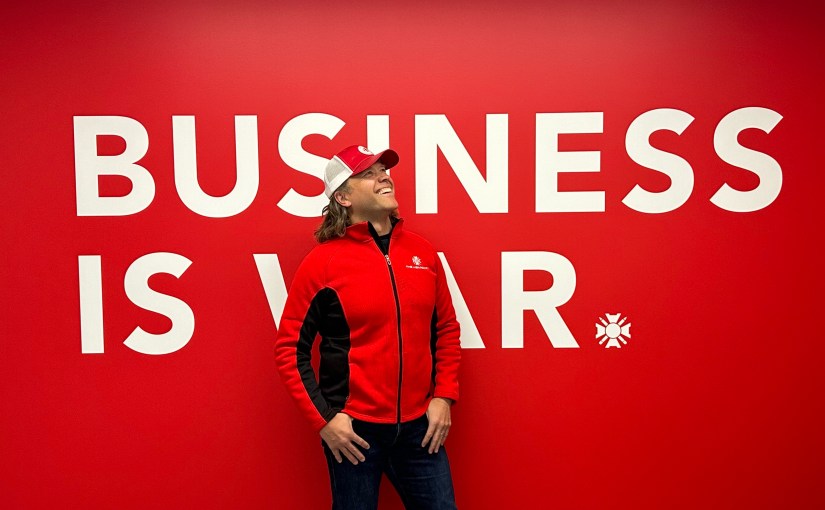
Why you should spend 1 hour each week working on building your own business.

You know who is great at starting a business? (Besides Richard Branson.)

Someone who already works in a business.

Someone who has seen how their employer’s business runs.

They know how their current business wins and how it gets beaten.

They see the flaws to be fixed and the opportunities to improve.

In other words, the best people to start their own business are people just like you. (And Richard Branson.)

Always Be Planning

You should always be thinking of what your own business would look like.

  • Think about the systems and processes.
  • Think about the customer you will serve.
  • Think about your values.
  • Think about your culture.
  • Think of who would be on your team.
  • Think about the epic company parties that aren’t yet restricted by a buzz-killin’ CFO. (I hope Kid Rock, Beyonce and The Rolling Stones are all playing at your party, and asking you to sign their foreheads, because they know you are a rock star!)

Imagining the details of your own business is how you build your own life raft. That way, it will be ready to use when you are ready to jump. (Or if your current business sinks or you get thrown overboard.) You can use your boat to save yourself, create your own epic adventure, or sail off into the sunset.

1 Hour Per Week

Spend an hour per week thinking about building your own business.

Take it from your InstaSnapTok time.

Then, every year, you will spend 52 hours working on your own business.

10 years into your career, you will have spent 520 hours working on your business.

And 2 decades into your career, you will have spent 1,040 hours on your own business. #mathwhiz

That’s how a steady drip of thinking, formulating, and crafting turns into a business started by a veteran with 20 years of experience, a vision, and a valuable network of industry experts, coworkers, partners and suppliers.

I know this approach works. Because it is how I started The Weaponry nearly 10 years ago. And it was the best career move I ever made.

Key Takeaway

Spend a little time each week thinking about what your own business would look like. Capture your ideas in a notebook or a Google Doc. Add a little bit each week. It is a great way to slowly plan your own business before you need it. And if you never need it, it will provide a great roadmap to improve the business you are currently in. It is a win-win that could lead to the greatest adventure of your career.

*If you know someone who could benefit from this message, please share it with them.

+For more of the best life lessons I have learned check out my book, What Does Your Fortune Cookie Say? from Ripples Media. And consider subscribing to Adam’s Good Newsletter.

Are you playing small ball or swinging for home runs?

Last week, I talked to my friend Ashley Skubon about her fun wine-focused business in Austin, Texas, called Snooti. Ashley and I worked together at Engauge. The first time I met Ashley, she said, ‘My name is Ashley, by the way.’ So naturally, I asked her if she was related to any other Bytheways.

I had seen through social media that Ashley and The Snooties had introduced some exciting new offerings recently, and I wanted to get the scoop.

During our conversation, she said something that has stayed with me.

As she told me the story about the big idea she recently launched, she shared that she felt that she had been playing small ball.

Which is a way of saying that she hadn’t been thinking big enough.

In baseball or softball terms, small ball is a careful approach that focuses on small opportunities for singles, walks, bunts and stolen bases. But when you play small ball, you are not swinging for the fences. You are not hitting home runs or grand slams. And AC/DC won’t sing songs about you.

The small ball mindset can keep you in the game. But it will also prevent you from recognizing when a home run opportunity is perfectly teed up for you.

Remember, Hank Aaron and Babe Ruth are American legends for their home run hitting prowess. While Brett Butler, the all-time leader in bunt hits, is the baseball player most likely to be confused with a character from Gone With the Wind. Or Grace Under Fire.

It is easy to buy into the safety of small-ball thinking. It keeps the lights on. It allows you to live to fight another day. But it doesn’t change the world. It won’t change your fortunes, your career or your tax bracket.

Key Takeaway

If you find you are playing small ball in life, in your career, as an entrepreneur, leader, innovator or artist, it’s time to carve out time to think bigger. Consider the smash hit opportunities right in front of you. See the benefits of your big swings. They can change your trajectory and your life in an instant.

*If you know someone who could benefit from this message, please share it with them.

+For more of the best life lessons I have learned, check out my book, What Does Your Fortune Cookie Say? from Ripples Media. And consider subscribing to Adam’s Good Newsletter.

This 4th of July, Remember That You Come From Brave People.

Happy 4th of July!

I love everything about this holiday.

The parades and fireworks.

The American flag swimsuits.

The hot dog eating contests, and imagining the parade and fireworks they must cause at the other end of the GI tract.

America

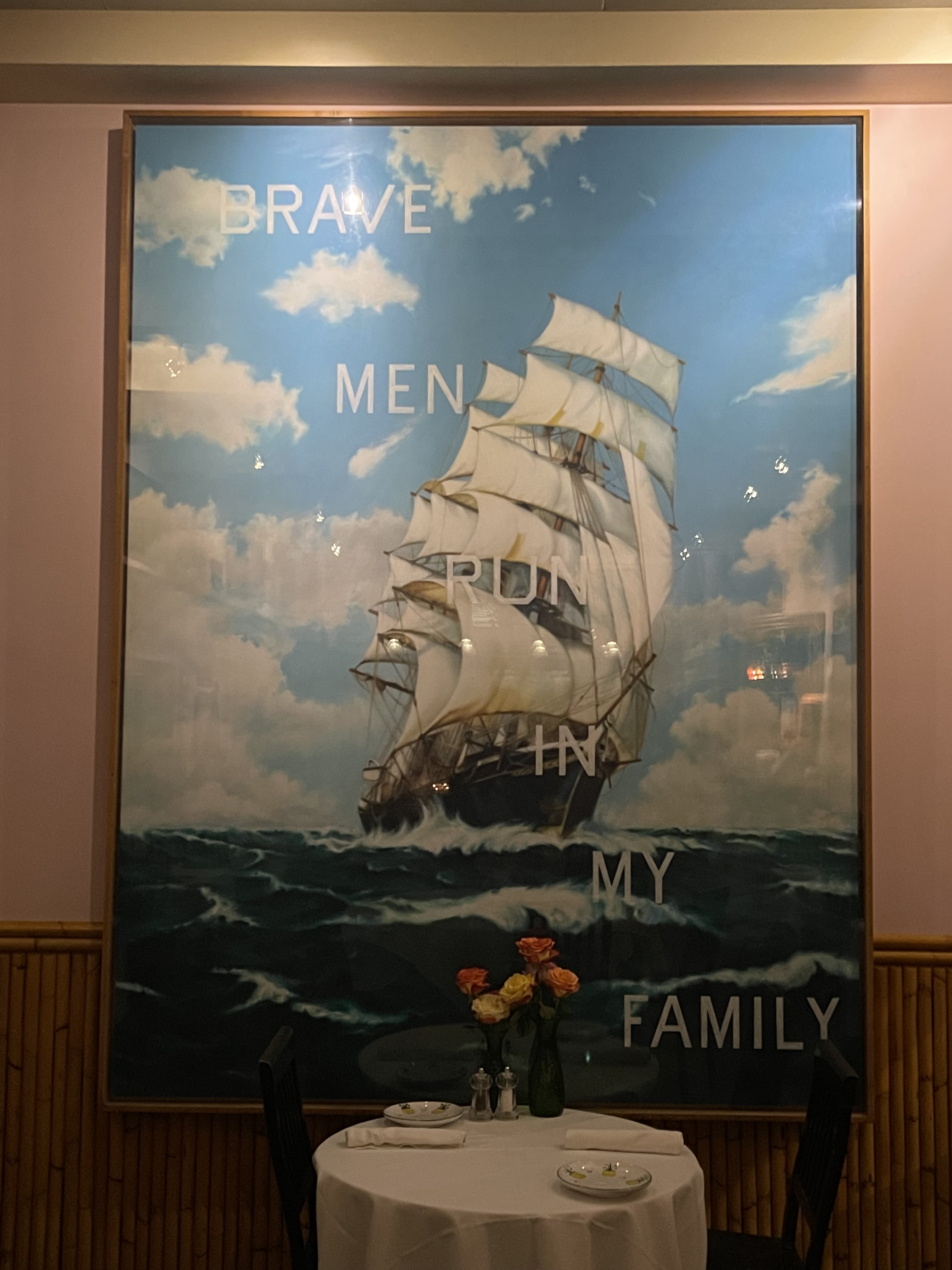
This year, as we celebrate the 249th 4th of July in America, my mind keeps returning to a piece of art I saw several years ago in California.

My family and I were celebrating my son Magnus’ birthday at Ivy At The Shore in Santa Monica. In the restaurant, there was a large image of a sailing ship with all sheets fully winded, plowing through rough seas.

Over the image were the words. ‘Brave Men Run In My Family.’

Ed Ruscha originally created this idea. I’m not sure who to credit this version to.

This piece really speaks to me.

Not because I come from a sailing family. (I come from more of a rummage saling family.)

I love it because the painting reminds me of all the brave decisions my forefathers and foremothers made to come to America and risk so much for a better life.

Their brave decisions gave me and my fellow American offspring better opportunities than we would have had in the non-American countries my people came from.

However, this truth is not unique to me and my family.

All Americans are descendants of brave Grandcestors who bet on themselves and came to America for the freedom to create better lives. Amazing lives. The kind of lives Robin Leach would have profiled, up close and personal.

As we celebrate Independence Day, remember that you come from brave men and women.

They left home, family, friends, and all that they knew to come to America, the land of the free, for the chance at something even greater.

Make sure to honor them by doing great things with your life.

Be brave and courageous.

Take calculated risks.

Live into your own dreams.

Bet on yourself.

It is the safest bet you will ever make.

Do if for yourself.

And do it for your family members who did it for you first.

Happy Independence Day.


*If you know someone who could benefit from this message, please share it with them.

+For more of the best life lessons I have learned check out my book, What Does Your Fortune Cookie Say? from Ripples Media.And consider subscribing to Adam’s Good Newsletter.

Top 10 Must-Have Software for Startups

There has never been a better time to start a business. Because so much of the infrastructure needed to run a business is simply a small stack of software that you can set up and run online. The software needs of a newborn business may seem intimidating from the outside. But they are easy to find, easy to implement and easy to scale. Like Eazy-E. To help make it even easier for you to start your own business, I am sharing the ten software suggestions to get your startup party started right.

One of the first things we did when we created The Weaponry in 2016 was set up a series of software accounts. This, in essence, becomes your operational center. It’s super easy to set up. And generally quite affordable to maintain. Not only are the software accounts scalable, which means you pay a small amount for a small business, and then slowly increase your payments as your needs or size increase, but there are free versions or free trial periods of many software offerings that allow you to try them out before you get too deep.

Here’s a quick overview of the software systems we use to run The Weaponry.

Google Workspace is the central hub of our business. It offers email. It offers Google Docs for writing. (I also write my books on Google Docs.) It provides Sheets for spreadsheets (not bed sheets) and Slides for building decks and presentations. (Not playgrounds.) It offers an online calendar, chat, a file storage drive for documents and much, much more. Microsoft Office also offers this type of functionality. Choose your favorite and get businessing!

We use Slack for instant communication. This is the primary venue for our teams day to day communication. This takes a lot of unnecessary traffic out of your email inbox. You can have real-time communications and share files instantly on this platform. Think of it like a super chat platform. (Or chatform.) You can create dedicated channels for specific accounts, departments or teams. There is a ton you can do for free. Or you can upgrade and also use Slack to store all of the documents you ever share on the platform. Which is cool. I also find that Slack is a better platform for sharing funny comments than email because it is quicker. And the little emoji responses make it feel like people think you are funny. (Just in case funniness is important to you.)

Quickbooks is the accounting software we use to track and manage all of our accounting. This is the heart of our accounting world. You connect all of your business bank accounts and credit cards here. It makes it easy to create and send invoices (bills) and to know what is due and when. It also provides reports (profit and loss, profitability, balance sheets, etc.) and dashboards that help you manage your business. You can set up Quickbooks to receive payments from your clients, including via credit cards. Get this going as soon as you can afford to. It will become the backbone of your accounting system. And your business’s scoreboard. It helps make everything official, and easy to share with your tax accountant when it is time to talk taxes. And best of all, Quickbooks is not the book equivalent of quicksand. (Just in case you were wondering.)

We use Harvest for all of our time tracking and reporting. Our team members enter the time they spend on each task, project, or client on a daily basis. This easy-to-use software helps us track our labor costs for every client. Plus it enables us to track our staff utilization. So we always know how much of our team’s time is billable. Which helps you know when you should hire more people. However, this software does not let us know the best time to harvest the stuff we grow in our gardens. I hope they fix that in the next update.

We use Asana as our project management tool. We use this to help house important information like timelines, files, overviews, and due dates on each project, by client. This becomes the central hub for all information needed to deliver a project. Like The Manhattan Project, The Alan Parsons Project, or The Mindy Project.

We use Gusto to process our payroll. You want a payroll processing software to help make sure you are automating everything in accordance with the IRS as well as state and local laws related to taxes and various benefits. Plus, it just makes your life a lot easier when you’re not wanted by the feds for tax evasion.

We use Guideline to provide and administer our 401(k) plan. Guideline is offered as a partner through Gusto. That makes it an easy add-on when your organization is mature enough to offer this great employee savings and retirement benefit. Which is kinda like hitting puberty for a startup. Only without the bad skin.

We use DropBox for file storage. This works as both a server and as a way to share and request large files with clients and partners. As an advertising and ideas agency, we create and move a lot of large files. Like art files, video files, X-Files and Simone Files.

We use Zoom for video conferencing. Thanks to the COVID-19 global pandemic, everyone on the planet knows about Zoom. At The Weaponry, we’ve been using Zoom for both internal and client meetings from day one. Because our clients are all over the country and in Canada. Not to mention we have worked with great clients in England, France and India. (Except I did just mention them. Which ruins the not-to-mention thing.) Google Meet also works well, and is offered as part of the Google Workspace. And if you go with Microsoft software you can use Teams.

We use Grasshopper as our virtual phone system. As a startup business you don’t need a receptionist or a fancy phone system. Grasshopper and options like it allow you to create a virtual system that connects your teams’ mobile phones and makes you appear professional and organized in a way that transcends simply using your personal phone as the phone number for the business. (Which of course is fine to do in your early stages. Part of the charm of a baby business is having a voicemail that says, ‘Hi, you’ve reached Billy’s voicemail, and the world headquarters for Galactic Pickles.)

Specialty Software

You will also find specialty software available for your specific industry. In our world, those things include the Adobe Creative Cloud for all creative development software including Photoshop, Illustrator, InDesign and more. We use Figma when creating websites. A quick Google search will help you discover the useful software services available to you and your industry online.

To Shop or Not To Shop…

There are plenty of other options for each of the software offerings shared above. But my goal is not to list all the options. It is to show you what you can grab today and get going so you don’t put off your great business idea any longer. I encourage you to look at these options first, and if you have a problem with something they don’t offer that you want or need, keep looking. But don’t let research and shopping turn into procrastination and delay. The key is to get going. And get rid of all the things that are stopping you from starting. Which sounds funny, but it’s true.

Key Takeaway

It has never been easier to set up your business infrastructure online. Start with the relevant software shared here. Shop for potential alternatives if these options don’t serve your specific needs. Many of these are available as free versions to get started, or for very low trial rates. The software offerings make it easy for you to set up a fully functional business quickly. So don’t let your infrastructure needs delay your entrepreneurial dreams. You don’t even need an IT expert to get these resources up and running. I am living proof of that.

*If you know someone who could benefit from this message, please share it with them.

+For more of the best life lessons I have learned check out my book, What Does Your Fortune Cookie Say? from Ripples Media.

How to put Charlie’s Rule of opportunities to work for you.

Last week I was talking with my good friend Charlie Wills about business. Charlie and I met through The W-Club, the University of Wisconsin varsity athlete alumni group. Talking with Charlie is a pain in the neck. Literally. Because Charlie is really, really tall. He is a former University of Wisconsin standout basketball player, who played in the 2000 Final Four against the Flintstones. #IYKYK

Today, Charlie towers over the real estate world in Madison, Wisconsin where he has been putting people before profits for over 20 years. Not only is Charlie a close friend of mine, but he is also a client of The Weaponry, the advertising and ideas agency that I lead.

Charlie shared an interesting statistic with me about where his clients come from. He told me that 96% of his organization’s clients come from within their sphere. That includes current and past clients, recommendations, friends, family and acquaintances.

If you are good at math, you also realize that only 4% of opportunities came from outside their sphere. Which is a shockingly small number. In fact, if that number was 4 sizes smaller it would be nothing.

I love the fact that Charlie uses the term sphere instead of network or circle. It’s very basketbally of him. And it gives the group more dimension.

Charlie’s Rule: The vast majority of your opportunities in business and in life originate within your sphere.

This rule, while surprising, is also logical.

People in India whom you have never met and have no real connections to, are highly unlikely to come to you with a life-changing opportunity. (The same goes for the dude from the royal family in Nigeria.) But your past client, your cousin, and the person you know from that thing you do in your spare time are likely to think of you when they need a You-Like person to help solve the kind of problem you are great at solving.

Armed with the knowledge that we all benefit from some variation of Charlie’s Rule, what are you supposed to do about it?

1. Develop more relationships. Whenever you are dealing with success as a percentage game, and it always is, increase the base number. The more people you know the more opportunities will come your way. Because opportunities come to you through humans. Kinda like COVID-19 and invitations to Tupperware parties.

2. Maintain the relationships you have. Not all relationships are equal. The kid you knew from kindergarten who you haven’t spoken to since you stopped napping together in class is not very valuable. So stay in touch with your people. Reach out via phone, email, text, or social media to keep your relationship active. Write a newsletter, blog, or other way to share what’s happening in your life. Social media is great for maintaining relationships across a broad spectrum of familiarity. Use this amazing resource.

Key Takeaway

Your relationships are critical to your success. Remember, Charlie’s Rule says that the vast majority of your opportunities in business and in life originate within your sphere. So bring more people into your sphere. Keep the relationships in your sphere active by staying in touch through any appropriate means. As a result, more good opportunities will find their way to you. Just like Charlie said.

*If you know someone who could benefit from this message, please share it with them.

+For more of the best life lessons I have learned check out my book, What Does Your Fortune Cookie Say? from Ripples Media.

Seek out inspiration that makes you dream differently.

I recently stopped into an REI in Medford, Oregon. My 13-year-old son Magnus has been growing like a legal weed. Which meant he needed a new pair of hiking boots as we began a family hiking adventure on the West Coast. Although a trip to REI is like a Costco run. You always buy things that weren’t on your shopping list. And those Darn Tough socks are darn tough to keep out of your shopping basket.

As we paid for the boots and socks for our party of 5, we also requested a National Parks annual pass. The cashier helping us inquired about our travel plans. We shared that we were hitting several great hiking spots, including nearby Mt. Shasta (which even sounds refreshing), Lake Tahoe (where they invented the large SUV) and Yosemite National Park (home of Sam the red mustached gunslinger).

When we mentioned Yosemite the woman’s eyes lit up and she swooned. She shared that both Mt. Shasta and Lake Tahoe are beautiful and great places to hike. Then she added:

“But Yosemite will change the way you dream.” -Swoony REI Associate in Medford, Oregon.

I loved that.

I had a lot of time to think about that statement during my 11 hours behind the wheel between Medford and Yosemite. I reflected on the things I have encountered throughout my life that changed the way I dream. They were special and varied. They are some of the greatest gifts of my life. They inspired me to explore the world and become an author and entrepreneur. They include:

  • Epic National Parks like Glacier, The Grand Canyon and The Rocky Mountain National Park
  • Entrepreneurs Ted Turner, Cornelius Vanderbilt, and Steve Jobs
  • Artists Walt Disney, Christoph Niemann and Gary Larson
  • Adventurers Lewis and Clark, Shackleton, and Red Bull
  • Writers Anne Lamott, Annie Proulx, Erik Larson, Stephen King, Daniel Pink and Ryan Holliday (which I say like Madonna)

Key Takeaway

Seek out places, experiences and people that change the way you dream. Discover influences that change your sense of what’s possible. That expand your belief in your own capabilities. Those sources provide tangible examples of what your world can look like. They move or remove boundaries, allowing your mind to travel farther than ever before. Once you’ve been exposed to enough possibilities you start to wonder if there actually are impossibilities. Which is when your dreams become biggest. Aim for that. There is nothing better.

*If you know someone who could benefit from this message, please share it with them.

+For more of the best life lessons I have learned check out my book, What Does Your Fortune Cookie Say? from Ripples Media.
12 Lessons I have learned from 8 years as an entrepreneur.

When I set out on my entrepreneurial adventure 8 years ago I had a lot to learn. So I became a student of entrepreneurship in the same way that I became a student of Journalism, Psychology and Bratwurst at The University of Wisconsin. I read books, magazines, and blogs. I talked to friends who were entrepreneurs and business leaders. The non-standardized tests started in April of 2016 when I launched the advertising and ideas agency, The Weaponry. And I am still tested every day.

8 years later, I can’t imagine my career without this chapter. I have learned a lot about what it takes to launch and run a business. It turns out there is a lot more to it than printing up a batch of business cards and cool company t-shirts. (Although you should do those things too.)

I wanted to share 8 lessons I have learned along the way. Because 8 ideas from the past 8 years seemed well-balanced. But I had too many lessons to stop at The Ocho. So here are 12-ish lessons I have learned that you should know if you are thinking about starting your own business, or if you already have a business and you now need to get your fecal matter straight.

12 Lessons I have learned from 8 years as an entrepreneur.

  1. Don’t quit your day job*. This is the most important lesson. Start working on your new business as a side hustle. Use your nights and weekends to study, plan and create your business. Use the income from your day job to fund your embryonic startup. Start generating revenue from the new entity. Then, as your startup indicates that it will be able to replace your required income, you can transition out of your full-time employment. But allowing your startup to grow as a side hustle will take a lot of pressure and stress off the early stages of entrepreneurship. From my first paid project to leaving my day job was 5 months. But a year or two of side hustling is not crazy. It is time well spent. *Note: This lesson is only for people who currently have day jobs. If you don’t have a day job the next 11 lessons are for you.

2. Good people are gold, Pony Boy. Business is the ultimate team sport. A great business is simply a great team of people running great plays. Find the right people. Treat them well. They will make the company and the culture amazing. As an entrepreneur, you get to pick your entire team. It’s one of the best parts of entrepreneurship. That and picking the dress code.

3. Good processes make it happen. Your systems and processes enable success, reduce friction, and organize the organization. Determine your organization’s way of doing everything. Write it down. Share it broadly. It ensures that everyone in your organization knows that you always pass the Dutchie on the left-hand side. Don’t worry if the process isn’t perfect. You can always improve it when you discover a better way. Read The E-Myth by Michael Gerber and Traction by Gino Wickman to help you dial this in.

4. Great creative thinking is key. As an advertising and ideas agency, creativity is what our clients come to us for. This has to be great or nothing else matters, like Metallica said. However, all entrepreneurial organizations should focus on creative thinking. It is how you get things done when you don’t have all the resources you wish you had. And it is how you beat competitors who always do things the same old way. Because creativity creates competitive advantages.

5. Great customer service is a must. This is why your clients stay. Always think about your service, and how you can make it better. We want to treat our clients so well that they never want to leave. And we want to make sure they hire us again when they leave their current job for a new opportunity. This has happened more times than I can count. And I am relatively good at counting.

6. Business development is critical. You have to put focused effort into expanding your business. There is natural attrition that happens in business, even if your product and your service are great. The economy plays games you can’t control. So do a dozen other influences. Businesses that forget to find new customers eventually die. Sometimes they die slowly. Sometimes they die all at once. But the net result is the same.

7. Trust is everything. At the beginning of your entrepreneurial adventure, people will take a chance on buying from your new entity solely because of you. The company will have no real track record or history of doing what it says it will do. But you do. Be a trustworthy human. That personal trust will be the bridge that gets early customers to try your offering before you have real proof that your business is as good as advertised. (Also remember to advertise that you are good.)

8. Build in a fair profit. It’s not enough to have paying customers. You have to understand the cost of your goods or services. Then you have to build in a fair profit. Which means if your offering costs you $100 to deliver, you must charge $5, $10, $20, or $100 on top of that to make sure the business makes a fair profit. That profit is what keeps the business sustainable. Some customers and most procurement departments will try to beat the profit out of your business. Don’t let them. Know what you need to make, know your value, and stick to it. Like a cocklebur on corduroy.

9. Share the success with your team. Business success is team success. You have to recognize and celebrate the contributions of everyone involved. When you do, a good team is eager to create even more success. That stuff is addicting. Like Dot’s Pretzels.

10. Relationships are extremely important. The personal relationships you create help create your success. Those include your relationships with your team, clients, partners, vendors, bankers, brokers, accountants, lawyers and the media. But all your relationships matter to business. Because you never know where your next referral will come from. And you never know who you may need as a character witness. Or who may be carrying an extra kidney that you may need one day. And don’t neglect your relationships with your family to make the business work. My relationship with my wife Dawn has been the most valuable relationship on my entrepreneurial adventure. And I get to spend more time with my kids now as an entrepreneur than I did as an employee. Which is perhaps the biggest win of all.

11. You have to keep experimenting. Business success is an interesting combination of running tried and true plays and trying new things that create new advantages. It’s kinda like the way you have to keep things spicy in your romantic relationship. Businesses that keep experimenting with new technology, new offerings, and new models survive changes. So stay on your toes. (If you have toes.) Watch the horizon for change, both in your industry and the broader economy. Expect that the future will be different than the past and you will be prepared for the strange changes. Like David Bowie said.

12. Create a newsletter. This is a great way to stay in contact with your community, which includes team members, customers, partners, supporters, potential customers, potential employees, the media, fans, and your parents. Add value through each issue. Share your news and successes. Social media channels are beyond your control, and it can be challenging to get your message in front of your audience there. But a newsletter is your own media outlet. It is like an express train to your audience’s inbox. Choo Choo! We use Mailchimp for our newsletter. There are many good options you can find using the Googler. You can sign up for The Weaponry newsletter here to see how we do it.

Bonus

13. Learn to spell entrepreneur. When you become one you end up writing the word a lot. At least you do if you have a blog sharing your experience as an entrepreneur. To spell entrepreneur, remember that all of the vowel holes start with ‘e’ and you come last. Which is how I remember that there is a ‘u’ after the last ‘e.’

Key Takeaway

Starting your own business is an exciting and rewarding adventure. It enables you to design your own life. It combines the thrill of competitive sports with the satisfaction of having a positive impact on your team members and your community. To start your journey, do some prep work. But then get going. You will learn what you need to know along the way. Remember to always bet on yourself. It is the safest bet you will ever make.

*If you know someone who could benefit from this message, please share it with them.

+For more of the best life lessons I have learned check out my book, What Does Your Fortune Cookie Say? from Ripples Media.

The Weaponry turns 8 years old!

When I first started my career in advertising I dreamed of starting my own agency one day. And one day I did. That one day was eight years ago. Today, I can say that there is almost nothing better than to say that your one day happened in the past. That your one day has an actual date. That your one day is not a hope, dream, or wish. It is part of your permanent record. Like that suspension from high school.

How It Happened

I didn’t just dream about starting my own business. I envisioned it. I planned it. I took action. And I made it happen. I did what I told myself I would do. And because I did, I started believing that I could take on other big challenges. Like starting a blog, writing a book, or swallowing a spoonful of cinnamon without crying for my mommy.

You may have noticed there were a lot of ‘I’s in the last paragraph, eleven to big exact. That is because it takes a lot of personal action, initiative and determination to start a business. But once you’ve started, it takes a lot of weness to keep it going. I am extremely thankful to our talented team of Weapons for building The Weaponry into the organization it is today.

The Weaponry was born on April of 2016. (I know that because I checked its born-on date, like a can of Budweiser from 1996.) In the beginning, it was a huge accomplishment to get to our first birthday. In fact, it was a huge accomplishment to make it to each of our first 5 birthdays, because such a high percentage of businesses don’t last 5 years. Kinda like a Kim Kardashian marriage.

But the thing that I love most about The Weaponry turning 8 years old is that there is no real significance to it. 8 years is not a memorable milestone. The business is simply taking care of business. Like Bachman-Turner Overdrive. If we put out a press release saying The Weaponry Celebrates 8 Years of Business no media would reshare our news. Except maybe The Adam Albrecht Blog. Because I know a guy there.

No Surprise Party

The other thing I love about turning 8 years old is that it is not a surprise. No one worried when we hit 7 years that we wouldn’t be here for the 8th. We didn’t eke out another year by the skin of our teeth. (Although I have never understood that saying. And I’ve never met a dental dermatologist.) Quite to the contrary, The Weaponry has had our two best years in 2022 and 2023, growing steadily each year.

Key Takeaway

When you start a new business there is a lot of instability. Which is part of the fun. And most of the challenge. But there is a great reward in reaching stable ground. It’s important to appreciate the steadying effect of hard work, smart systems, tested processes, a strong team, and accumulated experience. They make your business more predictable. Undoubtedly, there will always be more challenges ahead. And you will be ready for them when they come.

*If you know someone who could benefit from this message, please share it with them.

+For more of the best life lessons I have learned check out my book, What Does Your Fortune Cookie Say? from Ripples Media.

How to use the power of regret to live your best life today.

Imagine for a moment you got the news that you have one day to live. Just one. And it’s not Groundhog Day in Punxsutawney. (Nice try though.) You have enough time to say goodbye to your closest friends and family. But not enough time to add to your life resume in any meaningful way. I know this is a bummer. It’s supposed to be.

Now, take a moment to reflect.

What do you regret not doing during your time on the planet?

  • Travel?
  • Starting a business?
  • Writing your book?
  • The relationship you left unrelated?
  • Being scared?
  • Not giving back?
  • Not being your true self?
  • Too little time with loved ones?
  • That person you murdered?
  • Not buying life insurance?

The good news is, as far as I know, you have more than one day left.

The even better news is that you now know what to do with your time left. Do those things you would regret not doing now. Or stop doing the things you would regret not stopping now. That way, when you get to the real end of your story you will have more ‘I dids!’ and fewer ‘I wish I hads.’

The Proof

I gave myself this Regret Test on the eve of my 40th birthday. The regrets that surfaced inspired me to start my own business (The Weaponry), write a book (What Does Your Fortune Cookie Say?), travel more internationally, coach my kids’ sports teams, take redeye flights home from work trips to maximize time with my family and donate blood. The Regret Test offered the most important question I have ever asked myself. I encourage you to do the same.

Key Takeaway

Regret is a powerful tool. It helps you recognize the relative value of alternative outcomes. Tap into the power of regret to inspire your next actions. And start doing the things you wish you had done now, before it is too late.

*If you know someone who could benefit from this message, please share it with them.

+For more of the best life lessons I have learned check out my book, What Does Your Fortune Cookie Say? from Ripples Media.

An important reminder to get started because you learn faster by doing.

One of the great mistakes we make in life is waiting to act until we know everything there is to know about a subject. It seems we want to know everything there is to know about running a business before we start one. We want to know everything there is to know about investing before we commit our money. We want to know how to write a book before we actually write a book. And we want to know everything there is to know about raising a child before we ever have sex*. (*My kids may be reading this.)

Most of this quest for knowledge is simply procrastination. Starting the process is the greatest teacher of all. Because standard-issue humans learn best by doing.

When you take the first step the next step reveals itself. (Unless you are Eddie Rabbit, in which case you take that first step, ask her out, and treat her like a lady.) You will get better and smarter faster by starting than by studying alone. Until you take the first steps you don’t know what you don’t know. However, once you begin you quickly learn what you need to know next.

A Case in Point

I had thought about sharing some video lessons from my book What Does Your Fortune Cookie Say? for a long time. I knew that the summaries from each chapter would translate into good shareable video messages. But I never acted on it. Because I wasn’t clear on the best way to do it.

Then one morning when I got to work I talked to Taylor Amann, our social media manager at The Weaponry (and resident American Ninja Warrior) to help me get started.

Here’s What happened.

  1. We set up her phone on our ring-halo light tripod.

2. We explored recording the video standing up and sitting down.

3. We placed my laptop behind the phone so I could read the script.

3. We found a teleprompter app on my computer that allowed us to scroll the script like the teleprompter a newscaster uses to deliver lines directly to the camera. (And, yes, I reminded San Diego to stay classy.)

4. After getting a take we liked Taylor found a good app that automatically translated my spoken word into words on the screen. So viewers could read the words I was saying as I said them. This is not only great for reinforcing the lesson I shared, but it made the video fully digestible with the audio off.

5. Then we discovered that the app, also had a teleprompter. Which would lead to an even better sightline to the camera than the laptop teleprompter offered.

6. Finally, we rerecorded the video, on the halo light tripod, using the new app, which turned Taylor’s phone into a perfect teleprompter/camera combo. The app automatically added the supers so you could read what I said in real time.

The Learning

What stood out to me about this process is that by getting started we kept getting smarter and smarter. Within 30 minutes we went from never having tried to record a video like this to having discovered the perfect app that made it simple to combine the recording, the teleprompter, the supers, and even add music, or a zany slide whistle.

The video is not perfect. My shirt is all scurzumpled. I don’t have the energy I’d want for a shareable recording. But we quickly went from nothing to knowing how to create the video we wanted through a simple progression of testing, learning, and improving.

Key Takeaway

Don’t wait to get started until you know everything. Condition yourself to take the first step sooner. Because the first step is the kindergarten step. All other learnings and lessons come as a result of that first step. What you learn from a book, class or video is just theory. The application is where the quick and useable lessons kick in. So get going. Get smarter as you go. And get back to me when you realize how useful this approach is.

*If you know someone who could benefit from this message, please share it with them.

+For more of the best life lessons I have learned check out my book, What Does Your Fortune Cookie Say? from Ripples Media.