Jealous of others making a job change? Then it’s time to make your own.

I have mostly loved my career. I have always enjoyed the work I do. But there have been a couple of brief periods when I didn’t like where I worked.

At one point in my advertising career, due to some business loss, we decided to shut down one of our agency’s office locations. Which meant that virtually everyone in that office had to find a new job. The whole experience was right out of a movie.

But I had a very surprising reaction to the situation.

Under those circumstances, it is natural to feel lucky that you are not affected by the office shutdown. That while everyone else is losing their job, you get to keep yours. It should feel like a win. However, instead of feeling bad for that group of my teammates forced to find the next chapter of their careers, I found myself envying them.

I envied that they had to make a change.

I envied that they got to stop what they were doing and find a new situation. That could involve a new company, mission, industry, a new set of coworkers, a new career path, a new level within an organization, or a new attitude, like Patti Labelle.

Meanwhile, I was going to stay in the same job, with the same shortcomings, the same cultural challenges, the same feeling that this place didn’t fit me. The same sense that I was better than this situation. The same feeling that the only reason I was still here was for the money. For the false sense of stability that this salaried employee job offered me.

But something in the feeling of envy for those forced to move on and move forward in their careers, changed something profound in me. I recognized that life is too short to spend unhappy and unfulfilled at work, in a culture, climate and a missionless or purposeless environment.

So my mind shifted.

I knew I needed to find my own next chapter that would make me feel all the things I wish I felt. I spoke to several advertising agencies about the prospect of joining their teams. I explored several different markets to live and work in. The exploration was energizing. And I knew I was on the right path.

Within a year of my profound mindset shift triggered by envy for my teammates who had to make a career change, I had discovered my new path. I started my own business. I launched The advertising and ideas agency The Weaponry. And my life changed in all the ways that I hoped it would.

The past 9 years at The Weaponry have been the most adventurous and rewarding of my career. All because I tuned in to what my envy was telling me. I was willing to make a dramatic change for the better. I was willing to risk the perceived safety and security of my situation for the control and happiness of an unknown adventure. And that has made all the difference.

Key Takeaway

If you are jealous when others are forced to write the next chapter of their career, it means that you have to find your own new next chapter. It is time for greater happiness and fulfillment. It is time to throw off the ropes of your current condition and sail for something better, more fulfilling, more exciting and new. Something that matches your skills and vision for your life’s adventure. Get going. There’s nothing stopping you but you.

*If you know someone who could benefit from this message, please share it with them.

+For more of the best life lessons I have learned check out my book, What Does Your Fortune Cookie Say? from Ripples Media.
How to Develop a Growth Mindset Effectively, And Grow Baby, Grow!

When I was a little boy, I had a piece of needlepoint art in my bedroom. It depicted a little cowboy, like me, and the words, ‘Please by patient. God isn’t finished with me yet.’ It was my first reminder that who I was as a young boy was not who I was going to be as a full-grown adult. I just didn’t know that I would never outgrow my love for potty humor.

The Growth Mindset

As I grew older, I recognized how much I was changing, learning and growing. First, in elementary, middle and high school. Then, the growth and learning continued at The University of Wisconsin, where I majored in psychology, journalism and cheese curds.

But I liked learning, growing and developing so much that when I graduated from college, I enrolled in Adam Albrecht’s Self-Directed School of Life Long Learning. It’s where I have received all of my advanced degrees. The tuition at AASDSLLL is a great value. But our basketball team couldn’t beat a drum.

Lessons I Have Learned Along The Way.

I have learned that everyone adopts 1 of 2 mindsets.

Those with a fixed mindset believe their knowledge, skills, abilities and limitations are fixed and unchanging.

People with a growth mindset believe that they are continuously growing, evolving and improving. Which sounds way more hopeful. (Pro Tip: It’s also the mindset they are looking for at your parole hearing.)

A growth mindset means you recognize that what you know now is just a tiny percentage of what you could know.

A growth mindset means that you believe that you can feed your brain, your body, and your emotions with better inputs and get better outputs.

It means that if you currently stink at stuff, you are not condemned to a life sentence of stinkage.

It means that you have the superpower to transform yourself into a much better and more powerful version of yourself. Like Ironman.

A growth mindset means that every time you spend time with someone better than you are, their knowledge, skills and mindset rub off on you and make you better.

A growth mindset means that when you read a book, you reach the back cover smarter and more capable than you were when you lifted the front cover.

A growth mindset means you don’t say things like, I can’t or I don’t. And you don’t say Popeye stuff like, ‘I yam what I yam.’ What kind of sweet potato nonsense is that?

A growth mindset means that you see your self-improvement journey as an infinite staircase. The level, step or stair that you are on today is simply where you are today. You have the ability to take another step up in any area of your life, and by any measure you choose, any time you choose.

A growth mindset means having faith in the self-improvement process. Like George Michael. It means that small incremental gains will add up to have a transformational effect. Like compound interest in every area of your life that you invest time and energy into.

Leveling Up

When I entered high school, I was a 6-foot-tall, 150-pound freshman. During my 4 years at Hanover High School in Hanover, New Hampshire, no one spent more time in the weight room than I did. As a result, I graduated as a senior who was 6 feet tall and 215 pounds. (I couldn’t seem to do anything about the height. Maybe I have a fixed heightset.)

In my first track meet as a high school shot putter my freshman year, I finished 28th out of 30 throwers. My senior year I was the state champion.

During my freshman year, my coach didn’t think I was good enough to throw the discus in a meet. But, by the time I was a senior, I was a state champ, New England champ, and held the all-time state record in the discus. All of this happened because I could imagine it happening. So I put in the work to keep climbing that staircase.

How To Develop A Growth Mindset

The first step to developing a growth mindset is to visualize the best version of yourself. Imagine the greatest version of yourself you can conceive of. That is your ideal self. What you are today is your real self. It is the version of you that you have already realized or attained. Now, your job is to simply put in the effort to close the gap between your real self and your ideal self.

The Model And The Path

A growth mindset is simply having an open mind to your ability to improve yourself into someone greater than you are today. One of the best ways to do this is to find a model and a path.

A model is a person whom you aspire to be like. Pick a person you think has the skills, abilities, success, character or mindset that you want to have. (They don’t have to be an actual model, like Heidi Klum, Bella Hadid, or a T Ford.)

Then, examine your model’s path. Learn what work, steps, opportunities and influences helped them develop into the person they are today. (Or, if you choose a historical figure, focus on the path they traveled before they died. And decomposed.) Learn their helpful habits and routines. Learn about their knowledge sources. Which could be books, coaches, teachers, and role models. Learn about their experiences and influences.

Next, reproduce or approximate the helpful forces that pushed them to grow into the model you admire. This provides both a great recipe for improvement, and prevents you from having to reinvent the wheel. Or become a psycho stalker.

A Few Final Thoughts

A growth mindset is about experimenting. It is about adjusting variables to get better results.

A growth mindset means you give yourself permission to be an amateur. You can’t beat yourself up over all the things you don’t yet know or can’t do yet. By giving yourself permission to be an amateur, you allow yourself to start and put a premium on all the growth you experience along the way.

A growth mindset is about developing great habits. You are a product of your habits. Growth-focused habits have the power to help you improve every day. These include reading, practicing the skills you want to develop, time management, exercise, sleep, and gratitude.

Key Takeaway

To become the greatest version of yourself, you have to adopt a growth mindset. Imagine a version of yourself far greater and more capable than you are today. Then continuously work to close the gap. Allow yourself to be an amateur. Develop great habits that help you learn and grow. Experiment. Stay curious. Find someone who you want to be more like and discover their path. It will help you discover your own path to an even greater you.

*If you know someone who could benefit from this message, please share it with them.

+For more of the best life lessons I have learned check out my book, What Does Your Fortune Cookie Say? from Ripples Media.
To become a great problem solver, create backup plans for your backup plans.

I love meeting new people. And I love helping people solve problems. I got to do both of those things early one morning in 2016, and I still think about the story often.

The Story

I arrived at Hartsfield Jackson International airport in Atlanta just before 6:30am for a flight to New York City. I was flying to meet with Rachael Ray on the set of her TV show. I was neither a guest nor an audience member on her show. We were meeting between tapings so that I could present scripts for some new commercials we were going to film together. But as I stepped out of my car in the airport parking garage a panicked woman approached me saying, 

“I’m so sorry to bother you. But I just locked myself out of my car. My phone, purse, laptop and suitcase are all locked inside. I don’t know what to do.”

Talk about an exciting start to your day! The woman’s name was Kelly Harbin. She said she was flying to St. Louis on an 8:00 am flight. So we started going through our options. And yes, I said OUR options. Because as a professional problem solver, when someone brings me a problem, it becomes my problem too. Except for maybe hair loss. With hair loss, you’re on your own.

This was the scene that early morning at ATL when Kelly and I went into super solver mode.

So, like a couple of resourceful first-world problem solvers, we sprang into action! I pulled out my trusty smartphone, and we called the airport to see if they had an unlocking service. They didn’t. Boo. But they did offer us the phone number of a locksmith partner who may be able to help. Yay! 

So we called the locksmith. And yes, they could send someone to help. Yay! But not until  9:00am. Boo.

So we looked at other options. 

Me: Do you have a AAA membership?

Kelly: No.

Me: Do you have emergency services through your car manufacturer?

Kelly: No.

Me: Hmmm. Do you have any sevens?

Kelly: No. Go Fish.

Me: What time is your meeting in St. Louis?

Kelly: 11:00 am.

Me: So a later flight won’t work?

Kelly: No. And my company is counting on me to be there. We have built a technology product for this client and they are refusing to close the deal because they don’t understand it. I need to walk them through how the product works and solves their problem, or the multi-million dollar deal will fall apart! (Dun-Dun-Dun!)

Me: Do you have your driver’s license? 

Kelly: No.

Me: Why don’t we go see how we can get you through security without ID. (Heck, I got into bars in college all the time without an ID. How hard could it be?)

Kelly: (reluctantly) Let me check my car one more time just to make sure I’m not losing my mind.

At this point she walked back to her Ford Edge for another check. And I began searching on my phone for a Ford dealership that may be able to help.

A moment later she returned, slumped her shoulders and said, “You should go and catch your flight. And you can tell everyone on Facebook and Twitter that you met the dumbest woman in America. Because I have a Ford Edge. And the Edge has a keypad on the driver door.”

Me: Do you know the code?

Kelly: Yes.

Me: So you’re all set! 

 Kelly Yes!

At this point Kelly and I, strangers only moments ago, hugged, laughed and cheered on the top of the parking deck at the airport in the pre-dawn darkness. We celebrated our victory like we had just won the Showcase Showdown on The Price Is Right.


I made a new friend before 6:45am. Kelly made her flight. I got a test run on a valuable problem solving scenario. The Ford Edge got serious credit for a great problem-solving, flight-catching and potentially deal-saving feature. And as Kelly said, I got to tell all of my friends on Facebook, Twitter and LinkedIn about her morning. Kelly made the meeting! She closed that deal. And she no longer closes her car door until she has her key in hand.

Key Takeaway

Life presents an all-you-can-eat buffet of problems. The key is to become good at solving them. This means coming up with multiple ways to address the problem you face. The more solutions you consider, the more likely you will arrive at a great solve. And chances are, you’re problem isn’t as bad as you first thought it was. Just ask Kelly.

*If you know someone who could benefit from this message, please share it with them.

+For more of the best life lessons I have learned check out my book, What Does Your Fortune Cookie Say? from Ripples Media.
I have finally developed a skill I was never good at.

There are some things that I am good at. And other things I am not good at at all. (Like folding fitted sheets and stopping myself from thinking, ‘That’s what she said…’ a thousand times a day.)

One of the things I haven’t been good at at work is entering my time into our time-tracking software at the end of each day. (I also wasn’t good at avoiding that at-at thing in the previous sentence.)

To be clear, I keep a detailed to-do list each day that lists my activities. Plus, I schedule my daily activities on my calendar, which provides a detailed log of my time. So I have records of how I spent each day for great reference. In fact, when archaeologists someday discover my notebooks, they will have a strong understanding of how I spent my days and could enter my time for me. But I expect it will be too late for us to invoice that time.

Still, I have never liked walking away from the office without completing my time entry for that day. Yet the tight demands on my schedule often meant that I did anyway.

One of my goals for 2025 was to enter my detailed time each day on the day I did the work. So, I added something new and simple to my long list of habits.

On my daily Success List (what you might call a to-do list, and what Scooby Doo might call a Scooby To-Doo list), I have added a line that says, Enter Time in Harvest. Harvest is The Weaponry’s time-tracking software.

As we started February, I noticed something interesting. I entered my time each day for the entire month of January.

The key to my behavior change was simply writing Enter Time in Harvest on my daily Success List.

I love crossing things off my list. It makes me feel accomplished. Having a list keeps me productive and focuses my time on my most important activities throughout the day. Because I already had a strong list-making and list-crossing-off habit established, I simply utilized my habit of doing the things on my daily list daily to create this valuable new habit.

The key was right in front of me all along. Or should I say, write in front of me?

Bonus: Another valuable thing I added to my daily Success List last year was the line No Social Media Before Lunch. This prevented me from falling down social media rabbit holes and wasting precious time during the golden morning hours of productivity. Again, because I love crossing things off my list, I avoided the socials between 9 am and whenever I stopped for lunch. As a result, I got more important work done each day.

Key Takeaway

You are a product of your habits. If you use a daily to-do list or Success List, try adding the behaviors you want to modify to your list. Remember, those may be behaviors you want to add or eliminate. By writing them on your daily activity guide and crossing the actions off your list at the end of the day, you may discover the easiest way to get the results you want.

*If you know someone who could benefit from this message, please share it with them.

+For more of the best life lessons I have learned check out my book, What Does Your Fortune Cookie Say? from Ripples Media.
It’s time for your next step to a great 2025.

One great day is just one great day.

But if you can string together 4 to 7 great days you have a great week.

And if you can string together 4 or 5 great weeks you have a great month.

And if you string together 12 great months you have a great year.

And if you string together great year after great year, you create a great life.

And if you string together 6 great strings, you might have a guitar. Or an afghan.

Creating A Great 2025

I am trying to make 2025 my best year ever. I call it Project 2025. (Not to be confused with any other Project 2025s you may have heard about lately.) I hope you are doing the same. And if you haven’t been thinking about creating your own great 2025, now is the time to start. Because no one can make it happen but you. (With a strong assist from God, the world’s all-time assist leader.)

As we wrapped up the first 12th of the year, I spent Friday evening evaluating my January. Here are the bullet points in my self-report:

Adam’s January 2025

  • I went skiing 4 times. (That’s an average of once per week and twice the number of times I have skied between 1990 and 2024.)
  • I read 3 books. (More to come on this. But they were all great. And none of them involved coloring.)
  • I published 10 new blog posts.
  • I published 2 new editions of Adam’s Good Newsletter. (Please sign up if you like positive stuff.)
  • I met major milestones on a special writing project I have been working on. (I assume much of the world calls them kilometerstones.)
  • I worked out 16 times (despite being sick for a week with one of those little Gremlins Americans circulated in January. Which made me appreciate my good health even more.)
  • I booked 3 new speaking engagements. (Does that mean I now have 3 new speaking fiances?)
  • I bought a new set of Rogue dumbbells from 5 to 50 pounds and an additional set of 45-pound Rogue bumper plates. Then, I put them all to good use in my home gym. (I also drove from Milwaukee to Columbus to pick them up and save $300 in shipping costs. Plus, I got to see that huge candle in Indiana. #IYKYK)
  • The Weaponry conducted 2 transformative strategy workshops for new brands.
  • My great team added some cool new clients and we have several more about to come aboard, like the opening to The Love Boat.
  • I visited 5 states. And discovered that the new Salt Lake City airport is amazing. Tom Hanks should have been stuck in that terminal.
  • I visited my great friends Amy and Todd Urowsky at their beautiful home in Park City, Utah, and then skied at Brighton.
  • I spent time with my parents Bob and Jill Albrecht, in Lafayette, Indiana. Having parents is the best. Don’t take it for granted.
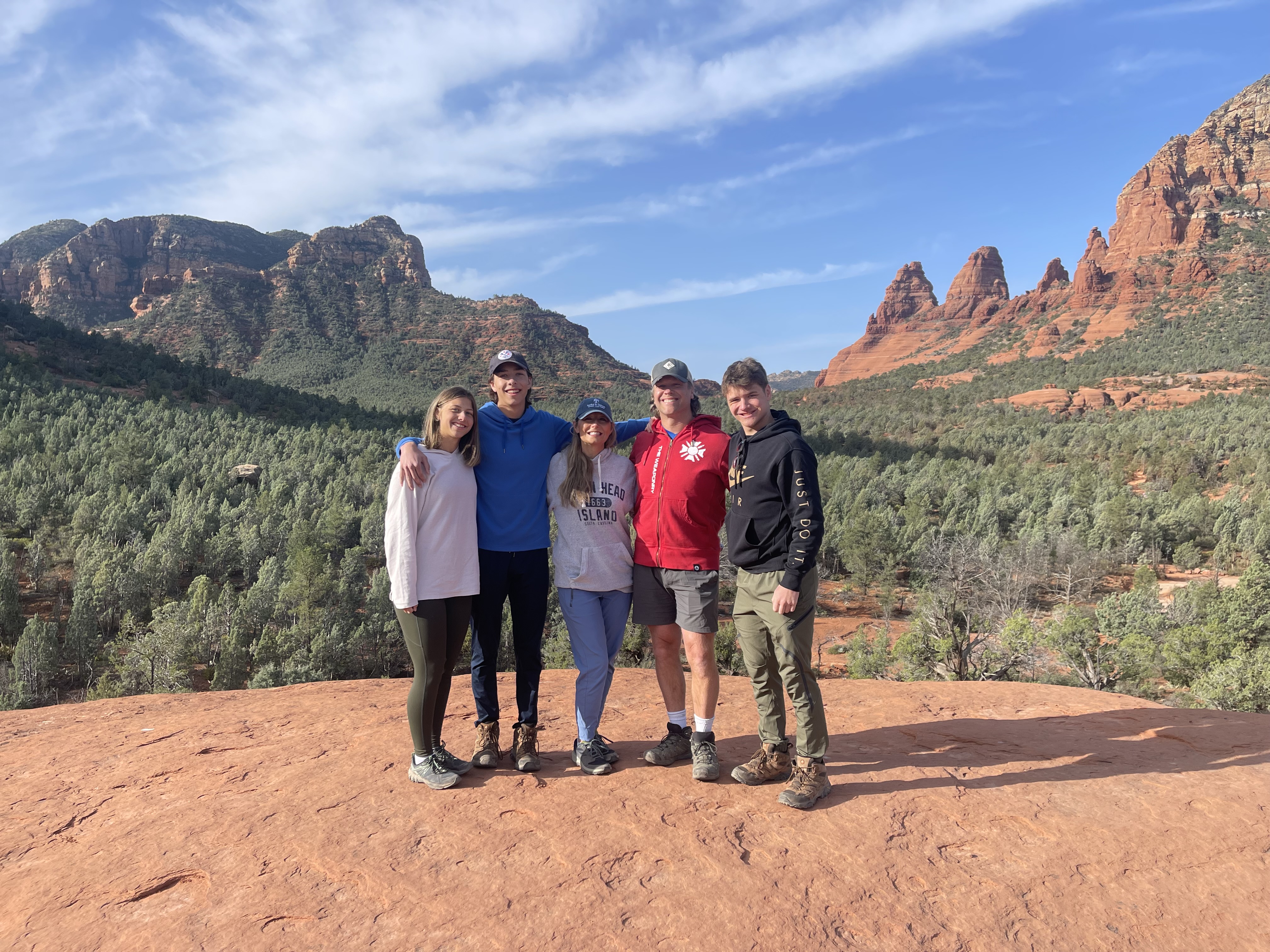
  • I planned and booked a spring break trip to Arizona. I’d love to hear your favorite things in Scottsdale and Sedona. (I already know about the tall cans of tea.)
  • I spent a lot of quality time with my wife Dawn, and sons Johann and Magnus. Plus, my daughter Ava was home from college for 3 weeks in January. Which was wonderful. Like George Bailey’s life.
  • I added several great new people to my Great People collection. Great people are the most valuable things you can collect.

I share this list to encourage you to create your own. You have to look back at your wins, both large and small, to recognize the great things in your life. The successes, the adventures, the experiences, the relationships, the learnings, the growth, and the commitments kept. By reflecting on them, you both tally your wins, and you get to enjoy them all again.

Let’s Go February!

Now, it’s time for us all to create a great February. I am excited about it. I hope you are, too. It all starts simply by having a great day today, whatever that looks like to you. And then doing it again tomorrow.

Key Takeaway

A great life, a great marriage, and a great career are built one day at a time. Start by knowing what great means to you. Then, live into that every day. String together great days. They create great weeks, months and years. You have to make it happen. And it is never too late to start.

*If you know someone who could benefit from this message, please share it with them.

+For more of the best life lessons I have learned check out my book, What Does Your Fortune Cookie Say? from Ripples Media.

Recognizing and Avoiding the Slow No.

You should always be aware of the slow no.

It’s the worst of the nos.

Worse than infernos, volcanoes and no-it-alls.

The slow no is the decision that is always going to be no. No matter how much support there is for a yes.

Decision makers will let you explore, research, propose, pile up work towards, and spend a lot of time diddling on things that are always going to finish with a no.

It’s a waste of time, energy, enthusiasm and hope. Like that romantic interest that you know is way out of your league, but they are really nice to you, and you start thinking there is a chance, when there is really no chance there is a chance.

What’s the best way to deal with the slow no?

Cut to the chase.

Ask if this is likely to end in a slow no.

Ask the decision-makers, if all the evidence seems to support a yes, will it still be a no because of politics, budget, bias, distance, favored-competitors, or other factors out of your control.

The slow no is likely to occur when:

  • You wonder why the decision maker hasn’t made a decision like this before
  • The cost seems out of line with the budget
  • It all seems too good to be true (like the whole Lance Armstrong thing)
  • The action would be out of character for the decision maker
  • You smell political factors or nepotism at play
  • They say you are facing 1 in a million odds, and you think they are saying there’s a chance
  • The decision maker puts the word pro in procrastination

The best thing you can do is hit fast forward and turn that slow no into a fast no. Or a know-now no.

You can also openly rescind your proposal or request.

When your change of heart is met with a shrug, you know it was a slow no.

That puts time back into your account. So you can use it more productively on something else. Or someone else.

Key Takeaway

Don’t lose time on a slow no. Sniff them out. Fast forward them to the final answer. And use your time on something more valuable.

*If you know someone who could benefit from this message, please share it with them.

+For more of the best life lessons I have learned check out my book, What Does Your Fortune Cookie Say? from Ripples Media.

The 2 Key Factors That Determine Success in Sports and Life.

I have spent a lot of time coaching and participating in sports. Both team sports and individual sports. My teams have won and lost. The individual athletes I have coached have both dominated and been dominated. Along the way, I have carefully analyzed what creates wins and losses. And I have discovered that there are 2 key factors that determine the outcomes of all sporting events. And despite what Nike and Mars Blackmon would like you to believe, it is not da shoes.

The key 2 factors that determine the outcomes of all sporting events are effort and errors.

Effort

In sporting competitions, the effort exerted by a team or individual competitor is stacked directly against the effort exerted by the other team or individual competitor.

The more effort you exert, the more likely you are to win. This is true in contact sports, races of all types, gymnastics, putting the shot, dodgeball, and Red Rover. (Where you always ask your opponent to send that low-effort kid over.)

However, effort is not the only factor at play. (See what I did there?)

Errors

The other key element that impacts every sporting event outcome is errors.

There is an ideal way to perform every move in sports, from the discus throw to the jump shot to the form tackle to the Triple Lindy. Any deviation from that technique, form, move or execution is an error. The more errors you commit, the less likely you are to win. Like Bruce Hornsby said, that’s just the way it is,

Sometimes, errors result from a lack of focus and are self-created. Other times, your errors are forced by your opponent. In fact, it is your job as a competitor to force errors in your competitors. You do this either through physical effort or through mental or psychological stress applied through pressure, confusion, conditions, or crowd noise. (Although crowd noise is illegal in tennis and golf.)

However, you and your opponent aren’t the only ones committing errors. There are also errors made by officials, judges, referees, umpires, scoreboard operators, timekeepers, and eager Cubs fans in left field excited to catch a foul ball. Their errors have the potential to completely change the outcome of a competition. Those are simply the facts of life, like Tootie, Blair, Jo and Mrs. G.

As a competitor, there are two things you can do to impact the outcome of a sporting event.

  1. Maximize your own effort.
  2. Minimize your own errors.

The rest is beyond your control.

Beyond Sports

The impact of effort and errors doesn’t just apply to sports. The same key factors influence such varied fields as business, relationships, and academic success. They are the key ingredients in gardening, investing, music performance, and even picking up hotties at a nightclub. So pay close attention to both your successes and failures. You’ll find these two critical variables play a major role in each.

Key Takeaway

Success in sports is simply a result of maximizing effort and minimizing errors. It is why you train and improve your strength and stamina. It is why you practice and drill over and over and over again. But these same influences on sports also determine the outcomes in most areas of life. From marriage to sales to self-confidence. Which is why sports are so valuable. They teach you how to be successful in all areas of life. And that’s the great win for us all.

*If you know someone who could benefit from this message, please share it with them.

+For more of the best life lessons I have learned check out my book, What Does Your Fortune Cookie Say? from Ripples Media.

How to build your personal brand, even without TikTok.

A good friend called me this week to tell me he had started a new business. Because his new entrepreneurial adventure would require him to sell himself to others, he asked me for my best advice on how to build a personal brand. I’m not sure if he asked me because I have spent my entire career building brands, because he admired my personal brand, or because he wanted to understand where I went wrong. I was afraid to ask. After a moment of reflection, I shared my best advice on building a personal brand. And here it is for you.

Influencers know something that other people don’t:

It is not about who you know. It really is about who knows you. 

The more people who know about you, what you know, and what you are doing, the better. The Kardashians have built an empire on this simple principle. And the fact that so many people can actually spell Kardashian is proof that it works.

The first thing you should consider when building your personal brand is to start a blog, vlog, podcast, newsletter, social media feed, or other regularly published knowledge. (Which would include having your own TV show like the Kardashians.)

When I first started The Weaponry, I also started The Adam Albrecht Blog. It has been an amazing vehicle to share my thoughts, ideas, successes, and learnings with the world. Literally. My blog has been read in over 150 countries. Who knew there were over 150 countries? (Geographers and cartographers knew. There are actually 195 countries.)

A regular commitment to sharing your knowledge and experience through blogging helps build your personal brand and reputation. For the past 9 years, I have shared my thoughts, experiences and perspectives two to three times per week. This creates a steady stream of value-adding content that I can then share on various other channels, including LinkedIn, Facebook, X, Medium, Reddit, Instagram and Threads. However, as of this morning, we Americans can no longer share our expertise or best dance moves and lip-syncing skillz on TikTok. Because apparently national security is more important.

As of this publishing, I have written and published 1,045 blog posts that I can share across my social media ecosystem. As a result, my business and I are both top of mind when people have relevant opportunities. I regularly hear from people that I haven’t seen in a long time who tell me that they think of me often. This is what sharing your content does for you. This makes it great for building your brand but terrible if you are in the witness protection program.

Podcasts, newsletters, vlogs, columns, and social media channels all work too. The key is to share information and value with the world broadly so that more people than you could reach through individual messages know about you, your skills, experience, philosophies, and your business offering.

While you may create your platform to help support your business, you never know where your platform may lead. My blog readers encouraged me to write a book. Which sounded crazy-hard, until 2020, when I suddenly had plenty of time on my over-sanitized hands to do crazy-hard things. I published my first book in 2021, building on the content I had first created for my blog. 

My first book, What Does Your Fortune Cookie Say?, created amazing new opportunities for me as a paid speaker, and as a guest on TV shows and podcasts. Those opportunities helped raise my profile, and enabled me to share more about my business and my personal perspective on a wide range of topics. 

In 2024 I also started publishing Adam’s Good Newsletter. The reach of the newsletter now exceeds the reach of my blog. And the newsletter is a great vehicle to share good news and information about all of my activities, interests and offerings. 

Having your own newsletter also means that you own a media channel. While Facebook, LinkedIn and X continue to modify their algorithm to their own advantage, making it harder and harder for you to share your message without paying for exposure, like at those clubs, you control everything about the way your message is shared in a newsletter. And the audience you develop for your newsletter becomes one of your greatest assets. 

What’s more, a newsletter created through a newsletter service provider like Mailchimp (which I use), Substack or others, enables you to see when readers have opened your newsletter, and which links interested them enough to click on them. This feedback enables you to create an even more valuable offering, both for your readers and for yourself and your business.

Key Takeaway 

Always remember, it’s not about who you know. It’s who knows you. Develop a platform to share what you know and what you are experiencing with others. This not only creates value for your audience, it raises your profile. It means that people will think of you more often, even when you are not thinking of them. As a result, you won’t just seek out your own new opportunities, the dynamic flips, and both people and opportunities find their way to you. Which changes everything. Kinda like a TikTok ban.

*If you know someone who could benefit from this message, please share it with them.

+For more of the best life lessons I have learned check out my book, What Does Your Fortune Cookie Say? from Ripples Media.

A good sign of a good time.

On Saturday, January 4th, I attended a dinner party at a restaurant in downtown Milwaukee.

I had a really good time with some really good friends.

I know I had a really good time because, around midnight, the valet sought me out in the private room I was in in the back of the restaurant to hand me my keys. I was standing in a circle of the last of the party-goers who weren’t even done with the night. Like John Cougar said before he got mellencamped.

Apparently, I had stayed at the party so long that the valet was turning into a parking pumpkin, and wanted to go home. So he had parked my car just outside the front door, found me in the restaurant, handed me the keys and walked away. Not only was he not looking for a tip, he didn’t even charge me for the valet parking. Which meant that I had enjoyed myself so much that I actually saved money in the process.

Reflection

It can be hard to know whether or not you are being generally successful in life. Not everything is easily scored. But in my scorebook, if the valet comes to find you at a party because he wants to go home and play Grand Theft Auto, and you still want to stay and hangout with your wife and your 4 other friends who aren’t ready to leave, it is a good sign, that at least for the night, you are winning at life. (Also according to my scorebook, if those friends will answer to Pablo or Bert, even though those are not their real names, you score bonus points.)

Key Takeaway

To live a great life, spend more time with people you want to stay up late with. Go to events you don’t want to leave. We have a finite amount of time on this planet. Make it count.


*If you know someone who could benefit from this message, please share it with them.

+For more of the best life lessons I have learned check out my book, What Does Your Fortune Cookie Say? from Ripples Media.

Balancing Growth and Goals in Your Self-Improvement Journey.

We are all on some type of self-improvement journey. It’s how we are wired as humans. There are always things we can find to improve. And the beginning of a new year is like Improvapalooza. Suddenly, we are thinking of all the things we should do to make more money, read more books and look better naked. (Presumably while reading books.)

There are 3 key points on your self improvement journey.

  1. Your starting point
  2. Your current position
  3. Your ideal

To maintain motivation, you need to balance how much time you spend focused on the distance to your goal, versus the progress you have made.

If you only focus on the ideal goal you will spend somewhere between 99% and 100% of your time on the journey disappointed.

Because you are always falling short. Like Martin.

If you spend all of your time focused on your growth you can feel like you have done enough.

Which will make you feel prematurely satisfied. A condition I call PreMatSat. (Which I think is also the test you take to get into med school.)

In this case, you are likely to settle for less than you set out to achieve.

The key is a balanced diet of both perspectives.

Just as your ideal food intake requires a proper balance of protein and carbohydrates, motivation requires a balance of attention towards both your goals and your growth.

I have found a simple formula that works best for me.

2/3rd Goal Perspective + 1/3 Growth Perspective = Motivation + Reward

Think of this like spending your work week focused on your goals and your weekends enjoying your growth. It provides a great combination of grind time and satisfaction with your accomplishments.

Key Takeaway

It is important to set lofty goals to push yourself to become the best you can be. But the real win isn’t simply in achieving your goals. The win is in the improvement. The goal is the tool to keep you marching forward. The growth is the reward. It’s the fruit you harvest. If you don’t take a little time to look at your improved physique in the mirror, enjoy a bit of that hard-won money, or admire your elevated skills, you are planting a garden without ever eating the crop. Don’t focus so much on the destination that you forget that the real value is in the journey. And it always has been.


*If you know someone who could benefit from this message, please share it with them.

+For more of the best life lessons I have learned check out my book, What Does Your Fortune Cookie Say? from Ripples Media.