Let your experiences and adventures change you.

This year, I have had a tall flapjack stack of fun and interesting experiences outside of work.

  • I traveled to Nashville in May to visit colleges and enjoy some live music at the Grand Ole Opry. (Although I still have no idea what an opry is.)
  • I spent our family’s spring break in Arizona, splitting time between Scottsdale and Sedona. (I didn’t have time for standing on the corner in Winslow.)
  • I completed a circle tour of Lake Michigan, seeing many things that are not that far away by the way the crow flys or the salmon swims, but quite far away by the way the car drives.
  • I coached 2 great athletes at the Wisconsin State High School Track Championship on the other side of the state in La Crosse.
  • I attended a family reunion in southern Minnesota, in my mom’s hometown of Elkton, with a whole flock of reuning relatives.

How To Profit From Your Experiences

My goal, when I experience such things, is to come back different.

I don’t want these to be inert experiences.

You want the special experiences of your life to have impact.

You want them to expand your view of the world.

You want them to create new or deeper relationships.

You want new learning.

You want new ideas.

You want to grow through each one of your novel experiences and be better as a result. (Your novel experiences don’t have to include a novel.)

You want to be a different and more capable version of yourself after the experience than you were before. (And you want to maintain all of your limbs and phalanges.)

When you aim to grow, expand and improve through your experiences, you will always find your path to accomplish your aim.

You will spot things you have never seen before.

You will recognize the learning, the lessons and the insights when they arrive.

You will grab the opportunity to meet new people you encounter. And you will find that each new person you meet will change you in some way. Sometimes these changes are large and profound. Other times, they are small and seemingly insignificant. But if you genuinely try to get to know people in a greater way, you will walk away a greater person.

Key Takeaway

Throughout your human experience, always look for ways to grow. Collect and connect dots. Add new humans to your world. Expand your circle of friends. Upgrade your world view. Come back from your experiences and adventures smarter, wiser and more informed. It helps generate excitement and curiosity every time you leave home. And it brings you back better, wiser and more creative than you were when you left.

*If you know someone who could benefit from this message, please share it with them.

+For more of the best life lessons I have learned check out my book, What Does Your Fortune Cookie Say? from Ripples Media.And consider subscribing to Adam’s Good Newsletter.

Collecting Dots: A Valuable Life Lesson from Slumdog Millionaire.

Back in 2008, the movie Slumdog Millionaire hit the big screens. This smash hit was about a young boy in India, growing up on the streets of Mumbai. Through a series of fortunate events, he becomes a contestant on the game show Who Wants To Be A Millionaire. And apparently he wanted to be a millionaire.

The movie was nominated for 10 Academy Awards in 2009, winning a remarkable 8 OSCARS, including Best PictureBest Director (Danny Boyle), and Best Adapted Screenplay. It also won an Adam Albrecht Award for Most Badass Type Of Millionaire.

The thing I loved most about the movie was that every question our hero, Jamal (Mr Slumdog), is asked triggers a flashback to the moment or event where Jamal learned the answer to that question.

I have been thinking a lot about this movie lately, even though I only saw it once, nearly two decades ago. I am thinking about the movie now, because I am recognizing the same flashback effect in my own life. It’s kinda like the flashback scenes from Wayne’s World, but without the wavy lines and sound effects.

Today, as I am digging into my ever-larger collection of knowledge, I often experience flashbacks to the moment I acquired the now-useful knowledge. It is as if I am playing an epic game of connect the dots, and as I connect dots, I am not just drawing a line between the dots; I am understanding the origin story of each dot. Which I recognize is getting pretty deep for dots.

This is happening for 2 reasons.

First, I am thinking about the original knowledge-gain experience as I am dippin’ into my dots. I am not mindlessly accessing the answers. I am watching it happen in my head, as if I were the third person, observing the story.

Essentially, the things I could be doing involuntarily, I am performing voluntarily or consciously, which creates a deeper level of insights and understanding.

Second, I am actively trying to collect more dots. Like a knowledge farmer. Or maybe a knowledge hunter and gatherer. I read books with the purpose of collecting dots, which include facts, trivia and history. I am actively collecting tips, tricks, best practices, insights, study results, good news, quotes and positive examples. I ask a lot of questions. I listen closely to details in my conversations. And I am mindful of the knowledge harvest as it happens. It enables me to sort, label and store the knowledge harvest more effectively. Which means that a great reason I am easily accessing my dots is that I am cataloging them on arrival. Like a nerdy librarian. Which may be the only kind of librarian.

The natural question is, ‘Why am I consciously labeling and sorting the new dots I am collecting?’ I believe that this is a result of blogging and writing books. It is rewiring the way my brain works. (Which is good, because my brain has always had pretty wonky wiring.)

As a writer, it is useful to file, organize and label my dots for future use. But the same approach is also beneficial as an advertising professional, strategist, creative thinker and entrepreneur. In fact, creative thinking is nothing more than connecting dots in new and novel ways.

The Insight

We are as wise and worldly as the dots we collect and the dots we can connect. To become a better thinker, more insightful, more creative, more strategic and more empathetic, collect more dots. As you collect, consider the lessons, insights and knowledge you are gaining as you gain them. This helps you store them more effectively and access them more easily. When you have a greater collection of valuable dots, well cataloged, like spice jars stored alphabetically in your spice rack, you can access them when you need them, and create a greater range of outputs with deliberately nuanced flavors. This is a valuable skill and asset. It improves your thinking, and your value to others.

Key Takeaway

Collect more dots so you can connect more dots. Recognize the value of your dots as you amass them. Think like a prospector, and learn to recognize gems when you see them. When you understand what you have collected, whether it is the results of a scientific study, or a broken heart, it becomes more valuable to your human experience. Because you never know when you will need that information again. But when you can easily access your knowledge, you can profit from it greatly, just like the Slumdog Millionaire.

*If you know someone who could benefit from this message, please share it with them.

+For more of the best life lessons I have learned check out my book, What Does Your Fortune Cookie Say? from Ripples Media.
Don’t be a fool. Make sure to get all the value you can from your vacation days.

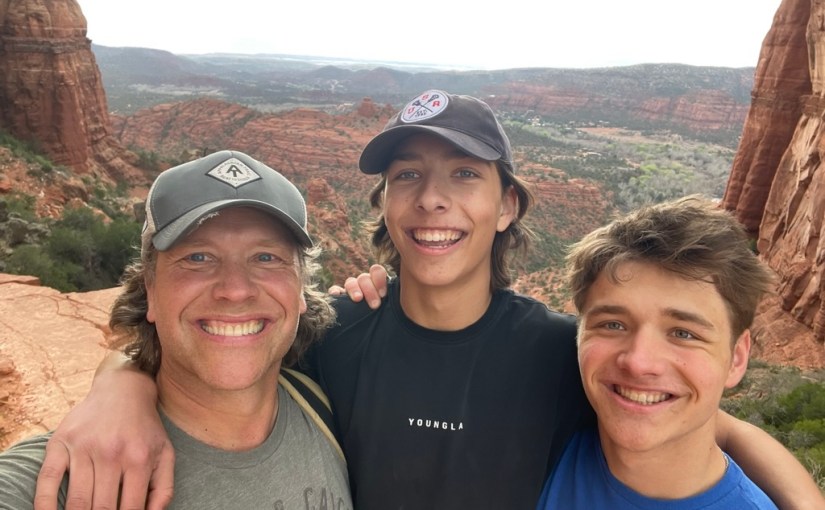
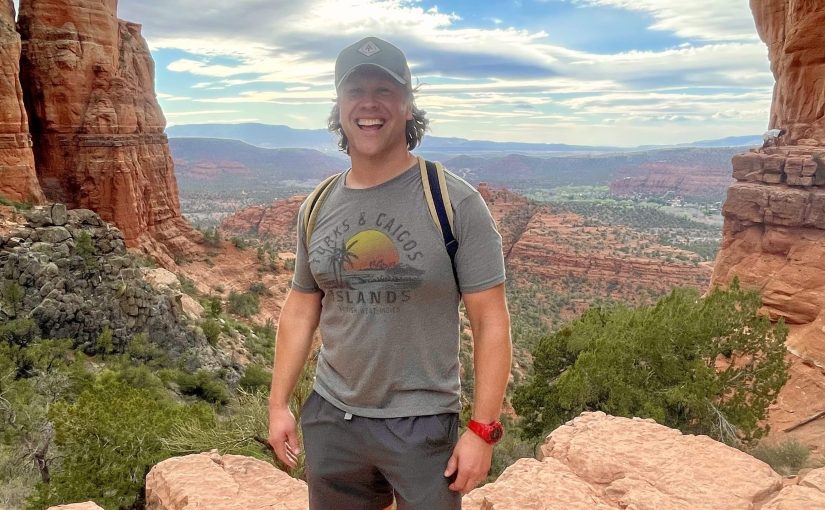
Happy April Fool’s Day! I just returned from a spring break trip with my family. The best thing I came back with was not relaxation or a tan. In fact, my vacations are rarely relaxing. I logged nearly 30 miles worth of desert hikes in Scottsdale and Sedona, Arizona. And my dermatologist would be happy with how much F-ing SPF I used. (Ok, so I don’t actually have a dermatologist. But I do pack a lot of derm, like a pachyderm)

Inspiration

What I came back from vacation with were more memories with my family, new inspiration, and more ideas. None of those things took up any space in my carry- on bag. In fact, the only souvenir I bought on vacation was a single ornament to hang on our Christmas tree. It’s a family tradition. And I’m traditional.

I saw new things. I ate new things. I explored new places that expanded my thinking.

I discovered businesses that made me think about businesses that I could start. And things I could introduce to The Weaponry, the advertising and ideas agency I lead.

People

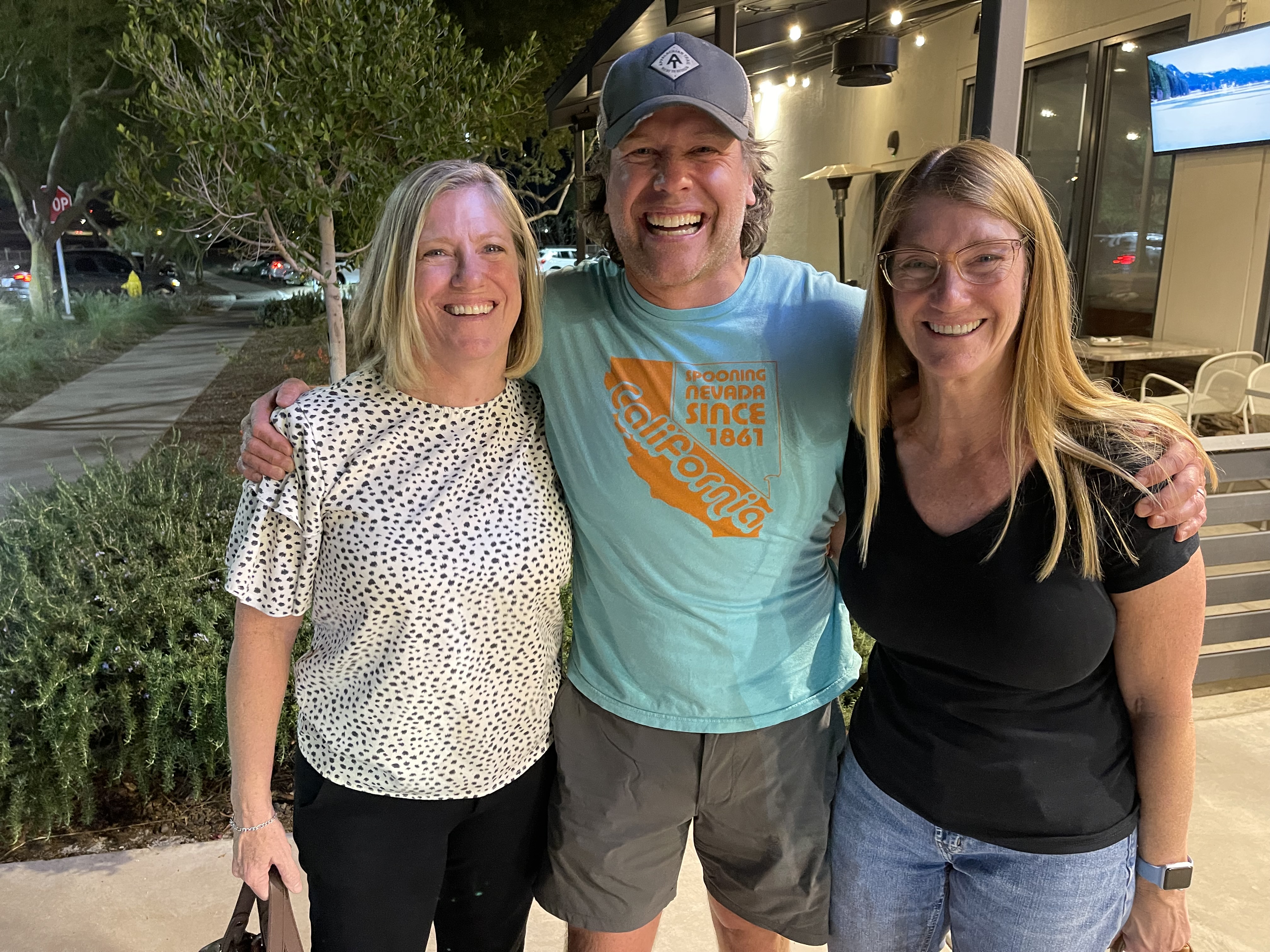
I met new people at hotels, on planes, and on hiking trails. I also saw my cousins Cher Fesenmaier and Chawn Tipton who live in Phoenix, whom I hadn’t seen since our Grandma Albrecht’s funeral a few years ago. Which was a surprisingly fun funeral. After all, she was 99 and taught us how to have fun. Even at funerals.

Cher, Adam and Chawn in Tempe. Make sure to see your people in real life.

Reading

I finished a book on vacation. (The Splendid and The Vile) I started reading 2 new books. (Barbarian Days and Dave Grohl’s The Storyteller.) Everything you read helps make you more creative. It feeds your brain more material and creates more dots to connect. Vacations would be valuable even if you just stayed at home and read. Your dermatologist would probably like that too.

Appetizers

I got to really dig into some locations that I had only experienced as appetizers in the past. My mom taught me that short visits to new places are like having appetizers. If you enjoy the appetizer, you can come back for more another time.

Memories

Your most valuable possessions are your memories. They are like pieces of art, movies, photos and paintings that you hang in the museum in your mind. The more new experiences you have the more you fill the most valuable gallery in your head. That gallery serves as your perpetual source of inspiration when you need ideas, and as your perpetual source of entertainment and conversation starters when you don’t have the time or money to travel. You get to relive the experiences of your memories over and over in your mind. Even when you are too old, weak, or poor to travel and adventure.

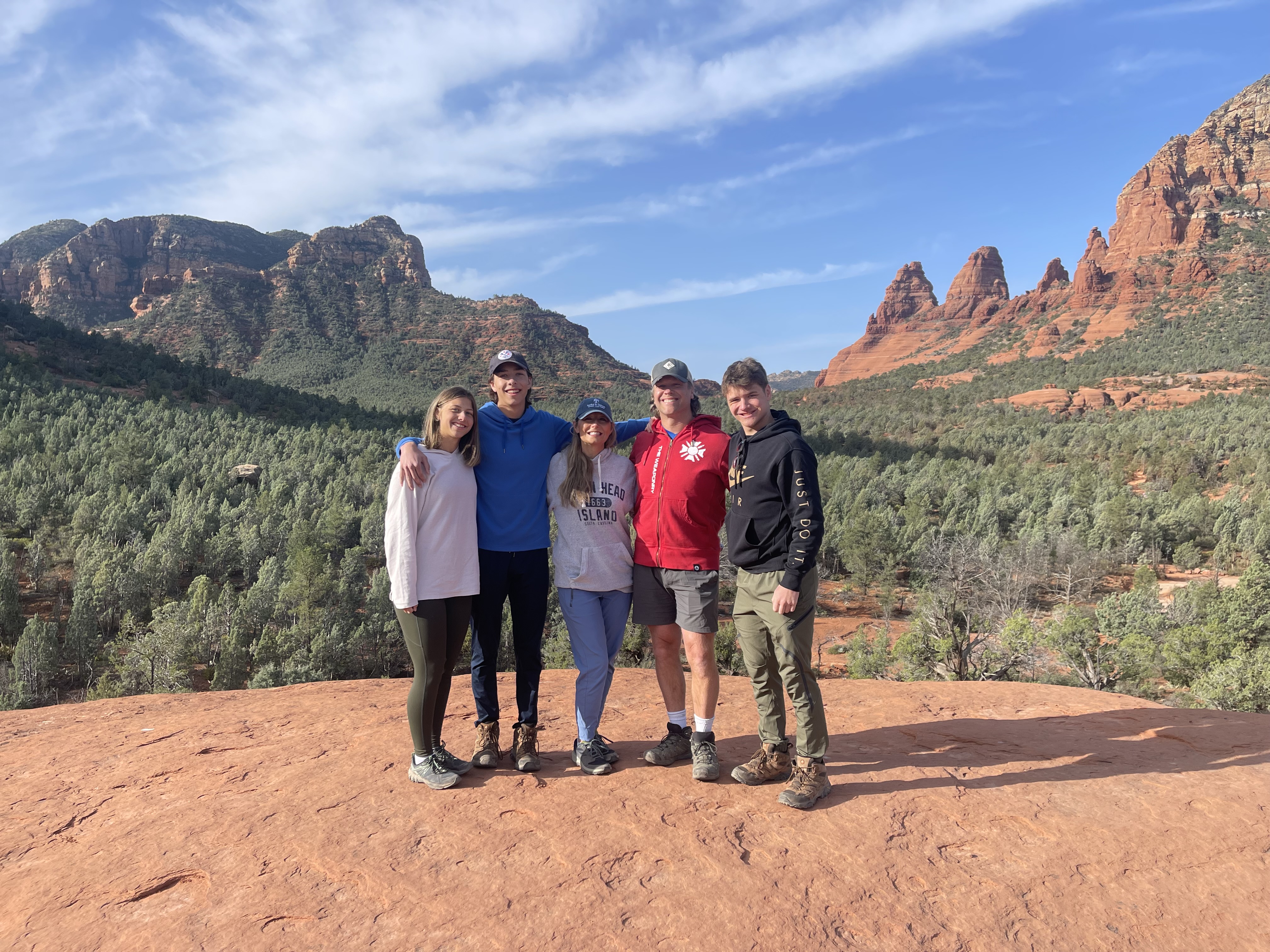
My people in Sedona. 10 out of 10. Can definitely recommend.

Key Takeaway

Make sure to take your vacation time. Use it to do new things. It enhances your creativity in immense ways. You collect new dots to connect to the other dots you already have. This helps you come up with new ideas and combine old ideas in new and novel ways. It expands your world and your thinking. It creates new perspective. It introduces you to new people. It gifts you new stories. And new reasons to laugh. It creates new memories. And sooner or later you realize that your relationships and your memories are your most valuable possessions. Your vacation days help you develop both.

*If you know someone who could benefit from this message, please share it with them.

+For more of the best life lessons I have learned check out my book, What Does Your Fortune Cookie Say? from Ripples Media.

11 Essential Truths About Great Advertising.

Advertising is typically thought of as a creative endeavor. More Art Garfunkel than science. But here are 11 simple truths about making great and effective advertising that every marketer, businessperson and communications professional should know. At The Weaponry, these truths drive everything we do. Here they are in a particular order.

11 Truths About Great Advertising.

1. It stems from great strategy: All great advertising and marketing begins with a great strategy. You have to know how you win. You need to know which of your advantages to leverage. You need to know who your audience is. And what they need to hear from you in order to give you their money, their vote, or their blood.

2. It differentiates. Great advertising sets you apart from the crowd. You are no longer a commodity. You are special. Like that little girl from The Help. This is the power we build into strong brands. It makes you irreplaceable. You want to be seen as a special exception. Be the option that sparkles and calls your customer’s name. They have to think, This is the brand that gets me.

3. You haven’t seen or heard it before. Great advertising feels new. It tickles a part of the brain that has never been tickled before. It offers phrases, imagery, design, or attitude that you have never encountered before. Which helps your advertising land in a new place on the perceptual map. Like new art. Or Chipotle. Which is why so many new food concepts are now described as the Chipotle of their cuisine type. You also know that Chipotle has built a strong brand because when people tell you they are going to grab Chipotle, you don’t imagine them grabbing a smoke-dried jalapeno.

4. You have to earn a longer leash to create it. Great advertising often represents a perceived risk. Because it feels different than what you’ve seen from the brand or the category before. Which means that the client-approver needs to trust the creators. The client approvers must trust that the creators have their best interest at heart. They must trust that this is a smart and calculated departure from the past, or from a norm. (Norm!!!) They must trust that you know what you are doing. This type of trust, which I call earning rope, or earning leash, takes time. Sometimes this is earned through a handful of interactions, like during the new business pitch process. Sometimes this is earned over years of working together. But without first earning trust, advertisers are less likely to jump the gap with you. (Which has nothing to do with mugging people at The Gap. Or minding the gap. Or Michael Strahan.)

5. It avoids layers of approval. Great advertising doesn’t get approved by an army of approvers. The more approvers that are involved, the more likely the work gets pushed right back to the center of the expected range from your category. The people who will be approving the great work should all be in the room or on the Zoom when the great work is presented. They should be exposed to the strategic thinking and the insights that birthed the idea. And they should be able to compare the work in question to the other ideas presented and their relative merits. (Not the merits of their relatives.)

6. It can not be evaluated devoid of the strategy. To judge great creative work you need to know the strategy. This is critical. If you don’t know the strategy the work can’t be right and it can’t be wrong. The strategy represents the aim of the work. Without knowing the aim, you can’t know if it hit the target. Armchair quarterbacks don’t know what the insiders know. You have to know the insider information to judge the idea and the execution.

7. A great idea gets better partners than your budget deserves. Creative people love creative ideas. They are more interested in bringing a creative idea to life than making money. Which means they will often slash their rates or even do work for free to be involved in great creative work that they can add to their portfolio, reel, or website. As a result, a great creative idea attracts talent and resources beyond what you can afford. So great ideas often get favorable treatment and privileges that ordinary work does not. In turn, it gets even greater at each step in the process.

8. You have to sweat the details. To make great advertising, you have to start with a great idea. But then you have to pay attention to all of the details throughout the process. You have to set high standards for every aspect of the work, and then be vigilant, and critical, to ensure that every element is done right. The words, colors, imagery, size of everything, performances, sound, casting, announcer, kerning, leading editing, graphics, photography, and retouching all have to be right. A flaw in any of those areas can ruin the whole thing. Like the pea under the mattress, the fly in the soup, or the toothy grin on Mona Lisa.

9. It causes envy. Great work may seem subjective. And in some ways it is. Supreme Court Justice Potter Steward once remarked that hardcore pornography may be hard to define, but “I know it when I see it.’ The same holds true for great advertising. The measure I always use is that it creates envy. When I see great advertising, I wish I had created it. I wish I had it in more portfolio. I wish I could brag about it. In fact, when I am hiring creative talent that is my requirement. The candidate must have work in their portfolio that makes me jealous. That’s what great advertising does. And indeed, great work of any type should create envy. (Side note: Don’t you wonder just how much hardcore porn Justice Steward has seen?)

10. It drives results. Great advertising can’t be great without driving results. Results don’t just mean sales. Because there are other factors that advertising can’t overcome that impact a final sale. But great advertising must drive interest, or engagement, inquiries, calls, store visits, website traffic, leads, votes or whatever it was intended to do. Ultimately, this is the measure that trumps everything else. (That was not a political sentence.) Agencies and marketers alike win when the work works.

11. It makes people look forward to your next idea. Great advertising flips the dynamics in the favor of the advertiser. The audience no longer sees you as an interrupter. They see you as interesting, entertaining, smart, or funny. They see you as adding value to their lives. And when you do that, the world looks forward to what you do next. They want to know what great idea you will share next. Whether it’s your funny Super Bowl commercials, your engaging content, your frame-worthy print ads, your stunning billboards, or your crazy stunts, great advertising means you are no longer interrupting. You are anticipated. You are sought out. This is the ultimate benefit of great advertising. The gatekeeper is keeping an eye out for you. And when you appear, they invite you to cut the line and make your way inside.

Key Takeaway

Great advertising is fundamentally different than technically sound advertising. It is created differently. It is approved differently. It triggers a different and more valuable response from your audience. Great advertising offers tremendous value and creates advantages that help you win your unfair share of the pie. If your advertising is not great, revisit this list to understand why and where it may have gone wrong. Then fix it. You always have the ability to get it right.

*If you know someone who could benefit from this message, please share it with them.

+For more of the best life lessons I have learned check out my book, What Does Your Fortune Cookie Say? from Ripples Media.
There are no guarantees that your great idea will work every time.

Every day there are new songs, books, and blog posts. (Like the new blog post you are reading right now.)

There are new businesses, restaurants, shops, clubs and bars. Including shops where you buy clubs and bars.

There are new clothes, accessories and decoration.

And there are enough new social posts to fill a whole new social sphere every single day.

So why all the newness, Huey Lewis?

Because people have great new ideas worth betting on all the time.

However, you never know which good new ideas will wallop and which ones will whimper.

Sometimes your favorites will fail like New Coke and Kendall Jenner’s Pepsi ad. And sometimes your maybes will make a mighty roar. Like cat videos.

Learn from both.

And just keep swinging.*

The only real failure is to stop sharing your new ideas.


*Don’t actually be a swinger.

If you know someone who could benefit from this message, please share it with them. Especially if you know Kendall Jenner or anyone thinking about swinging.

+For more of the best life lessons I have learned check out my book, What Does Your Fortune Cookie Say? from Ripples Media.
Why brainstorming is a bad idea and what to do instead.

I have never liked brainstorming. Ok, that is not entirely true. At first, I loved brainstorming. You know, the classic meeting that sounds like barnstorming, but without the barns, biplanes and scarves. In brainstorming sessions, a group gathers in a conference room with markers and candy to generate a collective storm of creative ideas that come from the brain.

In the very beginning of my career, I loved these meetings because I was good at them. Brainstorming sessions allowed me to show off just how stormy my brain was. I would blast the room with my ideas. I would build on the ideas that others stormed. I felt like I was in my element. Like a hottie in a swimsuit contest in Panama City on Spring Break.

But then I started realizing what was really happening in those brainstorming sessions.

  1. A small number of people shared a large number of ideas.
  2. A large number of people shared a small number of ideas.
  3. Too many people weren’t sharing any ideas. They were just eating the candy.

Boo.

The key to valuable ideation is volume and variance. You need to generate a lot of ideas. Because great ideas are a percentage of total ideas generated. You also need variance because you want different types and styles of ideas to compare and contrast with each other to weigh the relative benefits of each approach. If your volume is low, or your variance is low, your options are low. And your creative possibilities are limited.

Social dynamics also degrade the potential power of brainstorming sessions. The loudest and most influential people tend to Boss Hogg the air time. They create a hierarchy that prevents others from wanting to share ideas or stick their neck out with contrarian ideas. Which is what brainstorming sessions must have to provide maximum value.

Once I recognized how inefficient these group thinking sessions were I became a born-again non-brainstormer. And I have never liked them since.

A Better Solution

The best way to create the most ideas is to have people think on their own and write down as many ideas as possible. By ideating independently, each person maximizes their thinking time, which leads to more ideas, and a greater range of exploration. An hour spent with 10 people generating ideas independently means everyone has 1 hour of air time. That’s 10 hours of idea generation. Which beats 10 people together sharing 1 hour of air time every time. (See the talk show The View for proof.)

For maximum effectiveness, the ideas should be collected and shared anonymously, so they are evaluated without biases towards their creators. Once all of the ideas are available it is valuable to gather, evaluate, discuss and build on the ideas as a team. And you can still serve candy and sniff markers.

At The Weaponry, the advertising and ideas agency I lead, we’ve created something we call Seed Sessions. In these sessions, we share a broad range of pre-generated ideas that we call seeds. Each seed is shared as a slide with 3 elements.

  1. The name of the idea
  2. A short paragraph summarizing the essence of the idea
  3. A visual representing the idea

In a Seed Session, we may sow anywhere from 20 to 40 seeds. We discuss the ideas and build on the favorites. Everyone in the room has the opportunity to feed and water them. We shine sun on the favorites. And by the end of the session, the seeds have grown into vibrant plants full of potential.

The Seed Session process offers a great way to maximize idea generation and utilize the collective intelligence of the group to identify and build on the best ideas. Which is exactly what brainstorming sessions are intended to do. *Unless brainstorming sessions were actually created by candy companies to sell more candy to adults. Which is a pretty sweet idea.

Key Takeaway

Great ideas create competitive advantages for organizations. To generate the best ideas you should maximize both the volume and variance of your ideas. This is best done through individual ideation, which maximizes thinking time and minimizes social inhibitors and biases. Share the generated ideas and build on them together. It’s the greatest way to harness the collective brain power of your team.

*If you know someone who could benefit from this message, please share it with them.

+For more of the best life lessons I have learned check out my book, What Does Your Fortune Cookie Say? from Ripples Media.
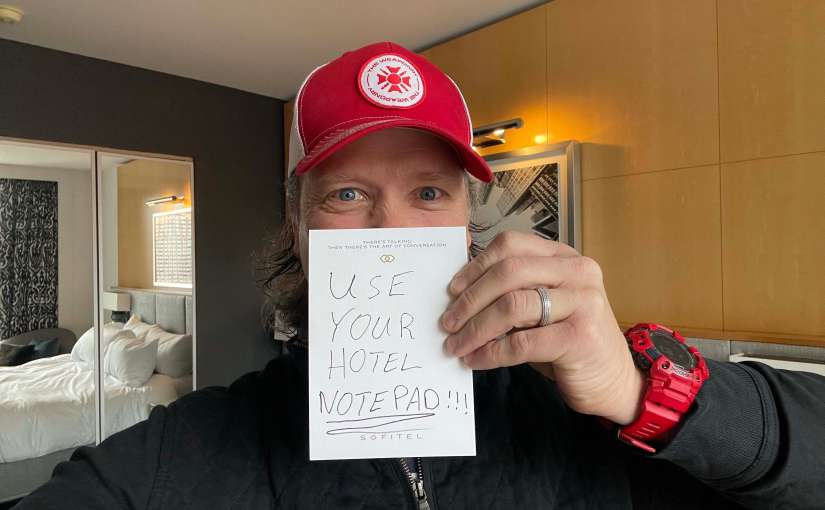
Why you should always use your hotel room notepad.

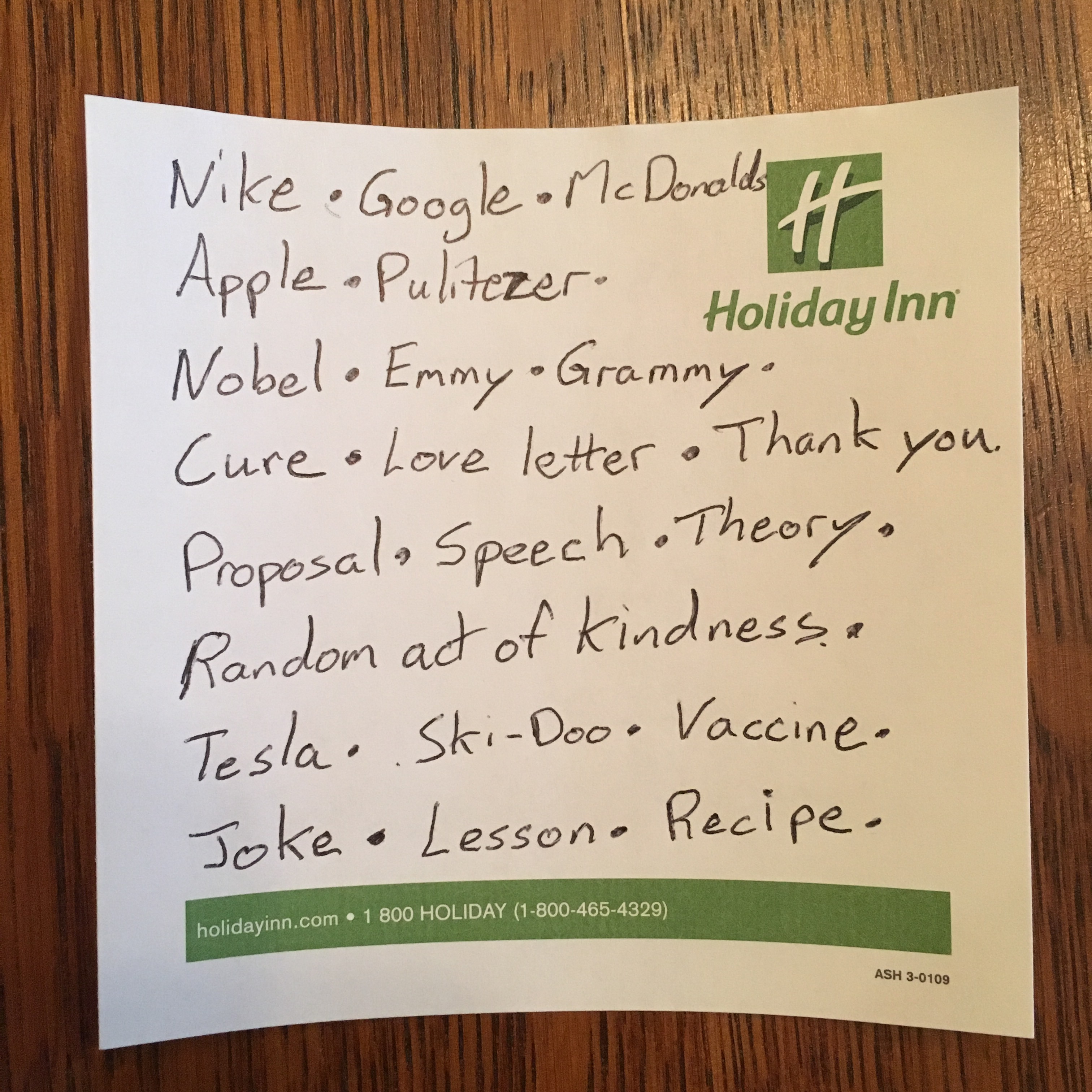
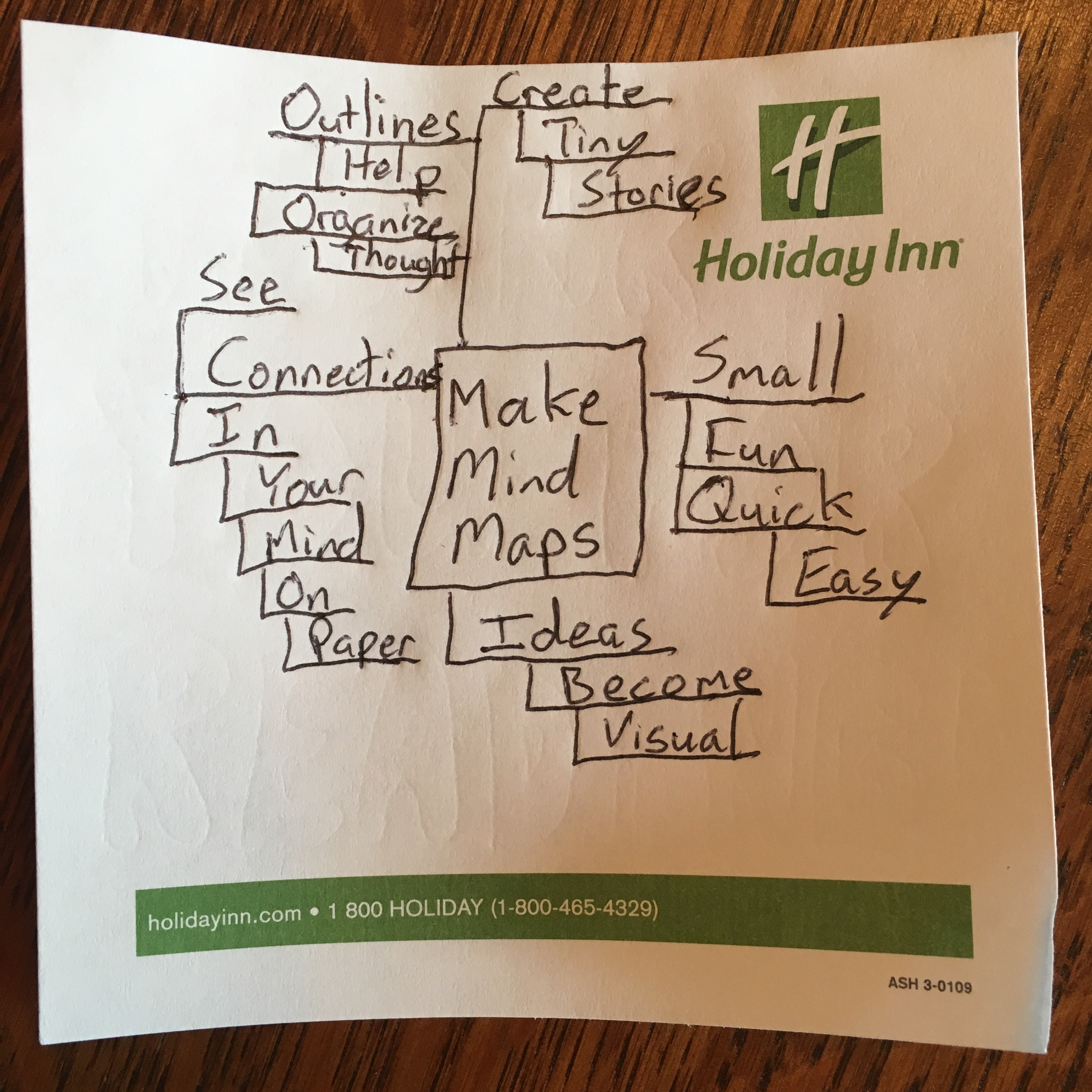
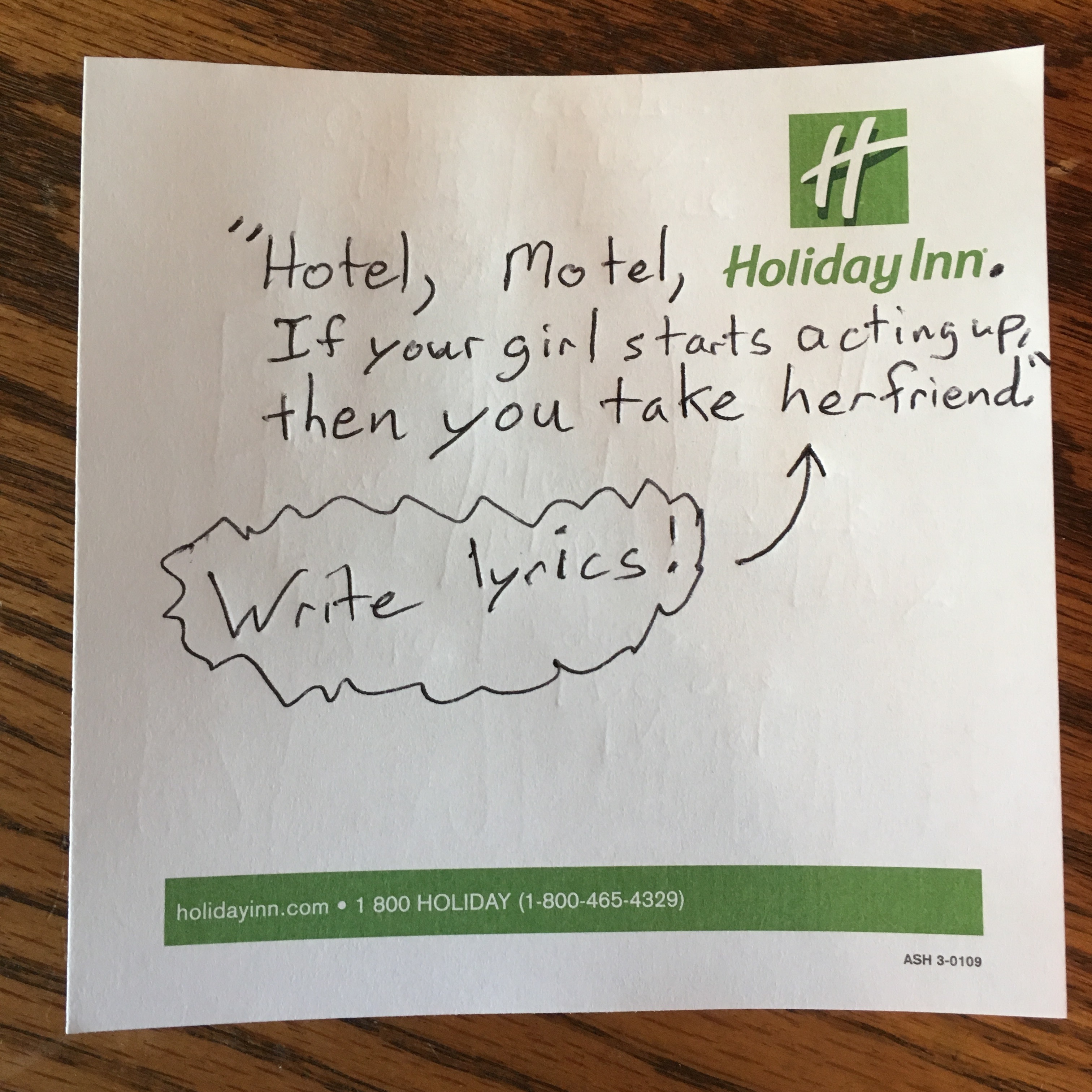
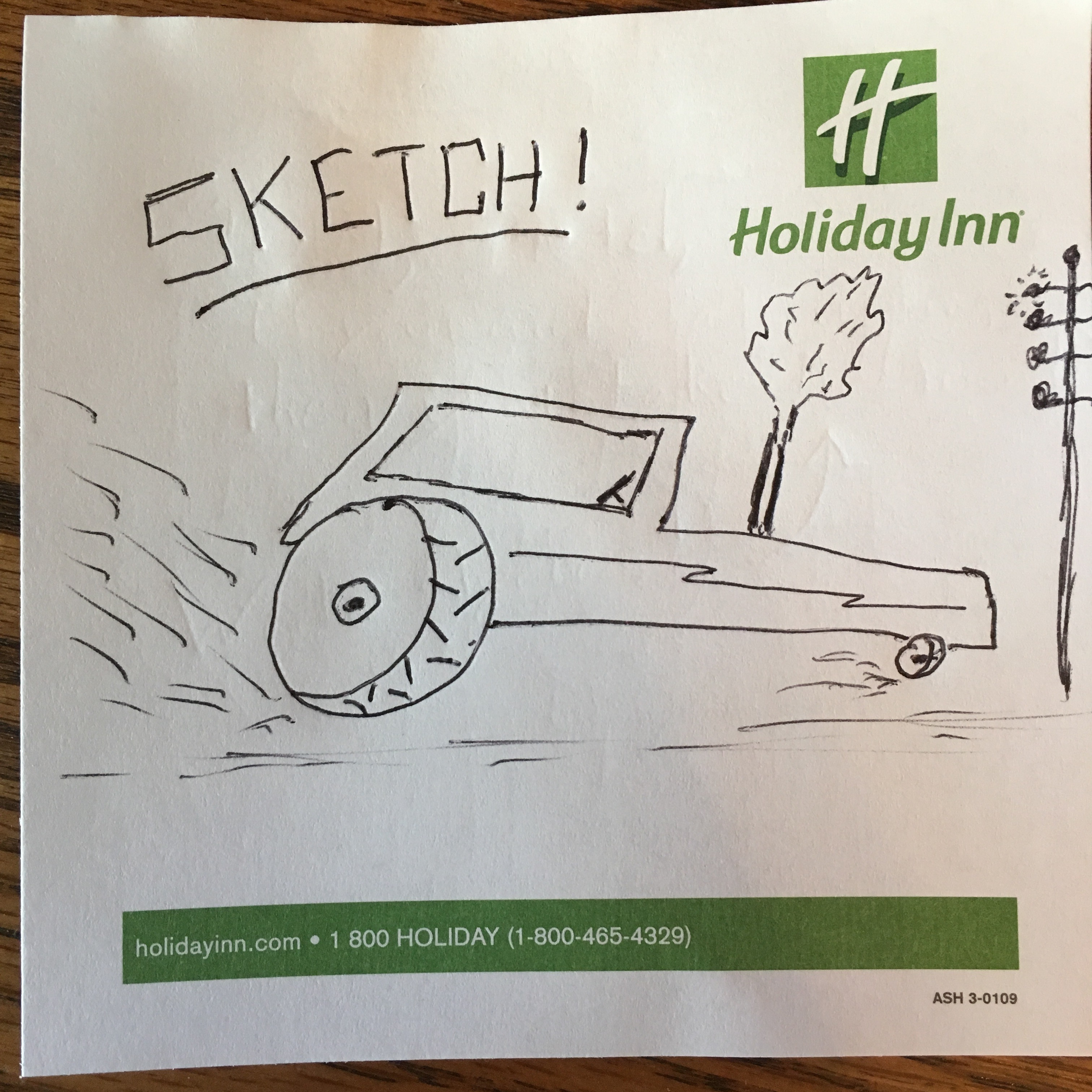
Last week when I was at my local gym my friend Spencer Koenig approached me while I was on the elliptical machine. (Not the ellipsis machine…) He handed me his phone. It displayed a photo of a profound thought he had written on a hotel room notepad.

Spencer smiled at me and shared, ‘In 2017, you wrote a blog post about how you should always use the notepad in your hotel room to write down your ideas. And I always think of that when I stay at hotels.’

I loved that!

I stay in a lot of hotel rooms each year. I have Titanium Elite status with Marriott. Apparently, that’s better than silver, gold and platinum, because they make body parts out of titanium. So I have body-part-worthy-metal status for my hotel room stays.

The Lesson

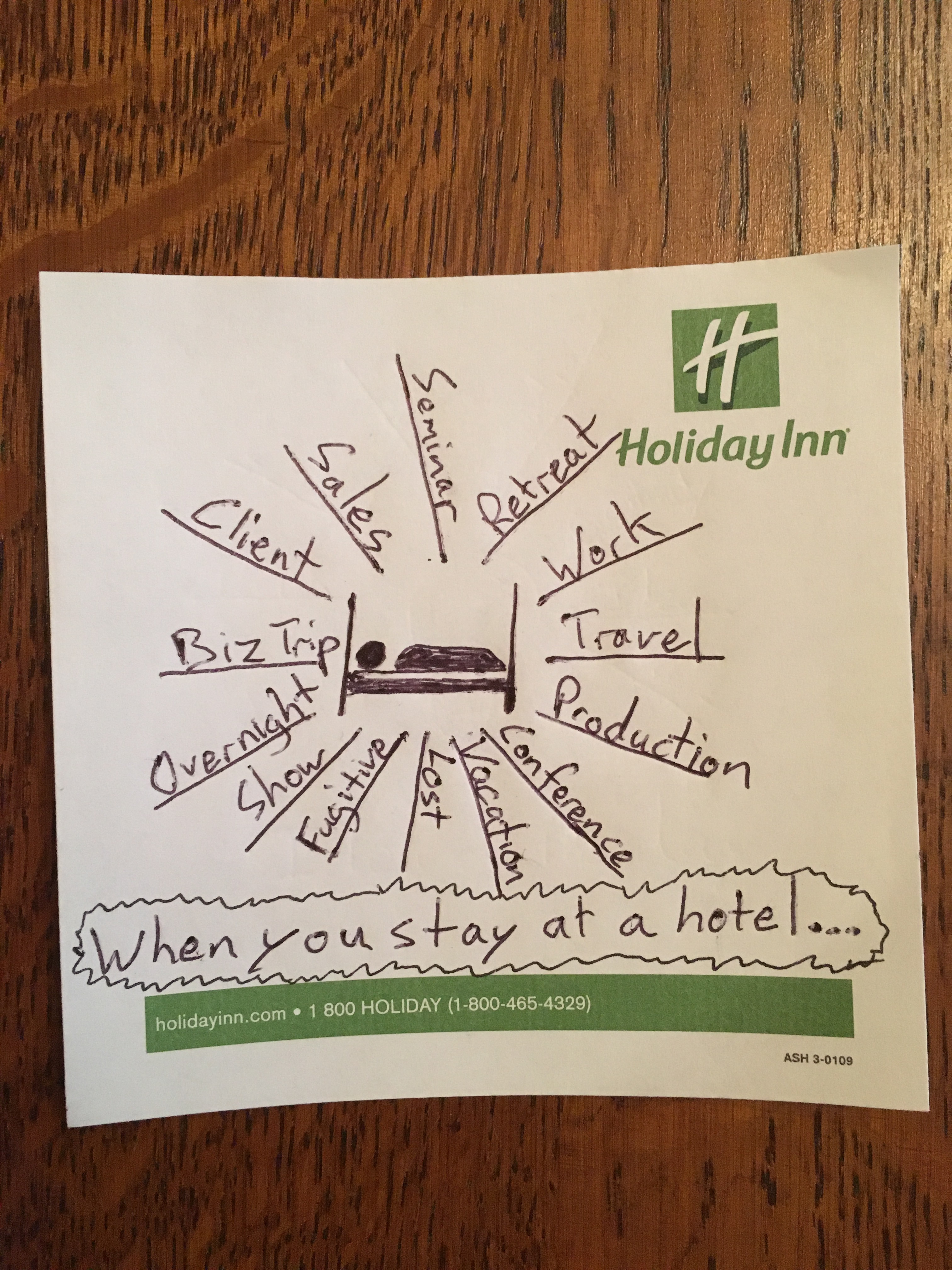
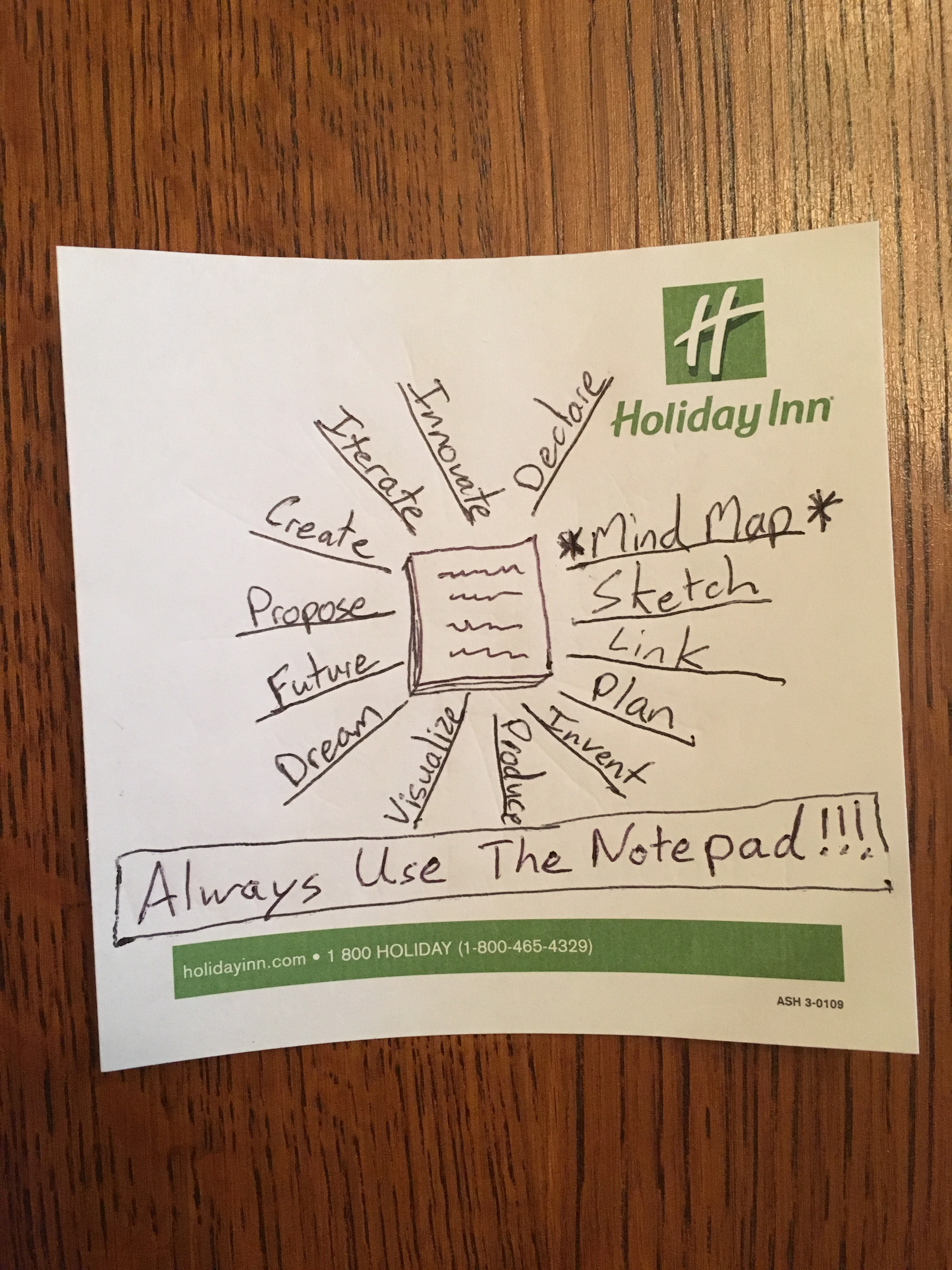
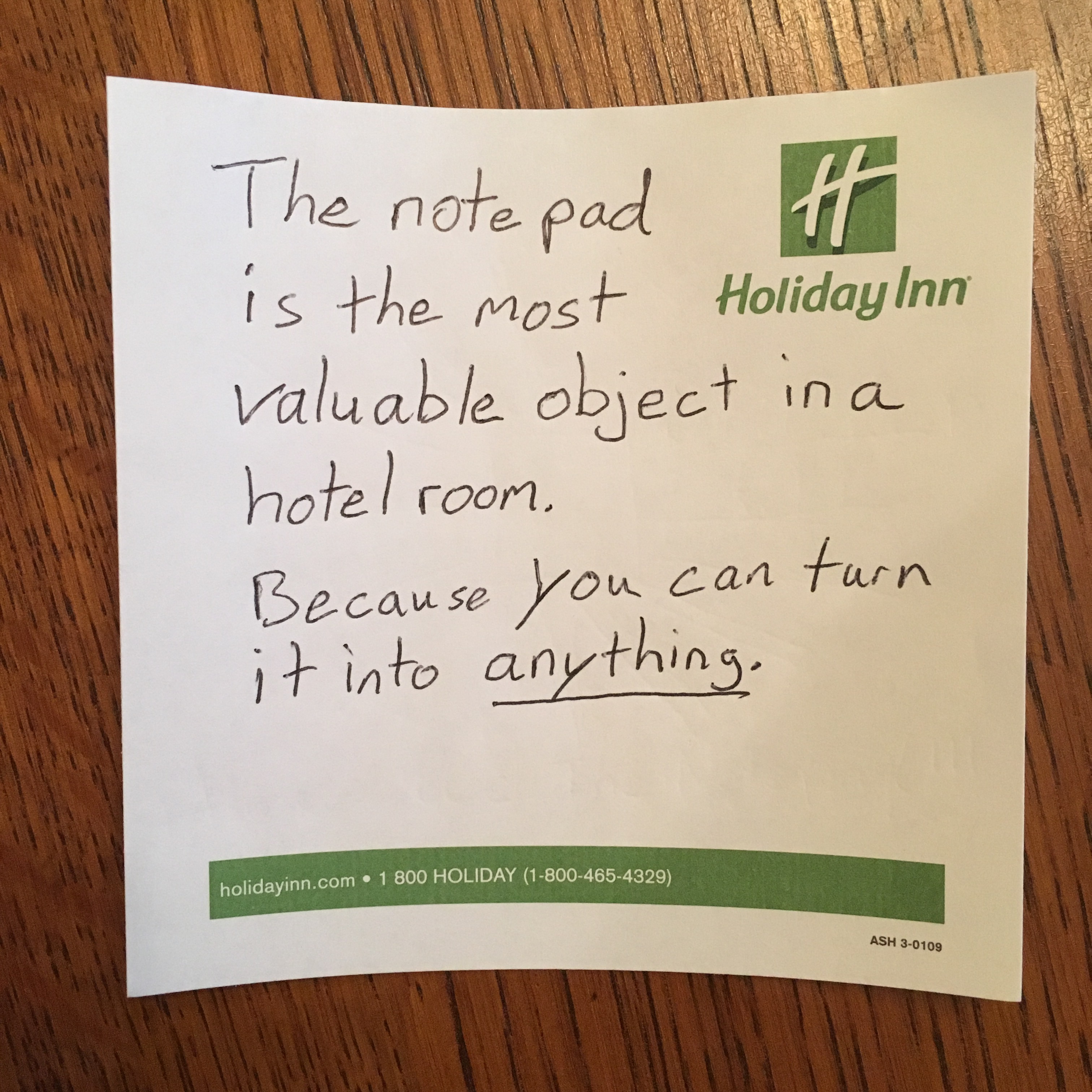
The most important thing I have learned from all that staying is that you should capture your ideas on the hotel notepads. By doing so, you turn the notepads into the most valuable object in the room.

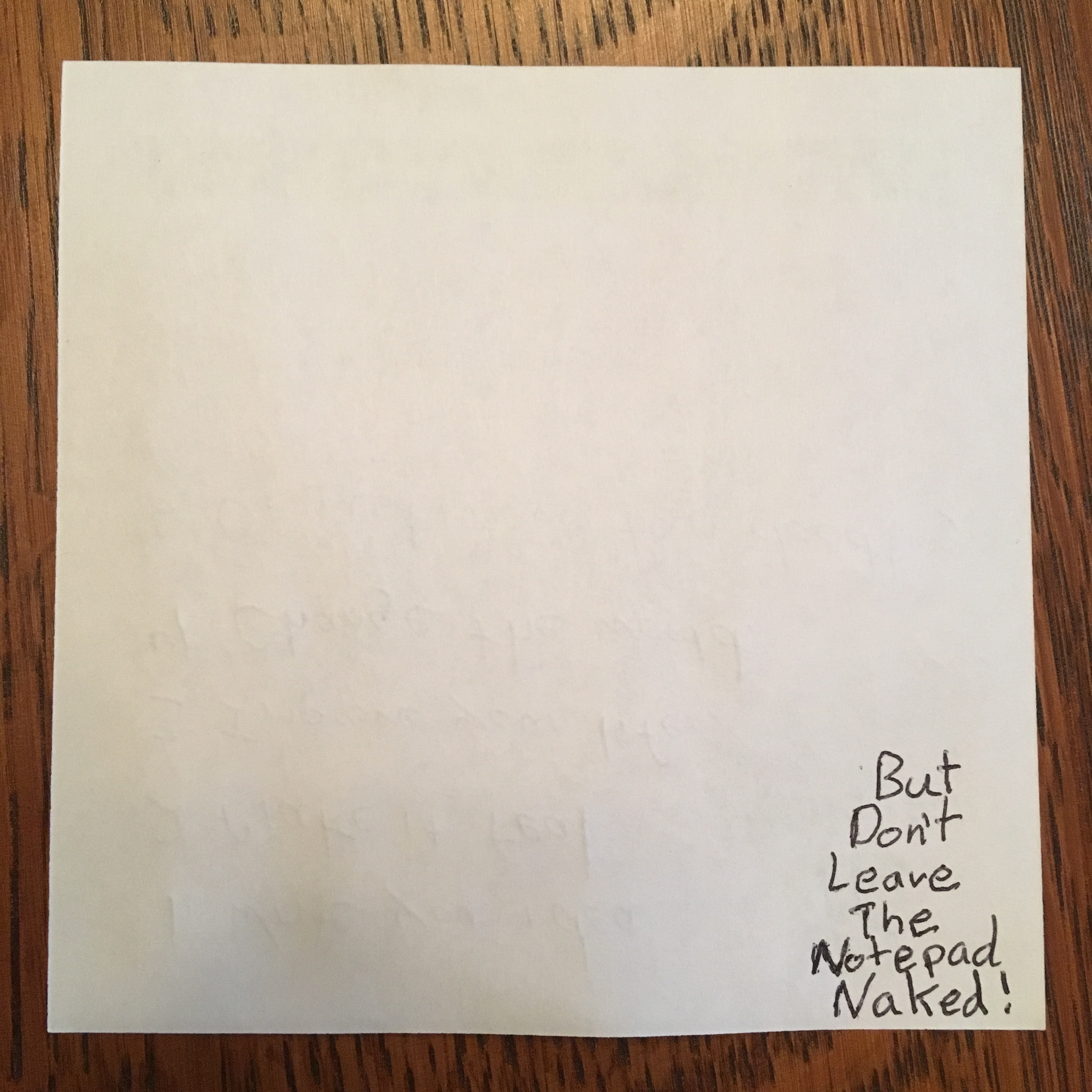
The following is the post I first shared in 2017. It is all written on the notepad from the hotel room I stayed at when visiting family in Austin, Minnesota.

Note: The Holiday Inn is a sweet hotel in Austin. And the Perkins next door is my go-to breakfast spot. I always order The Tremendous 12.

And now, The Notepad…

Why you should be an Imperfectionist, like me.

A great business is simply a collection of great people running a great process. But what makes people great, and thus collectible, is certainly a topic of debate. I am sure you have your own trait that you think makes you a valuable addition to a team. You advertise this special trait in job interviews. You are organized. Or ENERGETIC! Or cReAtIve. Or not easily bored…

Throughout my career, I have spent a lot of time interviewing job candidates. And there’s one trait I have heard people brag about more than all others. I couldn’t possibly count how many times I’ve heard people proudly state, ‘I am a perfectionist.’ This proclamation makes me want to throw up. Because if you are looking for creative thinkers and problem solvers, perfection works against you.

That’s why I proudly consider myself an Imperfectionist. So what does that mean? It means I value progress in any form. I am quite comfortable dreaming up and then sharing half-baked ideas. Or writing a first draft and passing it around for a reaction. Why? Because unbaked and half-baked ideas are available faster than fully-baked ideas. And typically, a team simply needs a ‘for-instance’ to get moving in the right direction.

I enjoy sharing ideas that are still in a moldable state. (But not a moldy state.) Sharing wet-clay ideas enables others to help form, modify and improve them before they’re finished. As an Imperfectionist, I embrace the process of creating, testing, learning and improving.

Today, speed is king. In the advertising agency business, we need to act quickly to help our clients take advantage of short-lived opportunities and thwart threats. This puts a premium on quick thinking. It’s why I like swift action as much as Travis Kelce does.

We no longer live in an era that rewards you for sitting alone in your office, with your Swingline, making sure your ideas are bulletproof before you share them.

Now don’t get me wrong. Once our team has determined a direction and we move into the execution phase, every detail matters. (Because you hate to get an execution wrong…) I will question the kerning, analyze the delivery of a line, and poke at a transition in an edit until I’m convinced we have it right. There is a time and place for this type of scrutiny. And it’s at the end of the process.

Being an Imperfectionist is what enabled me to launch The Weaponry. It is what allowed me to start this blog. It was the key to writing my first book What Does Your Fortune Cookie Say? And it is the great enabler behind all of my creative and business projects yet to come.

Key Takeaway

Be an Imperfectionist. Explore more. Fail fast. And improve faster. Share what you think are good ideas earlier in the process so that others can contribute their good ideas too. Imperfectionism is the difference between doing and dreaming. Action and inaction. It is the key to entrepreneurial thinking. And it has the power to change the world.

*If you know someone who could benefit from this message, please share it with them.

+For more of the best life lessons I have learned check out my book, What Does Your Fortune Cookie Say? from Ripples Media.

Why you can’t wait for creative lightning to strike.

I have spent my entire career as a professional creative. I started my career in advertising as a junior copywriter and worked my way up to Chief Creative Officer. Then I Rumpelstiltskined an advertising and idea agency called The Weaponry out of paper clips, bubble gum, and Real Red by Benjamin Moore.

Away from work, I do more creating. I have written 954 blog posts at The Adam Albrecht Blog. I wrote another hundred posts at a humor blog titled You Call That Work? I’ve authored a book titled What Does Your Fortune Cookie Say? I co-authored a book called The Culture Turnaround. I’ve co-created a comic strip called Kirky. And I have written and recorded several songs. One song I wrote when I was 16 was the first dance at my co-writers wedding reception. Think Always and Forever by Kip Dynamite.

I know a lot about creativity and the creative process. And I have found that most people wait for inspirational lightning to strike before they create. But Baby, I, I, I can’t wait.

What I Do Instead

I hunt the lightning every day. I put up lightning rods. I tie keys to my kite and fly it to the clouds. I erect an aluminum extension ladder to the heavens. I lasso the lightning and ride it. Like Metallica.

Clockwork Inspiration 

What that really means is that I sit down to write every morning by 6:10 am. And when I sit down to work, the inspiration comes. Every day. Without fail.

Because I have created a creative habit, the universe knows it has to deliver the electricity to my desk. Just like nature’s paperboy throwing the morning edition on the porch. (Or like Paperboy throwing Ditty my way in 1993.) And like clockwork, the electricity starts flowing my way.

I go through each day attracting bolts of inspiration the way mobile home parks attract tornadoes. My mind is always tuned for inspiration. Whatever the universe is serving, I can use. My eyes and ears are always open and taking in sparks, flickers and bolts. And because I’m always receptive, I always receive. Like Taylor Swift’s boyfriend. Or OBJ.

To be creative you have to be actively curious. Which means you are actively consuming inputs. Looking. Listening. Reading. Considering. Every day I am collecting more dots. Because creativity is nothing more than collecting dots, and then connecting your dots in new and novel ways.

Key Takeaway

Don’t wait for inspiration to strike you. Go strike the inspiration. Force it to pay attention to you every day by simply sitting down and doing the work. That’s what professional creatives do. And the juice just keeps flowing.

*If you know someone who could benefit from this message, please share it with them.

+For more of the best life lessons I have learned check out my book, What Does Your Fortune Cookie Say? from Ripples Media.

Here are the 3 types of opportunities available to you now.

Opportunities are the seeds of success. Just as the acorn becomes an oak, opportunities can transform into happiness, wealth, fulfillment, or success. And like little pigs, musketeers, and Charlie’s Angels, they come in 3 types:

  1. The opportunities that find you.
  2. The opportunities that you find.
  3. The opportunities that you create.

The first kind falls in your lap. The second kind you catch. The third kind you make.

If you wait around for the first type, you may wait forever, like an airline customer service representative.

The second type you need to look for. And you better be ready to compete for it when you find it. Kind of like parade candy. Or the t-shirt shot out of a cannon at a sporting event that isn’t even your size.

The third type will have no competition. Because without you it doesn’t exist. Like your next business, book or baby. This includes connections, creations, innovations and organizations of all types. Basically anything with a tion in it. Because the suffix tion turns a verb into a noun. Just like opportunities empower you to make things with your actions.

Key Takeaway

Keep your eyes open to find opportunities. But more importantly, keep your mind open to create your own. Because those are the most valuable and available variety of all.


*If you know someone who could benefit from this message, please share it with them.

+For more of the best life lessons I have learned check out my book, What Does Your Fortune Cookie Say? from Ripples Media.