A blog about self improvement, creativity, entrepreneurship, and advertising.
Author: Adam Albrecht
Adam Albrecht is the Founder and CEO of the advertising and idea agency, The Weaponry. He believes the most powerful weapon on Earth is the human mind. He is the author of the book, What Does Your Fortune Cookie Say? He also authors two blogs: the Adam Albrecht Blog and Dad Says. Daughter Says., a Daddy-Daughter blog he co-writes with his 16-year old daughter Ava. Adam can be reached at adam@theweaponry.com.
I have dreamed about writing a book since I realized people did such things. As a kid, I knew Dr Suess did it. So did Laura Ingalls Wilder. And Judy Blume got crazy with it. But it seemed super hard. And time-consuming. But in March of 2020, I took the pandemically-induced gift of time, and started writing. And like a literary Forrest Gump, I just kept write-ing and write-ing. Today, my little paper baby, What Does Your Fortune Cookie Say? is 3 years old! The book shares 80 of the best life lessons. Now, I have taken a moment to reflect on how writing this book has impacted my life.
10 Ways writing a book has positively impacted my life.
I learned I can do hard things. Doing hard things demystifies the hard things you do. Yes, writing a book requires a lot of time, energy and focus. But it requires a little bit every day, not a full deposit at one time. Writing a book is actually like running 3 marathons. A writing marathon, a publishing marathon, and a marketing marathon (which only ends when you stop promoting your book.) I wrote more about it in this post. I enjoyed the process. It was not too much for me. And it’s not too much for you either.
2. I have earned a new level of respect. Our society respects published authors. I think it’s because you have done something that other people know is hard. And it indicates that you have a deep level of knowledge in a specific area. Or that you are both creative and disciplined. #createiplined I consider being a published author The Poor Man’s Ph.D. (Or Poor Woman’s Ph.D.) Because when you add author to your title it earns you a higher level of respect. (I always say respect like Ali G says respek!)
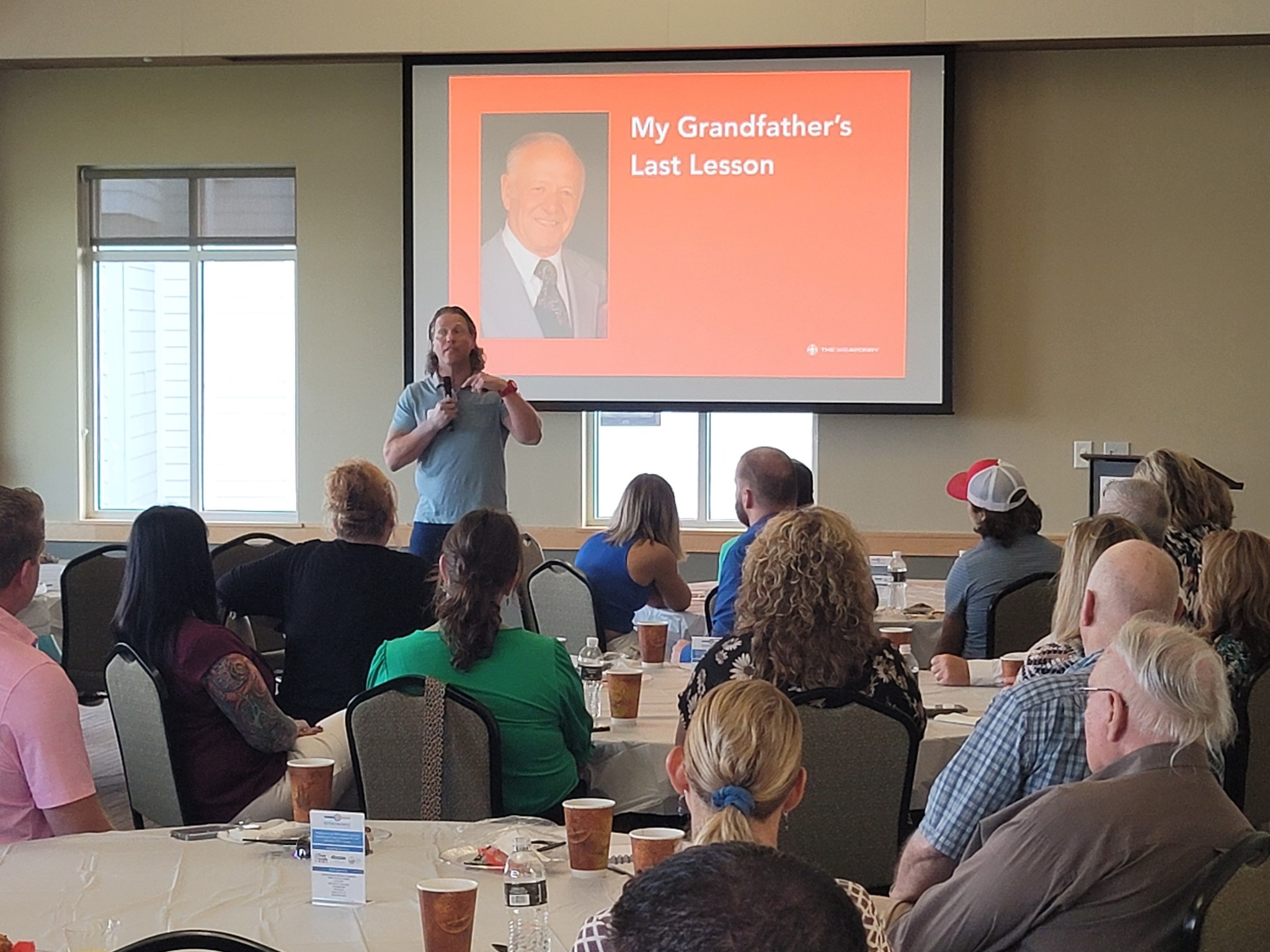
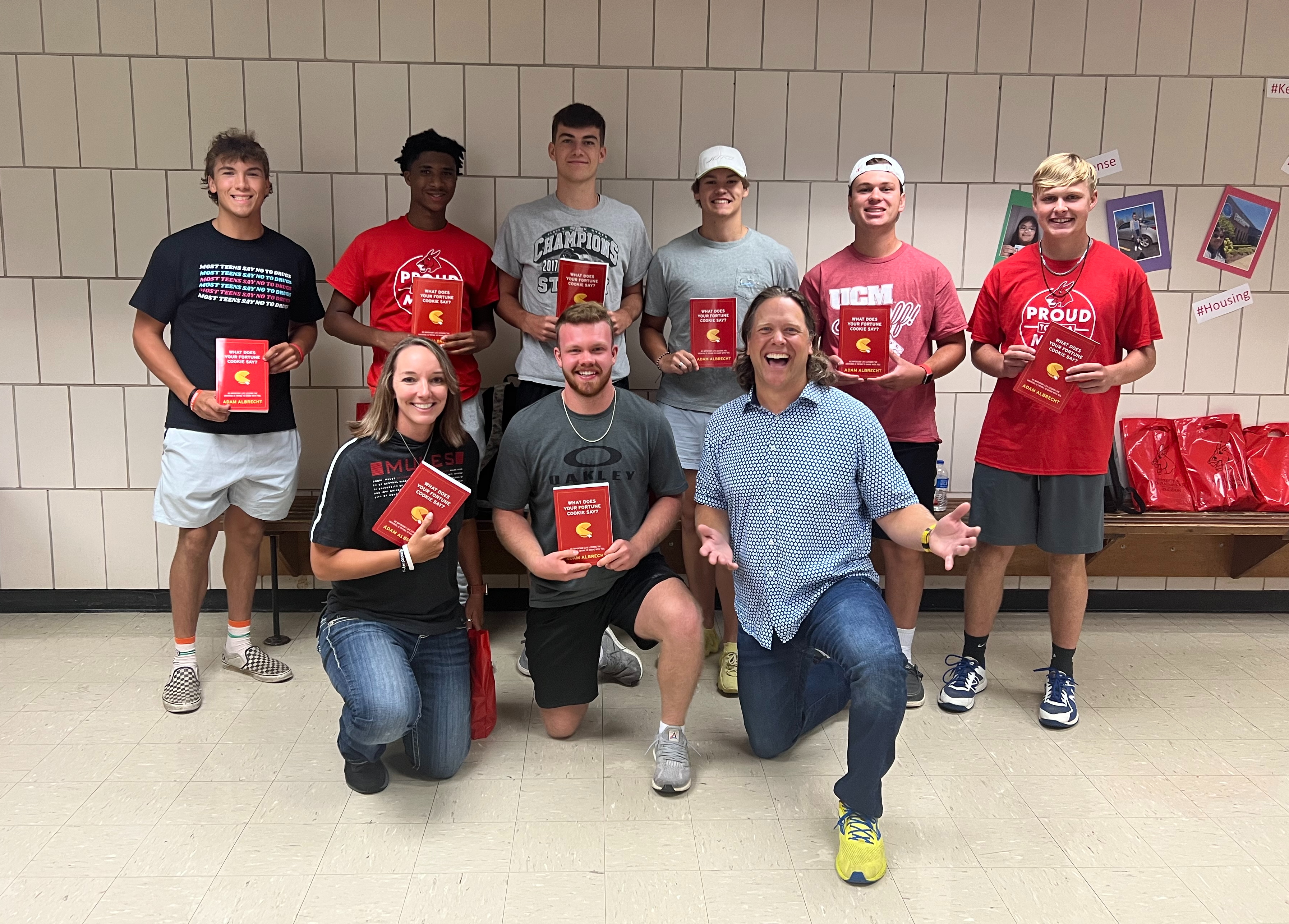
3. I get hired to speak. Since publishing my book my speaking requests have quadrizumpled. (Which is a Mary Poppins-like way of saying ‘greatly increased’. I have traveled all over the country speaking at conferences, symposiums, company meetings, association events, rotary clubs, chamber of commerce events, and schools. I love speaking. For me, it’s right up there with smiling and chocolate milk.
4. I have made money. Between book sales and speaking engagements, my book has become a source of income. It’s cool to have a product that you only have to create once, but you can sell over and over again, like Nelly and Tim McGraw.
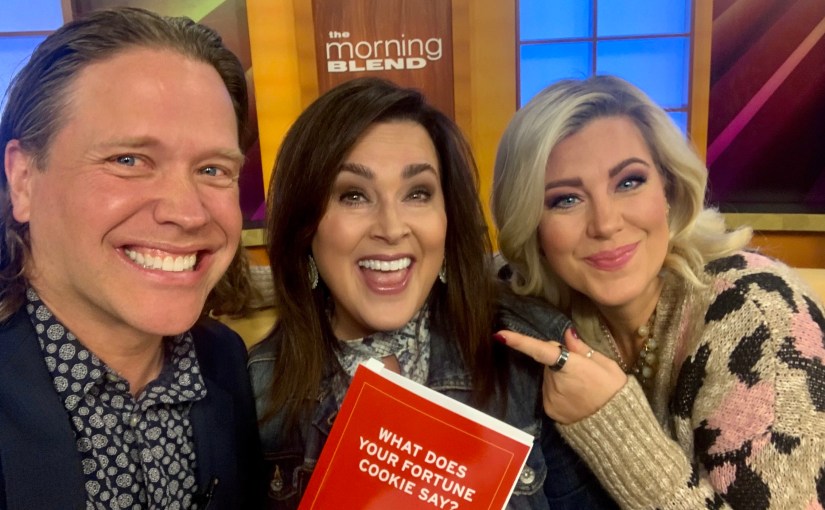
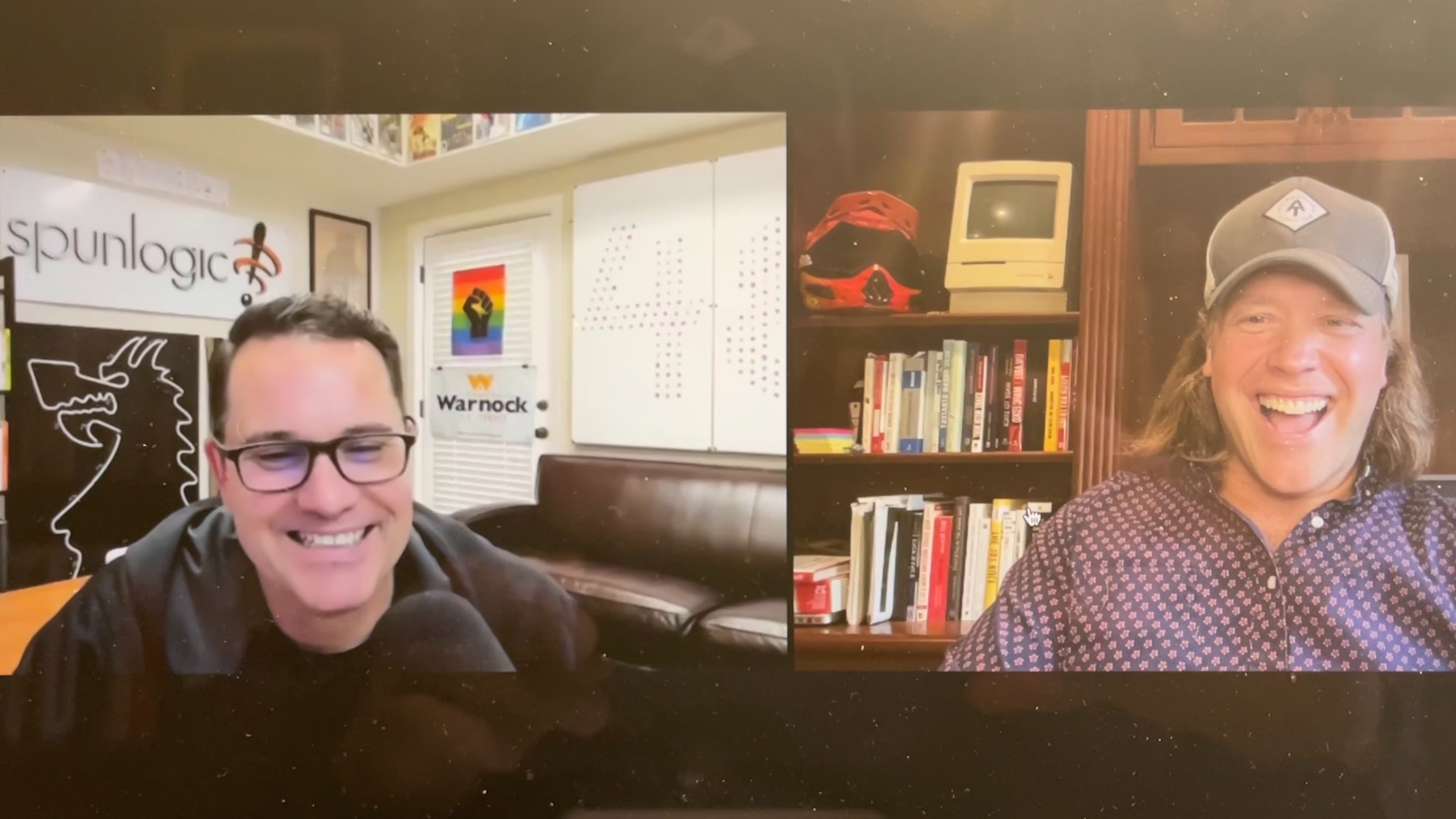
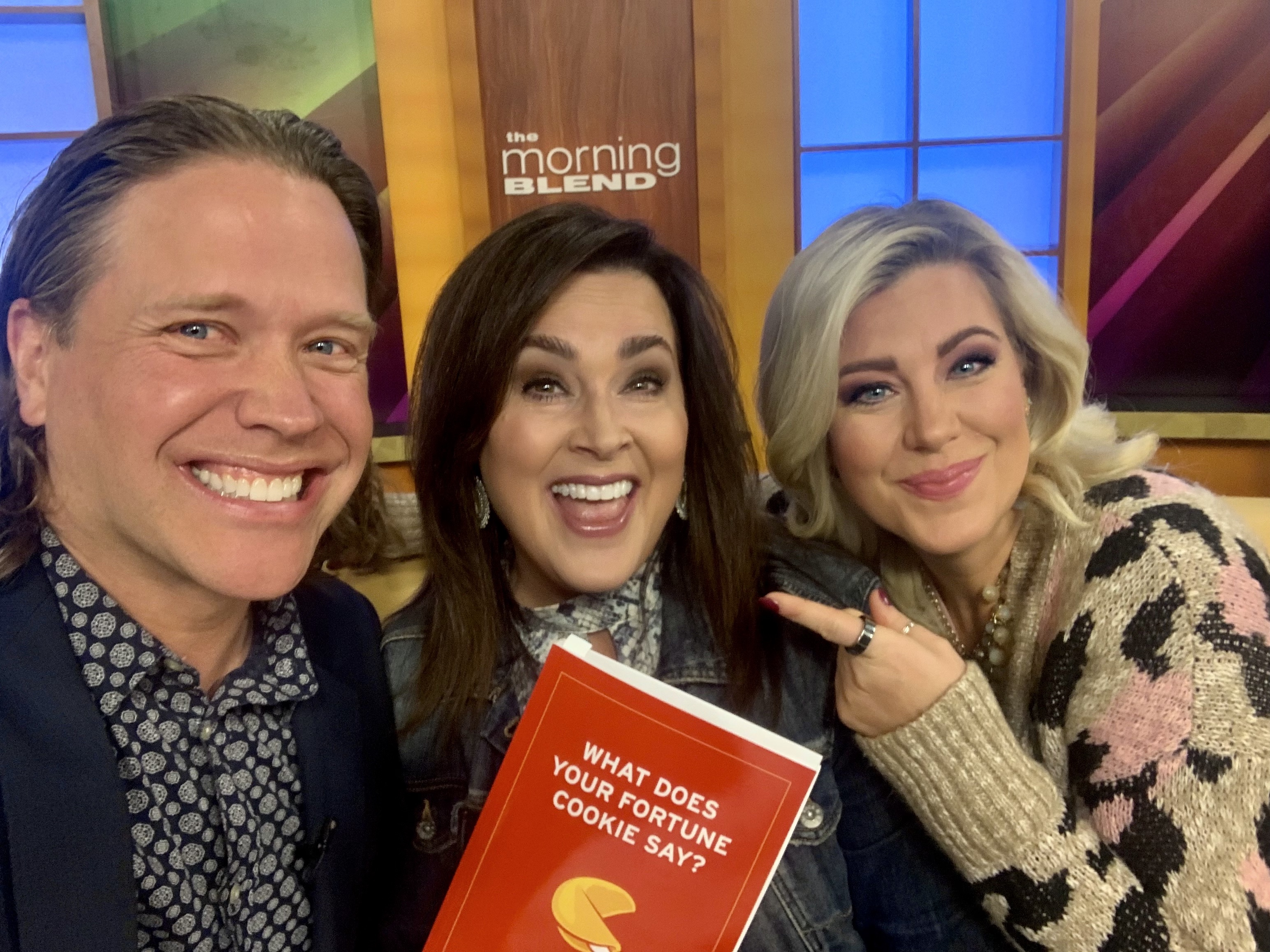
5.I get invited to be a guest. Since publishing my book I have been a guest on countless podcasts. (OK, I could probably count them if I tried really hard, but I haven’t.) I have also been invited to be a guest on the Milwaukee morning show The Morning Blend on NBC countable times: About 8 to 10 appearances.
6.I have been quoted. A cool result of writing a book is that I have been quoted on social media by people I don’t know. I have been alerted of mentions of my name, and when I followed the thread I realized that people I didn’t know shared quotes from the book. I have reached out to some of these people to thank them and find out how they read the quote. Some of them read the book. Others googled for quotes on positivity or other such positive terms. It’s pretty cool to have your work spread like that. Now I know how Jif and Skippy feel when people spread their work.
7.I attend book club discussions. I have never joined a book club. Perhaps because I am a dude, And book clubs have historically seemed less dudey. But I always thought they seemed like a cool idea. Now, every time I hear of a book club reading my book I volunteer to attend the discussion. It’s enjoyable to have conversations with people who read your book critically. And I love it when people share their favorite funny lines from the book. #DepecheMode
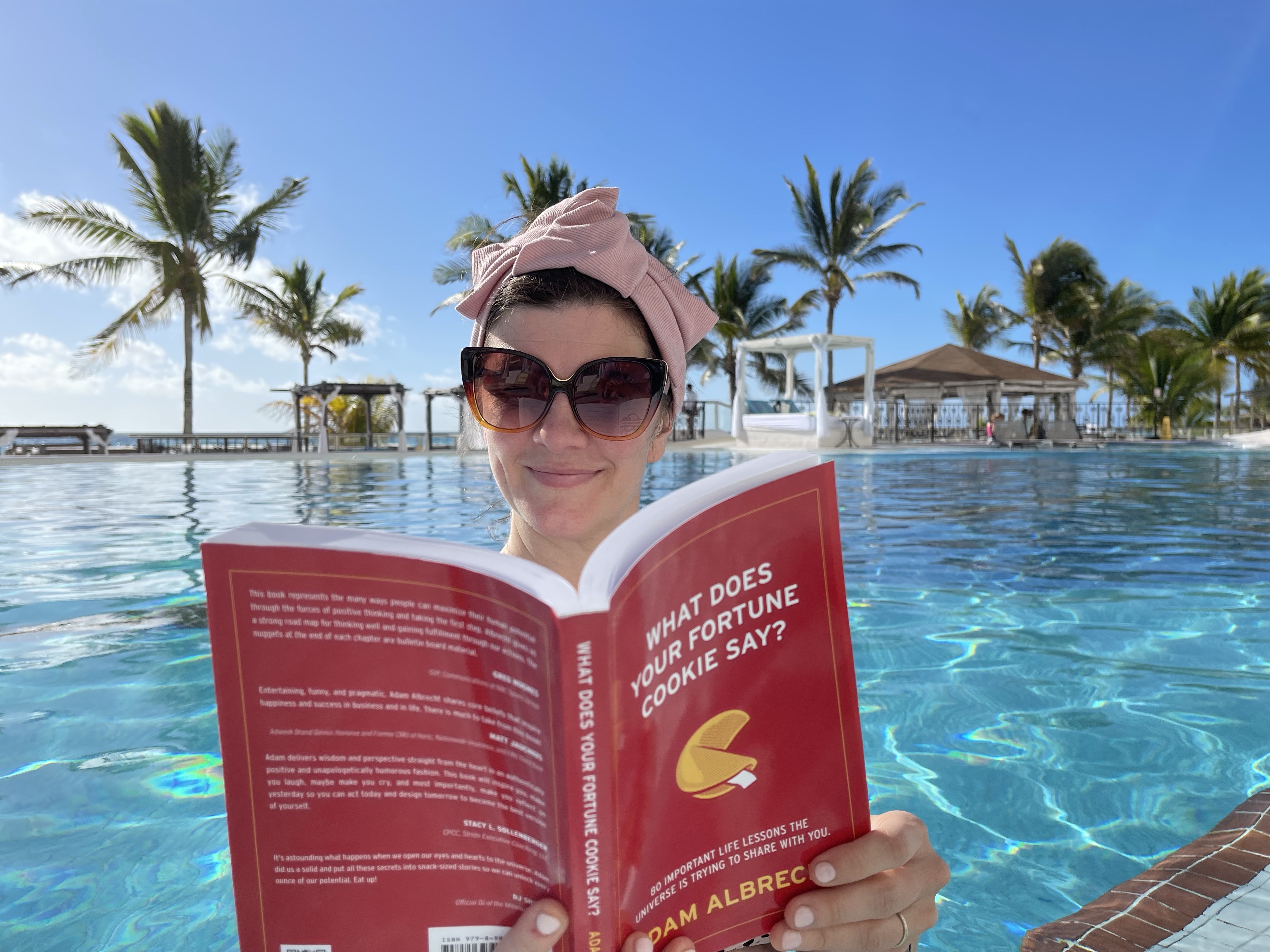
8. I have seen pictures of my book all over the world. Ok, so not North Korea or Antarctica. But, you know, a lot of cool places. People often take my book on vacation and enjoy reading it in some spectacular locales. Then they send me pics or tag me in photos. It is safe to say my book has been to more interesting places than I have.
9. I can buy my book from any bookseller. Initially, my book was only available on Amazon, from my publisher, Ripples Media, or from the trunk of my car. However, now, you can order my book from virtually anywhere. All the online booksellers that I have ever checked now carry it. And all independent bookstores can order it too.
10. I am motivated to write another book. And now I know how to get it done. Now, it’s a matter of when. (I actually already know that too.)
Key Takeaway
Writing and publishing my book has added to my life in many positive and rewarding ways. And the impact continues to compound. Yes, it takes work. But the payoff has been well worth it. If you have considered writing a book I strongly encourage you to do it for real. I am happy to share everything I know. Although the key is to simply open a Google document (or Word doc) and start writing. Then write a little more every day, just like Elvis Costello said.
If you are still looking for a great Christmas present that doesn’t break the bank, please consider giving What Does Your Fortune Cookie Say? If you read this too late to be delivered and you live in the Milwaukee area, reach out to me directly at adam@theweaponry.com. I can hook you up with a signed copy, even up to the last minute. Boom!
*If you know someone who could benefit from this message, please share it with them.
I never wanted to be a coach. Some people are innately drawn to it. I am not. I thought it was a cool role for other people. But I just wasn’t that into whistles and sweatpants. When I graduated from college, I fully expected to never be involved in sports again, other than as a fan. Even after I had 3 kids, I never expected to coach them at any level. I didn’t feel like I knew anything well enough to coach. Except maybe being a class clown. But I felt I could teach that through more of a mentoring relationship.
So it is very strange to realize that this fall I wrapped up my 7th season coaching my son Magnus’ football team. So, how did this happen? To find out we’ve got to go back in time, like Marty McFly.
In The Big Inning…
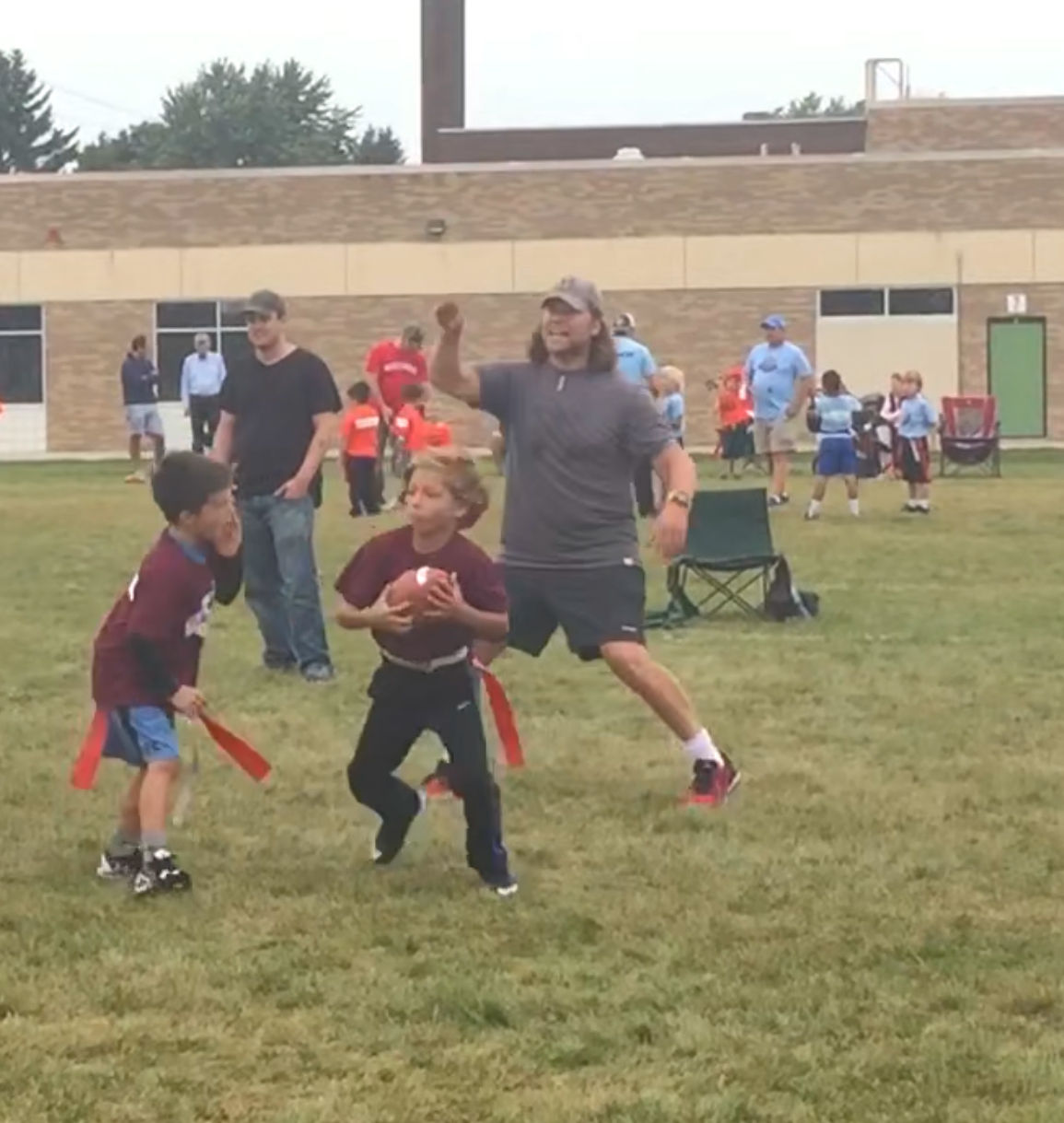
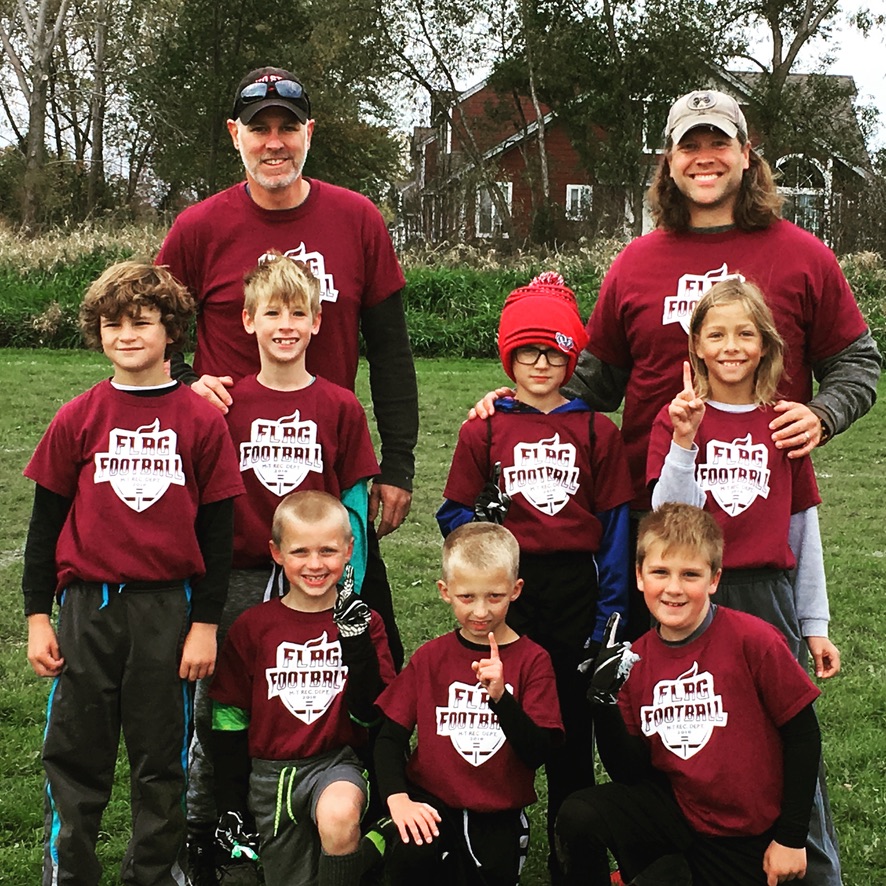
Like most things, my coaching career started very small. When Magnus was in first grade, we signed him up for flag football. At that level, the teams practiced for one hour and then played a game for one hour on Saturdays in the fall. At the first practice-game the two guys coaching Magnus’ team asked me if I could help out the following week because one of them was traveling. I was happy to help. And I felt like a helper more than a coach. Plus the kids were in Kindergarten and first grade. So they wouldn’t be fact-checking my coaching.
Magnus carrying the ball in 1st grade, when I could point where I wanted the players to go.
That Saturday’s practice-game went well. I had fun. Magnus enjoyed having me involved. None of the kindergartners asked to be traded or held out for more NIL money. So I became the third coach on the staff, helping whenever I could the rest of that cute little 6-week season.
Stepping Up A Notch
When Magnus entered 2nd grade, the program was looking for more parents to coach. My wife Dawn encouraged me to volunteer. So I got paired with another father. And we had a good time. Again, this was just 2nd and 3rd graders with one practice-game combo pack each week on Saturday mornings in the fall. And we were literally on the field placing each player in position and whispering in their ear what we wanted them to do. It was kinda like playing chess with tiny humans. Even better, the play didn’t start until the coaches said they were ready. The hardest part was organizing which parents were bringing the snacks.
Magnus and Me in our second season together. That’s a happy father/son combo pack.
Gaming The System
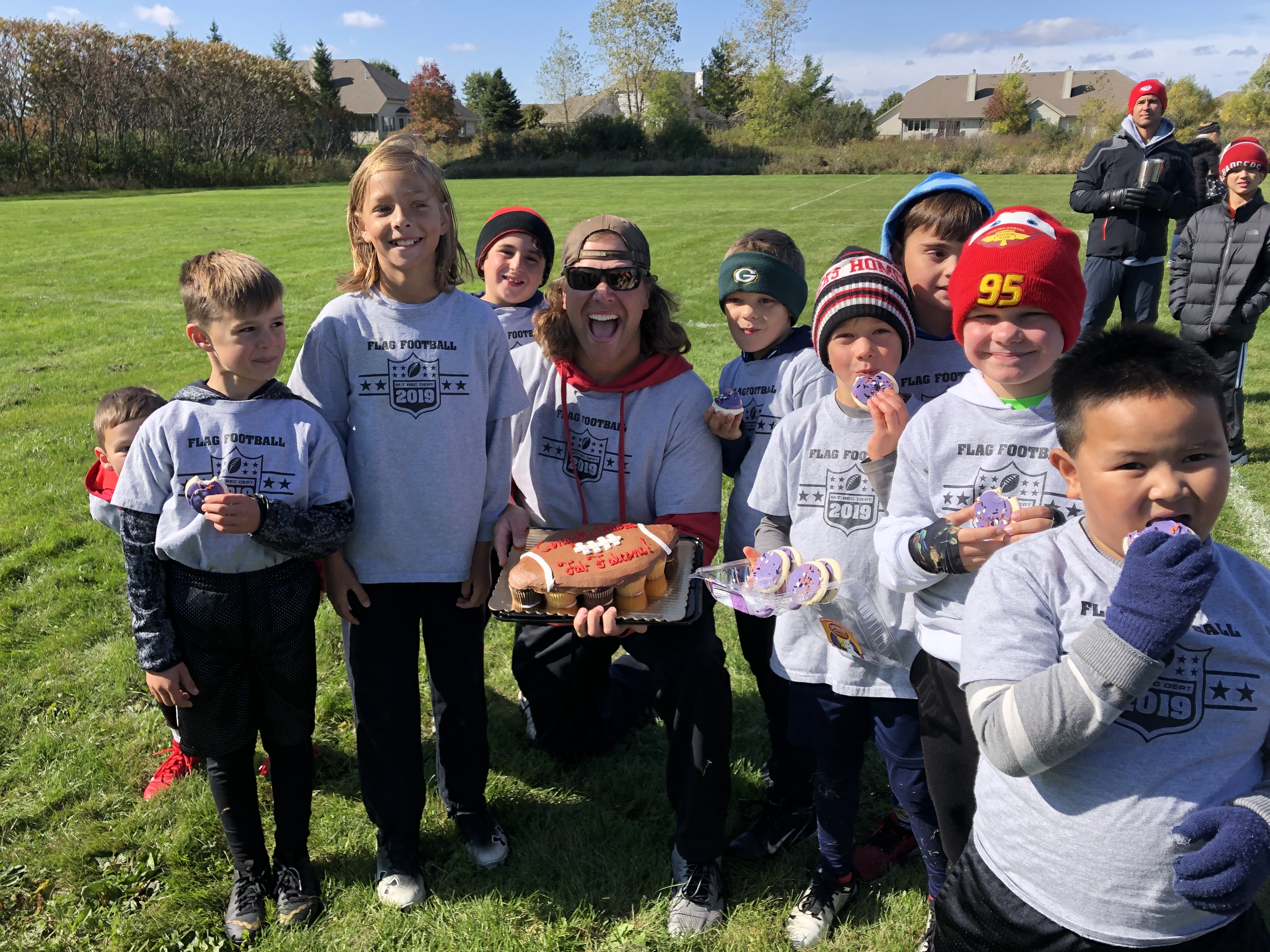
By 3rd grade, I realized that you could choose to pair up with another coach to lead a team. And when you did that, it allowed you to stack your team with 2 good players. So my great friend Dr. Mike Brin and I teamed up to coach. DMB played football for the University of Wisconsin Badgers, and we had been friends since we were teenage college athletes in Madison. Mike’s son Josh ‘Aquaman’ Brin was a talented and enthusiastic athlete. Josh and Magnus gave us a strong nucleus to build a team around. Kinda like D-Wade and Chris Bosh. We were lucky enough to land a few other really talented second and third graders, and we had a fun and successful season, even before the snacks.
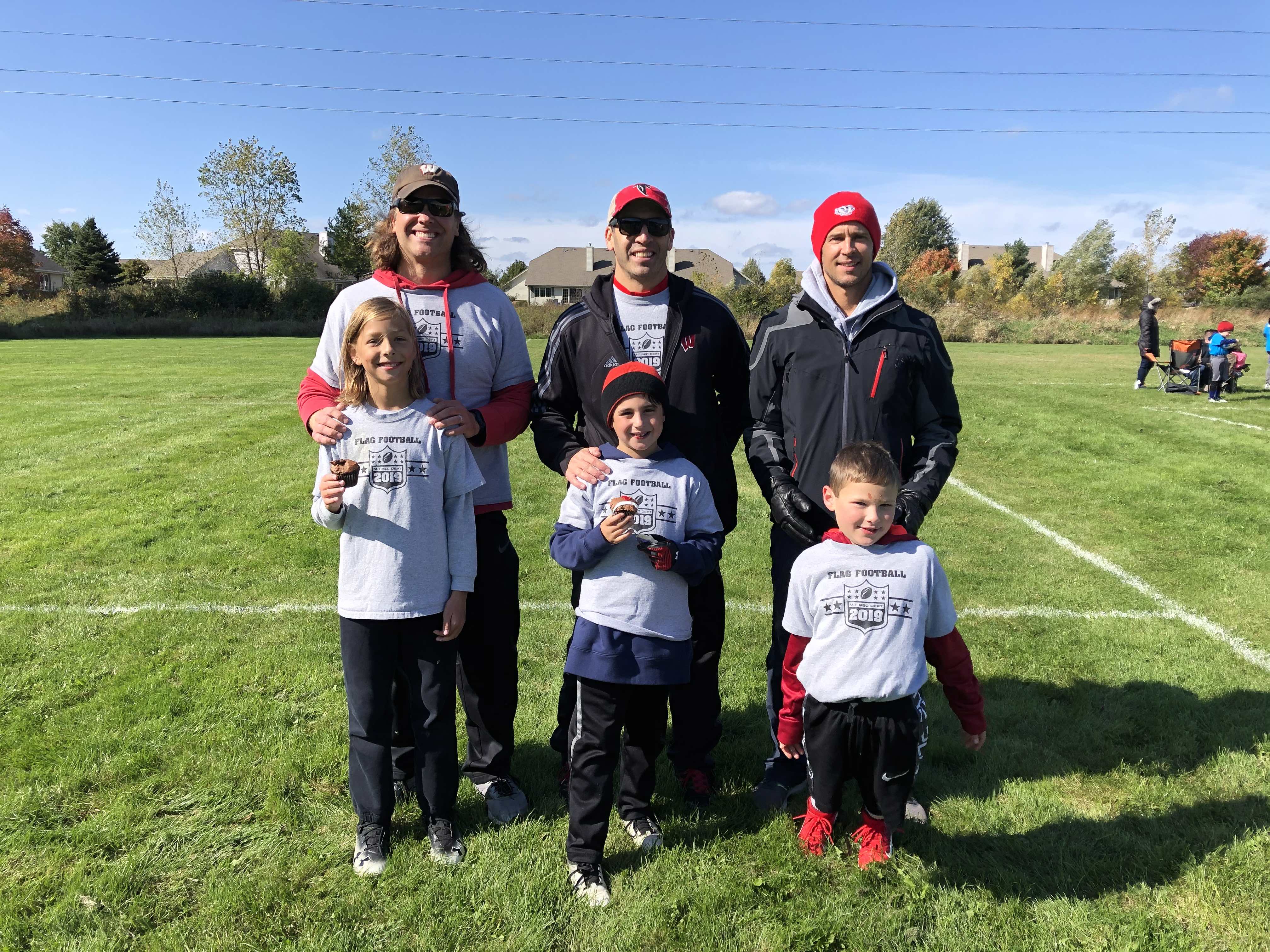
Season 3. We were really upping our snack game by then.Me and Magnus, Mike and Josh Brin, Josh and Hudson Hunt. All 3 of the guys in the back row were UW Badger athletes, which meant we knew how to recruit. (You do it with cupcakes.)
The Curve Ball
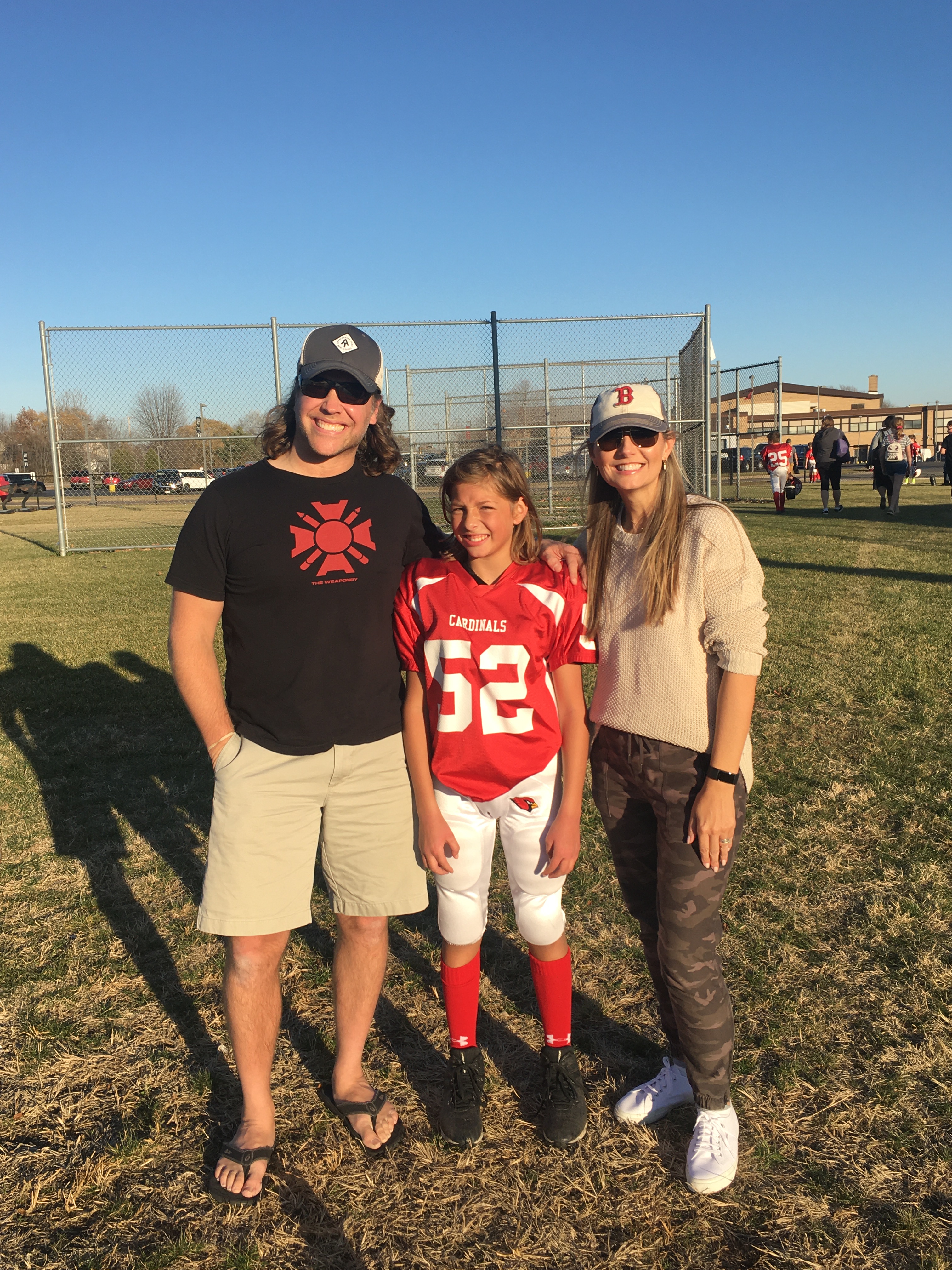
In 4th grade, COVID-19 hit. And the program was canceled for the year. Boo. But Magnus was desperate to play football. So we were allowed to enroll him in the 5th grade Mequon-Thiensville Cardinals tackle football program, where he played up a grade as a tall and eager 4th grader. The boys played with face masks over their face masks, which looked funny and may have had no practical effect, but it made everyone feel better about playing football during a global pandemic. No kids got sick. And I got to sit in the stands, 6 feet apart from other fans, and cheer through a mask like a normal COVID-era parent.
At this point, I thought I was finished coaching. I enjoyed the season as a fan only. (Not to be confused with Fans Only.
When Magnus was in 4th grade, he played tackle football with 5th graders, And I got to cheer in the stands with Dawn. I also got to wear flip-flops without a fear of getting cleated.
Magnus and a little wind machine for the hair.
Back On Track
That spring, I made a much bigger coaching commitment and started coaching high school track and field. My daughter Ava Albrecht was a freshman at Homestead High School in Mequon, Wisconsin. And I knew that I knew more about throwing the discus and putting the shot than most Mequonians. The flag football coaching experience made me think I could handle track. After all, when you coach throwing, you simply coach technique. There is no strategy. Or defense. Or concussion protocol. Go track!
Tackling Tackle Football
When Magnus entered 5th grade I was asked to help coach his tackle football team. I was reluctant because of the time commitment, especially on the heels of a long track season that went almost to July and left me with just 1 month without coaching obligations. But my coaching confidence was growing. So, I agreed to coach part-time. I was another warm body there to supervise kids and help run drills. I cheered a lot. And I tried to make it fun. For much of the season we only had 16 kids available. So we could only run 8 vs 8 scrimmages. Which was pretty silly. But I like silly.
5th Grade. And We’re back together for Cardinal Rules football.
Jumping Into The Deep End Of The Pool.
When Magnus entered 6th grade my friend Josh Hunt volunteered to become the team’s head coach. Josh played football at the University of Wisconsin and had a lot of coaching experience. He asked me if I would be willing to be the defensive coordinator for the team. I agreed. Because Josh is a nice guy and didn’t seem like the type to burn my house down if I made some mistakes.
Realer Than Real Deal Holyfield
That’s when coaching got real. The slow build of casual coaching obligations helped lead me to a very real coaching position. Suddenly, I would be preparing for every week by watching game film of the teams we would be playing that week. I sketched out every unique formation and play the upcoming opponent ran, noted who carried or caught the ball, how frequently they ran each play, and generally how effective it had been. This represented a huge increase in both my time commitment and my emotional investment. I started to understand why Bobby Knight threw chairs and why Mike Leach went off on a seemingly insane rant about the players fat little girlfriends. Now I certainly don’t condone their behavior. But I started to understand it.
In practice, I taught our team the opponent’s plays and devised strategies to defend against them. Then, on Sundays, I watched our own game film from Saturday and marked up all of the footage on software called Hudl to show what we did right, what we did wrong and how to do things better the next time. I learned that those 3 lessons are the basic pillars of coaching.
I spent more time than I care to admit watching game film, preparing defensive strategies and developing lineups each week. It was a significant commitment. But I loved coaching this group of boys. And I loved spending so much additional time with Magnus.
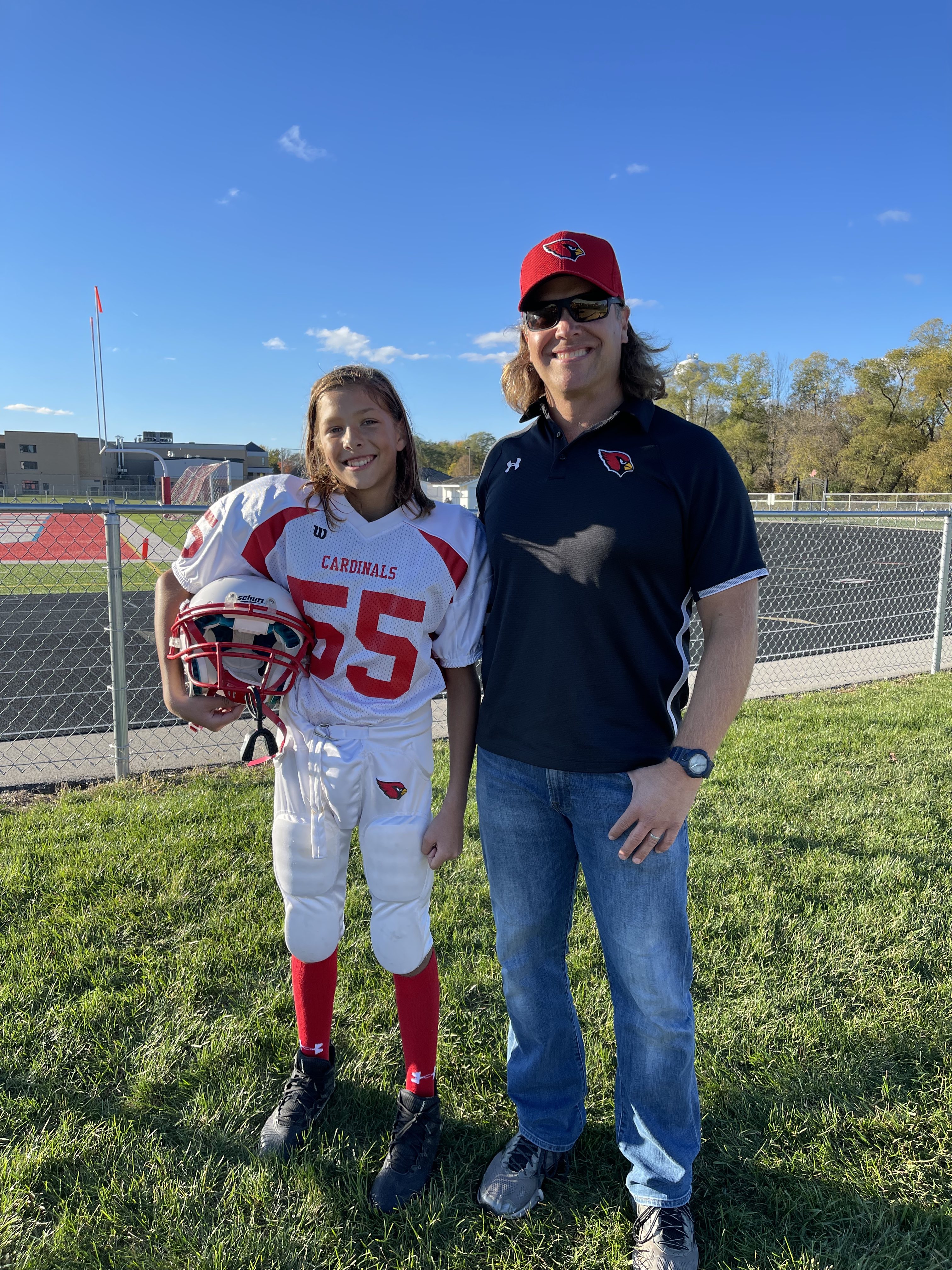
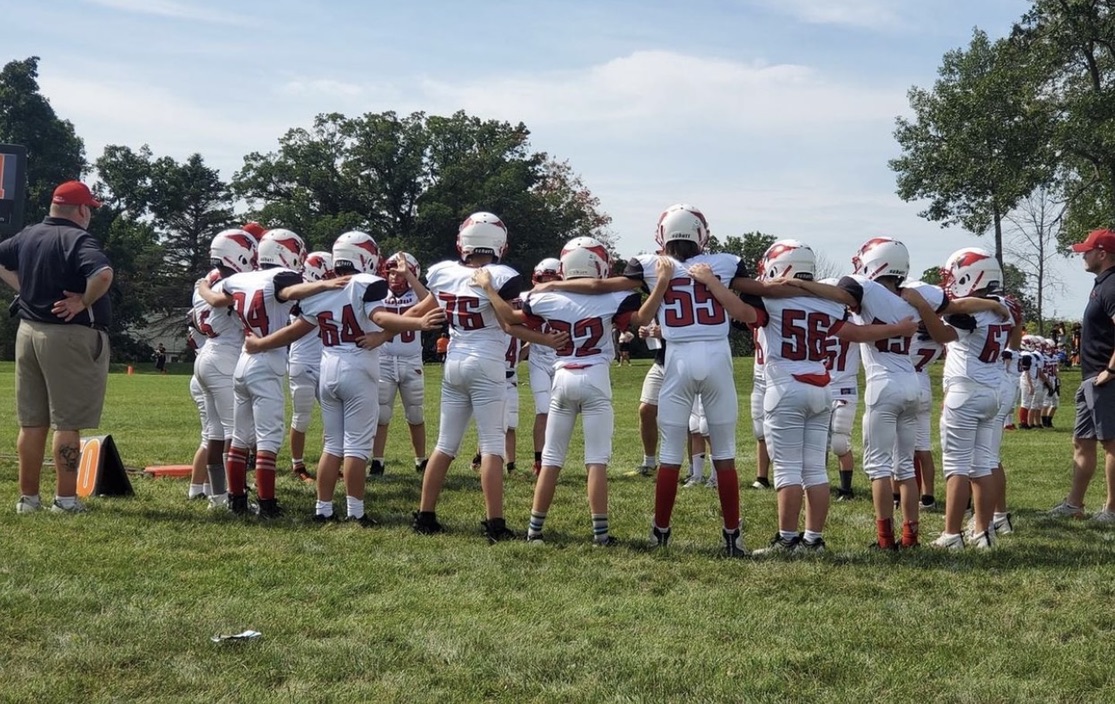
6th Grade. And one of my favorite photos. If you look closely you can see my knee next to Magnus’ (#55)
So I raised my hand to do it again in 7th grade.
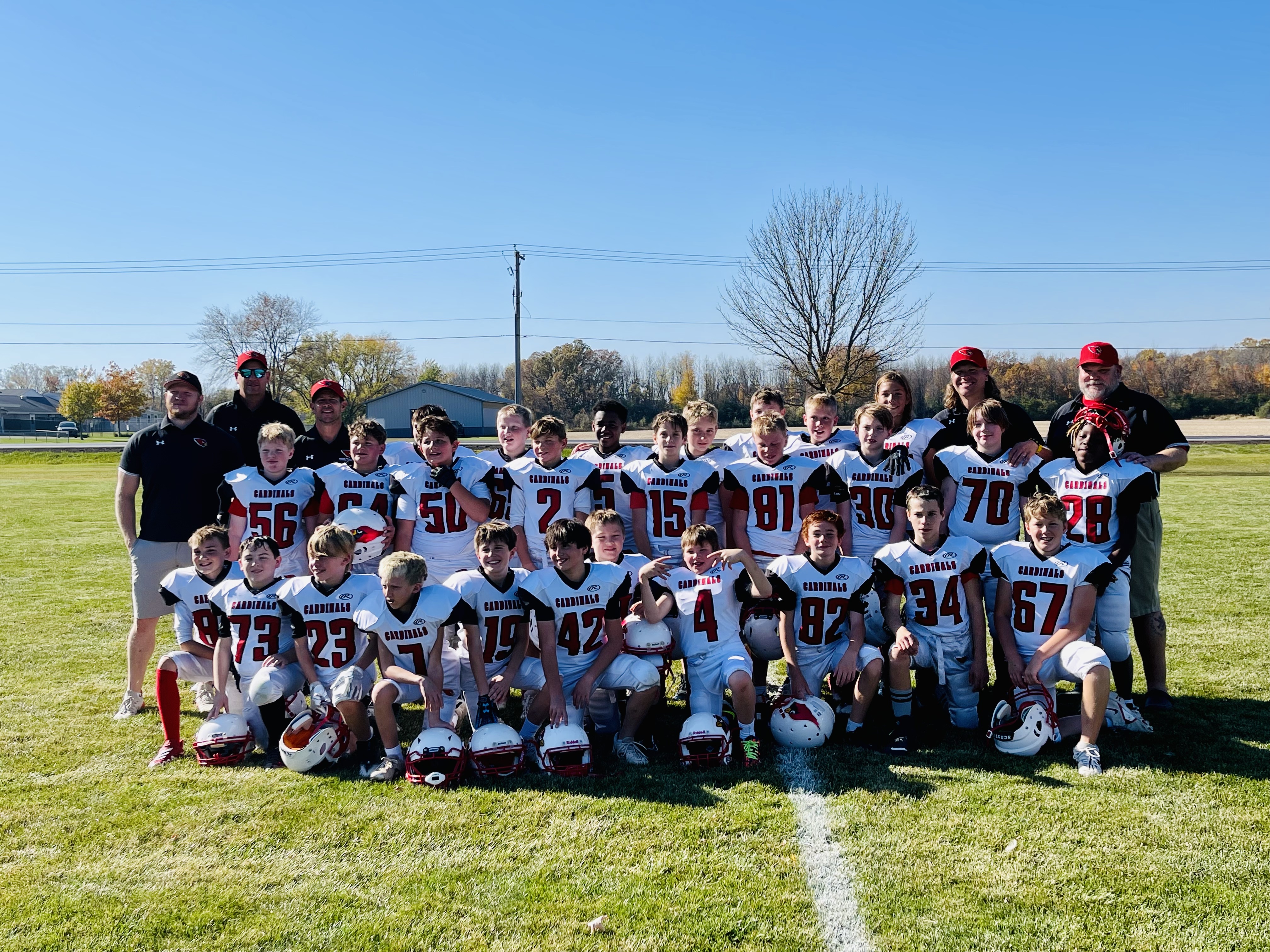
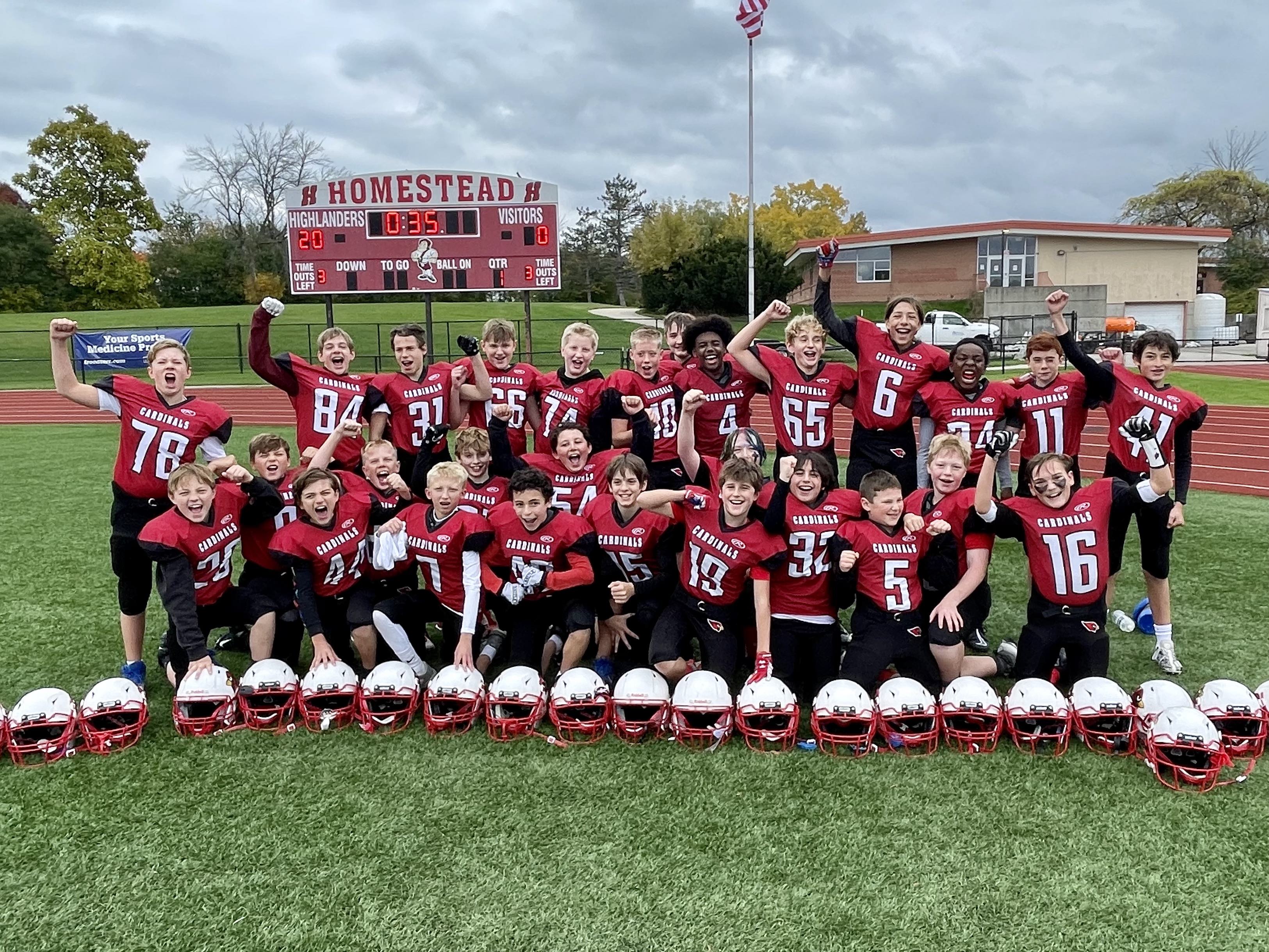
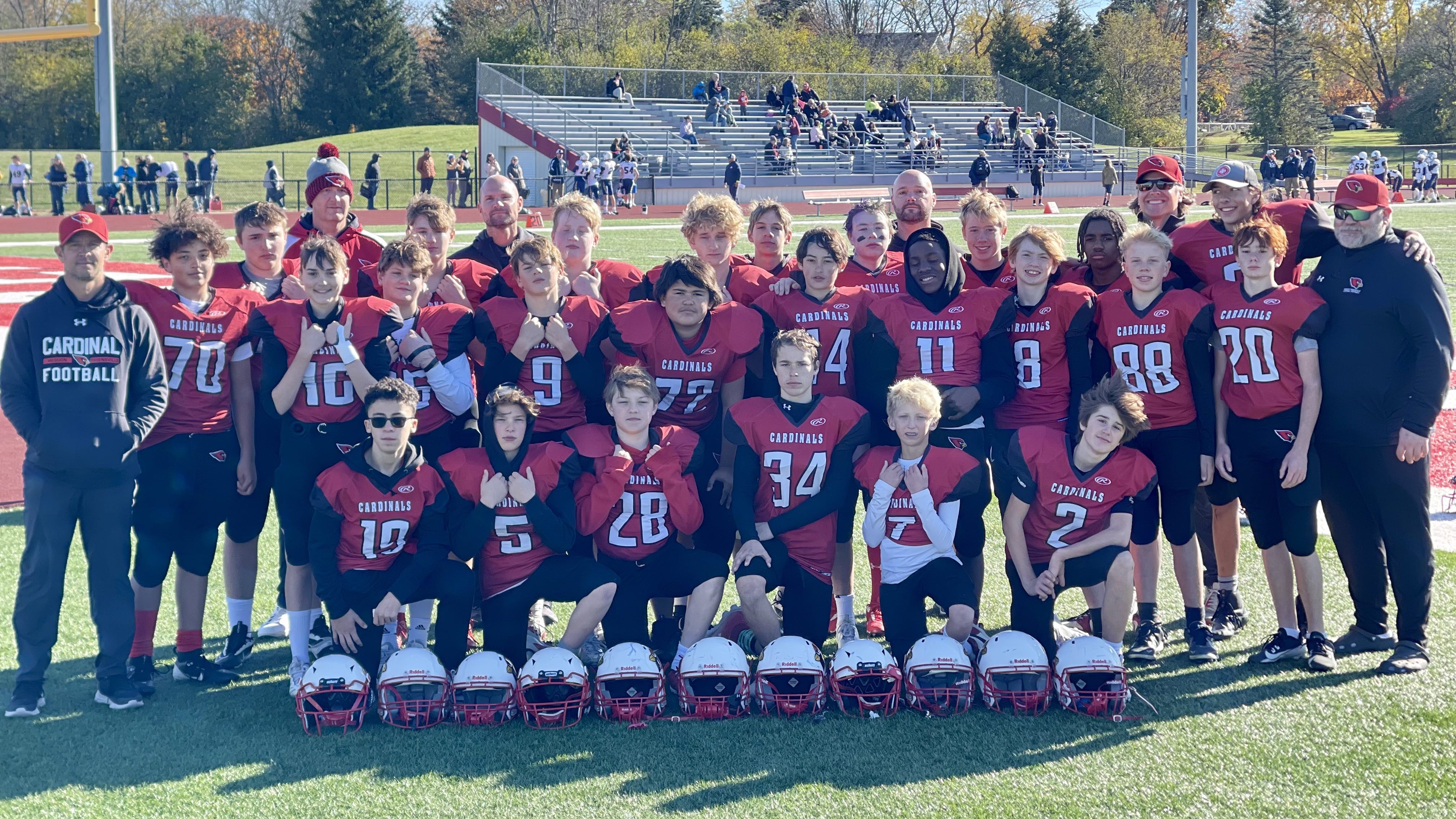
We had a great season in 7th Grade. This was after our last game of the season. Every team should end the year feeling like this.
And again in 8th grade.
For the past four years, from August through October, football has been an intense focus for me. I felt the pressure that comes with being an amateur coach in a high-profile team sport like football. So I prepared as much as I could to help give the boys an edge in the games. Sometimes it really helped. Sometimes it didn’t seem to help at all. This was either because our opponent was so good at doing what they do that we couldn’t stop them, or because they were bigger, faster and stronger than us, and we couldn’t stop them. But either way, I always felt as if I did all I knew to do to prepare our team for each game. And I learned a little from each win and each loss. Which meant that I found a way to win no matter what the outcome was.
Magnus’ 8th grade season. My last year coaching football. And the first time Magnus was taller than me..
The 10 Best Things About Coaching Football.
1. Winning. There is nothing quite like winning a team sport.
2. Being called Coach. For years, I have been called Coach in our community. It’s always fun and surprising for someone who never expected to coach anything to be called that on the sidewalk, in the schools, and in stores and restaurants. It feels both respectful and as if you had a positive influence on a child’s life. It also makes me feel like I should be wearing a whistle everywhere I go.
3. The Brotherhood: Seeing these boys support each other and coming together as a strong team is amazing. Hearing the stories of them sitting together at lunch at school is rewarding. And knowing how close I still am to the guys I played football with makes me excited for them and the relationships they are forging through their collective football experience.
4. Hearing our defense call out the opponent’s offensive formation and the play they are about to run during a game. It meant the boys were paying attention in practice, they recognized what they were seeing and were prepared to defend the play. I loved that.
5. Stops in the backfield: Quarterback sacks and stuffed runs were the big wins for a defensive coordinator. We have had plenty of those over the past few years. It was a thrill every time.
6.Blocked Punts and Kicks. These have a huge impact on the game. They are magical gifts from heaven. Magnus had a slew of these during his Cardinal football career. And I discovered that a slew is the same amount in both the English and Metric system.
7.Interceptions: These are mission-accomplished plays. They are never not exciting.
8. The Funny Kids: Football is a serious game. But I love the kids who brought their sense of humor to practice and made us all laugh. The funnies often create stronger memories than the wins.
9. The Intense Kids: These kids set the tone for the team at practice and in games. They helped get the team mentally prepared to go to work. I always admired the mentality these winners brought to the field.
10.The Respectful Kids. The kids who responded to all coaching with Yes, Coach and No Coach, who looked you in the eyes, and who asked intelligent questions were a pure pleasure to work with and a sign of good parenting.
Key Takeaway
If you have a chance to positively impact the lives of kids, do it. Coaching, mentoring, volunteering, teaching, chaperoning. All of it helps. And you will get just as much out of it as the kids. Our youth can never have too many positive adult influences in their lives. And you gain by sharing your time, talent and knowledge with others. Don’t worry that you don’t know enough. Raise your hand and learn as you go. That’s what I did. And I can’t imagine my life without this chapter, these experiences, and these boys.
*If you know someone who could benefit from this message, please share it with them.
Marriage is a fascinating human experience. It’s both highly rewarding and challenging. Yet while most couples put a lot of preparation into the wedding day, few put much, if any effort into preparing for the marriage itself. Which is why half of marriages end in I don’t. And a healthy percentage of the other half of marriages aren’t as healthy as they could be.
The Program
To help prepare for our marriage, my wife Dawn and I listened to an audio program called Marathon Marriage. We learned the many lessons and philosophies of the program and did all of the exercises shared in the 4 CD set. (At least it wasn’t on 8-track cassettes.) It was a good reminder that just as you need to prepare to run a successful marathon, you need to prepare for a long and successful marriage. So we stocked up on plenty of Gatorade and snacks. And we felt like we had a good game plan.
The Mentors
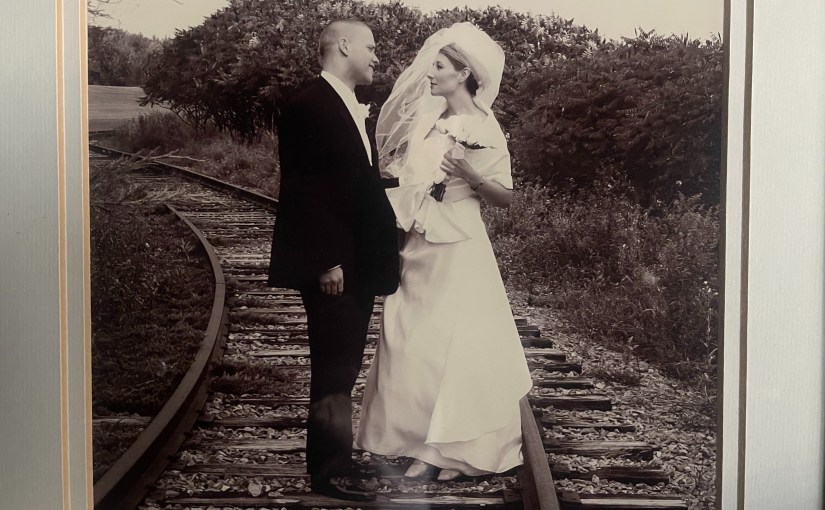
Then, on our wedding day I wanted to cram in one last bit of preparation. So I scheduled breakfast with my three marriage mentors, which included my dad and my two grandfathers (who would all laugh me off the family tree for calling them my marriage mentors). At the time, my parents had been married 32 years. My two sets of grandparents had been hitched for 61 and 63 years.
After we sat down at Emma Krumbees in Wausau, Wisconsin and worked through some Northwoods pancakes and sausage, I decided it was time for the knowledge share. I asked The Paternity Council, ‘What is the key to making a marriage great?’ With 156 years of experience at the table, I was about to get the fatherlode of great advice.
Then my 86-year-old maternal grandfather, Kenny Sprau, crossed his arms, leaned back in his chair and shared,
‘Keep doing what you’re doing.’
Um… WTF Grampy? 61 years of trial and error, nine kids and a World War, and that’s all you’ve got? I wanted to give him a mulligan and see if he could hit it past the ladies’ tee this time. But he went on. ‘You have to keep doing the things that got you to this point.’
My Grampy, Kenneth Adam Sprau. (Thanks for the hair.)
Perspective On The Advice
While at the time the 29-year-old me was totally underwhelmed by the advice, over the past 22 years I have developed a deep appreciation for what Grampy Sprau said. Because when we are dating, we are at our best. The unfortunate tendency is to drop the hard work, energy, attention, and charm we put into the relationship after the contract is signed. Without pouring that effort, care and prioritization into the relationship, the relationship isn’t as healthy and strong as it was during your courtship and engagement. Which is kind of like leaving the cap off a bottle of soda-pop, only to realize that it’s the cap that keeps the soda popping.
Over our 22 years of marriage, I have recognized plenty of times when I was not putting in the same kind of attention and prioritization into our relationship as I did when we were just kids in the heartland, like in that little ditty ’bout Jack and Diane. It gets much harder alongside the demands of raising children, building a successful career, growing a business, and the effort required to fend off the Dad bod creep. But whenever I find that my attention to my bride has slipped (or I am reminded by my bride that my attention to my bride has slipped), I use Grampy Sprau’s advice, to help make the appropriate adjustments and corrections.
Applying The Advice To Business
Eight years after launching the advertising and ideas agency, The Weaponry, I have discovered that Grampy Sprau’s advice holds true in business as well as marriage. You need to treat your potential clients and partners well. Act as if you would like nothing more than to spend the rest of your time together. Listen. Make them laugh. Show them you are interesting, kind and thoughtful. And then after you get the contract signed, keep doing what you’ve been doing.
In business, as in marriage, listening and collaborating are valuable approaches to your growth strategy. Clients and spouses alike really like that stuff. (Crazy right?) When you respond favorably to a client’s request, they generate something called ‘good feelings’ about you. And these ‘good feelings’ make them want to see you more and work with you more. And the result is business growth.
The opposite is also true. If you are the all-time best seller at The Jerk Store, no one wants to be around you. This is true of both the individual and the organization.
If you recognize complacency, apathy or combativeness between your organization and your clients or between you and your spouse, stamp that out like a flaming bag of dog poo on your front porch. The behavior may feel justified today. But you’ll regret the justice leveled tomorrow when you’re trading the offspring in the McDonald’s parking lot.
Key Takeaway
Treat your spouse the way you did when you were dating. Treat your current business like new business. Never take either of them for granted. Work to re-win them every day. Even after you put a ring on it.
Thanks for the wise advice, Grampy.
*If you know someone who could benefit from this message, please share it with them.
How do you make yourself more important? It’s a simple but valuable question to ask. While there may be a million ways to become more important, there is one proven approach that anyone can use, regardless of your current skills and resources. It even works if you are not really, really good-looking, like Zoolander.
Here it is in two simple steps.
In every situation you are in determine who is the most important person.
Make yourself useful to that person.
Some examples:
In school, become useful to your teacher, professor, principal or Dean. Volunteer. Ask questions or provide answers. Make them look good during their annual evaluations. (Definitely do that last one.)
On a team, make yourself useful to your coach. This could be through actions or attitude. Set a great example. Help set up for practice or clean up after. You could also show up every day really tall, fast, strong, or coordinated. Coaches love that.
As an employee, make yourself useful to your boss, Hugo. Get your work done on time, every time. Help improve processes, efficiencies and effectiveness. Help improve revenue or profitability. If your boss is a bumbling idiot, help them hide it. (I always appreciate it when my team does that for me.)
At a party, make yourself useful to the host. Be a quick set of helping hands. Smile and have a good time. Introduce people. Play the games the host wants played. Unless the host is P-Diddy.
At home, there are always opportunities to be useful to your spouse or your parents. And making yourself more useful at home is one of the most important things you can do.
Try It Yourself
Start by evaluating who is the most important person in every room or situation you are in. Most of the time, this is easier than it sounds.
Then look for opportunities to provide value.
It’s a great habit to develop. And you’ll get better at it the more you practice. Soon you’ll recognize how valuable this approach is when you are the most important person in the room and others are going out of their way to be useful to you.
Key Takeaway
People are deemed important because they add value in some way. It may be through their intelligence, leadership, experience, responsibility, or a range of other skills and attributes. When you make yourself valuable to those people, you are adding to the value they bring. Which in turn increases your usefulness. As a result, you stand out from the crowd in the eyes of the person who already stands out from the crowd. Remember, your value is directly related to your contribution. Contribute to the most important person in the room’s success and you will contribute to everyone in the room’s success. That is how you make yourself important.
*If you know someone who could benefit from this message, please share it with them.
Welcome to December. 2024 is now 11/12ths complete. Which means you have one month left to make progress on your life and yearly goals. If you are a procrastinator, you have already hit the snooze button 11 times, and it is now time to get up and go. (If you are an amateurcrastinator you are not as good a procrastinator. But I don’t know if that means you put things off more or less. #ThingsThatMakeYouGoHmmm.)
December means you have one month left to:
Finish the year fitter, not fatter. The best way to a better body in 2025 is to start in 2024.
Revisit your New Year’s resolution. You likely left it somewhere in January.
Start a new habit. (ReadAtomic Habits by James Clear to check the box on this and the next item. Plus it is half-price right now. You are welcome.)
Read a great book this year. (See above.)
Get in touch with that person or people you haven’t touched in too long.
Go to church. December is the best time to go anyway, for Christ’s sake. And for the bread and juice. And to try to get off the naughty list.
Donate to charity. (And get the tax benefits.)
Start that business. (I am working on starting an Excite Hustle with my son. We have talked about it for forever. But we are going to make it happen this month! An Excite Hustles is like a side hustle, but it excites you about doing work.)
Begin writing that book. Just start by writing down a simple outline of what you know about the topic, or a paragraph summarizing the plot, like Sir Mix-A-Plot. I write my books in a Google Doc. You don’t need anything fancy. Or schmancy.
Take that trip. Or schedule and book that vacation. It’s a great time to lock in your spring or summer travel and give yourself something to look forward to this winter. Unless you live somewhere vacationy already. In which case, pick another thing to do with your 12th month.
Do a million other things. Those first ten items were just examples. I don’t have time to write an exhaustive list of everything you could possibly do this month. Because we both have more important things to do. So let’s go, Geronimo!
Key Takeaway
Time keeps on slipping, slipping, slipping into the future. You have to recognize the passage of time to make its scarcity useful. The last month of the year, the last day of the week and the last hours of the day create a valuable sense of urgency, signaling it’s go time. Remember, when you hit a deadline, the opportunities afforded by that unit of time are dead. Let that motivate you to go now. There’s no better time.
*If you know someone who could benefit from this message, please share it with them.
This week, you get an amazing gift. No, Ed McMahon won’t be showing up with a humongo check. You won’t have wise men pop in unannounced to drop off gold, fruitcake and myrrh. Instead, you will get the precious gift of time. Time away from work, or school, or even working at a school.
But you don’t just get 1 or 2 hours free. And not just 8 or 24 hours either.
You get a shipload of time.
In fact, you get 111 hours free!
The Math
If you are one of the many who don’t have to work or go to school Thursday through Sunday, your time off starts at 5pm on Wednesday and ends at 8am on Monday.
In between there are 111 hours for you to spend wisely.
You can use it on quality time with friends and family. There is plenty of time for talking, playing, singing, and laughing until liquids sprays our of your nose. And if your friends don’t make you laugh until you leak, you need better friends.
You can invest in your health. Walking, turkey trotting, hiking, or any other calorie burning activity before or after the meal is a great idea.
You can read. You can read a lot in 111 hours. In fact, you could probably read all 1032 blog posts I have written here at The Adam Albrecht Blog. You could read my book What Does Your Fortune Cookie Say? Or you could read an important piece of literature, a valuable self improvement book, the biography of a wildly successful human or a tale of epic human adventure and triumph. But my blog will have more random pop culture references. So I’ve got that going for me. Which is nice.
You can schedule that health checkup, or that therapy session you know you need. You could enroll in a program to stop doing that thing you know you shouldn’t do no more, like Phil Collins said.
You can start working on that master project you have always dreamed of. Or that mini project you couldn’t seem to find time to do, Mickey.
You could plan a vacation. Or book a vacation. Or at least watch National Lampoon’s Vacation.
You could transfer money to savings. Or to that investment account. Or to me.
You could plan a dinner with people you love chewing the fat with.
You could schedule a Zoom with friends or family that you won’t see in real life this holiday. But not if they are no longer in real life. (Zoom hasn’t worked out that technology yet.)
You could plan impromptu in-person get-togethers, right now, over me.
You can play games. Board games. Card games. Football games. Reindeer games. We don’t game enough.
You could start planning your own business. (Not that that’s any of my business.)
You could start filling a notebook with everything you know about a specific topic. That’s a great way to start writing a book.
You could volunteer. Even if you are not in Knoxville.
In fact, you can do just about anything you please.
But please, please, please don’t do nothing, Sabrina.
You can do nothing anytime.
Key Takeaway
You are about to receive the most precious gift of all. The gift of time. 111 hours. A stately sum. Invest it any way you like. But whatever you do, don’t waste it. Because you will never get it back.
If you found something valuable or rewarding to do with your 111 hours, please shoot me a note to let me know what you did at 614-256-2850 or at adam@theweaponry.com. I am always looking for good ideas and success stories.
*If you know someone who could benefit from this message, please share it with them.
It’s that time of year again. My inbox is full of Black Friday promotional emails. Everyone is offering discounts to get you to spend your hard-earned money with them in their final push to profitability for the 2024 fiscal year. And these great deals have many salivating like Pavlov’s poodles on a pile of bull pizzles.
But I have already picked up the best bargains available this week. And you can too.
Yesterday, I drove to my local Goodwill store with a load of donations. I dropped off 5 boxes of clothes, shoes, toys and other odds and ends that have outstayed their usefulness in The Albrecht Home. (You ever notice it is always the odds and ends that go, and never the evens and middles?)
After dropping my load in the drive-through, I parked my Expedition and walked into the store. I didn’t browse. I headed directly to my usual destination at the far back corner of the store. There, between the obsolete records and DVDs, I found my favorite treasure hunt honey hole: the Goodwill used bookshelves.
I scanned every shelf, looking for discount gold. I found 5 books, each for sale for between $1.99 and $2.99 that I had to have. I made my way back to the cashier counter and paid for my collection. But I felt like I stole them. Because I only paid $14. And that included rounding up for charity.
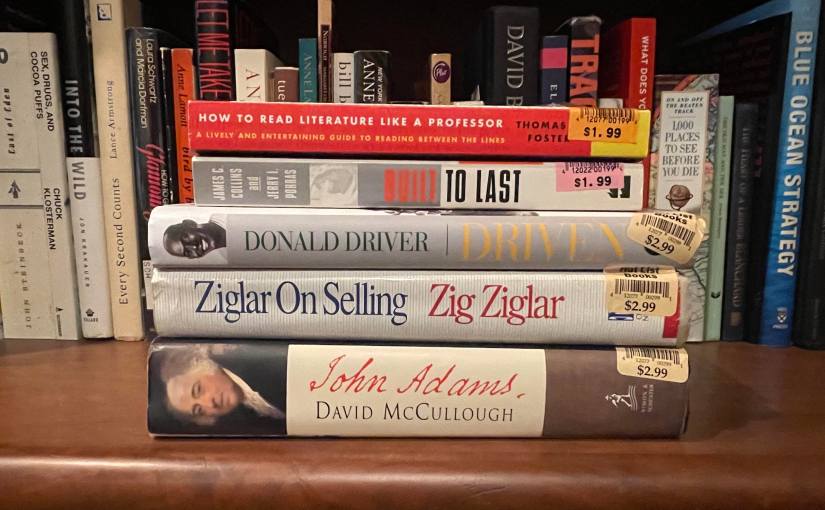
For that $14 I got:
Driven by Donald Driver: From this book, I will learn a lifetime of lessons from one of the greatest football players of all time. I expected to be entertained, educated and inspired by a man who went from homeless to Super Bowl and Dancing With The Stars champion. How much would you pay to hear him share his best life lessons? I bet it’s more than $2.99.
Ziglar On Selling by Zig Ziglar:Double Z is known as the greatest authority on selling ever. (In fact, he sold me on that designation.) And in case you didn’t realize, we humans are all selling all the time.) I expect I will pick up lessons from this book that will help translate to millions of dollars of revenue from my businesses, books and speaking engagements. All for $2.99.
Built to Last by James C. Collins and Jerry Porras. From this book, I know I will learn successful habits of visionary companies. Not only because it says so on the cover, but because I have already read this book. But that was before I owned The Weaponry. Now I will reread this great business book with a new perspective that will help my business thrive long into the future. Which is worth far more than the $1.99 I paid.
How To Read Literature Like A Professor, A lively and entertaining guide to reading between the lines by Thomas ‘Bananas’ Foster: This New York Times Bestseller is sure to help me get more out of my reading and understanding of the most important books ever written. And I expect that Foster will have more interesting insights to share with me than when kids used to hold up their 3 middle fingers and tell me to read between the lines. Understanding the deeper meanings of great literature seems like a steal for just $1.99.
John Adams by David McCullough This epic biography of one of America’s Founding Fathers is sure to deliver great inspiration and historical insights. I will learn more about the grit and determination of those charged with creating and fighting for this great nation. And I might finally learn what was up with those powdered wigs. Plus, buying a 750-page hardcover book for just $2.99 means I got more value in burnable paper than I paid for. And that’s before you factor in a full squid’s worth of ink.
Key Takeaway
As you look for bargains this week, don’t overlook books. Books at any price offer immense value. But on sale, or at second-hand-discounts they provide the best return on investment you will ever find.
*If you know someone who could benefit from this message, please share it with them.
When I was a kid, I liked chewing gum. I found the whole process fascinating. And when I say the whole process, I mean the whole process. I discovered that human effort can transform gum. And through the same process, we can learn to transform ourselves. Which is getting pretty deep for a story about chewing gum. But let’s go with it and see what we land.
Chew, Chew!
Gum starts as a solid form. It’s typically a stick or a small blocky nugget of some sort. Although it could be shaped like tape or rope. It could be a primary-colored ball. (I always call gumballs Bryant or Greg.) Or your gum may be shredded like cheese if you are into Big League Chew. And I am into Big League Chew.
As you begin to chew, your gum changes form under your direction. It softens as you mash it and mold it with your molars.
During the chewing process, gum releases its embedded flavor into your mouth. Gumtastic flavors include mint, peppermint, spearmint, experiment, wintergreen, cinnamon, grape, orange, watermelon, sour apple, lemon, strawberry, blueberry and the elusive juicy fruit, the Sasquatch of fruit.
Despite the wide range of interesting flavors that are used to create and market gum, shortly after you start chewing, the flavor disappears. And when it does, the most enjoyable part of the experience is over. Boo.
Then, not long after that, the gum begins to harden. Double Boo.
At this point, the fun part of chewing gum is over for most people. In fact, most people spit their gum out somewhere between the flavor dissipation and the great hardening.
But my favorite part of chewing gum comes after most people quit it, spit it and forget it.
At that point, most people feel they have extracted all the value they could get from gum. Other than maybe sticking the hard, flavorless wad to the underside of a desk or a railing for Buddy Elf.
Most people have no idea what happens after chewing gum loses flavor and hardens.
But I know.
Because when I was a kid, I loved to keep mashing away after the thrill was gone for most kids. I felt like the gum became an opponent to beat. I felt the gum was challenging me to a showdown on the playground at high noon. And the formerly fruity gum thought it was tougher than me.
But I wouldn’t wave the white flag.
I kept chewing and chomping. Like a cow chewing cud. Or Hubba Bubba. Or Bazooka.
Then, an interesting thing happened.
The gum gave up.
The wad of gum that became so tough to chew threw in its tiny little gum towel. It softened again. And then it fell apart. It lost all shape. It lost its will to gum. It stopped resisting. And it literally liquefied.
The formerly proud gum became a runny puddle of nothingness. No flavor. No form. No function. In fact, you could no longer even hold it in your mouth. If you didn’t spit the puddle out it would leak out of your face.
I loved getting to that point. It always made me feel like I had won. I felt like I took on a difficult challenge and completed it. I felt like I took on a difficult opponent, and I beat it. Like Michael Jackson.
The Lesson
Gum chewing taught me I could do hard things. That I could push through the unrewarding muddy middle of a long process. And that if I just kept going, even when it wasn’t fun. I would win.
I have applied the gum-chewing lesson countless times throughout my life. I found the approach useful as a track and field athlete when the work felt hard and the rewards felt small. It was helpful as an entrepreneur when I started The Weaponry and found that you just have to keep chewing no matter what. The lesson served me well when I wrote What Does Your Fortune Cookie Say? and the work seemed long and the finish line was nowhere in sight. And as I faced the hard and unrewarding parts of parenthood, employment and yard maintenance I reminded myself that the key to getting through tough times and past challenging obstacles it to just keep chewing.
Key Takeaway
Success and accomplishment is like chewing gum. Everyone enjoys the beginning. It’s full of flavor and quick rewards. But when those immediate rewards disappear, it’s easy to quit. You lose interest and motivation. And when things get hard, it’s easy to get soft. But if you just keep going, keep doing and chewing, you will win. You will get the ultimate reward of knowing that you are tougher than the things you face. It’s an incredibly valuable lesson to learn from a stick of Big Red or Juicy Fruit. It’s a lesson that is more valuable than the fun, the flavor or the freshening the gum provides. But you only learn that lesson by sticking around when things get hard, and chewing to the very end.
*If you know someone who could benefit from this message, please share it with them.
Are you worried about your age? Are you concerned that you are too old for the types of opportunities that now interest you most? Do you feel that you are too old to learn the new thing that is transforming your industry? Do you feel like you are too old for the dream you have been dreaming your whole life? Do you think you are too old to cut the mustard and not realize that mustard no longer needs to be cut?
Or do you think you are too young? That you don’t know enough and that you are not ready for the opportunities that are at your doorstep? Do you feel too young for the next level of responsibility? Do you find yourself singing, I don’t wanta grow up. I’m a Toys R Us kid?
I am currently reading Curtis Jackson’s book Hustle Harder, Hustle Smarter. You may know Curtis better by his monetary name, 50 Cent. Fifty talks about how some people have a difficult time transitioning as times change. Then he dropped these 2 cents (which may mean he is now 48 Cents):
“Age isn’t about what year you were born in. It is about how you approach the year you are in right now. “
-Curtis ’50 Cent’ Jackson
This is a good reminder to face today as if you belong. As if the changes, advances and technologies are coming for your benefit. Not to leave you behind, like Nicolas Cage and Lea Thompson.
Approach this year and every year with a growth mindset. As a learner. As a Curious George, ready to get into new trouble. Or as a Sponge Bob, ready to soak up new ideas and new possibilities, instead of simply becoming a Krabby Patty.
Key Takeaway
Your mindset should be an asset, not a liability. Approach each year with a youthful spirit and you will learn, grow, explore, and take advantage of all the new opportunities available. Recognize the new roles and opportunities afforded to you. Don’t get stuck in the good old days mindset. There are great things in every day. You simply need to adapt to take advantage of them.
*If you know someone who could benefit from this message, please share it with them.
Today is the big day! Election Day 2024. Today, one way or the other, the political ads will be over, and we can finally get back to more important commercials about beer, incontinence, and the fancy new weight loss drugs.
If you pay attention to the political ads and news coverage you may believe that the outcome of the election will mark the end of days if it doesn’t go your way. The messages from the candidates’ campaigns are ominous. They all paint a stark win or lose, do or die, fail or thrive future. It is as if our very existence rests on the outcome of this election.
But none of that is true. Whatever happens, we will be fine. We can and will survive anything that comes our way. We have endured the Civil War, The Great Depression, and the Disco era. We have faced the oil crisis, the mortgage crisis, the COVID-19 pandemic and the toilet paper crisis. They all did their best to sink us. But America is the Molly Brown of countries.
I have voted in every presidential election since I turned 18. I carefully studied the candidates and how their beliefs aligned with mine. I looked at how their policies would impact my personal freedoms and finances. I considered how they would act to help others in my community and country. I evaluated how the candidates would affect our relationships with other countries and world peace. Then I carefully voted for what I believed to be the best candidate. Just like a good American should.
However, the candidate I voted for has only won half of the elections. Which means that, in theory, the person who wanted the opposite of what I wanted won the other half of the contests. Yet, ob-la-di, ob-la-da, life has gone on.
It is easy to get caught up in the hype and extremism of a political election and think that there are clear winning and losing scenarios for the masses. But history would indicate otherwise. You will naturally lose roughly half the elections you vote in. And when you lose, America will still be full of moms, baseball and apple pie. And you can still share all of those things on Facebook, Instagram and Tik Tok. Plus, you will still get to vote again in 4 years. And the pendulum always swings. Like Benny Goodman. And the Squirrel Nut Zippers.
So today as the last of us vote, and tonight as you watch the results come rolling in, remember, it will all be okay. There is more than one way to lead our country. There are pros and cons to each style, and each belief system. It’s why roughly half the country agrees with your thinking and half the country doesn’t understand you.
I respect that political positioning forces the campaigns to market the candidates ideas and ideals as diametrically opposed. But at the end of the day, both sides want to continue developing a great America. They just have different ways of going about it. Which means they are focused on pulling different levers, and pushing different buttons on the Wonkivator to get the machine to perform at its best.
America is a great country. Because it was founded by rebellious people who believed there was a better way of countrying. And America has attracted great and rebellious people ever since (think David Bowie and Billy Idol) who have continued to bring new and better ways of countrying.
Sure, we have unsolved problems. And we always will. Because life is one long problem solving adventure. We will continue to work towards better approaches to equality, security, safety, prosperity, health and peace. We just have different beliefs in how it is done. Neither approach is 100% right. And neither approach is 100% wrong. There ain’t no good guy. There ain’t no bad guy. There’s only Americans, and we just disagree. But that’s ultimately what makes the system work.
Key Takeaway
Things are going to be okay. There will be a lot of drama beginning tonight. It may last for months. But we will all be okay. Both candidates approaches generally work. We will continue to improve our country, our security and our economy no matter who is in the White House. Because ultimately, it all comes down to what we the people do.
*If you know someone who could benefit from this message, please share it with them.








 Adam Albrecht Blog