This 4th of July, Remember That You Come From Brave People.

Happy 4th of July!

I love everything about this holiday.

The parades and fireworks.

The American flag swimsuits.

The hot dog eating contests, and imagining the parade and fireworks they must cause at the other end of the GI tract.

America

This year, as we celebrate the 249th 4th of July in America, my mind keeps returning to a piece of art I saw several years ago in California.

My family and I were celebrating my son Magnus’ birthday at Ivy At The Shore in Santa Monica. In the restaurant, there was a large image of a sailing ship with all sheets fully winded, plowing through rough seas.

Over the image were the words. ‘Brave Men Run In My Family.’

Ed Ruscha originally created this idea. I’m not sure who to credit this version to.

This piece really speaks to me.

Not because I come from a sailing family. (I come from more of a rummage saling family.)

I love it because the painting reminds me of all the brave decisions my forefathers and foremothers made to come to America and risk so much for a better life.

Their brave decisions gave me and my fellow American offspring better opportunities than we would have had in the non-American countries my people came from.

However, this truth is not unique to me and my family.

All Americans are descendants of brave Grandcestors who bet on themselves and came to America for the freedom to create better lives. Amazing lives. The kind of lives Robin Leach would have profiled, up close and personal.

As we celebrate Independence Day, remember that you come from brave men and women.

They left home, family, friends, and all that they knew to come to America, the land of the free, for the chance at something even greater.

Make sure to honor them by doing great things with your life.

Be brave and courageous.

Take calculated risks.

Live into your own dreams.

Bet on yourself.

It is the safest bet you will ever make.

Do if for yourself.

And do it for your family members who did it for you first.

Happy Independence Day.


*If you know someone who could benefit from this message, please share it with them.

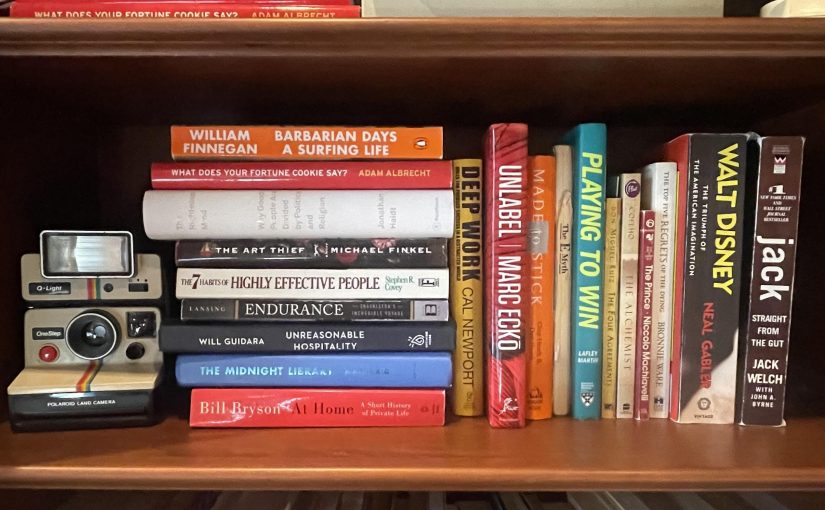
+For more of the best life lessons I have learned check out my book, What Does Your Fortune Cookie Say? from Ripples Media.And consider subscribing to Adam’s Good Newsletter.

My Misogi Challenge for 2025.

I have been intrigued with Misogi Challenges since I was a teenager. Granted, back then, I didn’t know that they were called Misogi Challenges. I just called them Personal Challenges. Or Doing Hard Things. But I like the Japanese name for them better. Because it makes them sound more profound and official and less like a Hold-My-Beer stunt.

What the Miyagi is a Misogi Challenge?

A Misogi challenge is an annual event in which you take on a difficult personal challenge with a high probability of failure. You do this to push your personal limits, develop grit, resiliency, growth and confidence. It also provides good content for your social media network. Especially if your challenge is to step into a boxing ring with 57-year-old Rusted Mike Tyson.

My Misogi Challenges have included:

  • Trying to break the New Hampshire state record in the discus within 8 months of ACL reconstruction surgery. (That was freaking hard.)
  • Eating my lunch outside every weekday for an entire year. (I ate alone a lot in 2015.)
  • Launching a business. (That’s how I started The Weaponry)
  • Publishing a book (That’s how I wrote What Does Your Fortune Cookie Say?)

Misogi Challenge 2025

This year, I have given myself a bench press challenge.

For context, I first benched 300 pounds when I was 17 years old, during the summer after my junior year of high school.

My senior year in high school, I benched 335 pounds while recovering from the ACL reconstruction surgery mentioned above.

At the end of college, when I was 23, I put up 423 pounds when I weighed 211 pounds. 423 is an odd number for weight lifting. But I was using heavy-duty, 1.5-pound collars to secure the weight to the bar. And at 211 pounds of body weight, I counted every pound to see if I could double my body weight.

But that was nearly 30 years ago. That was back when Mike Tyson would have destroyed a social media influencer if such a thing existed.

My 2025 Misogi Challenge includes 4 different goals.

  1. Bench Press 300 pounds. This is a fun club to still be in 35 years after I first joined it.
  2. Bench Press 315 pounds. Everyone who lifts weights seriously knows that this is three 45-pound plates on each side of the bar. It’s a milestone for weightlifters. And it looks great on the bar. (But not so great if it is sitting on your chest.)
  3. Bench Press 335 pounds. I love the idea of still being as strong at 52 as I was at 18.
  4. Living to fight another day. I don’t want to push myself in a way that compromises my tomorrow. So I am listening to my body. And if it says, ‘Back off!‘ like those Yosemite Sam mud flaps, I will back off. You have to play the long game.

The Progress

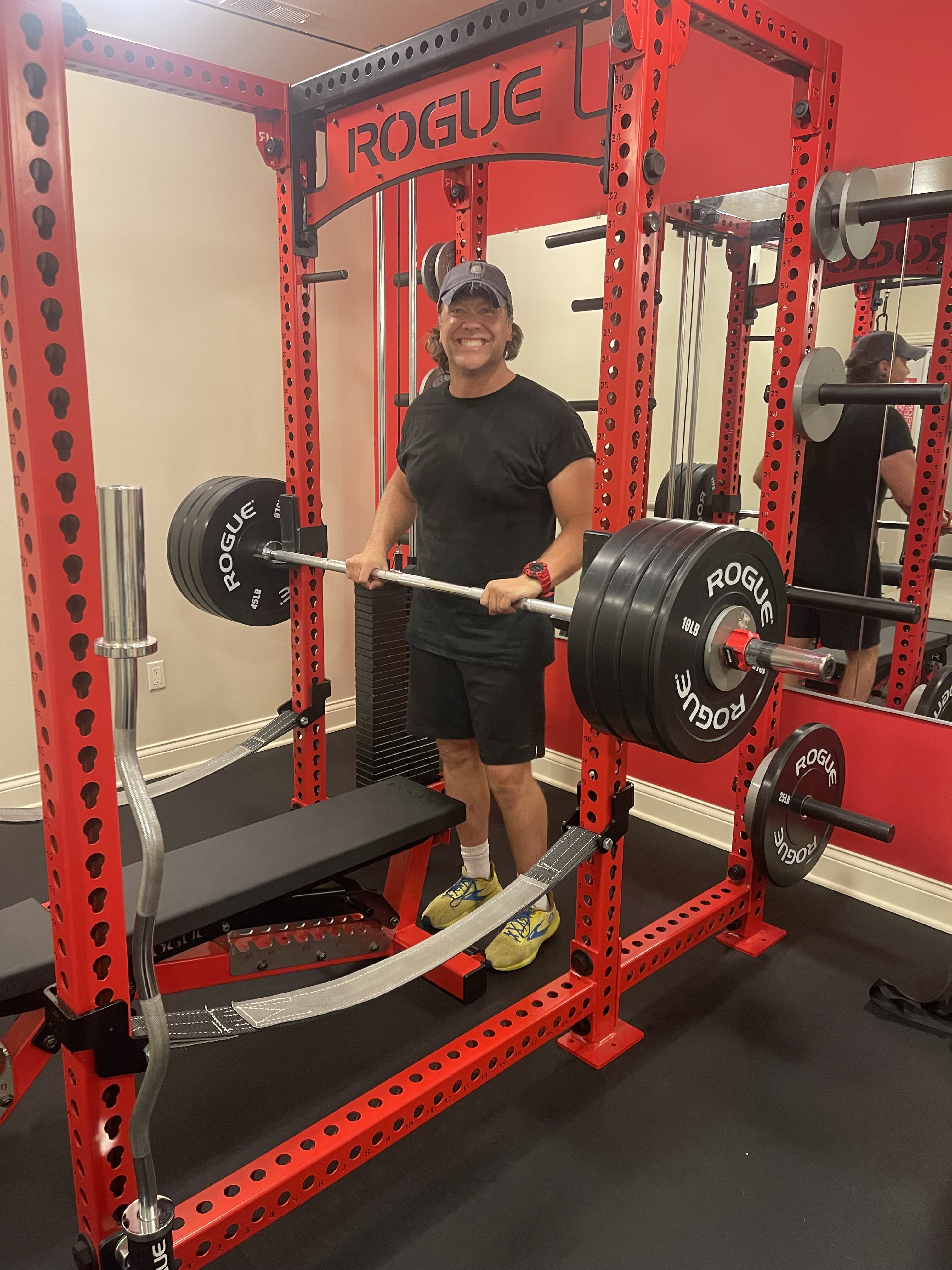
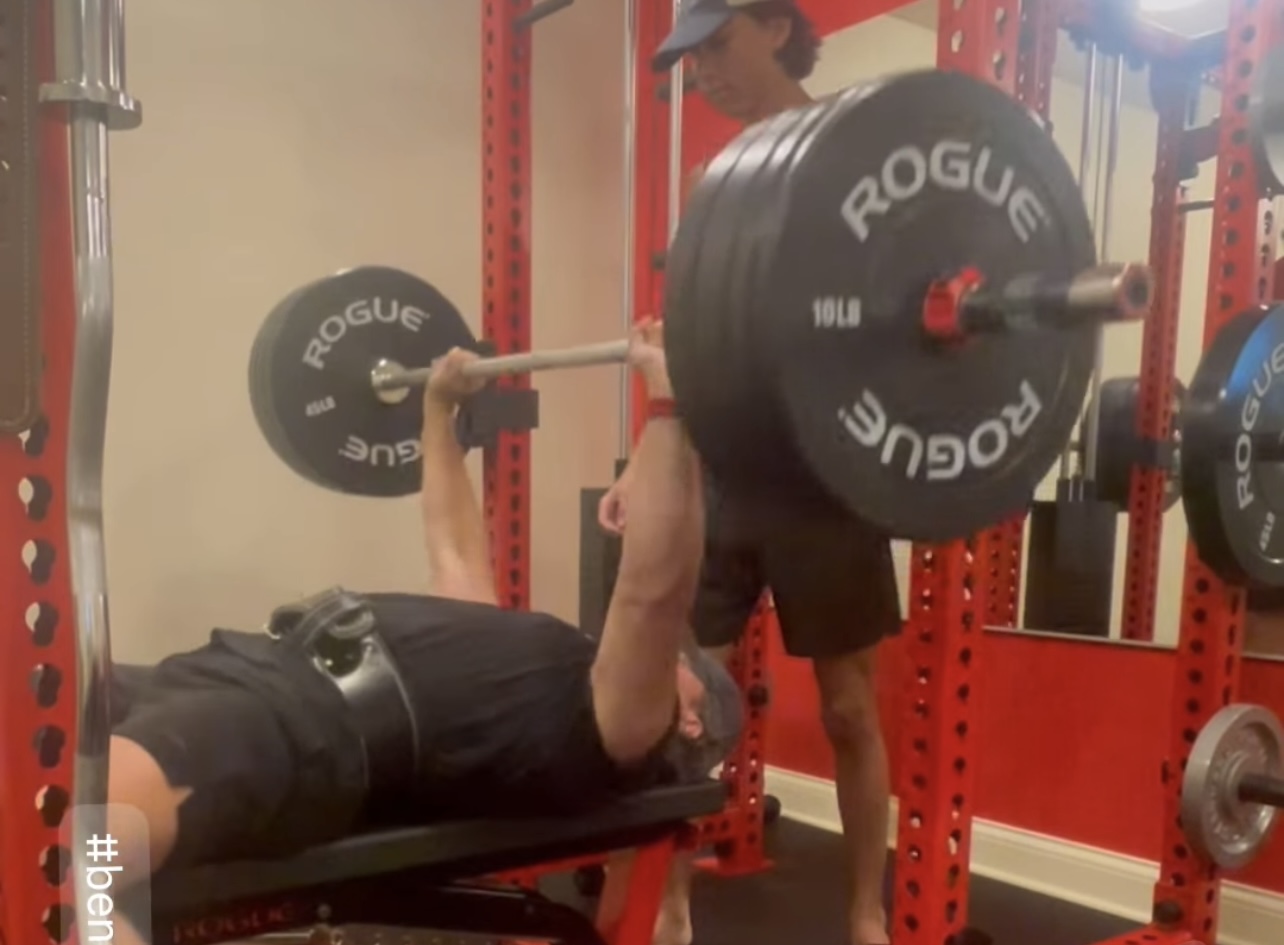
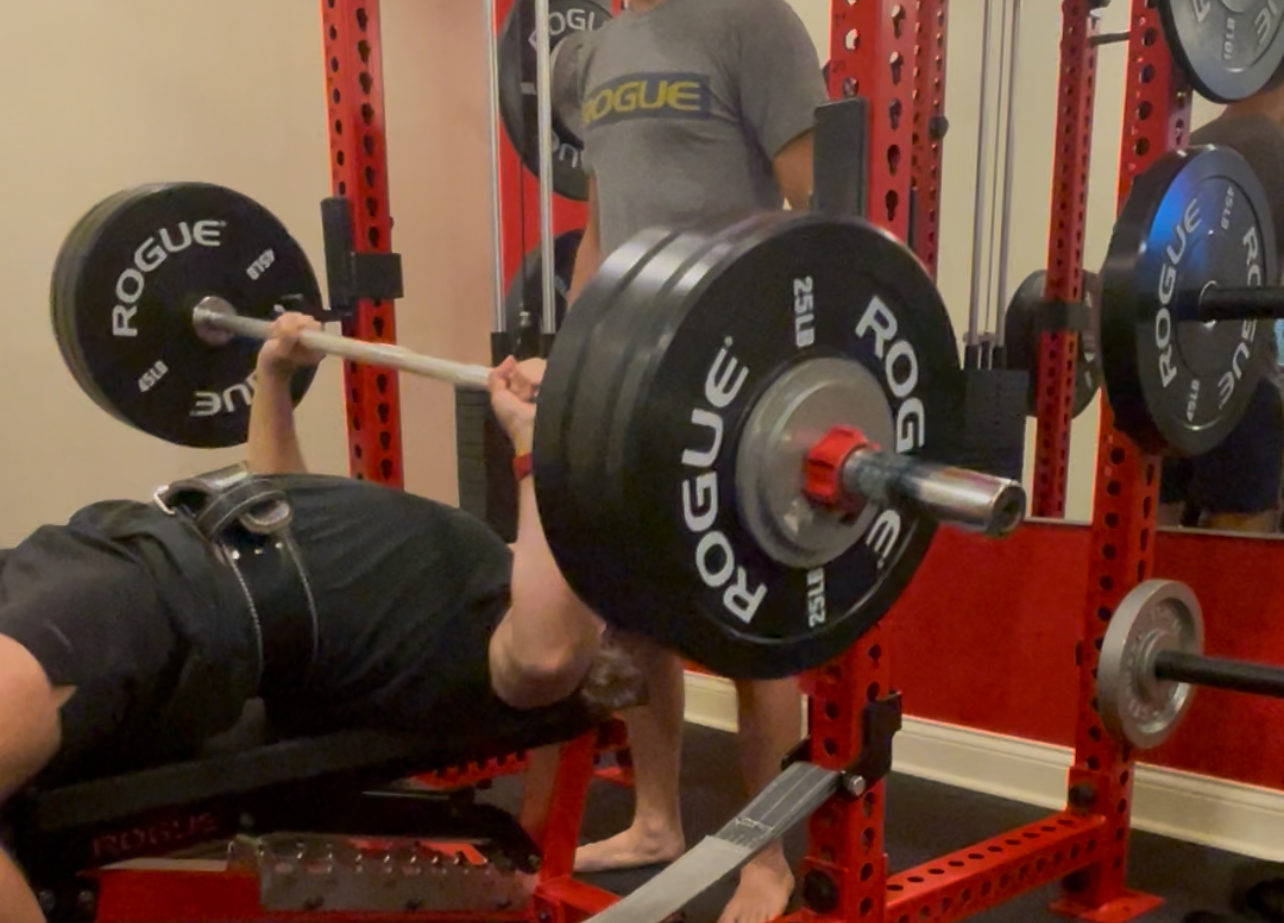
Monday night at 9:15pm, I bench 295 pounds 4 times.

The week before, when I was fresher and lifted earlier in the day, I benched 290 pounds for 5 reps.

My Monday night workout with my undersized spotter.

While these numbers are a far cry from where I was at my best, I have learned that the decades add to the degree of difficulty. I love that this challenge is pushing me to do hard things. When I was in my teens, 20s and 30s I never thought I would still be flirting with these kinds of numbers in my 50s. But then again, I also thought I would be bald.

I plan to share updates on my progress over the next month. I should attain the 300-pound goal next week. And I expect to peak by late July or August. And most importantly, I hope to live to fight another day. Because I have plenty more challenges yet to come.

It’s Your Turn

I encourage you to take on your own Misogi Challenge. They can help you accomplish great feats, like writing books, starting businesses and running marathons. They create exciting chapters of your life, which help make the story of your life more interesting. They push you to expand and redefine your personal limits. And they fan the flames of your competitive spirit.

Key Takeaway

Do hard things. Push yourself. Challenge yourself. A good Misogi Challenge, or difficult challenge by any other name, makes you feel alive. These challenge force your to keep growing. They stoke your competitiveness. They build your resilience and confidence. They help you live a more interesting life. And they help remind you that you can do hard things. Which means that when the hard things come your way, you know you can handle them. Because you’re a badass. And you choose to do hard things for fun.

*If you know someone who could benefit from this message, please share it with them.

+For more of the best life lessons I have learned check out my book, What Does Your Fortune Cookie Say? from Ripples Media.And consider subscribing to Adam’s Good Newsletter.
Wake Up And Take Control Of Your Day with This Simple Habit.

When I was a kid, I had a small, square alarm clock.

It was very simple.

It had a traditional analog face, with an hour hand and a minute hand. (They actually looked more like arms than hands. But I think that ship has sailed.)

On the back of the clock, there were two simple dials. One set the time. The other set the alarm.

On top, there was a single, mushroom-shaped button. (Which grew in the dark.)

You pulled the plastic mushroom up to set it.

You pushed it down to turn it off.

That’s all there was to it.

But what was really important about my alarm clock was its location, location, location.

I didn’t set it on my nightstand like normal alarmists.

I placed it on top of my dresser on the other side of the room.

Every morning when the alarm clock sounded, I hopped out of bed and hustled across the room to turn it off.

And just like that, I was up and out of bed for the day.

I never hit the non-existent snooze button.

I didn’t crawl back in bed.

I started my day.

The Adam Albrecht Approach to Alarm Clocking has trained me to get up and start my day the moment my alarm sounds for the rest of my life.

Go Ahead, Make Your Day.

By training yourself to start the day when your alarm goes off, every day, you train yourself to take control of your life.

Today, I have stacked a series of beneficial habits into my morning routine.

Here’s The First Hour+ Of My Day:

When my alarm goes off, I turn it off.

Then I put a big smile on my face for 10 seconds.

I get out of bed.

I make my half of the bed.

I go to the bathroom and drink a tall glass of water I set out the night before. (Which means today’s success began yesterday.)

I weigh myself. (The daily feedback helps me keep my weight between the ditches.)

I enter my weight in my Happy Scale app.

Then I sit down at my desk in my home office to write.

I write from 6:10am until 7 or 7:30am.

As a result of this morning routine, I wake up, smile, hydrate, track my weight, and produce new creative work every morning.

Not because I decide to each day.

But because I decided to once, 10 years ago.

By 7am, I am rolling. I have won the first hour of the day. And I roll into the rest of the day, and my next habit stacks, with momentum.

But it all starts with the way I respond to my alarm clock.

Key Takeaway

Get on top of your day before your day gets on top of you. When you control how you start each day, it helps you take control of your entire day. And when you are in control of your days, you are in control of your life. So get up when your alarm goes off. Set your alarm on the other side of the room if you have to. Put a big smile on your face. And go win the day.

*If you know someone who could benefit from this message, please share it with them.

+For more of the best life lessons I have learned check out my book, What Does Your Fortune Cookie Say? from Ripples Media.And consider subscribing to Adam’s Good Newsletter.
17 Ways To Develop Your Entrepreneurial Mindset

On Monday, I had the opportunity to talk to a talented group of young entrepreneurs about the entrepreneurial mindset. This 2025 cohort of Youth Mean Business was inspiring, engaging, curious, and full of good questions and good answers. They made me feel like a total Slackle Jack for waiting until I was in my 40s to start my own business.

To prepare for my talk, I combed through the things I feel have most helped me develop my entrepreneurial mindset. This mindset offers a valuable approach to life that enables you to create value for others. It’s not just about starting businesses. It’s about creating value, solving problems, and developing resilience in yourself. But like Trix Cereal, these approaches aren’t just for kids. Here are tips anyone can use. Even silly rabbits.

17 Ways To Help Develop Your Entrepreneurial Mindset

  1. Spend Time With Other Entrepreneurs.

 Jim Rohn famously declared, “You are the average of the five people you spend the most time with.”

So, spend time with entrepreneurs to become more like them. Entrepreneurs think differently. They see the world through a different lens. Surround yourself with them. Read about them. Ask them questions. It’s the fastest way to transform your mindset. And for Pete’s sake, stop hanging out with Debbie Downer.

2. Tap Into Your Energy & Enthusiasm

They make things happen. And they attract customers, employees and partners.

3. Create Things

James Clear shared, ‘Education teaches you to analyze. Entrepreneurship teaches you to create.’

So always Be Creating.

Not just businesses:

  • Systems
  • Processes
  • Clubs
  • Blogs
  • Newsletters
  • Events
  • Content
  • Videos
  • Words
  • Lists of bullet points

4. Develop a Bias Towards Action

Nontrepreneurs Talk. Entrepreneurs Act.

Take action. When you see an opportunity that you think is right for you, take steps towards it. Each time you take a step, the next step is likely to reveal itself. It is more important to take action than to plan everything out ahead of time. The need to plan everything will prevent you from taking steps. And there is no elevator to success. You’ve got to take the steps.

5. Be An Imperfectionist.

Perfectionists have to get everything exactly right. They down’t lyke mayking missteaks. But entrepreneurship is quick, messy and full of janky solutions, until you can afford better solutions.

Create quick models, products, services, content and promotions. Then improve as you go. That is how life works. You don’t have to have everything figured out from the beginning.

6. Give Yourself Permission To Be An Amateur.

One of the greatest gifts I gave myself as an entrepreneur was the permission to be an amateur.

It took the pressure off. It allows me to learn as I go. And to not beat myself up over the mistakes I would surely make, Shirley.

In fact, I loved what this did for my entrepreneurial mindset so much that I have adopted this in all areas of my life.

Today, I give myself permission to be an amateur as a:

  • Parent
  • Husband
  • Speaker
  • Coach
  • Blogger
  • Author
  • Newsletterer
  • Content Creator
  • Brain Surgeon (Which is probably why my rating is so low on Health Grades.)

As a result, I am always learning a lot. And I remain open to suggestions.

7. Read

Read as much as you can. On a plane. On a train. In a box. With a Fox. Entrepreneurs need to know things about all areas of their business.

  • Read about business and entrepreneurship.
  • Read for motivation and inspiration.
  • Read biographies of successful people to pick up clues you can use to be more successful.
  • Read to practice the slow grind of reading.
  • Listen to audiobooks when you are commuting.

8. Be Trustworthy

The most important thing you need to do to become an entrepreneur is to have people trust you.

To earn your first customers, you have to sell on trust.

  • So do what you say you will do.
  • Show up on time.
  • Deliver what you said you would deliver
  • Catch people if you do that trust-fall team-building exercise. (But if you do drop someone, make sure to get it on video.)

9. Approach Your Business Like A Video Game

Entrepreneurs face endless challenges and obstacles. Embrace the challenges.

Video games are fun specifically because they offer a challenge. The deeper you get into them, the higher level you achieve, the more challenging they get.

That’s part of the fun.

When things get hard, think of it as a fun and interesting challenge that will help you level up and become even better. And remember, you get points for eating Inky, Pinky, Blinky and Clyde.

10. Collect Friends

All opportunities come through people.

The more people you know the better.

My very first client was a friend of mine I have known since 7th grade.

  • Always be meeting new people.
  • Introduce yourself to people.
  • Ask for introductions to people you think would be good to know.
  • If you don’t have business cards, get them printed and hand them out whenever you can.
  • Then, make a regular effort to reach out to your people.
  • Especially when you don’t want or need anything from them. (Read this bullet again. And then reach out to me to practice this.)
  • This is how you maintain relationships and make them valuable when either of you needs something later on.

11. Grab Chocolate Milk

Get together with people to talk.

Adults grab coffee or beer or wine or cocktails.

I don’t drink alcohol.

So I grab chocolate milk.

Or Ice Cream

Or Juice or Soda.

Or Carmels.

It all works the same way. These activities offer a good opportunity to get together and talk and develop your friendship, share ideas and discuss other opportunities.

12. Become A Problem Solver

Businesses are designed to solve problems.

So, become good at spotting problems.

And become good at solving them. Like Vanilla Ice.

This means replacing ‘I can’t do that.’ with ‘How could I do that?’

13. Focus

You will have the greatest success when you really focus on the most important thing at the moment.

FOCUS = Focus On Completely Until Solved

Focus fully on the important things you need to do or create. Do less. And do them better.

*Focus is the English word that many of my native French-speaking friends pronounce most hilariously. Listen for it. And let me know when you hear it.

14. Be Willing To Sacrifice

To be a successful entrepreneur, you have to sacrifice things you would like to do or have now. But you do this to get more freedom and more opportunities later. The delay of gratification means more gratification later. So don’t eat the first marshmallow right away.

15. Don’t worry about how much milk you spill as long as you don’t lose your cow.

You will lose money at times.

That’s ok.

Just don’t lose your money maker, and you will always be ok.

16. Bet On Yourself

You are the safest bet you will ever make. You can stack the odds in your favor through your hard work, determination, and creativity.

Bet!

17. Don’t Burnout

You need to pace yourself.
Entrepreneurship is a marathon. Not a sprint.

Key Takeaway

Entrepreneurship is a mindset. It is a way of approaching life. So develop yours. And it will empower you to create businesses and all kinds of other valuable things that make the world a better place. And remember to share what you know. When others approach you to share your knowledge, do it. It’s one of the best ways you can add value to the Universe and positively impact lives.

*If you know someone who could benefit from this message, please share it with them.

+For more of the best life lessons I have learned check out my book, What Does Your Fortune Cookie Say? from Ripples Media.And consider subscribing to Adam’s Good Newsletter.
5 Lessons From A Middle School Graduation Speech We Can All Use.

Last week, my son Magnus wrapped up his 3-year run as Magnus In The Middle School. It culminated with a graduation service on Wednesday evening. My friend Dr. Matt Joynt, the Super Duper Intendent of the Mequon-Thiensville School District, spoke at the ceremony and gave the graduating 8th graders five great pieces of advice. And since I am in the business of passing along the good advice I have heard, here is the High 5 from Dr. J.

Dr. Matthew Joynt, Superintendent of The Mequon-Thiensville School District and Dropper of Knowledge.
  1. Do More Of What Works For You. I love this. To me, this means figure out what works for you in the broadest sense. The routines. The preparation. The responses. The flossing and deodoranting. It means spending your time in areas that offer you a strong return and doing things that build your confidence and drive good outcomes.

2. Make a plan for handling challenges. Challenges will always come. Like Cold & Flu season. In fact, life is one long hurdle race of interesting challenges. So expect them. And have a framework for working through them ahead of time. Develop a philosophy for dealing with them. (I repeat ‘This Too Shall Pass” a lot.) Keep advisors and supporters you can turn to when times get tough on speed dial. Or at least keep them on speed text.

3. Praise Your Base. And Show Your Gratitude. None of us does this, whatever this is, on our own. We all have people who support our success. It is important to recognize those who help you succeed and to show gratitude for what you have. And thank your tribe for tribing with you.

My son, Magnus, and his certificate of high school eligibility.

4. Choose a trusted adult and commit to talking to them about anything. This is strong advice for young people. Developing a trusting relationship with an adult can be one of the greatest relationships and advantages of your life. There are parents, teachers, coaches and bosses who want to help you succeed. They have already experienced many of the things you are going through, or will go through. Having that kind of resource in your corner is a huge help. Even if you don’t have an actual corner. But adults should so the same. Find someone 10 years older than you who you can talk with regularly. They can give your perspective from a decade down the road. That is a valuable resource. Kinda like Google Maps, but better equipped to eat food and drink beverages with you.

5. Thank your community. It is important to recognize that schools are supported by the community. This is through taxes, votes, volunteerism, attendance and a variety of other methods. It takes a village to create and support the schools that support your growth and development. Recognize the efforts and commitment of those in your community to your success.

However, students aren’t the only people supported by their community.

I recognize the variety of communities that support me. As a parent, I recognize that my local community helps support my children’s education and development. As an entrepreneur and business owner, my community of clients, partners and advocates support me and my team in a wide variety of ways. As an author, blogger and newsletterer, my community of readers, including you, provide valuable support through your time, attention, purchases, endorsements, recommendations and feedback. As a track coach, a strong community of athletes, parents, fans, coaches, trainers, administrators, officials, referees and media support my efforts.

Thank you to all of you who help support my efforts. You are much appreciated.

Key Takeaway

Thank you, Dr. Joynt, for sharing this good advice with our kids. But commencement speeches are not just valuable for the graduating students. They offer great advice and reminders for everyone willing to listen. So do more of what works for you, make a plan for facing challenges, praise your base, find a mentor, and thank your community. It’s timeless advice that will compound in value over time.

*If you know someone who could benefit from this message, please share it with them.

+For more of the best life lessons I have learned check out my book, What Does Your Fortune Cookie Say? from Ripples Media. And consider subscribing to Adam’s Good Newsletter.
The Power of 5 Minutes: Creating Big Impact In Small Moments.

Two weeks ago, my daughter Ava and I traveled an hour and a half to attend a Wisconsin high school sectional track meet in Neenah, Wisconsin. (Which is near Pinta and Santa Maria, Wisconsin.)

The meet was the last stop before the state championship meet. I coach 2 athletes who were competing that day in the shot put and discus. Both throwers, Terron ‘And On’ McCall and Luka ‘Ivanarock’ Ivancevic, finished in the top 3 of both events and qualified for the state meet last weekend in La Crosse. Which makes this story a prequel to the post I shared earlier this week about the state meet.

However, just before the shot put was set to start, after all of the throwers were fully warmed, hyped and ready to rock, a thunderstorm rolled in, like a Garth Brooks song, and forced a 1.5-hour delay in the competition. Boo.

This was double boo for me, because I had to leave the meet at 6pm, no matter where we were in the competition. It was my son Johann’s 18th birthday. And we had a family dinner celebration back in Milwaukee.

Terron and Luka, after taking 1st and 2nd in the shot put and second and third in the discus. They qualified for the state meet in both events. Fun Fact: behind Luka’s head, you can see part of the sign for Neenah’s school mascot: The Hot Pockets. Their school song is simply the Hot Pockets jingle.

When it was clear that I would miss the boys’ shot put competition, my daughter Ava and I left the shelter of the shiny new Neenah High School and headed for the parking lot to jump in our Expedition and hurry home from our northern expedition.

However, between the school and the parking lot, I spotted two familiar faces. One belonged to my college track teammate Scott Hammer. Hammer coaches at West Bend West High School, which is in our conference. So I see him regularly throughout the spring. His son Carson is a great 800-meter runner and qualified for the state meet in the 4 X 800-meter relay.

The other familiar face belonged to Josh White, another college track teammate, and one of my roommates for 3 years of college.

My University of Wisconsin track & field teammates Scott ‘Hammer’ Hammer and Josh ‘Slosh’ White. (In college, everyone had a nickname. Hammer’s was pretty obvious.)

It had been a few years since Josh and I had seen each other. Following huge smiles and hugs we quickly caught up. We said funny things to make each other laugh. We have a lot of funny history. I shared that Ava would be living just a block from our old off-campus house in Madison next year.

We then told Ava a story about the night we threw our first college house party, and how the cops showed up at our door at 4am, telling us there had been noise complaints.

But the noise complaints were not related to the party, which was long over, and very underagey. The loud noise was my roommates and I singing loudly, and repeatedly as we tried to leave the perfect answering machine message on our house answering machine. It’s fun to be around someone with whom you have so much shared history. It’s also fun to spend time with someone who remembers answering machines.

But of course, our time was short. Ava and I had a birthday dinner to get to. As we said our goodbyes, Josh said, ‘It was so good to see you. Even just 5 minutes together was awesome.’

We had to hurry back to Milwaukee for dinner and fun with Johann, the newest adult Albrecht!

As we pulled out of the parking lot and pointed the car south on I-41 towards Brew City, I kept thinking about what Josh said. ‘Even just 5 minutes together was awesome.’

He was right. And I am so thankful he said it. I asked Ava if she remembered what Josh had said before we left. She remembered it word for word, just as I had. We both reflected on the power of that statement.

Reminder

You don’t need a lot of time to catch up. You don’t need a lot of time to have a positive impact on someone. Or to make progress on a challenge, or to make something important happen. 5 minutes well spent can create magic.

In 5 minutes you can:

  • Catch up with an old friend
  • Make a new friend
  • Have a career-altering interaction
  • Make Minute Rice
  • Discover the key to unlocking a problem
  • Connect important dots
  • Make a big decision
  • Learn an important lesson
  • Have an aha moment (And write Take On Me.)
  • Start a flywheel spinning
  • Have a breakthrough
  • Say your are sorry
  • Tell someone you miss them
  • Ask for that thing you really want and get it.
  • Do that simple thing you have been putting off for too long
  • Get medical lab work done
  • Schedule your checkup
  • Call for help
  • Listen to 5 Minutes of Funk by Whodini

Key Takeaway

It only takes 5 minutes to do something that has a major impact on your life, career, or the lives of others. Meaningful reconnections, introductions, breakthroughs, discoveries and actions can happen in a flash. Never underestimate the power of these short blocks of time. Life and success are not built on hour-long blocks. They are built in meaningful moments. Take advantage of those small opportunities, and they can positively impact the rest of your life in big ways.

*If you know someone who could benefit from this message, please share it with them.

+For more of the best life lessons I have learned check out my book, What Does Your Fortune Cookie Say? from Ripples Media.

The magic ingredient that leads to high performance when it counts most.

This weekend I will be coaching at the Wisconsin State High School Track & Field Championships in La Crosse, Wisconsin. I work with two great athletes who have had impressive seasons and are in the running to end the state meet and the season, standing on the podium with medals around their necks. And when this Hollywood ending happens, I will treat everyone to the non-alcoholic drink of their choice at the local Kwik Trip.

At this point in the season, all of the preparation is done. As we say in track & field, the hay is in the barn. (I think they also say that in farming.)

My job now is mostly not to do anything to mess my kids up. Which is also my number one responsibility of parenting. But I have found that there is one thing coaches can do at the pinnacle of the season that helps more than anything else.

Build Their Confidence

Two weeks ago, my son Magnus, who is in 8th grade, won the Wisconsin State Middle School Track Meet in the discus. When I asked him afterwards when he knew he was going to win, he said, ‘After my first throw.’ I then asked him how he built his confidence for the meet. He replied, ‘I just focused on feeling happy, excited and playing a great, exciting song in my head.’

That sounds like a winning formula to me.

Why Confidence Is So Important

Confidence is the magic ingredient in high-pressure situations. When the heat is on, it is confidence that keeps you cool.

Confidence makes you feel as big as the moment itself.

Confidence enables you to focus.

Confidence keeps your attention on yourself and the things you can control. (Like Janet Jackson.)

Confidence makes you feel prepared. Like a Boy Scout.

Believing in yourself when you are facing strong competition is the ultimate win.

Self assurance can be felt by others.

Your visible confidence, as communicated through your body language, positively impacts your teammates and negatively impacts your competition.

Confidence keeps you fully engaged in the competition to the very end, preserving the premium value of your final efforts.

Confidence quiets the doubt. And fear. And gets the butterflies to quit flapping and flying in your stomach.

Confidence neutralizes the shifting landscape of competition.

Confidence helps you overcome a weak week of practice.

Confidence lets you lock into what you know.

Confidence lets your training shine through.

Confidence means you can’t wait to step up to the line, the runway, the circle or apron. (Or onto the field, court, pitch, rink, floor or whatever you call that thing that fencers stand on.)

Confidence helps you remember all of your preparation.

Confidence helps you remember all of your past successes.

Confidence helps you forget the times you fell short.

The Keys To Building Confidence In others

Shift the feedback diet from correction to celebration.

Share success stories parallel to their own story.

Provide a simple and clear mental game plan.

Remind them of their past successes.

Remind them of their preparation.

Focus on what they are doing right.

Let them know you believe in them.

Help them play to their strengths.

Reduce distraction.

Discount shortcomings.

Surround them with support.

Lead the cheers.

Never underestimate the power of a good movie.

Encourage them to compile their pre-competition soundtrack. (I suggest starting with Imagine Dragon or One Republic. And here’s my confidence-inspiring playlist on Spotify.)

Key Takeaway

Confidence is a game-changer. It helps you perform at your very best. It enables you to tap into all of your preparation and rise to the occasion. As a coach, leader or parent, your most important job is to instill confidence in those you lead. As a competitor, it is important to create your own competitive advantage by tapping into the magical powers of your own self-confidence. Create pre-competition routines, self-talk and soundtracks that build your self-belief. When you do, the results will naturally follow.

*If you know someone who could benefit from this message, please share it with them.

+For more of the best life lessons I have learned check out my book, What Does Your Fortune Cookie Say? from Ripples Media.

How I Use An Annual Self-Evaluation As A Guide to Personal Growth.

I just had another birthday. Which I think is great. But it is easy to not think your birthday is great. When you are happy with your life, family, career, health and finances, birthdays can be enjoyable reminders that you are doing well. Because you are where you thought you would be at your stage of life. And not living in a van down by the river.

However, the opposite is also true. When you reach your birthday, but feel that you are not where you expected to be at your age, it can make you feel like you are behind the pace you set for yourself. And the farther off pace you feel you are, the more likely it is to affect your happiness.

A great exercise to do when you feel off pace is an honest self-evaluation. This helps you identify where you are feeling short of your expectations, which gives you an area to focus on for greater happiness and accomplishment.

The other benefit of the self-evaluation is that it often highlights all the things that are going well in your world. This can help you shift your focus from your shortcomings to your longcomings. (I don’t think I will use that parallel phrasing again.)

Despite the fact that I am feeling good about my life right now, I find the annual self-evaluation valuable. It serves as a reminder of the good in my life. And it highlights areas for growth and improvement and helps me prioritize experiences and actions that I identify as important. Remember, what is important to you is both highly personal and fluid. Like your blood, sweat and tears. So your list can change significantly from year to year. Just like your hairstyle or the style of your fashionable jeans.

So without any more color commentary, here’s Adam’s Annual Self-Evaluation 2025.

Doing Well

  • I am happy.
  • I smile a lot (Smiling’s my favorite.)
  • I am very happy in my marriage.
  • I have a good relationship with my 3 kids.
  • I enjoy my work.
  • I have seen my doctor and my dentist in the past year. (And I play Doctor My Eyes by Jackson Browne as my appointment walkup music.)
  • My health labs and screenings are all up to date and in the right zones.
  • I continue to both develop and maintain good relationships .
  • I seek out a lot of knowledge and self-improvement.
  • I believe in myself (Someone has to.)
  • I gather people (Kinda like Noah, but without the ark and the imminent doom.)
  • I read dozens of books each year.
  • I talk to my parents regularly.
  • I believe in my ability to improve.
  • I exercise regularly.
  • I feel strong for my advanced age.
  • I have relatively good endurance. (but not for long boring meetings)
  • I don’t drink or do drugs. (But I understand why others do. #raisingteenagers)
  • I have hobbies and activities I enjoy.
  • I have added to my investments in the past year.
  • I vote regularly. (Typically for Pedro)
  • I travel regularly.
  • The Weaponry is healthy with a great outlook.
  • My speaking opportunities are exciting.
  • I have prioritized my annual guys trip for several years now, making it a real thing.
  • I typically get good sleep.
  • I volunteer a lot of my time.
  • I am sharing my knowledge with youth.
  • I think I am pretty good at admitting when I am wrong.

Want To Do Better

  • Be more patient and tolerant.
  • Be a better Christian. (And a better Adam.)
  • Less time on my phone.
  • Be more present. (Because the present is a present.)
  • Follow through on all the things I say I will do.
  • Get better at giving gifts.
  • I want to drop below my snoring weight. (I’m about 5 pounds over my snore-free weight now.)
  • Get in better shape (But I still want to be human-shaped.)
  • Think bigger.
  • Create a better system for giving to charities and other worthy causes.

Things I have done.

  • Started a business (The Weaponry LLC. This was on my Life List when I turned 40.)
  • Wrote a book (What Does Your Fortune Cookie Say? This was on my Life List when I turned 40.)
  • Created a blog (AdamAlbrecht.Blog) (I tried starting a blog 6 times before it finally took.)
  • Created a newsletter (Adam’s Good Newsletter) (This was on my life list last year. Now there are 16 issues.)
  • Traveled extensively across America (49 Countries and Puerto Rico – no Hawaii by the time I turned 5-0.)
  • Traveled to 6 countries in Europe
  • Traveled to India and Argentina
  • Been married for 22+ years
  • Own a home
  • Paid off my cars
  • Coached Track & Field at a proficient level
  • Coached youth football
  • Helped kids improve their skills and confidence
  • Made people smile and laugh. (I don’t know if they were laughing with me or at me, but I’ll take it.)
  • Found a great wife (Yes, it is you, Dawn!)
  • Created and partially raised 3 pretty great kids
  • I have ridden a snowmobile 113 mph
  • I have bounced back from failure. (And I am still bouncing.)
  • I have volunteered for hard jobs when I knew I was the best person for the job
  • Donated blood regularly (Which I had never done until COVID. This was on my list of things I regretted never having done when I turned 40. Now I give regularly, which is proof that this evaluation helps. And that I have blood.)

Things I haven’t done yet that I really want to do.

  • Write more books.
  • Give a commencement address.
  • Travel to East Asia.
  • Travel to Africa (And bless the rains, like Toto.)
  • Travel to Australia & New Zealand.
  • Travel to Italy and Norway.
  • Rim-to-rim hike of the Grand Canyon. (While drinking Brim)
  • Walk a marathon.
  • Attend a Super Bowl, The Grammys and The Oscars.
  • Become proficient at an instrument. (Preferably a musical instrument.)
  • Become reasonably fluent in another language.
  • Do everything I say I will do.
  • Own enough rental properties to support my retirement.
  • Hike to Havasu Falls.
  • Create a self-sustaining business that doesn’t need me anymore.
  • Go hunting. (Like Good Will)
  • Create my own highly successful brand.
  • Become embarrassingly rich.
  • Go skydiving (I’m waiting for that sweet spot when my dependents don’t depend on me anymore, but I’m still not wearing Depends.)

Key Takeaway

To create the life you want, give yourself an annual self-evaluation. Focus on the positive. Note your accomplishments and what is going well. Then consider areas of improvement, experiences, actions, and accomplishments that would be meaningful to you. Identify them. Prioritize them. And deadline them. It’s the best way to do more of the things you value in the year ahead.

*If you know someone who could benefit from this message, please share it with them.

+For more of the best life lessons I have learned check out my book, What Does Your Fortune Cookie Say? from Ripples Media.

The simple steps to achieve not-so-simple goals.

First, the bad news:

You can’t reach your goals in a day.

Boo.

At least not any meaningful goals that stretch your current skillz and abilities.

Now, for the good news:

You can do something every day to make meaningful progress towards your goals.

Boom!

When you have a clearly identified goal, you can clearly identify actions that will help you make progress towards that goal every single day. Even if you are not single. Or ready to mingle.

If you want to get in great shape, you can make time each day to lift weights, do cardio, eat well, or get good sleep. All of which are steps towards your goal. Even the sleeping part. (How sweet is that?)

If you want to write a book, blog, newsletter, song or screenplay, you can write a few lines every day. That’s how it is done. (And it’s how the 27 lines of this blog post ended up in your eyeballs.)

If you want to start a business, you can work on your offerings, plan your business, map out your next steps, put some money away, talk to other entrepreneurs, or read relevant books every day. That is the business of developing a business.

Recognize that your goals are destinations. You can make progress towards them every day through productive actions. And when you arrive at your goals, you’ll be happy that you started taking those daily steps. Because simple daily steps get you to the finish line.

Key Takeaway

Today is a great day to make progress towards your biggest goals. Make the small investment of your time and energy today that will compound with your small investment tomorrow, and the day after that. Start now. You’ll thank yourself tomorrow.

*If you know someone who could benefit from this message, please share it with them.

+For more of the best life lessons I have learned check out my book, What Does Your Fortune Cookie Say? from Ripples Media.

Here’s the other reason reading is so good for you.

Reading is better for you than you know. Yes, reading is a great way to learn things. That’s why I read Judy Blume novels in middle school. But that’s only part of the benefit. Just as importantly, reading is mental exercise that helps you maintain your mental strength and fitness. Which means that reading can help prevent your brain from getting any softer and flabbier than it already is.

One of the most important reasons to read books is that reading for long periods of time is hard. Reading is a grind. And not the kind R. Kelly sang about. Reading is not something you can rush through. It is slow, deliberate, unrushable work. Reading is something you have to do at a walking pace. And walking a great distance takes time and steady effort. That slow, steady effort is how things get done. It is how learning happens. It is how knowledge gets accumulated. It is how brains and the humans that walk them around transform into better versions.

Remember, success, like reading, is slow. So is growth. And wisdom accumulation.

Reading helps you develop your patient pursuit of greatness. Word by word, day by day, you learn to stay with your self-improvement tasks.

If you hired someone else to read for you, which is essentially what you do when you listen to an audiobook, your pace is basically the same. You just read with your ears, rather than your eyes. Which means there really isn’t a way around the pedestrian pace of reading. There is no hack, other than hacking your way through a book like a slow, steady walk from Hackensack to Hacksaw Ridge.

It is often said that the average CEO reads a very above-average number of books each year. That number has been reported to be as high as 5 or 6 books per month, or 60 books per year. The question is, do CEOs start to read a lot once they become CEOs? Or do people who have trained themselves to slowly and steadily accumulate knowledge through reading become CEOs? The answer should be clear.

Brain coach and speed-reading expert Jim Kwik breaks it down like this:

“I went to Amazon and looked at the medium average number of words per book, and it came out to about 64,000 words. So let’s say the average person reads 200 words per minute. We’re talking about 320 minutes to get through a book, which is about 45 minutes a day, to read a book per week. That makes it a little more realistic.”

-Jim Kwik

Have you ever thought about reading in terms of distance? I have. Because I am curious, like George. If all those lines you read in an average book were laid out in a straight line, on the earth, you would read for half a mile. This is according to my calculations of width per line (4 inches) multiplied by number of lines per page (27) multiplied by pages in book (263). Then I converted the inches into miles. Because I read on American roads. And always on the right side.

That steady mental march along mile after mile of words laid out in books improves you along the journey. As you travel that great literary distance, you pick up new words and expand your vocabulary. You gain new knowledge. You learn about people and places and things. (Oh, my!) You improve your understanding of people, history and problems. That’s why reading creates such a valuable adventure.

As you read, you collect knowledge to draw upon to create new and novel products, services, and art. You collect tools that can be used to solve problems. And you accumulate best practices and all the things that people before you learned in much harder ways than reading.

Strengthening your reading muscles helps you develop mental stamina to focus on all kinds of tasks longer. Reading helps you write for longer stretches. It helps you sit still and quiet. (And if I can sit still and quiet, you can too.)

By learning to read books, you become better at reading reports, studies, and briefings. All of which help make you smarter and more informed. And if you ever find yourself in court and they try to throw the book at you, being able to read that book is highly beneficial to you and your lawyer.

But patiently reading books also helps you learn to read the world. Including nature, people, weather, and art. You learn to slow down and pick up on clues all around you. You learn to slowly and patiently observe how the world works and how humans and animals feel. You notice the health of plants. And countless quiet signs and signals from the universe.

So put down your phone and your other electronics. (After you finish this post.) Find books on bestseller lists. Find the greatest books you haven’t read. They get you on track for developing those very valuable reading muscles that will improve your life.

Key Takeaway

Dedicate time to the slow, deliberate process of reading. It helps train your brain to work at its most effective pace. It teaches you patience and rewards you with a steady, long-term return on your invested time. It strengthens your focus and task stamina. And it provides a road map to reach your most important long-term goals.

*If you know someone who could benefit from this message, please share it with them.

+For more of the best life lessons I have learned check out my book, What Does Your Fortune Cookie Say? from Ripples Media. Don’t worry, it’s a quick read.